
Resources · Quranic Studies & Thematic Sessions
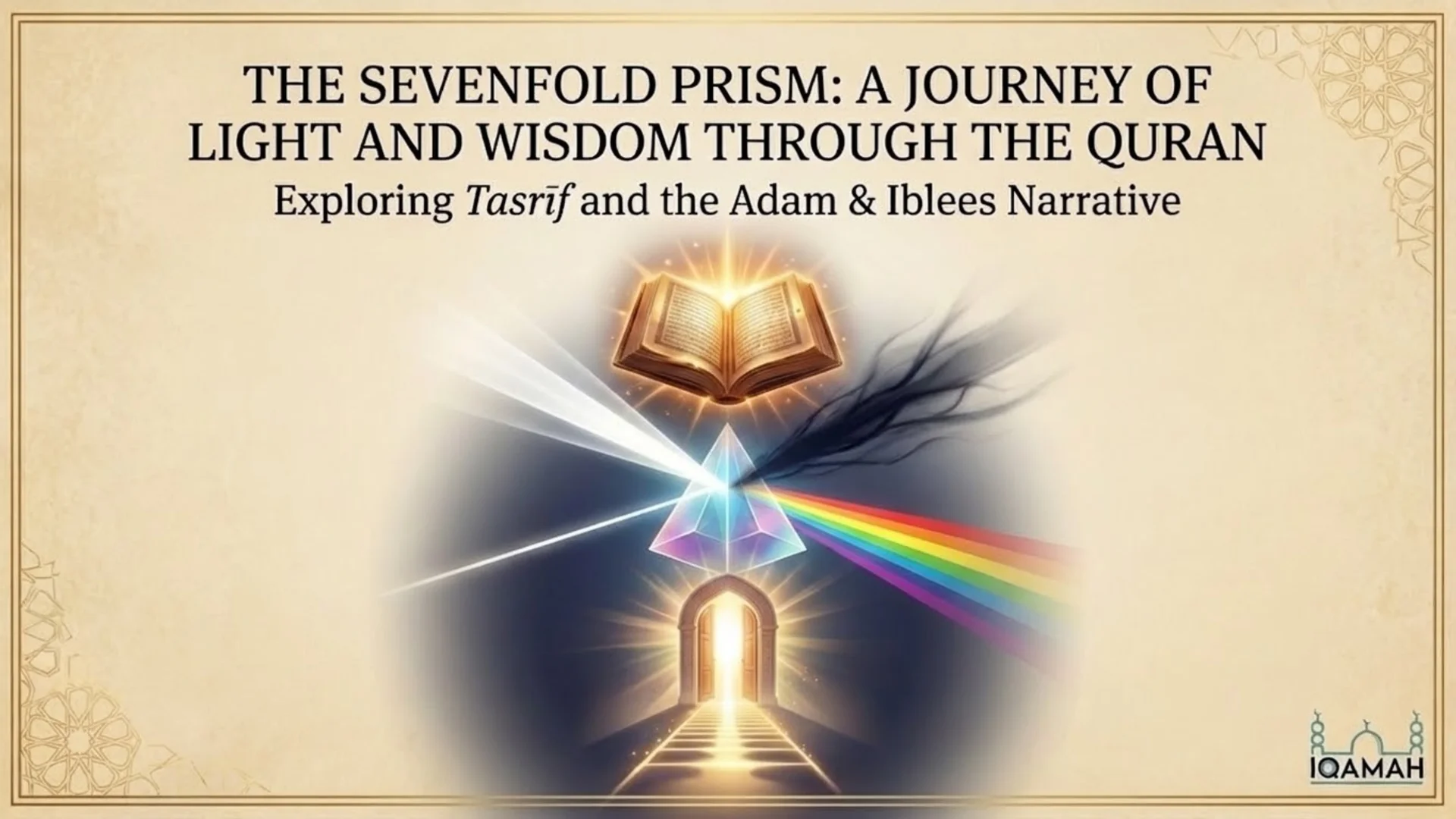
The Sevenfold Prism
Tasreef, the Adam & Iblees Narrative, and the Path from Darknesses to Light
A study of tasreef — the Qurʾān's deliberate rotation of the same macro-narrative across seven sūrahs — followed verse by verse through the Adam & Iblees story. Each of the seven retellings refracts a different facet of human vulnerability and Satanic arrogance; together they trace the path out of ẓulumāt (darknesses) into nūr (light).
Slides
34
Format
Slides + notes
Category
Quranic Studies
Slide 2 of 34
#
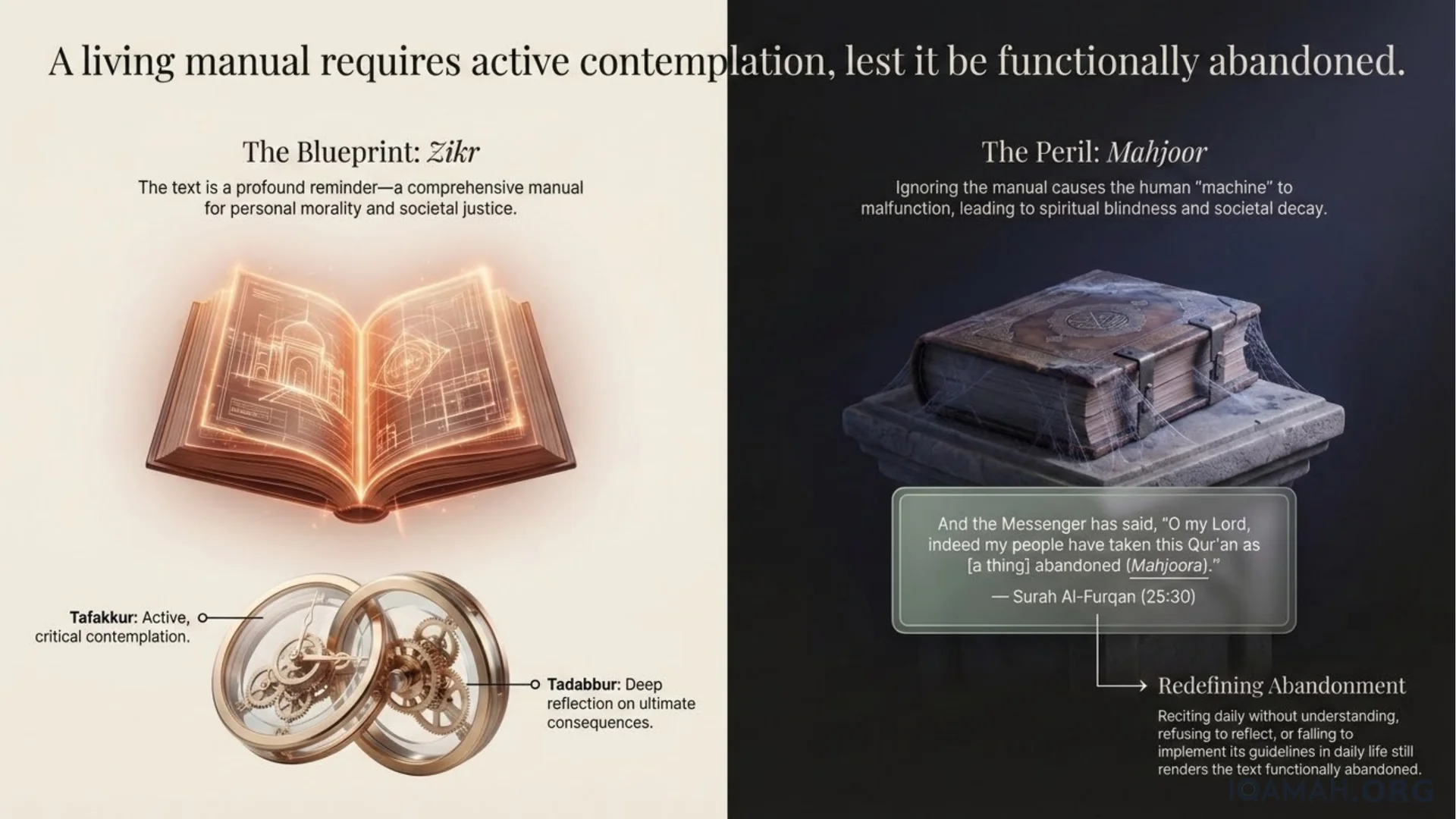
A Living Manual Requires Active Contemplation
The Quran as Zikr and a Literal "User Manual"
The Quran frequently refers to itself as Zikr—a reminder. In the Islamic worldview, the human soul already possesses an innate recognition of the Divine (the Fitrah). Therefore, the Quran serves to "remind" humanity of what it inherently knows but has forgotten due to the distractions of worldly life. It brings the past—the triumphs and failures of previous nations—into the present, extracting timeless lessons for current circumstances.
To actualize this reminder, the Quran functions as a comprehensive "User Manual" for the believer.
Guidance (Huda): It provides actionable frameworks for everything from personal morality and spiritual hygiene to social justice, economics, and family law.
The Need for Tadabbur and Tafakkur: Because life is complex, the manual cannot simply be skimmed. The Quran explicitly commands Tadabbur (deep reflection, looking at the consequences of things) and Tafakkur (active, critical contemplation). It demands that the reader pause, internalize the verses, and figure out how to apply a 7th-century revelation to a modern-day scenario.
The Consequences of Neglect and the Complaint of the Prophet (ﷺ)
When a user manual is ignored, the "machine" malfunctions. In the Islamic paradigm, ignoring the Quran has profound consequences:
In This Life: It leads to spiritual blindness (Ghaflah), a lack of inner peace, moral confusion, and societal injustice. The "machine" of human society breaks down when the manufacturer's instructions are disregarded.
In the Hereafter: It results in severe accountability, as the ultimate guide was provided but willfully ignored.
This neglect culminates in a powerful, heartbreaking verse in Surah Al-Furqan (25:30), which captures the Prophet’s (ﷺ) complaint to Allah on the Day of Judgment:
وَقَالَ الرَّسُولُ يَا رَبِّ إِنَّ قَوْمِي اتَّخَذُوا هَذَا الْقُرْآنَ مَهْجُورًا "
And the Messenger has said, 'O my Lord, indeed my people have taken this Qur’an as [a thing] abandoned (Mahjoora).'"
Scholars note that making the Quran Mahjoor (abandoned) does not just mean failing to read it. One can recite it daily but still abandon it by failing to understand it, refusing to reflect (Tadabbur) upon it, or, most importantly, failing to implement its guidelines in daily life.
Slide 3 of 34
#
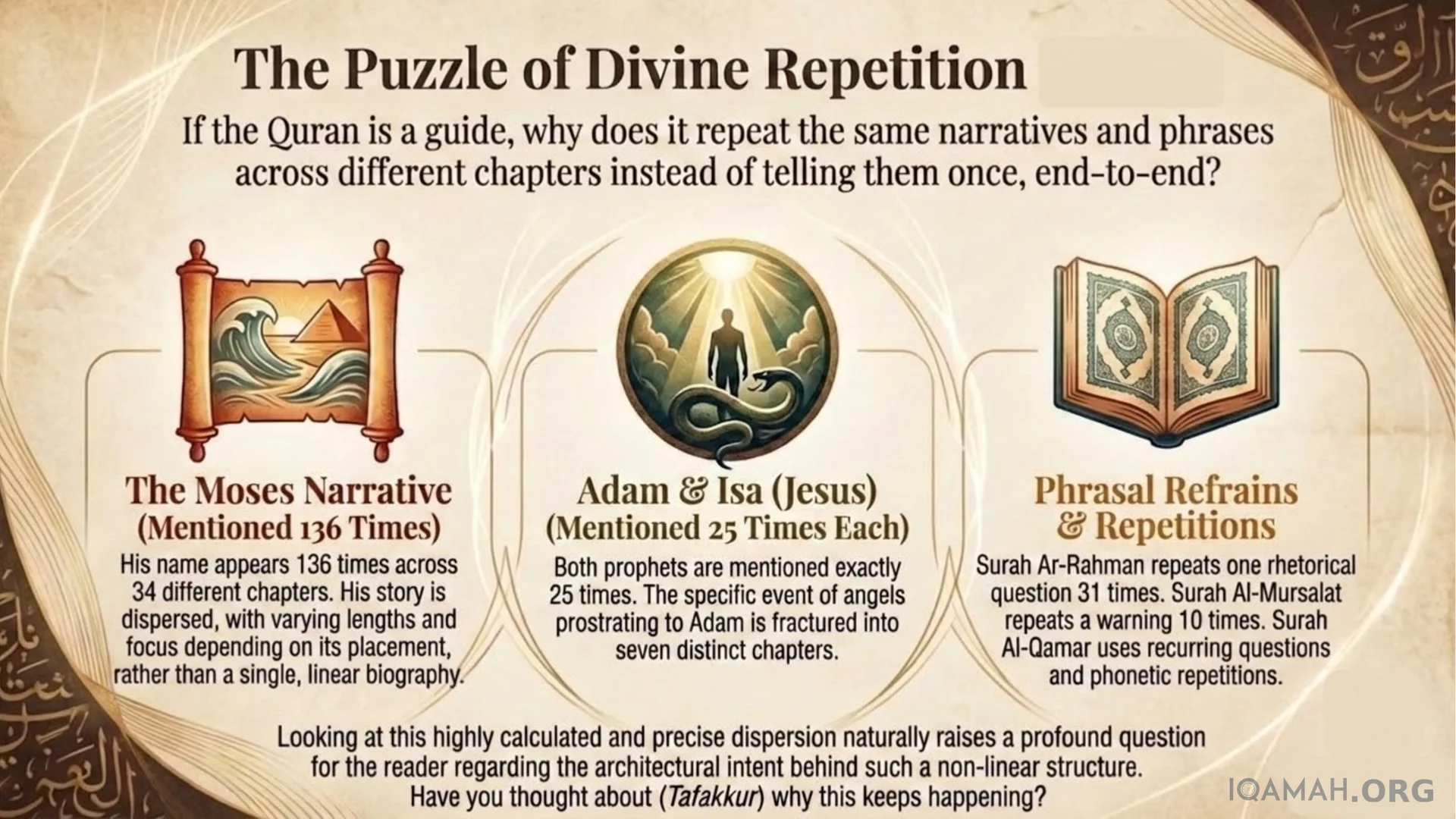
The Puzzle of Divine Repetition
SubhanAllah, have you ever wondered why the Quran doesn’t tell a story once, chronologically, from beginning to end? The story of Prophet Musa (alayhis salam) is mentioned 136 times across 34 Surahs! Adam and Isa (alayhimas salam) are mentioned 25 times each. The specific event of the angels prostrating to Adam is fractured across seven distinct Surahs. This highly calculated structure invites our intellect to pause and ask: Why?
Slide 4 of 34
#
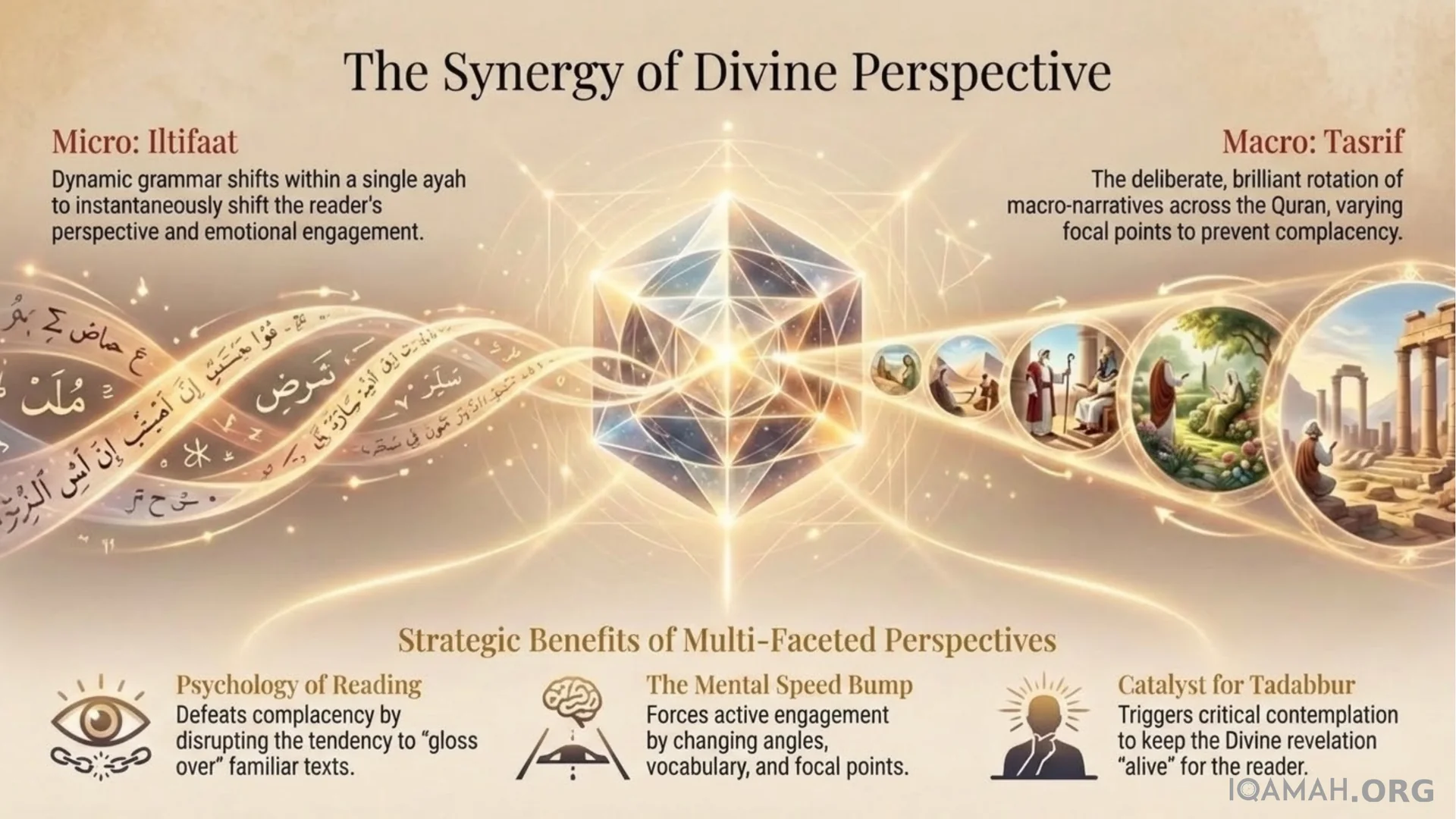
The Synergy of Divine Perspective
Tasreef: Repetition that Demands Contemplation
To prevent the human mind from becoming complacent, the Quran employs a unique linguistic and structural tool known as Tasreef. Just as Iltifaat is a dynamic grammatical shift within a single Ayah to grab your attention, Tasreef is the deliberate rotation of macro-narratives across different Surahs.
Because humans are prone to forgetfulness (hence the need for Zikr), they need constant reminders. However, repeating a story exactly the same way would cause the reader to gloss over it. Tasreef changes the angle, the vocabulary, and the focal point of the narrative based on the specific context of the Surah.
This directly ties into the necessity of Tadabbur. When a believer encounters a familiar story presented in an unfamiliar way, it acts as a mental speed bump. It forces the reader to stop and ask: "Why is this detail included here, but left out earlier? What new lesson am I supposed to derive from this variation?"
Well-Known Examples of Tasreef:
The Story of Prophet Musa (Moses) and Pharaoh: This is the most repeated narrative in the Quran. It appears in vastly different forms and lengths in Surahs like Al-A'raf, Ta-Ha, Al-Qasas, Ash-Shu'ara, and Ghafir.
The Creation of Adam and the Refusal of Iblis (Satan): The dialogue between God, the angels, and Iblis is repeated in several places, including Al-Baqarah, Al-A'raf, Al-Hijr, Al-Isra, Sad, and Ta-Ha, each time highlighting a different facet of human vulnerability or Satanic arrogance.
The Destruction of Past Nations (Thamud, Aad, the people of Lut): These historical accounts are interwoven throughout the Makkan Surahs (e.g., Hud, Ash-Shu'ara, Al-Qamar), varying in emotional intensity and focus depending on the surrounding verses.
By presenting these narratives through Tasreef, the Quran ensures it remains an active, living Zikr—a manual that constantly engages the intellect and refuses to be read as a static, abandoned book.
Slide 5 of 34
#
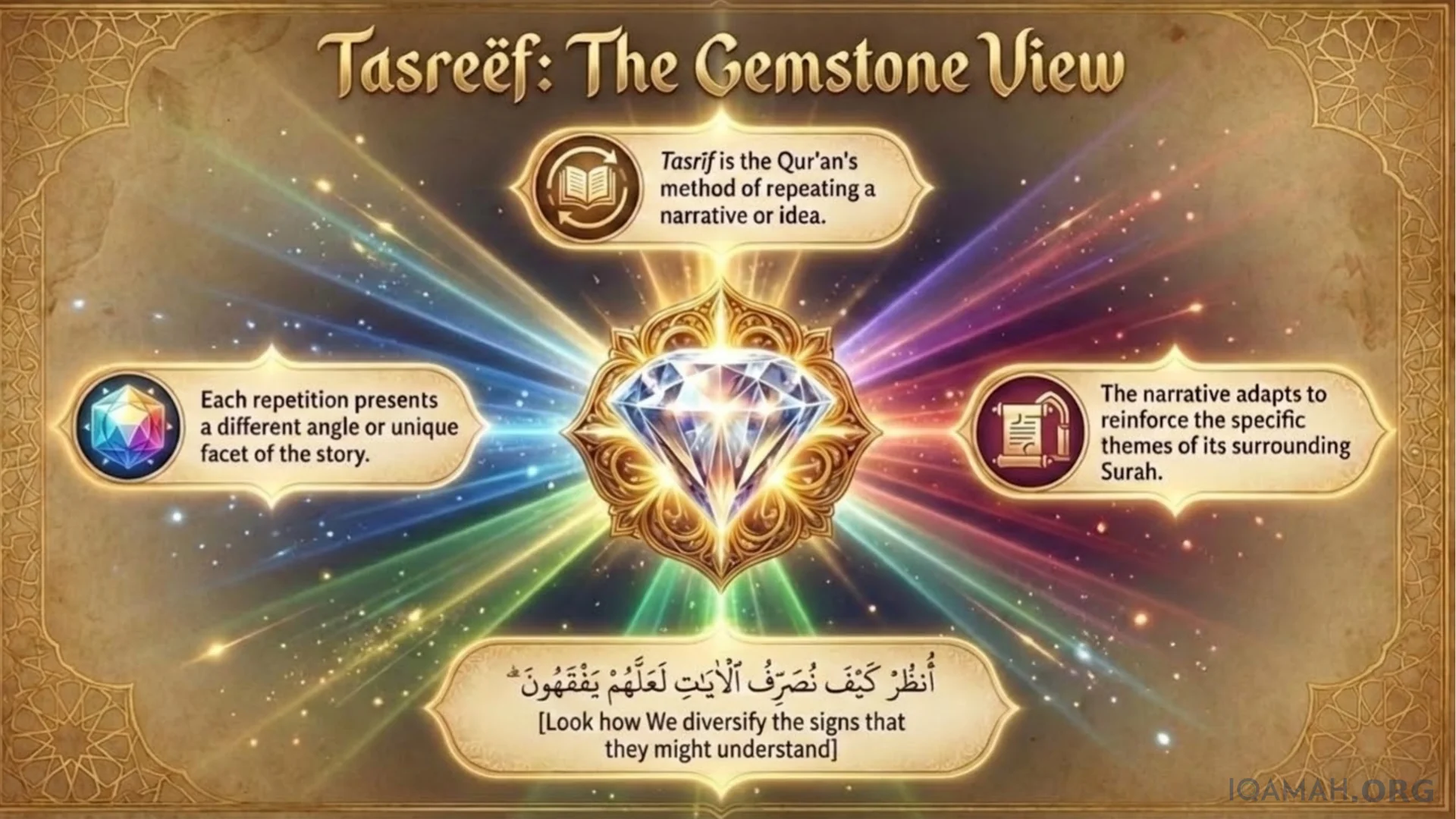
Tasreef: The Gemstone View
Think of Tasreef like a radiant gemstone that is set in the middle of a beautiful landscape. As you examine the gemstone carefully, you will see the landscape around it reflected from the facets of the gem. And if you peer deep into the stone, you will see the landscape through it, colored by the beauty of the stone itself. So the landscape is enhanced by the gemstone, and the gemstone shines and reflects the landscape it is set in. This is the example of tasreef. Each story, in its repetition, is a unique gemstone set within the landscape of the Surah in which it is placed. The story adapts perfectly to reinforce the overarching themes of the Surah it sits within. See. As Allah 'azza wa jal says [Surah Al-An'am 6:65]: انظُرْ كَيْفَ نُصَرِّفُ الْآيَاتِ لَعَلَّهُمْ يَفْقَهُونَ "Look how We diversify (nusarrifu) the signs that they might understand."
Slide 6 of 34
#
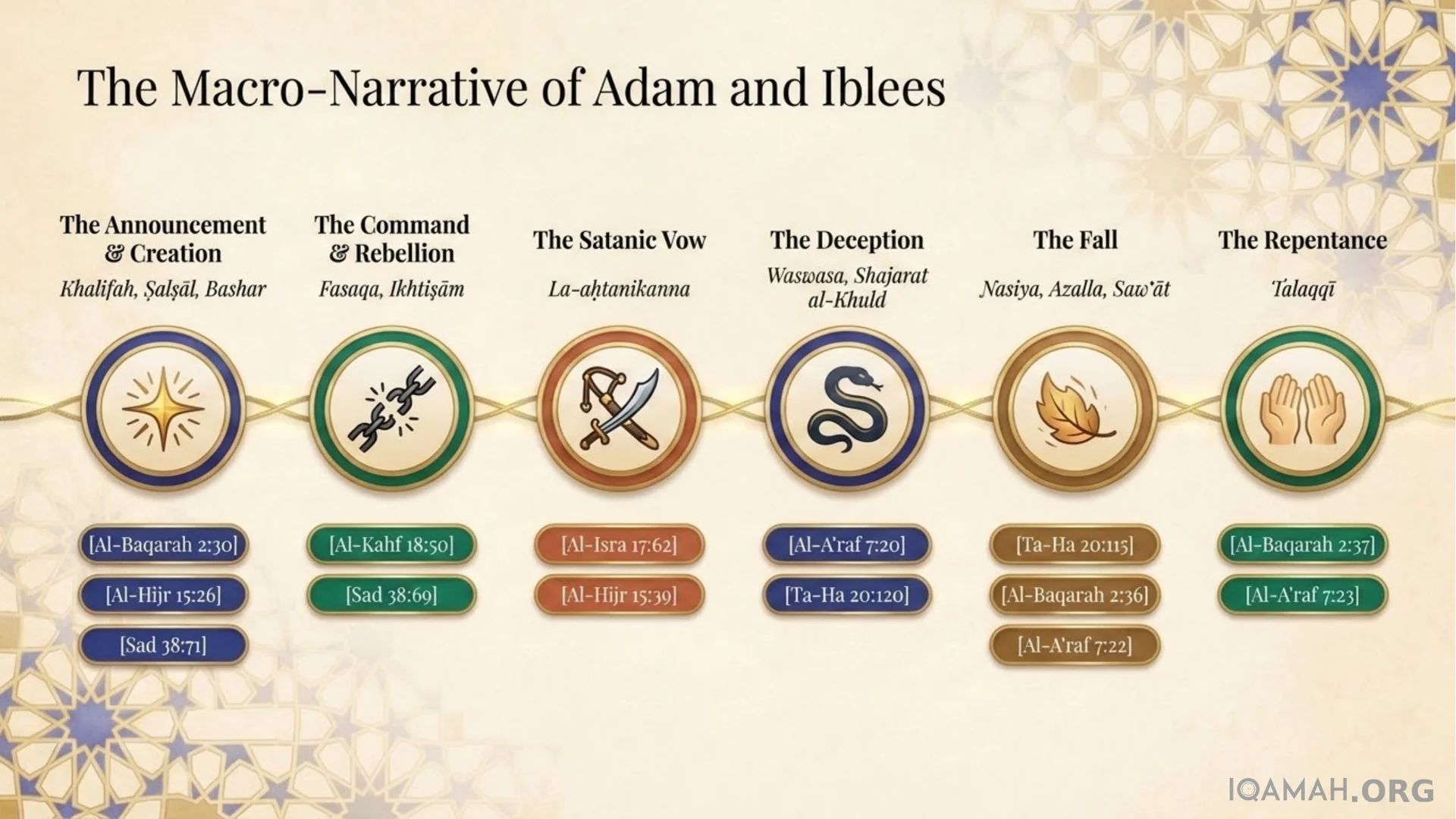
The Macro-Narrative of Adam and Iblees
We’ll study one specific example of Tasreef in the Quran: the narrative of Adam’s creation and how Iblees reacts to this event. This narrative appears seven separate times in the Quran, each story might repeat some aspects of the overall narrative but is also unique within the setting of each surah, and adds some details that match the lessons and goals of the surah itself.
A chronological synthesis of the 7 Quranic accounts, highlighting key terminology.
The Announcement: Allah declares to the High Assembly His intention to place a Vicegerent (Khalifah) on Earth,.
The Creation: Adam is fashioned from sounding clay (Salsal) and altered black mud (Hama'in Masnun), highlighting his humble, physical exterior (Bashar). Allah then breathes His Spirit (Ruh) into him.
The Command & Rebellion: The angels prostrate simultaneously, but Iblees—who was of the Jinn—rebels (Fasaqa) out of arrogance and intense jealousy. He argues his origin of fire is superior to clay.
The Satanic Vow: Banished, Iblees swears to execute an omnidirectional attack (front, back, left, right) and cognitively bridle (Ahtanikanna) humanity, though he admits he has no power over Allah's sincere servants (Mukhlasin),,.
The Deception: Adam and Hawa reside in Paradise. Shaitan whispers (Waswasa) with false empathy, tempting them with the illusion of immortality (Shajarat al-Khuld),.
The Fall & Repentance: Overcome by forgetfulness (Nasiya) and a lapse in resolve ('Azm), Adam slips (Azalla). Their vulnerabilities and nakedness (Saw'at) are exposed,,. They immediately repent using words given by Allah, are forgiven, and sent to Earth to fulfill their destined Vicegerency,.
Slide 7 of 34
#
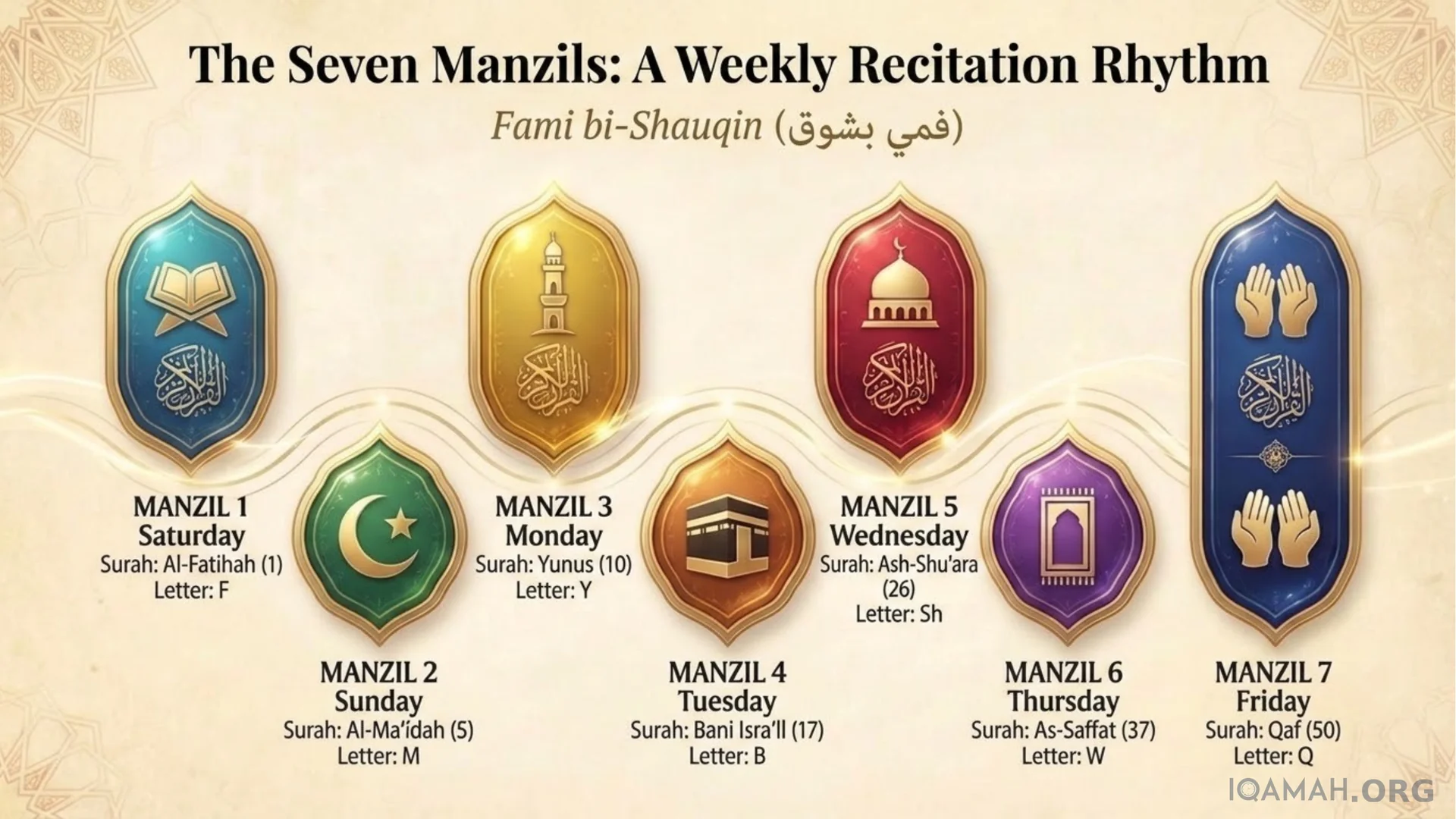
The Seven Manzils: A Weekly Recitation Rhythm
The Manzils are a traditional division of the Quran into seven roughly equal parts, designed to facilitate the completion of a full recitation in exactly one week. A beautiful Arabic mnemonic to remember the starting Surah of each Manzil is Fami bi-Shauqin (فمي بشوق - "My mouth longs with yearning").
While the Manzils are a structural tool, many scholars and spiritual teachers note that the story of Adam and Iblis appears in various forms throughout these divisions. This "mapping" illustrates the recurring struggle between human potential and satanic arrogance.
The placement of this story exactly seven times across the Quran is a profound architectural miracle. A believer reading one Manzil a day will be reminded of the story of Adam and Iblees each day. This daily encounter is a required spiritual recalibration. Just as humans are inherently forgetful, they require a daily reminder of their cosmic origin, their ultimate destination, and the active, invisible enemy working daily to derail them.
Slide 8 of 34
#
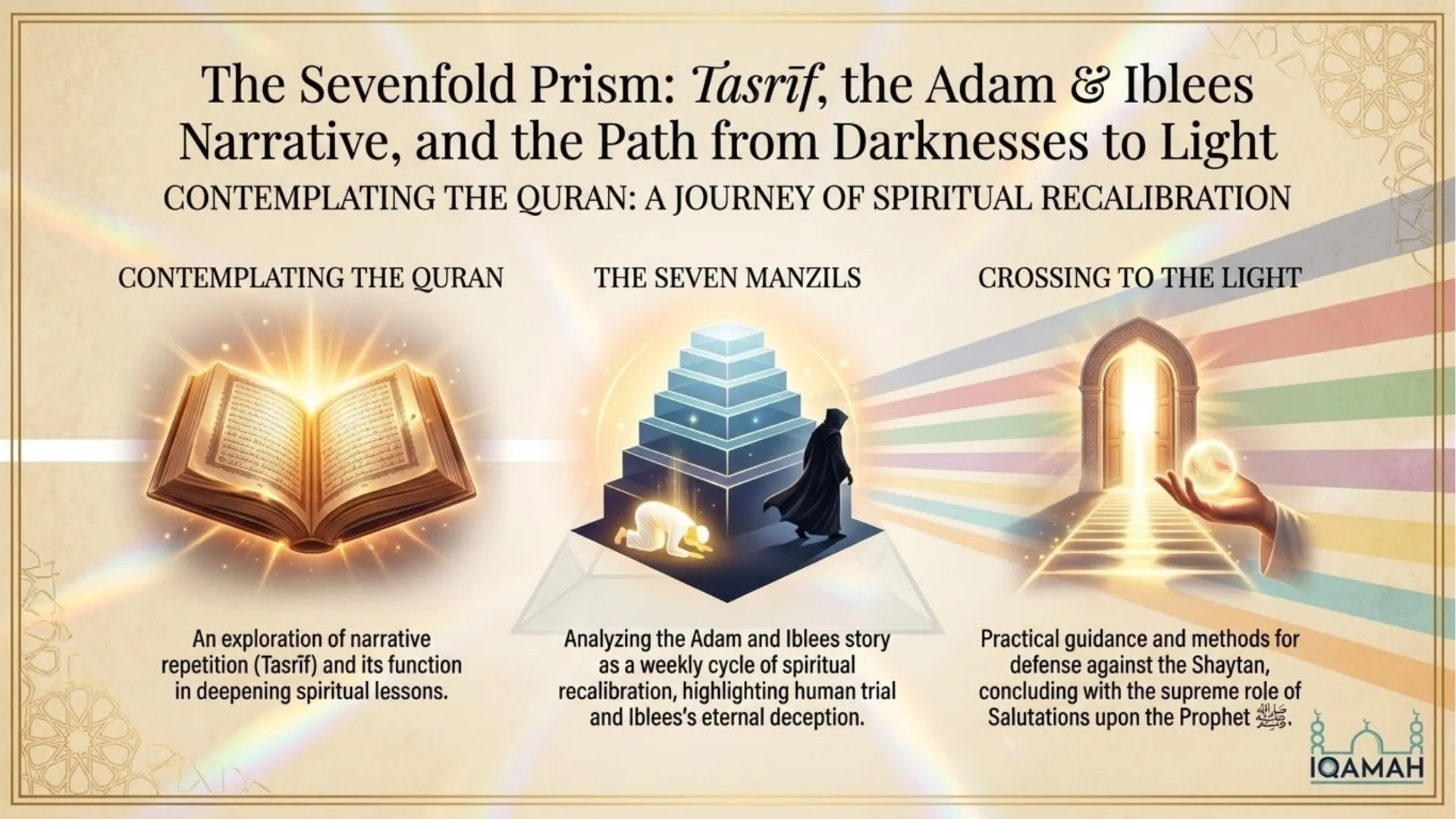
Contemplating the Quran (Roadmap)
Over the course of the next few slides, we are bridging these three concepts: Understanding Tasreef, analyzing the Adam and Iblees story within the daily cycle of the seven Manzils, and extracting practical Imaan defense mechanisms to cross from darkness into light.
Slide 9 of 34
#
The Adam & Iblis Narrative: A Daily Spiritual Defense
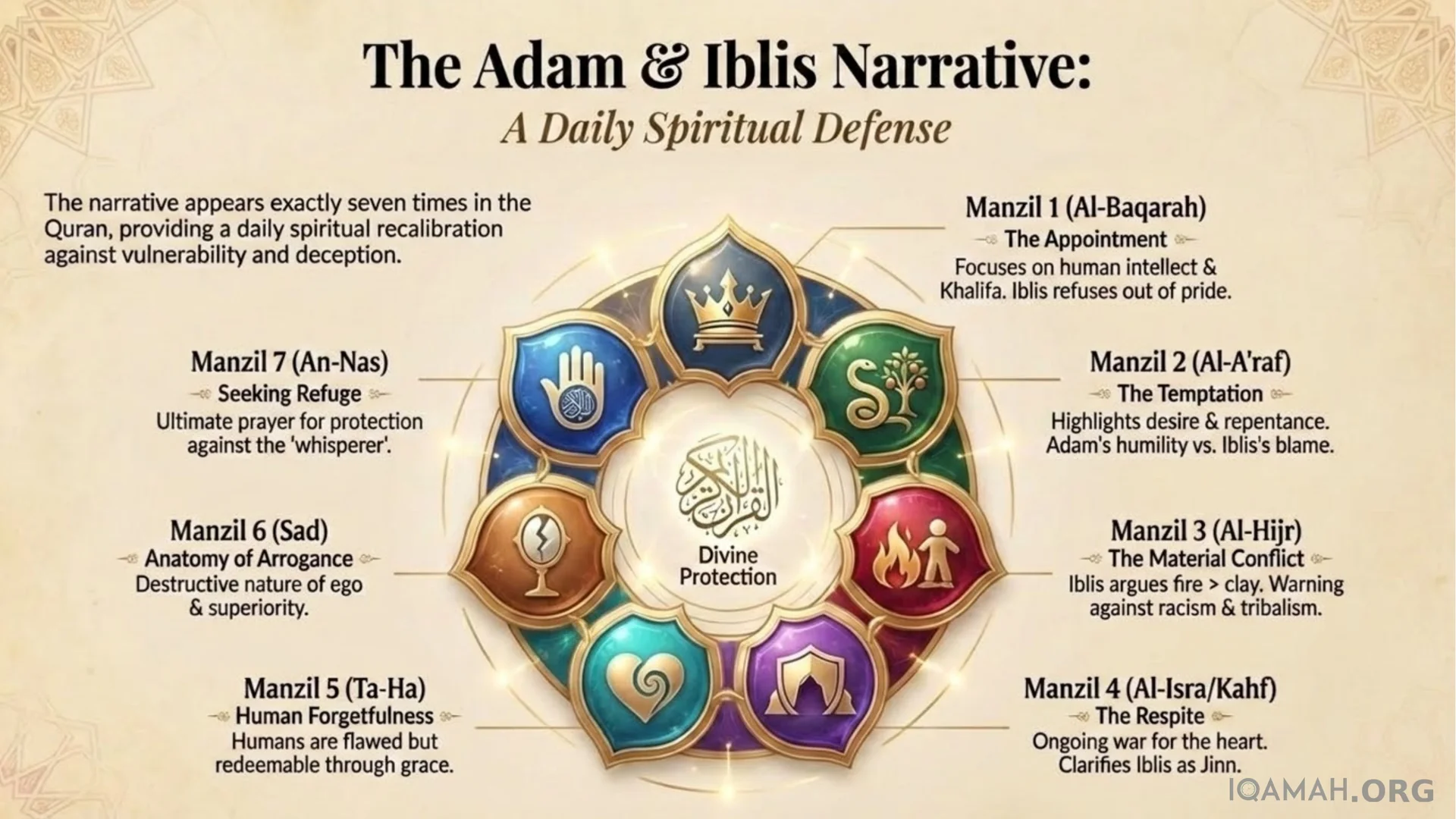
The story of Adam and Iblis is mentioned seven times in the Quran, which aligns beautifully with the seven Manzils. Each mention emphasizes a different stage or facet of the human-satanic conflict.
1. The Appointment (Manzil 1: Surah Al-Baqarah)
Focus: Adam as the Khalifa (Vicegerent).
Narrative: God informs the angels of His plan; Adam is taught the "names" (knowledge); Iblis refuses to bow out of pride.
Mapping: This introduces the human as a being of intellect and potential.
2. The Temptation (Manzil 2: Surah Al-A'raf)
Focus: The psychology of the slip.
Narrative: Iblis targets Adam’s desire for immortality. After the mistake, Adam and Eve show repentance ("Our Lord, we have wronged ourselves").
Mapping: This highlights the contrast between Iblis’s arrogance (blaming God) and Adam’s humility (taking responsibility).
3. The Material Conflict (Manzil 3: Surah Al-Hijr)
Focus: The substance of creation.
Narrative: Iblis argues that fire is superior to clay.
Mapping: This serves as a warning against racism and tribalism—judging others by their "origin" or physical makeup rather than their spirit.
4. The Respite and Threat (Manzil 4: Surah Al-Isra & Al-Kahf)
Focus: The ongoing war for the heart.
Narrative: In Al-Isra, Iblis asks for a delay until Judgement Day to "uproot" Adam's progeny. In Al-Kahf, it is noted that Iblis was from the Jinn, choosing to disobey.
Mapping: This alerts the believer that they are in a constant state of spiritual defense.
5. The Moment of Choice (Manzil 4/5: Surah Taha)
Focus: Human forgetfulness.
Narrative: God notes that Adam "forgot" the covenant, but he was not malicious.
Mapping: This offers hope; humans are flawed and forgetful, but as long as they aren't arrogant like Iblis, they can be guided.
6. The Final Warning (Manzil 6: Surah Saad)
Focus: The ultimate anatomy of arrogance (Istikbar).
Narrative: As discussed previously, Surah Saad focuses on the dialogue between God and Iblis regarding the soul (Ruh).
Mapping: It acts as the "final argument" against those who let their ego prevent them from bowing to the truth.
7. The Protection (Manzil 7: Surah An-Nas)
Focus: Seeking refuge.
Narrative: While not a retelling of the Adam story, the final chapter of the final Manzil is the prayer for protection against the "whisperer" (Iblis).
Mapping: The journey ends by acknowledging that we cannot defeat this enemy alone; we need the protection of the "Lord of Mankind."
Slide 10 of 34
#
Surah Al-Baqarah (The Test of Leadership)
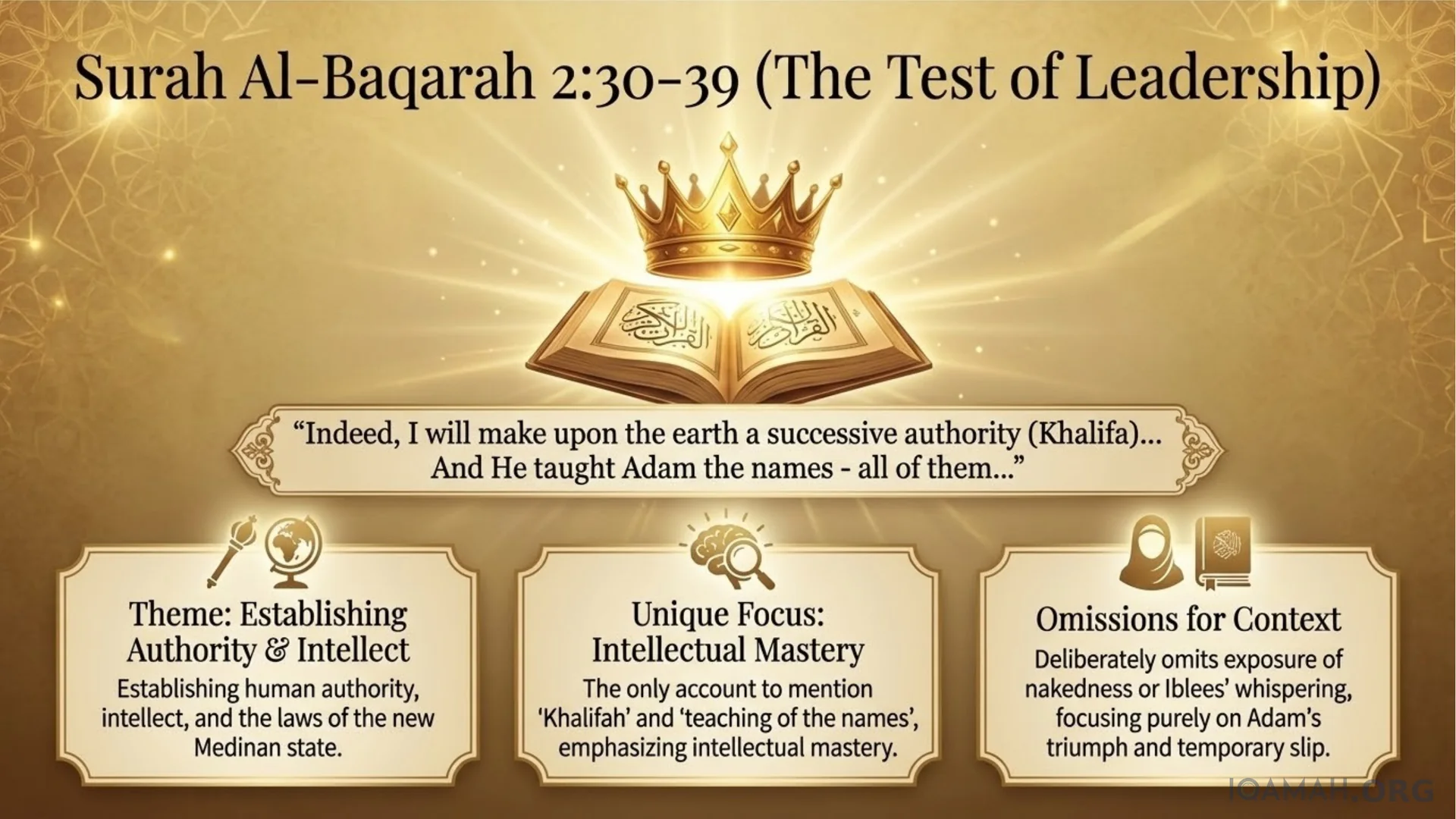
"And [mention, O Muhammad], when your Lord said to the angels, 'Indeed, I will make upon the earth a successive authority.' They said, 'Will You place upon it one who causes corruption therein and sheds blood, while we declare Your praise and sanctify You?' Allah said, 'Indeed, I know that which you do not know.' And He taught Adam the names - all of them... And We said, 'O Adam, dwell, you and your wife, in Paradise and eat therefrom in [ease and] abundance from wherever you will. But do not approach this tree, lest you be among the wrongdoers.' But Satan caused them to slip out of it and removed them from that [condition] in which they had been. And We said, 'Go down, [all of you], as enemies to one another...' Then Adam received from his Lord [some] words, and He accepted his repentance.",.
Unique Highlights of this Narrative:
Theme: Establishing human authority, intellect, and the laws of the new Medinan state.
Unique Focus: It is the only account to mention the term Khalifah (Vicegerent) and the teaching of the names (intellectual mastery). [Surah Al-Baqarah 2:30]: وَإِذْ قَالَ رَبُّكَ لِلْمَلَائِكَةِ إِنِّي جَاعِلٌ فِي الْأَرْضِ خَلِيفَةً... "And [mention, O Muhammad], when your Lord said to the angels, 'Indeed, I will make upon the earth a successive authority (Khalifah)...'"
Omissions for Context: Deliberately omits the exposure of nakedness or the whispering of Iblees, focusing instead on Adam's intellectual triumph over the angels and his slip (Azalla)
Slide 11 of 34
#
Surah Al-Baqarah: The Epistemological Mandate
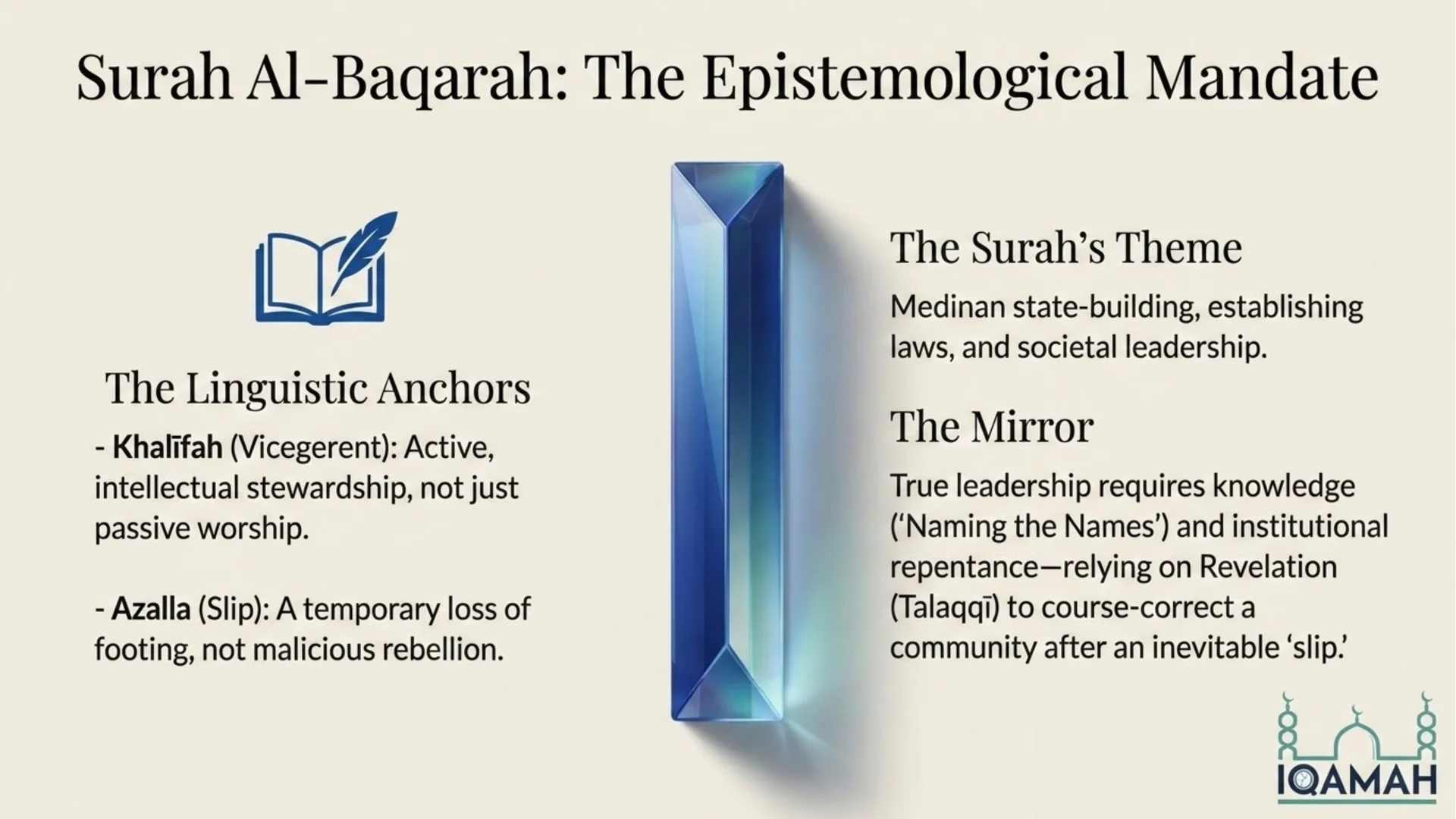
In Surah Al-Baqarah, the narrative focuses intently on the establishment of human authority, the cosmic purpose of creation, and the epistemological superiority of Adam over the angelic hosts.
خَلِيفَة (Khalīfah): When Allah announces the creation of Adam to the angels, He utilizes the highly consequential term Khalīfah.6 Etymologically derived from the trilateral root kha-la-fa (خ ل ف), which carries the meanings "to succeed," "to come after," "to represent," or "to stand in the place of," the term is most frequently translated as "vicegerent," "steward," or "successor".8 In this specific context, classical linguistics make clear that this does not imply that Allah requires a successor due to absence or incapacity, but rather designates humanity as an earthly representative endowed with moral agency, intellectual capacity, and the mandate to execute Divine will on Earth.7 The tone established by this word is majestic, authoritative, and elevating. It firmly establishes human beings not merely as biological entities or passive worshippers, but as active cosmic ambassadors entrusted with the stewardship of the physical realm.
أَزَلَّ (Azalla): In describing the mechanism of the fall, the Quran employs the phrase fa-azallahuma ash-shaytan (فَأَزَلَّهُمَا الشَّيْطَانُ), which is translated as "Satan caused them to slip".11 The root za-la-la implies a physical loss of footing, an accidental sliding, or a temporary lapse in stability.3 This specific word choice is psychologically critical; it deliberately avoids framing Adam and Hawa's action as an intentional, malicious, or ideological rebellion against the Divine command. Instead, it casts their error as a "slip" from their highly elevated station, setting a tone of merciful understanding toward human frailty and establishing the groundwork for their eventual repentance and restoration.
The Theme: Surah Al-Baqarah was revealed as the early Muslims migrated to Medina to establish a new society and assume leadership on Earth.
The Narrative Mirror: The Adam story here ignores the details of physical nakedness or Iblees's specific whispers. Instead, it focuses entirely on the concept of Khalifah (Vicegerency), the teaching of "the names" (knowledge), and the angelic questioning. It teaches the newly formed Ummah that true leadership on Earth is not claimed by bloodshed or force, but is bestowed by Allah through knowledge, obedience, and the willingness to repent when errors are made.
Slide 12 of 34
#
Surah Al-A'raf (Modesty and Boundaries)
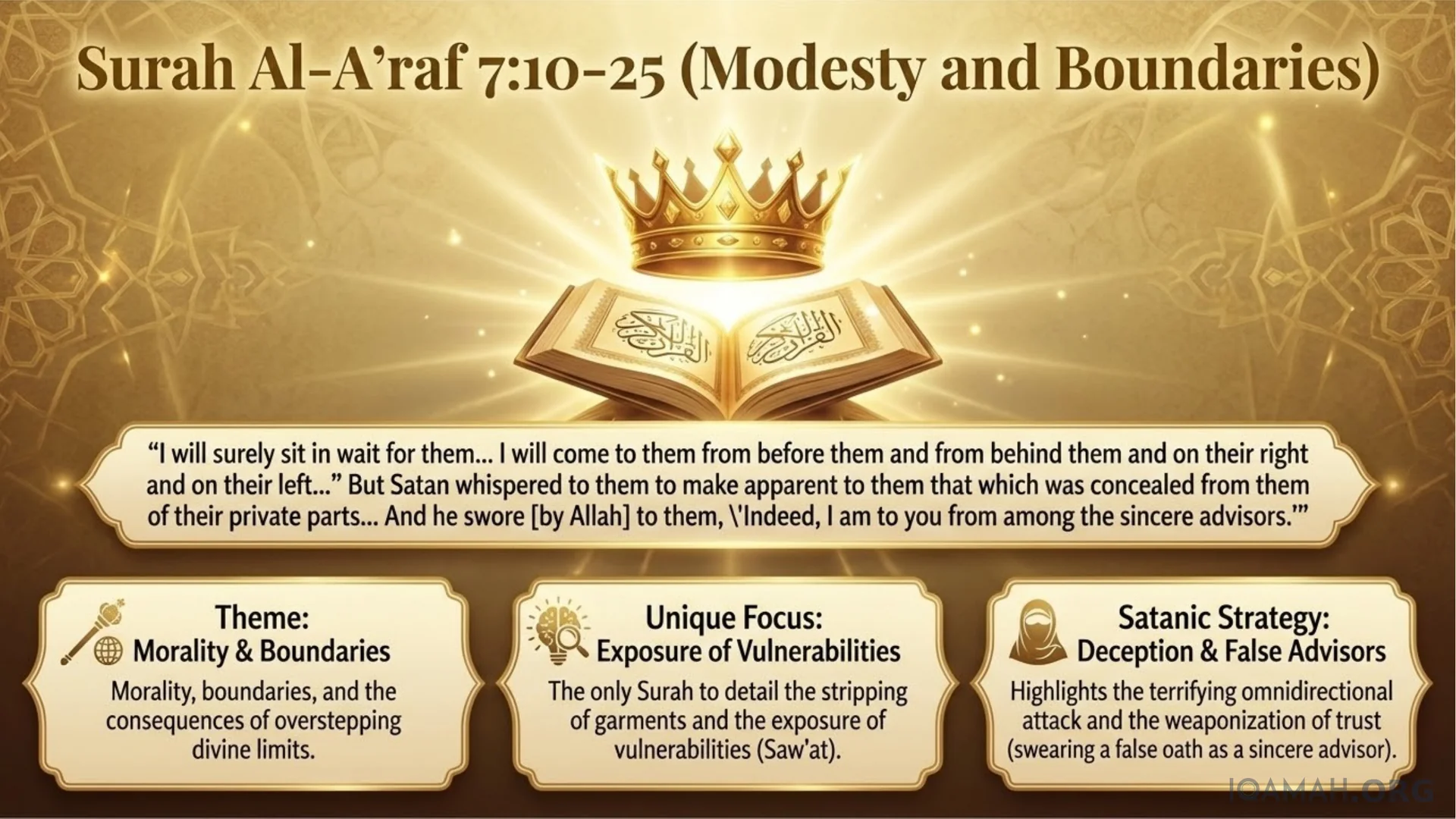
"And We have certainly created you... then We said to the angels, 'Prostrate to Adam,' and they did. But not Iblis... [Allah] said, 'What prevented you from prostrating...?' said, 'I am better than him. You created me from fire and created him from clay.'... said, 'Because You have put me in error, I will surely sit in wait for them on Your straight path. Then I will come to them from before them and from behind them and on their right and on their left...' But Satan whispered to them to make apparent to them that which was concealed from them of their private parts. He said, 'Your Lord did not forbid you this tree except that you become angels or become of the immortal.' And he swore [by Allah] to them, 'Indeed, I am to you from among the sincere advisors.'... And when they tasted of the tree, their private parts became apparent to them... They said, 'Our Lord, we have wronged ourselves, and if You do not forgive us and have mercy upon us, we will surely be among the losers.'".
Unique Highlights of this Narrative:
Theme: Morality, boundaries, and the consequences of overstepping divine limits.
Unique Focus: The only Surah to detail the stripping of garments and the exposure of vulnerabilities (Saw'at).
Satanic Strategy: Highlights the omnidirectional attack and the weaponization of trust (swearing a false oath as a "sincere advisor"). [Surah Al-A'raf 7:16-17]: قَالَ فَبِمَا أَغْوَيْتَنِي لَأَقْعُدَنَّ لَهُمْ صِرَاطَكَ الْمُسْتَقِيمَ ثُمَّ لَآتِيَنَّهُم مِّن بَيْنِ أَيْدِيهِمْ وَمِنْ خَلْفِهِمْ وَعَنْ أَيْمَانِهِمْ وَعَن شَمَائِلِهِمْ "[Iblees] said, 'Because You have put me in error, I will surely sit in wait for them on Your straight path. Then I will come to them from before them and from behind them and on their right and on their left...'".
Slide 13 of 34
#
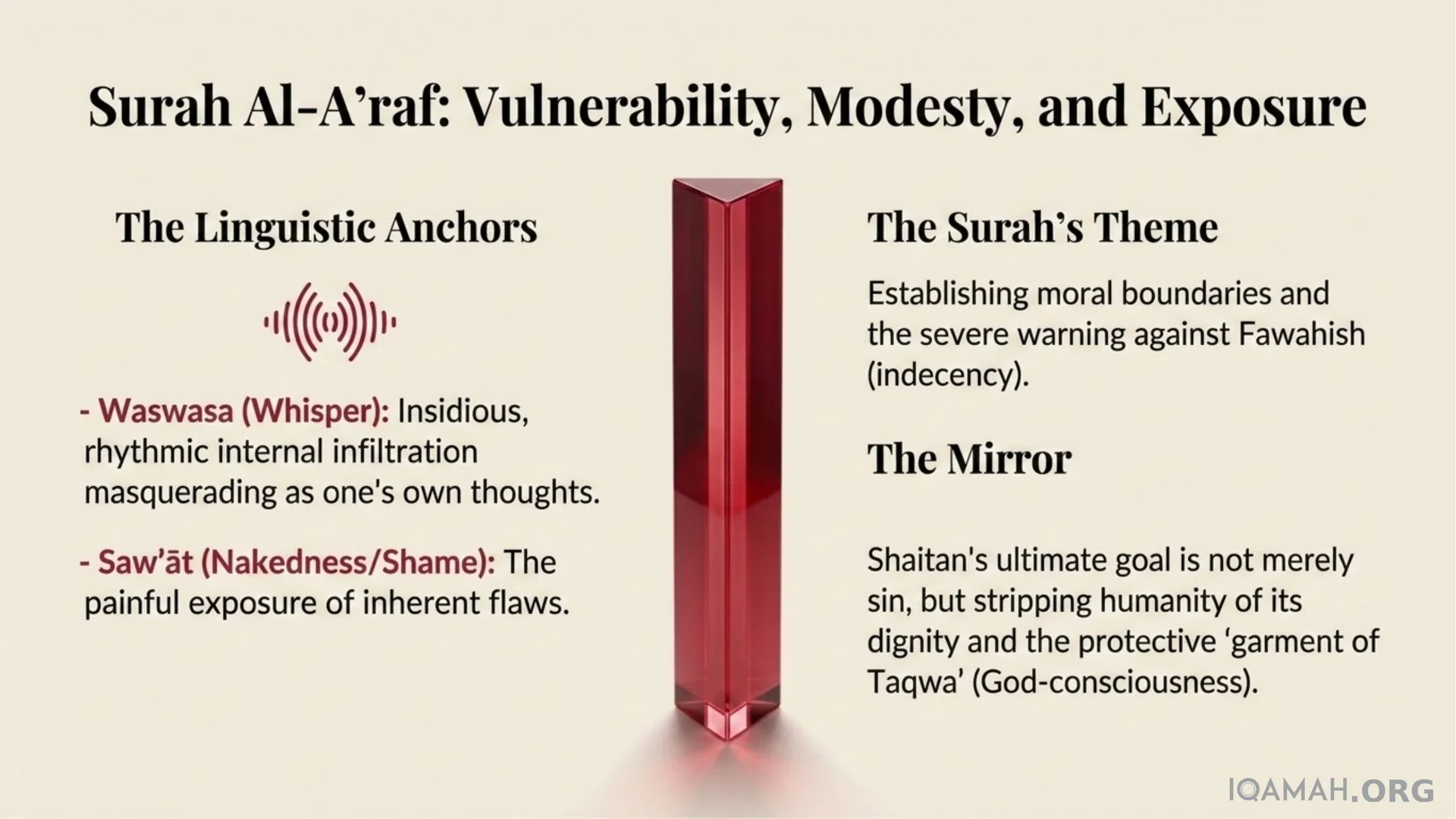
Surah Al-A'raf: Vulnerability, Modesty, and Exposure
Surah Al-A'raf presents the most detailed, emotionally resonant exposition of the temptation, focusing on the stripping of innocence, the weaponization of trust, and the physical manifestation of sin.
وَسْوَسَ (Waswasa): To describe Iblees's approach to the couple, the text utilizes the verb waswasa (to whisper).13 This word operates as an auditory onomatopoeia; the repetition of the waw and seen sounds physically mimics the continuous, subtle, and rhythmic hissing of a hushed whisper.15 Etymologically, it was historically used by the Arabs to refer to the faint sound of jewelry jingling or the subtle rustling of wind through the leaves. Psychologically, it radically shifts the narrative tone to one of insidious infiltration, demonstrating that Satanic deception does not arrive as a frontal, recognizable assault, but as a repetitive, internal suggestion that masquerades as the victim's own internal monologue or thought process.15
سَوْآت (Saw'āt): Following the consumption of the forbidden tree, their nakedness suddenly becomes apparent to them (saw'atuhuma). Derived from the root sa'a (ساء), meaning that which is evil, ugly, or inherently distressing, saw'ah specifically refers to the private parts of the body, but metaphorically extends to anything that brings shame, vulnerability, or public disgrace. The utilization of this word highlights the immediate psychological and ontological consequence of disobedience: a profound sense of shame, spiritual vulnerability, and the painful, inescapable exposure of one's inherent flaws when the metaphorical garment of Divine protection is removed due to sin.
The Theme: Surah Al-A'raf deals heavily with human boundaries, the history of ruined nations, and the establishment of moral limits.
The Narrative Mirror: This is the only Surah that details the stripping of Adam and Hawa's garments and the exposure of their nakedness. Allah directly transitions from this story into a profound address: "O children of Adam, We have bestowed upon you clothing to conceal your private parts... But the clothing of righteousness (Taqwa)—that is best" (7:26). For the believer, it shows that Shaitan's ultimate goal is not just to make us sin, but to strip us of our modesty, dignity, and spiritual covering.
Slide 14 of 34
#
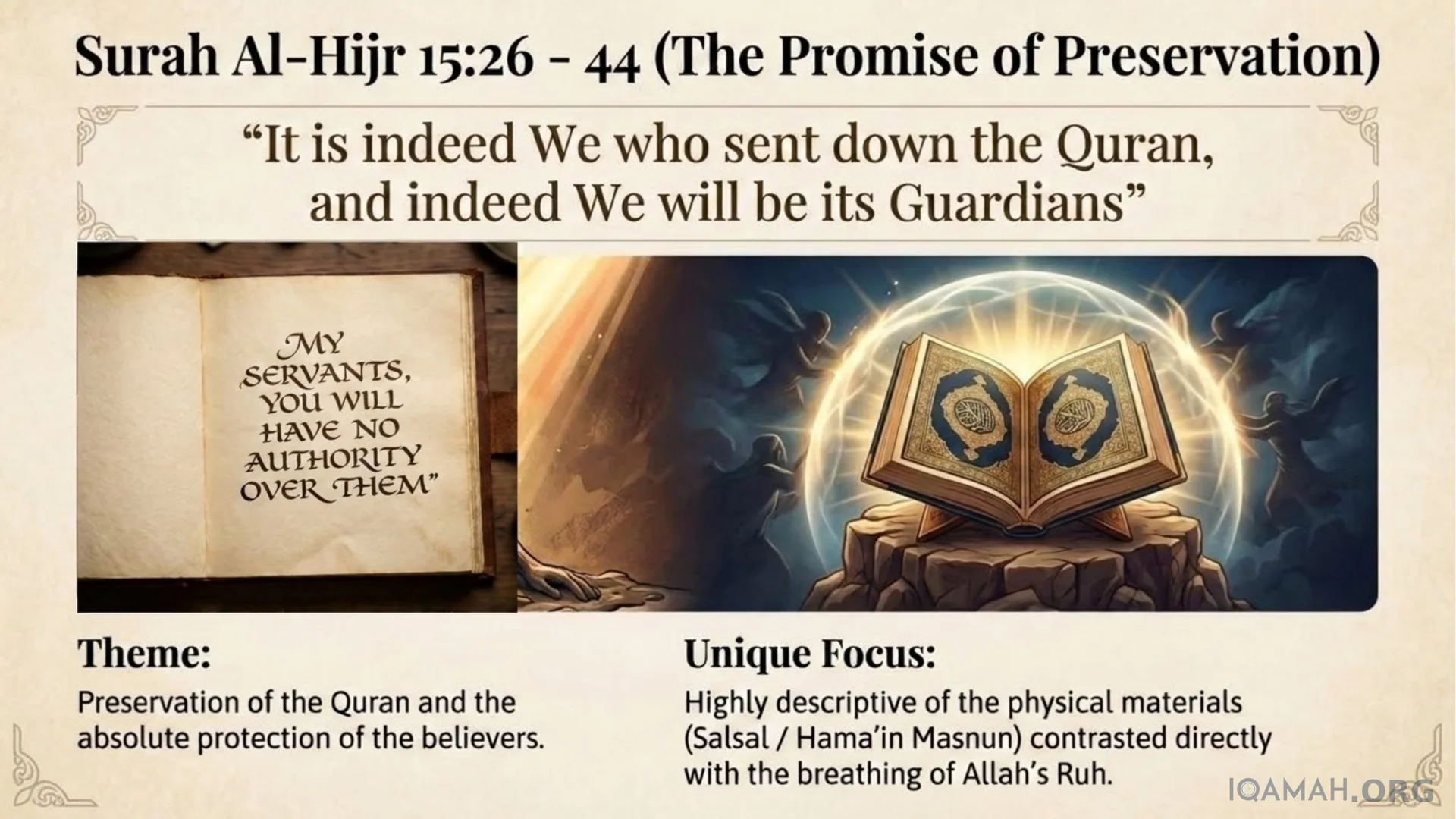
Surah Al-Hijr (The Promise of Preservation)
"And We did certainly create man out of clay from an altered black mud. And the jinn We created before from scorching fire. And [mention, O Muhammad], when your Lord said to the angels, 'I will create a human being out of clay from an altered black mud. And when I have proportioned him and breathed into him of My [created] soul, then fall down to him in prostration.' So the angels prostrated - all of them entirely. Except Iblis... [Iblis] said, 'My Lord, because You have put me in error, I will surely make [disobedience] attractive to them on earth, and I will mislead them all. Except, among them, Your chosen servants.' [Allah] said, 'This is a path [of return] to Me [that is] straight. Indeed, My servants - no authority will you have over them, except those who follow you of the deviators.'" [],.
Unique Highlights of this Narrative:
Theme: Preservation of the Quran and the protection of the believers.
Unique Focus: Highly descriptive of the physical materials of creation (Salsal / Hama'in Masnun) contrasted with the breathing of Allah's Ruh [],.
The Defense: Explicitly establishes that Shaitan has zero authority over Allah's sincere, chosen servants (Mukhlasin)—a guarantee of divine preservation.
Slide 15 of 34
#
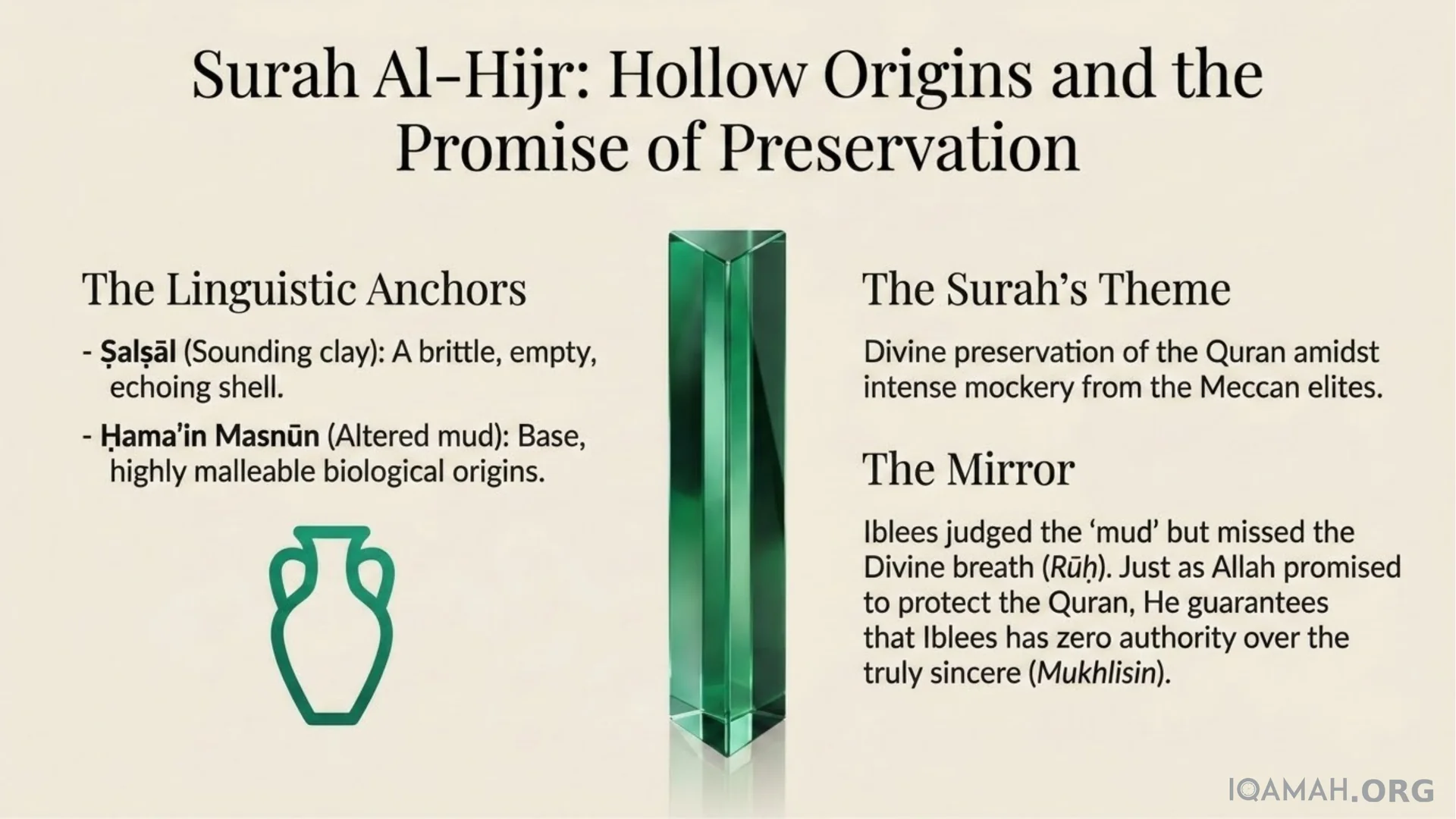
Surah Al-Hijr: Hollow Origins and Preservation
Surah Al-Hijr delves deeply into the ontological materials of creation, contrasting the humility and potential of earth with the arrogance and volatility of fire, directly refuting materialistic theories of human origins.
صَلْصَالٍ (Ṣalṣāl): Adam is described as being created from ṣalṣāl (sounding clay).18 The root ṣalṣala describes a sharp, ringing, or clinking sound, akin to dry pottery being struck.18 This word paints a vivid portrait of the human vessel prior to the infusion of the Divine spirit (Rūḥ) as brittle, dry, and fundamentally hollow. The psychological tone is one of existential emptiness and physical fragility; without Allah's breath, the human being is merely an empty, echoing shell, entirely reliant on Divine animation.
حَمَإٍ مَسْنُونٍ (Ḥama'in Masnūn): This highly descriptive phrase translates to "dark, altered, or fermented mud".18 Hama' refers specifically to black, foul-smelling mud, while masnūn indicates that it has been intentionally molded into a shape and left to alter, age, or ferment.20 This terminology emphasizes the base, lowly, and highly malleable origins of human biology. It establishes the foundational stage for Iblees's arrogant logic: he views the dark, smelly, static mud as inherently inferior to his dynamic, smokeless fire, utterly failing to recognize the value of the Divine breath that elevated this mud to a state of supremacy.
The Theme: Surah Al-Hijr was revealed during a time of intense mockery, where the Quraysh demanded angels be sent down and mocked the Quran. In response, Allah makes His ultimate promise: [Surah Al-Hijr 15:9]: إِنَّا نَحْنُ نَزَّلْنَا الذِّكْرَ وَإِنَّا لَهُ لَحَافِظُونَ "Indeed, it is We who sent down the Qur'an and indeed, We will be its guardian." And just as He protects the Zikr, He promises that Shaitan has no authority over His sincere servants (Mukhlisin).
The Narrative Mirror: The Adam narrative here focuses heavily on the physical materials of creation (sounding clay, altered mud) and the breathing of Allah's Ruh. More importantly, it focuses on Iblees's vow to misguide humanity, to which Allah responds that Iblees will have zero power over His "sincere servants" (Mukhlasin). Just as Allah promised to preserve the Quran from the corruption of the Quraysh, He promises to preserve the hearts of the sincere believers from the corruption of Shaitan.
Slide 16 of 34
#
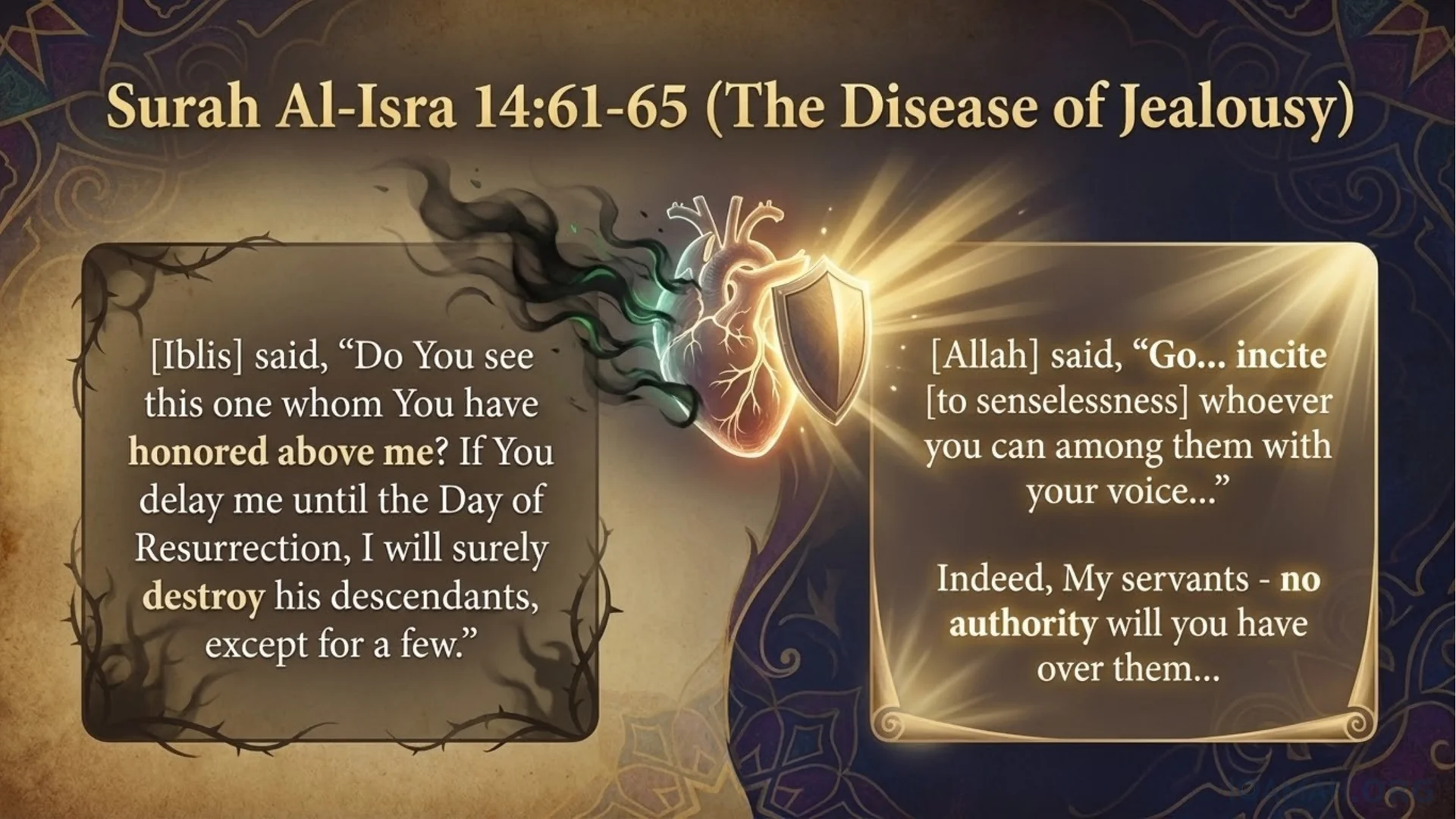
Surah Al-Isra (The Disease of Jealousy)
"And [remember] when We said to the angels, 'Prostrate before Adam,' so they all did—but not Iblis, who protested, 'Should I prostrate to the one You have created from mud?' He said, 'Do You see this one whom You have honored above me? If You delay me until the Day of Resurrection, I will surely destroy his descendants, except for a few.' [Allah] said, 'Go, for whoever of them follows you, indeed Hell will be the recompense of you - an ample recompense. And incite [to senselessness] whoever you can among them with your voice and assault them with your horses and foot soldiers and become a partner in their wealth and their children and promise them.' But Satan does not promise them except delusion. 'Indeed, over My [believing] servants there is for you no authority. And sufficient is your Lord as Disposer of affairs.'" ,.
Unique Highlights of this Narrative:
Theme: Addressing the history of Bani Israil and their rejection of the Prophet (ﷺ) due to racial arrogance.
Unique Focus: Exposes the intense, blinding jealousy of Iblees ("Do You see this one whom You have honored above me?"), mirroring the jealousy of the Bani Israil.
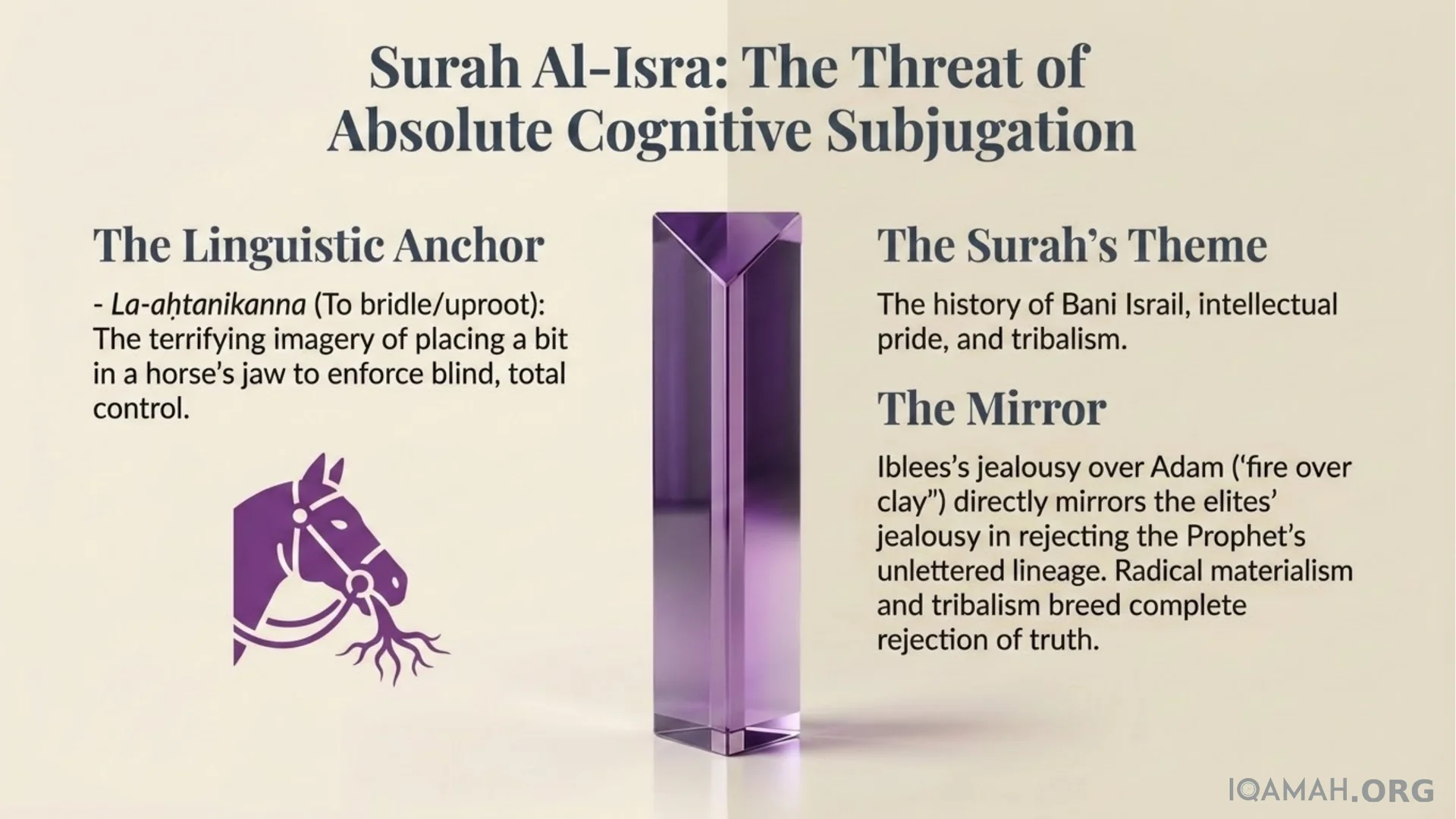
Linguistic Depth: Uses the terrifying term Ahtanikanna, meaning to completely uproot or bridle a horse by the jaw, showing Shaitan's desire for absolute cognitive control.
Slide 17 of 34
#
Surah Al-Isra: Absolute Cognitive Subjugation
Surah Al-Isra focuses on the destructive, predatory vow of Iblees against Adam's progeny, establishing the stakes of the ongoing spiritual war.
لَأَحْتَنِكَنَّ (La-aḥtanikanna): In a moment of absolute defiance, Iblees threatens, "I will surely destroy [or uproot] his descendants, except for a few".22 This highly unique verb derives from the root ha-na-ka (حَنَكَ), which refers to the palate, the jaw, or the specific act of placing a rope or a bit into the mouth of a horse or camel to bridle and completely control it.22 The linguistic imagery is terrifying and deeply psychological: Iblees envisions humanity not as independent agents, but as dumb beasts of burden that he intends to bridle by the jaw, steering them blindly toward their own destruction. Alternatively, classical linguists note it means to completely uproot a tree, signifying his desire to completely sever humanity's spiritual roots and connection to the Divine.22 The tone here is aggressively hostile, depicting spiritual warfare as a struggle against total cognitive, behavioral, and moral subjugation.
The Theme: Also known as Surah Bani Israil, this chapter addresses the history of the Israelites, their elevation, and their subsequent corruption due to rejecting the Prophets. Surah Al-Isra focuses on the disease of Hasad (jealousy) [Surah Al-Isra 17:61-62]: وَإِذْ قُلْنَا لِلْمَلَائِكَةِ اسْجُدُوا لِآدَمَ فَسَجَدُوا إِلَّا إِبْلِيسَ قَالَ أَأَسْجُدُ لِمَنْ خَلَقْتَ طِينًا "...[Iblis] said, 'Should I prostrate to one You created from clay? ... Do You see this one whom You have honored above me?'" This arrogant tribalism perfectly mirrors the Bani Israil's rejection of Prophet Muhammad (ﷺ).
The Narrative Mirror: The Adam narrative here specifically highlights the jealousy and racial arrogance of Iblees. Iblees says, "Do You see this one whom You have honored above me?" (17:62). This perfectly mirrors the psychology of the Bani Israil regarding the Prophet Muhammad (ﷺ). Just as Iblees felt racially superior (fire over clay) and could not accept that Allah chose to honor Adam, the Bani Israil felt superior as the "chosen people" and could not accept out of jealousy that Allah bestowed the final Prophethood upon an Arab. It serves as a stark warning to the Muslims: do not let spiritual privilege breed the satanic diseases of jealousy (Hasad) and arrogance (Takabbur).
Slide 18 of 34
#
Surah Al-Kahf (The Corruption of Theology)
"And (remember) when We said to the angels; 'Prostrate to Adam.' So they prostrated except Iblis (Satan). He was one of the jinns; he disobeyed the Command of his Lord. Will you then take him (Iblis) and his offspring as protectors and helpers rather than Me while they are enemies to you? What an evil is the exchange for the wrong-doers.".
Unique Highlights of this Narrative:
Theme: Protection from profound trials (Fitnah) and refuting the Christian theology of the "Son of God" (a corruption of belief).
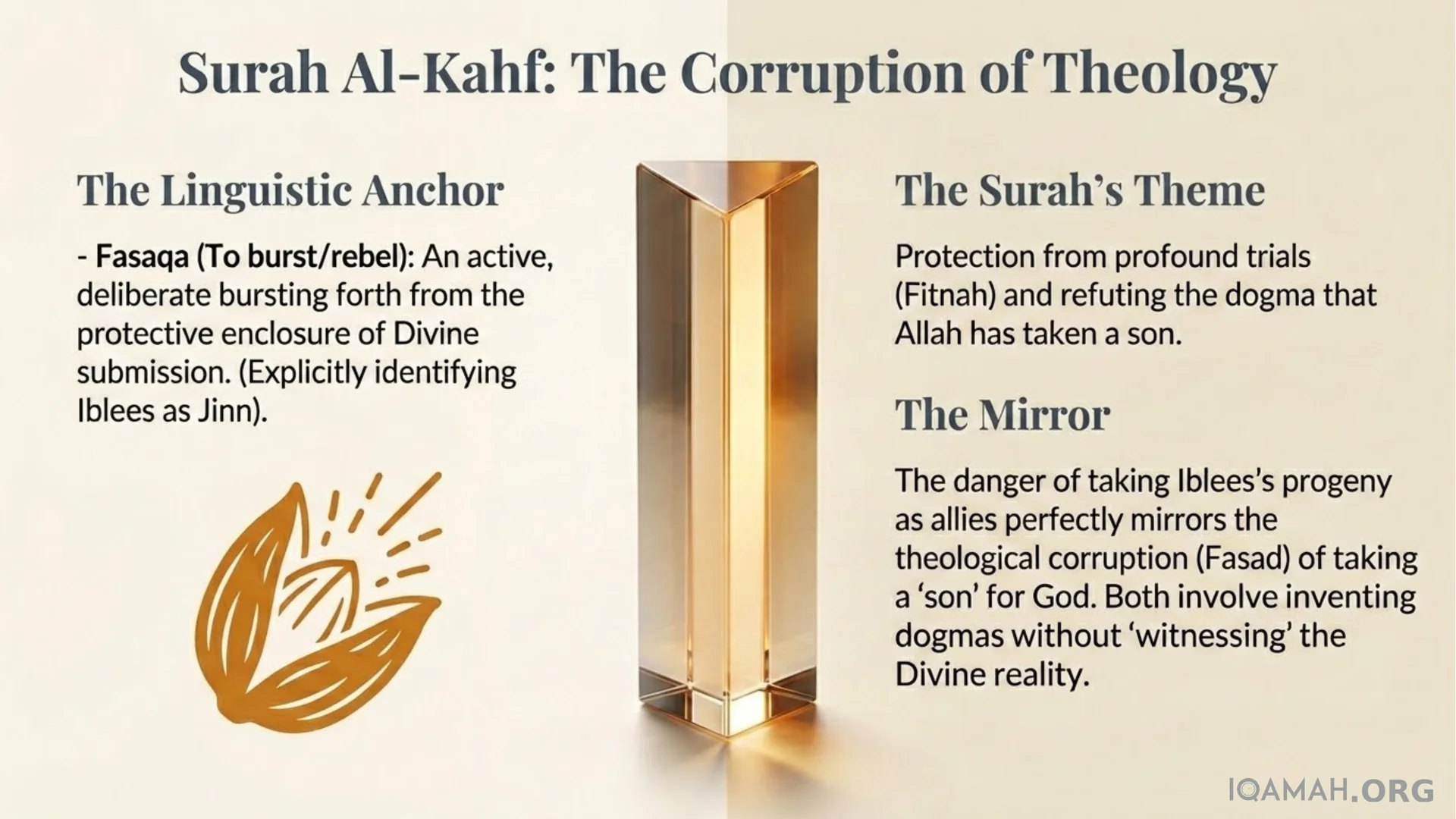
Unique Focus: This is the only iteration that explicitly clarifies Iblees "was of the Jinn" and that he "rebelled" (Fasaqa). [Surah Al-Kahf 18:50]: كَانَ مِنَ الْجِنِّ فَفَسَقَ عَنْ أَمْرِ رَبِّهِ "...he was of the jinn and rebelled (fasaqa) from the command of his Lord."
Theological Corrective: It completely ignores Iblees's argument of "fire vs. clay" and focuses entirely on his divergence from obedience, refuting the Judeo-Christian concept of "fallen angels".
Surah Al-Kahf serves as a crucial theological corrective regarding the precise nature of Iblees and the mechanics of his disobedience.
فَسَقَ (Fasaqa): The Quran explicitly states that Iblees was of the Jinn, and he "rebelled" (fasaqa) against his Lord's command.24 The root fa-sa-qa in classical Arabic was originally used by Bedouins to describe a ripe date bursting completely out of its skin, or a rat suddenly emerging from its hole.13 Theologically, it denotes breaking the boundary of obedience and exiting the realm of submission. By utilizing fasaqa, the tone portrays Iblees's disobedience not as a passive failure or a mere slip (unlike Adam's azalla), but as an active, destructive, and deliberate bursting forth from the protective enclosure of Divine submission into the lethal exposure of eternal damnation.
The Theme: Surah Al-Kahf begins with a severe warning to those who say "Allah has taken a son" (the Nasara/Christians), describing it as a monstrous word that causes the Prophet (ﷺ) immense grief. The Quran elsewhere praises the Christians for their humility, noting they are not arrogant.
The Narrative Mirror: Strikingly, the Adam story in Al-Kahf (18:50) does not mention Iblees's pride or his argument that "fire is better than clay." Instead, it introduces a unique detail: "He was of the Jinn, so he rebelled (fasaqa) against his Lord's command". The focus is entirely on his divergence and corruption of obedience. This mirrors the Christian condition: their fatal flaw was not necessarily arrogance or pride, but a massive theological corruption (fasaq) in taking Jesus as a divine son. Furthermore, the Surah asks, "Will you then take him and his descendants as allies instead of Me?"—a direct parallel to humanity taking false protectors and corrupted ideologies instead of relying purely on Allah in times of Fitnah (trials).
Slide 19 of 34
#
Surah Ta-Ha (Human Forgetfulness & Comfort)
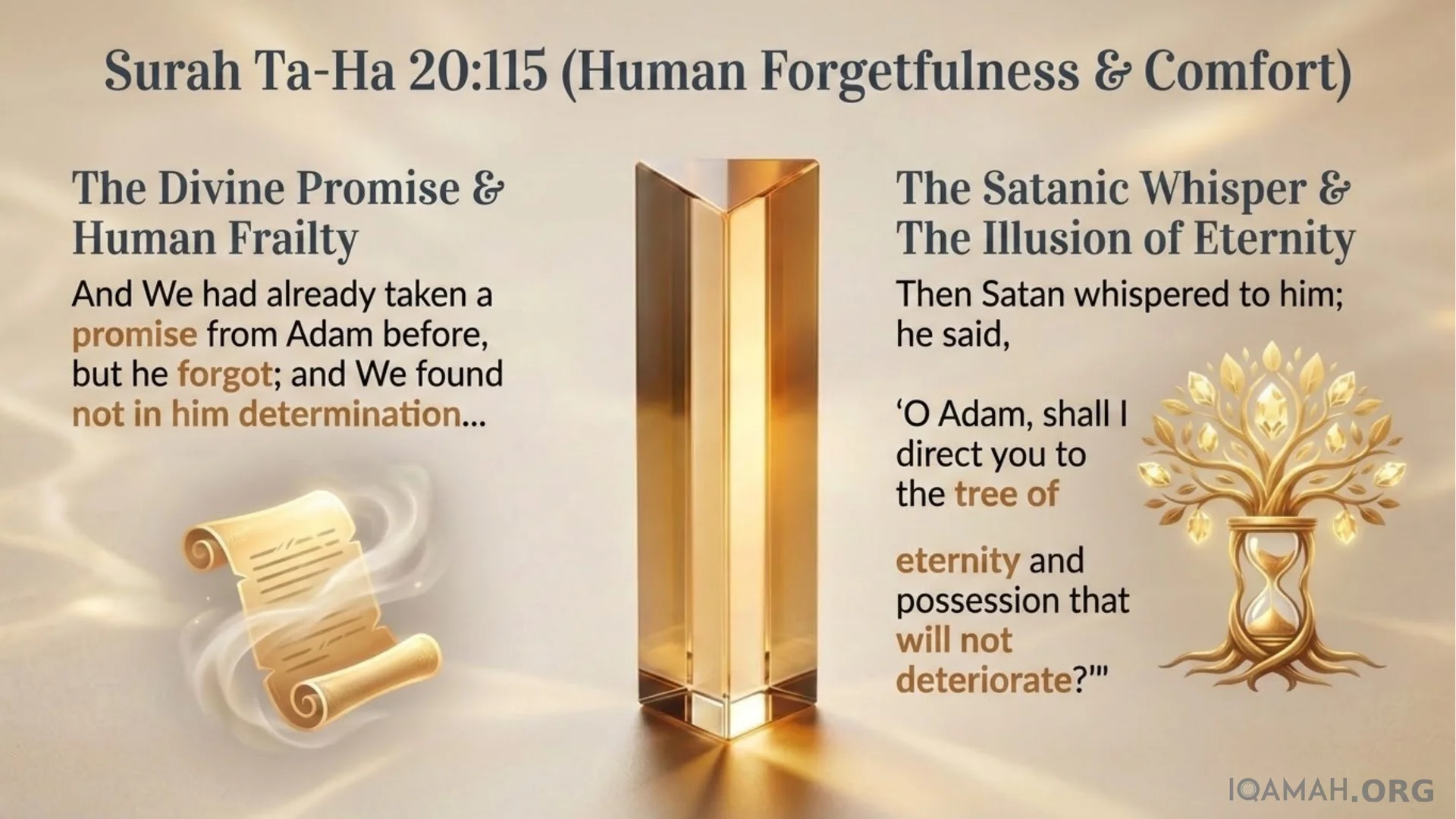
"And We had already taken a promise from Adam before, but he forgot; and We found not in him determination. And [mention] when We said to the angels, 'Prostrate to Adam,' and they prostrated, except Iblees; he refused... Then Satan whispered to him; he said, 'O Adam, shall I direct you to the tree of eternity and possession that will not deteriorate?' And Adam and his wife ate of it, and their private parts became apparent to them, and they began to fasten over themselves from the leaves of Paradise. And Adam disobeyed his Lord and erred. Then his Lord chose him and turned to him in forgiveness and guided [him].".
Unique Highlights of this Narrative:
Theme: Revealed to console the Prophet (ﷺ) during intense Meccan persecution; a reminder that the burden is not meant to cause distress.
Unique Focus: Highly empathetic to human frailty. Explicitly names the root of Adam's sin as forgetfulness (Nasiya) and a lack of determination ('Azm). [Surah Ta-Ha 20:115]: وَلَقَدْ عَهِدْنَا إِلَىٰ آدَمَ مِن قَبْلُ فَنَسِيَ وَلَمْ نَجِدْ لَهُ عَزْمًا "And We had already taken a promise from Adam before, but he forgot (nasiya); and We found not in him determination ('azm).".
Satanic Strategy: Shaitan targets existential anxiety, tempting Adam specifically with the "Tree of Eternity" (Shajarat al-Khuld).
Slide 20 of 34
#
Surah Ta-Ha: Cognitive Frailty and Consolation
Surah Ta-Ha provides the most empathetic and deeply psychological reading of Adam's failure, focusing heavily on internal cognitive weakness rather than external manipulation alone.
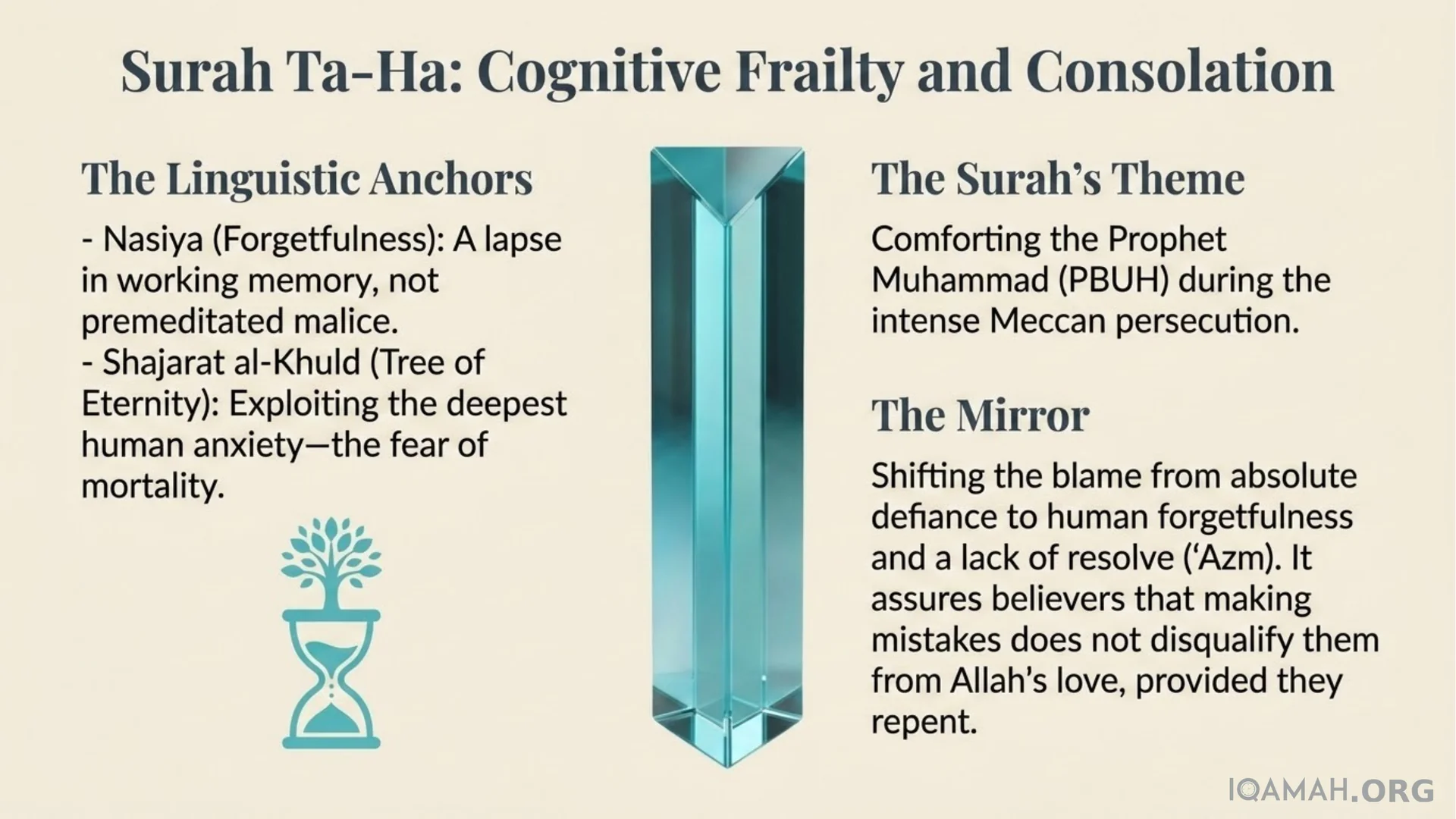
نَسِيَ (Nasiya): The Quran categorically states, "And We had already taken a promise from Adam before, but he forgot (nasiya), and We found not in him determination".26 The root na-si-ya emphasizes cognitive lapse, amnesia, and a failure of working memory. This profoundly alters the psychological tone of the fall; it wasn't an act of premeditated malice or defiance against Allah's sovereignty, but a lapse in memory and a critical weakness of resolve.26 It establishes human sinfulness as largely a byproduct of forgetfulness.
شَجَرَةِ الْخُلْدِ (Shajarat al-Khuld): Iblees tempts Adam with the "Tree of Eternity" and a "kingdom that will never decay" (mulk la yabla).26 The linguistic appeal to Khuld (eternal, unending existence) is a highly sophisticated tactic. It bypasses lower-level desires and directly targets the deepest, most inherent psychological anxiety of the highly conscious creature: the paralyzing fear of mortality, the cessation of existence, and the loss of accumulated blessings.
The Theme: Surah Ta-Ha begins by comforting the Prophet (ﷺ): "We have not sent down to you the Quran that you be distressed" (20:2). It was revealed during intense persecution to relieve the Prophet's (ﷺ) heavy burden.
The Narrative Mirror: The telling of the Adam story here is incredibly empathetic. It is the only place that explicitly identifies the root of Adam's sin: "And We had already taken a promise from Adam before, but he forgot (nasiya); and We found not in him determination (azm)" (20:115). By highlighting forgetfulness rather than defiance, Allah is comforting the Prophet (ﷺ) and the believers. It shows that human beings will inevitably make mistakes and fall short of perfect resolve, but this weakness is built into our design. As long as we immediately turn back in repentance—like Adam did—we will not be abandoned.
Slide 21 of 34
#
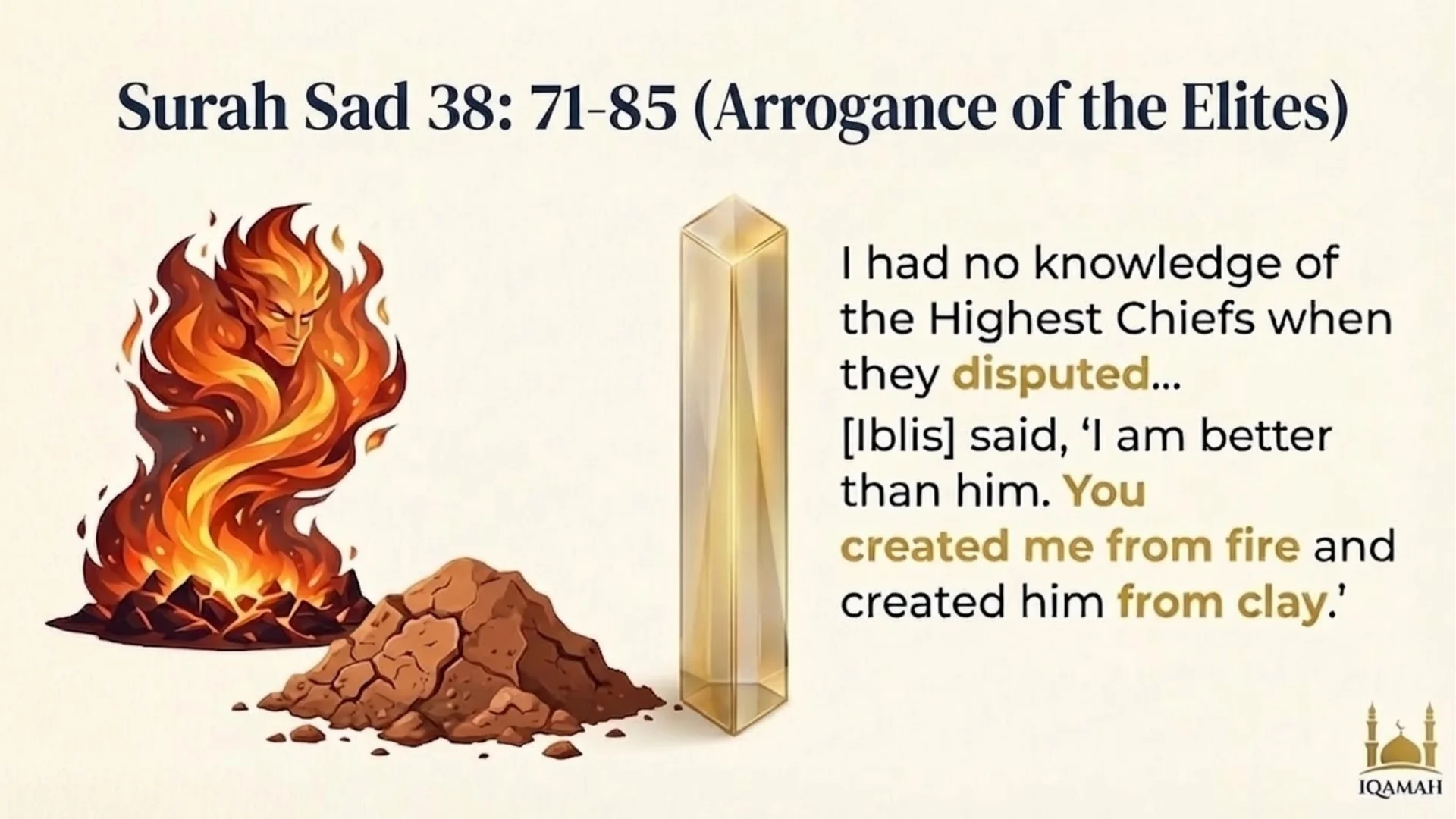
Surah Sad (Arrogance of the Elites)
"I had no knowledge of the Highest Chiefs when they disputed. It has not been revealed to me except that I am a clear warner. (Remember) when your Lord said to the angels: 'Truly, I am going to create man from clay. So, when I have fashioned him and breathed into him (his) soul created by Me, then you fall down prostrate to him.' So, the angels prostrated themselves, all of them, Except Iblis, he was proud and was one of the disbelievers. (Allah) said: 'O Iblis! What prevents you from prostrating yourself to one whom I have created with Both My Hands. Are you too proud or are you one of the high exalted?' [Iblis] said, 'I am better than him. You created me from fire and created him from clay.'",.
Unique Highlights of this Narrative:
Theme: The stubbornness and dispute of the Quraysh leadership (Mala') against the Prophet (ﷺ).
Unique Focus: Frames the event around the "dispute" (Ikhtisam) in the High Assembly. [Surah Sad 38:71-72]: إِذْ قَالَ رَبُّكَ لِلْمَلَائِكَةِ إِنِّي خَالِقٌ بَشَرًا مِّن طِينٍ فَإِذَا سَوَّيْتُهُ وَنَفَخْتُ فِيهِ مِن رُّوحِي فَقَعُوا لَهُ سَاجِدِينَ "...[Mention] when your Lord said to the angels, 'Indeed, I am going to create a human being from clay. So when I have proportioned him and breathed into him of My [created] soul, then fall down to him in prostration.'".
Socio-Political Mirror: Iblees's refusal to prostrate to a mortal made of clay perfectly mirrors the Meccan elites' refusal to submit to an orphaned human Prophet (ﷺ). Iblees focuses on the superficial exterior (Bashar) and completely misses the Divine reality within.
Slide 22 of 34
#
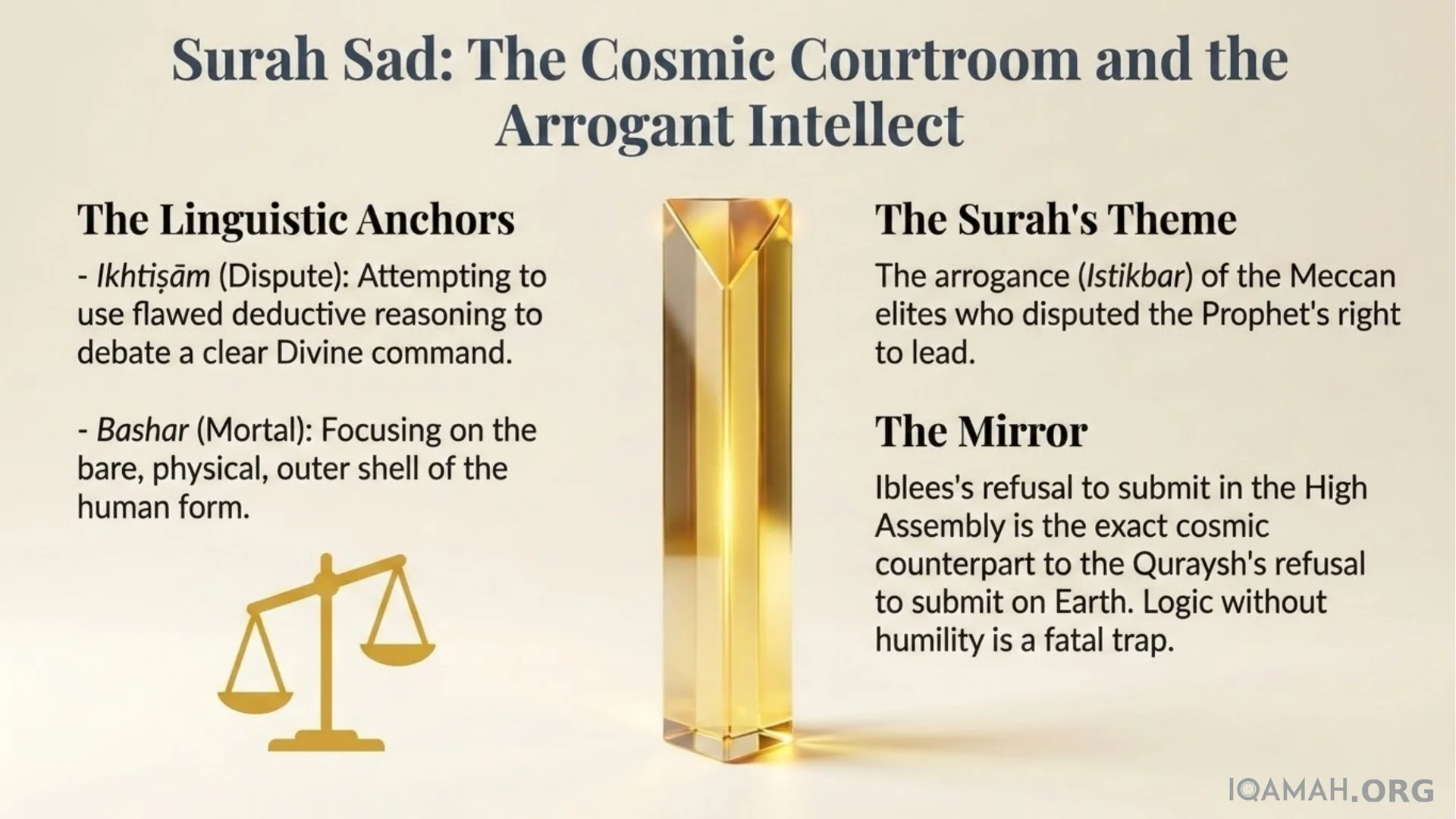
Surah Sad: The Cosmic Courtroom
Surah Sad emphasizes the grandeur of the cosmic courtroom, the severity of the confrontation, and the deeply flawed rationale behind the rebellion.
إِخْتِصَام (Ikhtiṣām): The Surah refers to the event as the debating or disputing (ikhtiṣām) of the High Assembly.5 The root kha-sa-ma involves argumentation, intense debate, and the severing of ties through conflict. It sets a formal, almost legalistic tone, highlighting how Iblees attempted to use flawed deductive reasoning and debate to justify his refusal, essentially turning a clear Divine command into a subject for philosophical dispute.
بَشَر (Bashar): Allah tells the angels He is creating a mortal (bashar) from clay.5 The root ba-sha-ra refers to the outer epidermis or the bare, hairless skin of a human being. The use of this word focuses deliberately on the physical, exposed, and vulnerable outer shell of the human form, which is precisely the superficial, material layer that Iblees judged, entirely missing the profound inner spiritual reality of the soul within.
The Theme: Surah Sad opens by describing the arrogance of the Quraysh leadership (the Mala' or elites), who haughtily disputed the choice of Muhammad (PBUH): "Has the message been revealed to him out of [all of] us?" (38:8).
The Narrative Mirror: The Adam narrative is framed around the "dispute" in the High Assembly (Mala-i A'la). The Prophet (ﷺ) is told to say, "I had no knowledge of the High Assembly when they disputed" (38:69). Iblees's refusal to prostrate in the High Assembly is a direct cosmic mirror to the Makkan elites' refusal to submit to the Prophet on Earth. Just as Iblees felt his status made him immune to following a mortal made of clay, the Quraysh leaders felt their wealth and tribal status made them too important to follow an orphaned Prophet (ﷺ). The narrative assures the Prophet (ﷺ) that this rejection is not a reflection on his worth, but the exact same arrogant stubbornness that condemned Iblees.
Slide 23 of 34
#
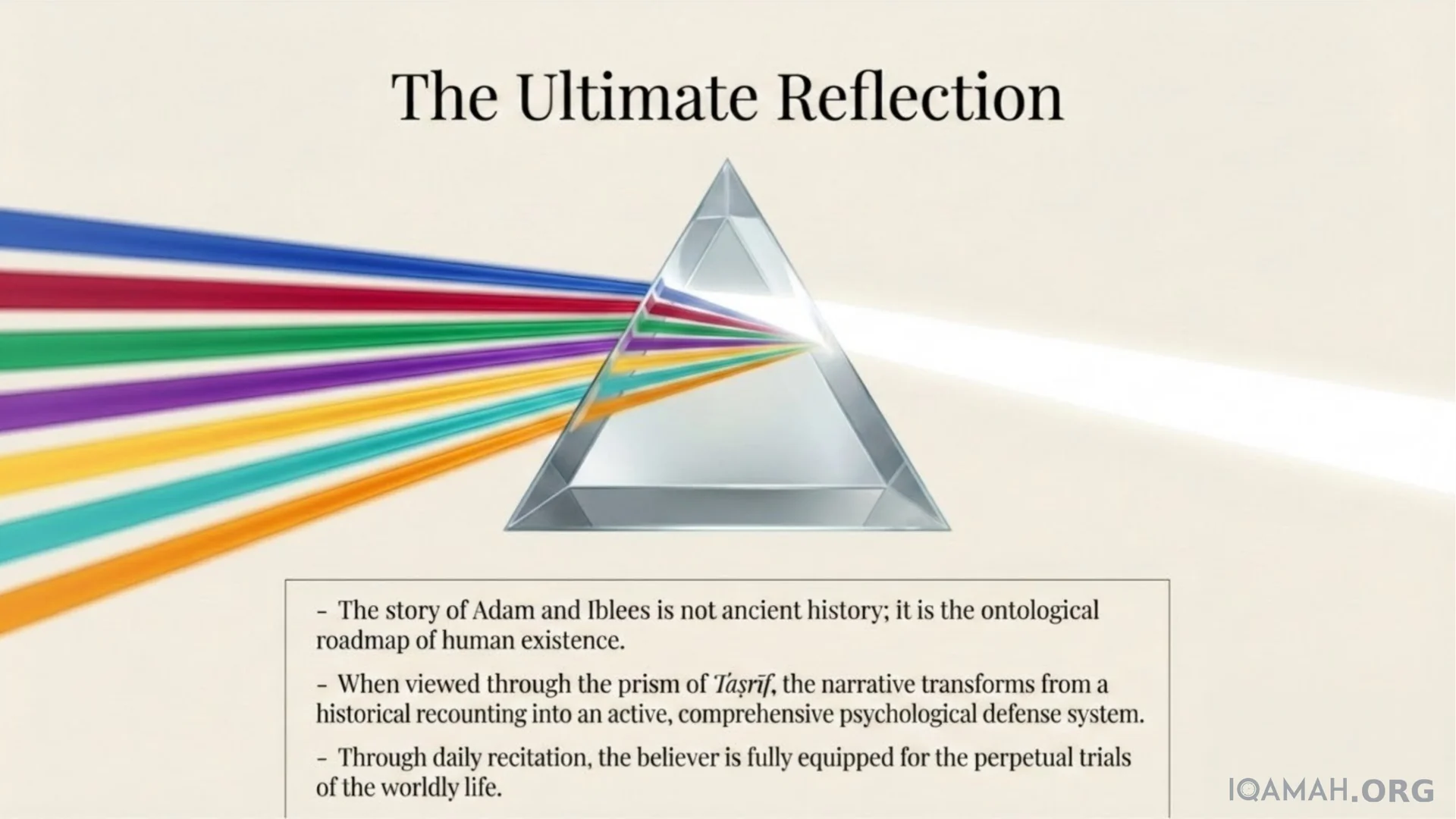
The Ultimate Reflection
Through the prism of Tasreef, this is not just ancient history. It is the ontological roadmap of human existence. When we read our daily Manzil, we are actively equipping ourselves for the perpetual trials of the worldly life.
Slide 24 of 34
#
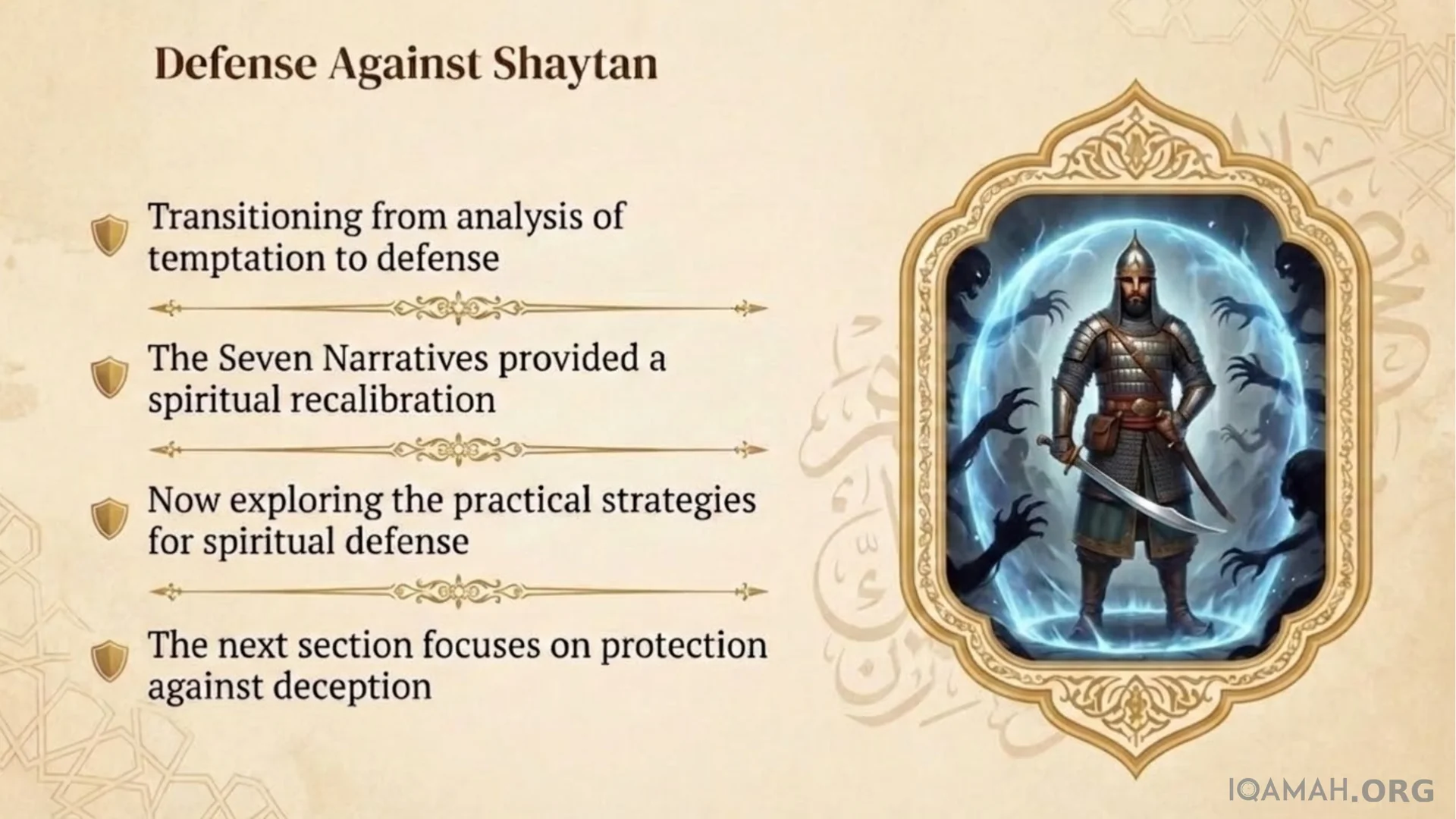
Defense Against Shaytan
Having diagnosed the methodology of our eternal enemy, we now transition into practical defense. How do we protect our Imaan from these highly calculated psychological attacks? The Quran does not merely diagnose the pathology of spiritual warfare; it provides a highly specific, practical defense mechanism. This framework is derived exclusively from the actions, prayers, and Divine decrees found within these seven specific Surahs, providing a blueprint for the believer to navigate the attacks of Iblees.
1. The Shield of Absolute Sincerity (Ikhlāṣ) In Surah Al-Hijr (15:39-40) and Surah Sad (38:82-83), Iblees makes a profound, legally binding admission regarding the absolute limits of his own power. He vows to mislead all of humanity, but explicitly carves out an exception: "Except, among them, Your chosen, sincere servants" (Illa 'ibadaka minhumul mukhliseen).51 The primary theological defense here is Ikhlas (purity of intention). Shaitan's power operates strictly in the realm of ego, pride, and hidden worldly desires. When a believer purifies their intentions entirely for Allah, operating without ego, they become structurally immune to Satanic leverage, as there is no internal arrogance for Shaitan to manipulate.14
2. The Mechanism of Immediate Accountability and Repentance (Tawbah) The defining difference between the failure of Iblees and the failure of Adam is not the commission of a sin, but the reaction to the sin. Iblees intellectualized his disobedience, shifted the blame to Allah ("Because You have put me in error..." 7:16), and doubled down in his pride.47 Adam and Hawa, conversely, immediately internalized the blame without making excuses. Surah Al-A'raf (7:23) provides the ultimate formula for restoration: "Our Lord, we have wronged ourselves, and if You do not forgive us and have mercy upon us, we will surely be among the losers.".52 The defense against spiritual destruction is the total abandonment of ego-driven justification and the immediate embrace of radical accountability and repentance.
3. Reliance on Divine Epistemology (Talaqqī) In Surah Al-Baqarah (2:37), the Quran states: "Then Adam received from his Lord Words, and He accepted his repentance" (Fatalaqqa adamu min rabbihi kalimat...).53 When humanity falls into error, the human intellect alone is insufficient to find the way back to Divine grace. Adam did not invent his apology; he received (talaqqa) the words directly from Allah.54 The defense mechanism requires the believer to abandon reliance solely on self-help, human philosophy, or flawed intellect, and instead turn directly to the revealed words of Allah (the Quran and Prophetic supplications) to navigate spiritual crises and secure forgiveness.
4. Constant Cognitive Vigilance and the Rejection of False Alliances Surah Al-Kahf (18:50) issues a stark, rational warning to the intellect of the believer: "Will you then take him and his descendants as allies instead of Me, while they are enemies to you? Wretched is the exchange for the wrongdoers.".24 The defense here is an active, sustained cognitive awareness of the enmity. The believer is commanded to live with the perpetual realization that an active, invisible adversary is attempting to exchange their eternal inheritance for temporary, hollow satisfaction. By maintaining this intense vigilance, the whispers (waswasa) lose their disguise as the believer's own thoughts and are correctly identified as hostile, external intrusions that must be immediately rejected.14
Slide 25 of 34
#
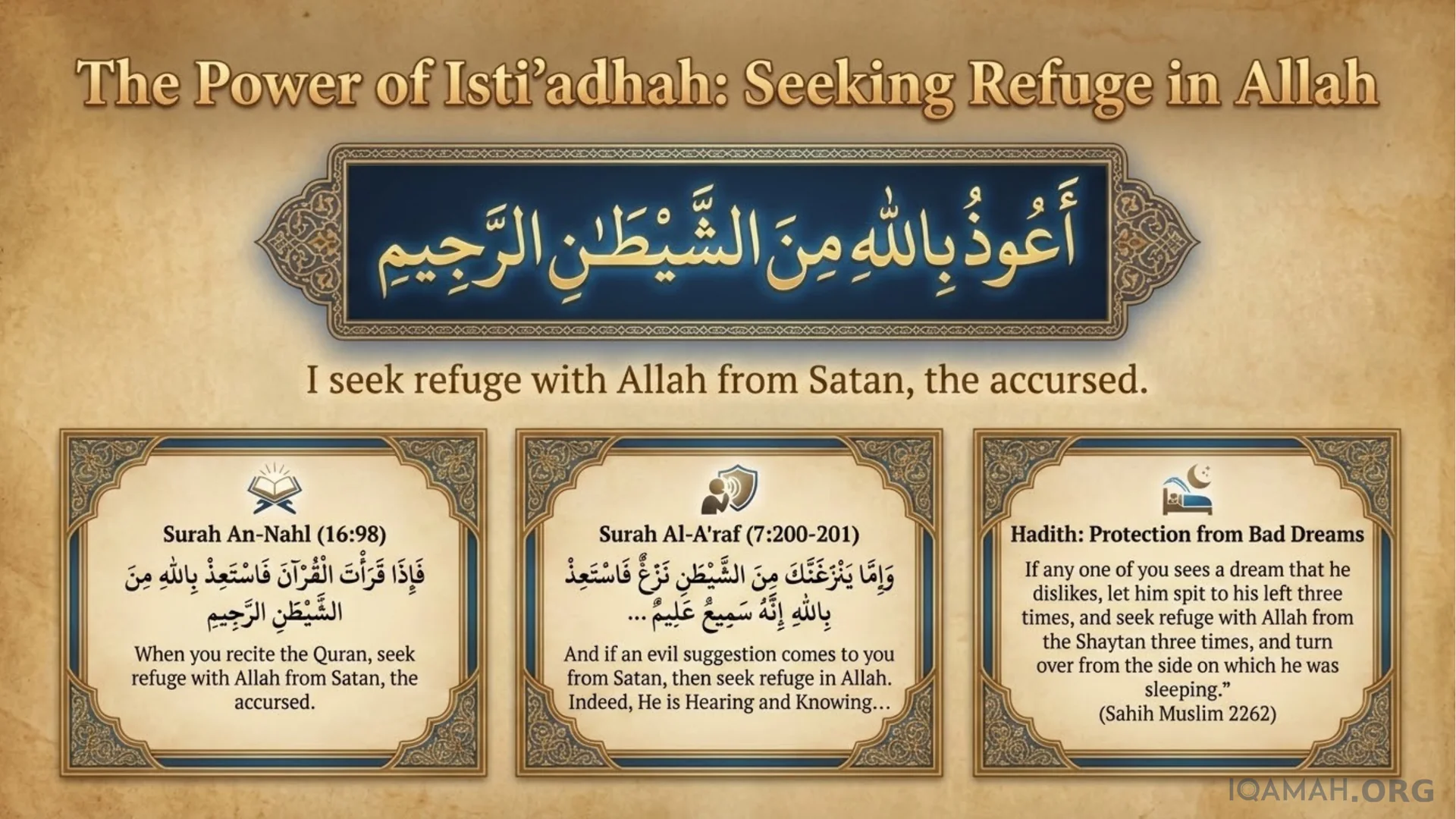
The Power of Isti'adhah: Seeking Refuge
The Islamic tradition prescribes a highly specific architecture of verbal and cognitive mechanisms to establish a fortified perimeter around the believer. These practices operate on the foundational theological principle of Tawhid (the absolute oneness and sovereignty of God). By invoking the Absolute Authority of the Creator, the believer effectively neutralizes the localized, finite threats posed by unseen creations.
The Tawwuz, commonly articulated in Arabic as A'udhu billahi min ash-shaitan ir-rajeem ("I seek refuge with Allah from the accursed Shaytan"), serves as the foundational defensive invocation in Islamic praxis. Its theological premise is rooted in explicit Qur'anic injunctions, which command the believer to seek immediate divine sanctuary whenever malevolent psychological or spiritual disturbances arise. The Qur'an states: "And if an evil whisper comes to you from Shaytan, then seek refuge with Allah. Verily, He is All-Hearer, All-Knower" (Fussilat 41:36 and Al-A'raf 7:200).
The Tawwuz functions as an ontological assertion of human dependence and divine omnipotence. By reciting it, the believer actively acknowledges their inherent vulnerability to unseen manipulation and appeals directly to the ultimate power of Allah. It is employed to instantly sever the cognitive and spiritual tethers that malevolent forces attempt to attach to the human psyche. Prophetic traditions emphasize its immediate efficacy in acute states of psychological distress. For instance, the Prophet Muhammad (ﷺ) observed a man whose face had become red with intense, irrational anger. The Prophet (ﷺ) prescribed the Tawwuz, stating that reciting it would cause the suffering and rage to dissipate instantly, thereby indicating that highly destructive emotional states are frequently catalyzed or amplified by demonic influence. The Tawwuz acts as a cognitive reset, purging the mind of external energetic corruption.
Slide 26 of 34
#
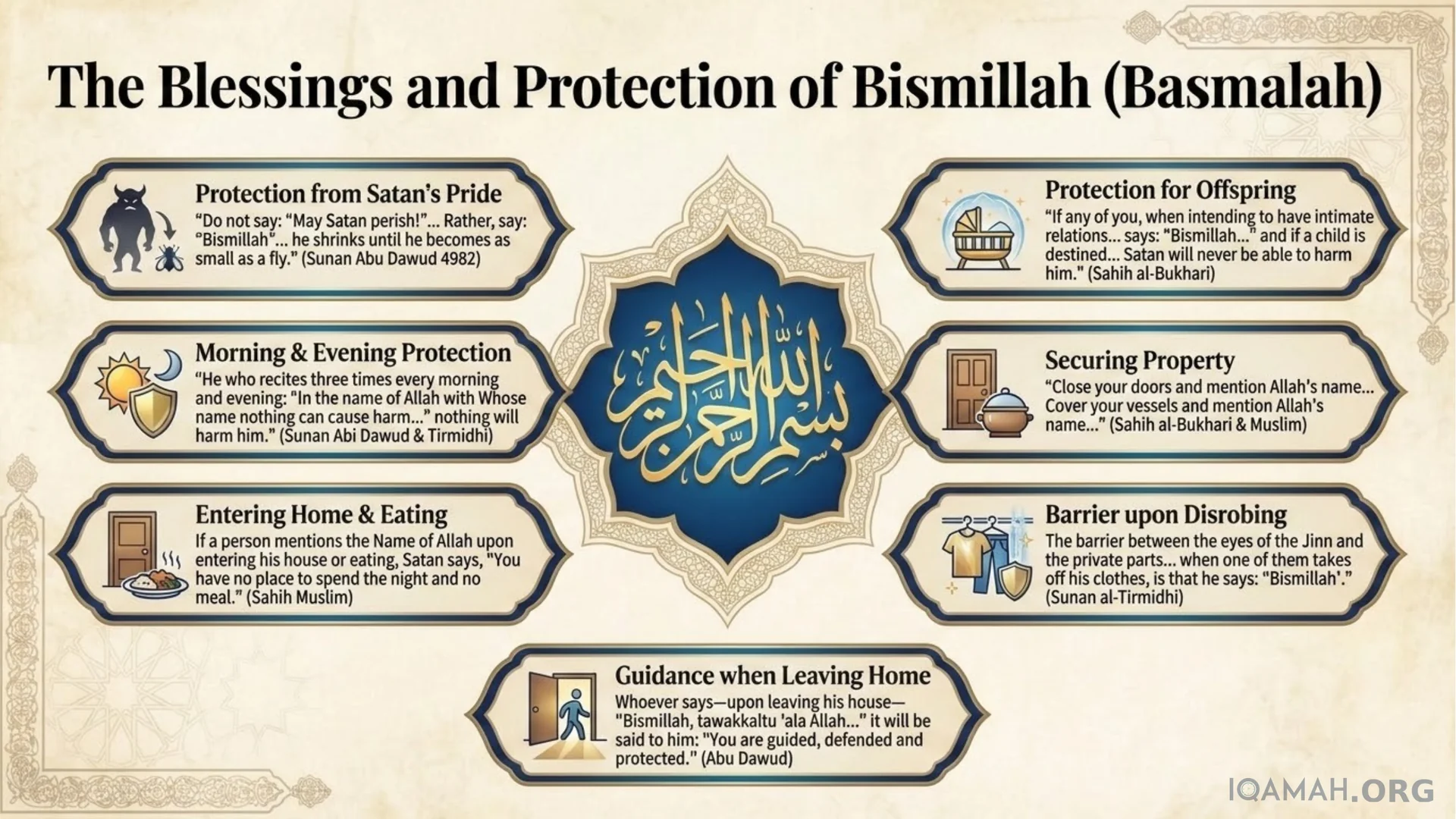
The Blessings and Protection of Bismillah
While the Tawwuz operates as a reactive shield against whispers and cognitive malice, the Basmalah—Bismillah ar-Rahman ar-Raheem ("In the Name of Allah, the Most Gracious, the Most Merciful"), or its abbreviated form Bismillah—operates as a proactive, dimensional barrier. In the specific context of protection against the Jinn, the Basmalah is identified in classical theology as a Sitr or Hijab (a veil or screen) that blocks the perceptual abilities of unseen entities.
Classical Hadith literature provides precise, mechanical details regarding this phenomenon. According to a highly authenticated narration recorded by Imam Tirmidhi, the Prophet Muhammad (ﷺ) stated, "The screen between the eyes of the jinns and nakedness of the children of Adam when one of you enters the area of relieving oneself is saying: 'Bismillah'". Because the Jinn exist in a parallel dimensional plane, they ordinarily possess the visual capability to observe humans undetected. However, the invocation of the Divine Name establishes a metaphysical frequency that effectively blinds the Jinn, rendering the human form imperceptible to their malevolent gaze.
This protective property of the Basmalah extends deeply into the broader routines of daily existence. Classical scholars, extrapolating from prophetic traditions, emphasize that mentioning the Name of Allah before entering a home, before eating or drinking, and before disrobing creates an impenetrable seal. This seal prevents the Shayateen from crossing the threshold of the physical space, partaking in the believer's sustenance, or gazing upon their modesty. The invocation acts as a spiritual lockdown, severing the Jinn's access to the mundane aspects of human existence. Furthermore, the concept of Sitr (concealment) is deeply tied to one of the divine attributes of Allah, As-Sitteer (The Concealer), who loves modesty and shields His servants from exposure to physical and metaphysical harm.
Additional notes from the slide deck
بِاسْمِ اللَّهِ اللَّهُمَّ جَنِّبْنَا الشَّيْطَانَ وَجَنِّبِ الشَّيْطَانَ مَا رَزَقْتَنَا The Messenger of Allah ﷺ said: “If any of you, when intending to have intercourse with his wife, says: ‘Bismillah, Allahumma jannibnash-Shaitana wa jannibish-Shaitana ma razaqtana’ (In the name of Allah, O Allah, keep Satan away from us and keep Satan away from what You bestow upon us), and if a child is destined for them, Satan will never be able to harm him.” (Sahih al-Bukhari)
بِسْمِ اللَّهِ الَّذِي لَا يَضُرُّ مَعَ اسْمِهِ شَيْءٌ فِي الْأَرْضِ وَلَا فِي السَّمَاءِ وَهُوَ السَّمِيعُ الْعَلِيمُ ‘Uthman bin ’Affan reported: The Messenger of Allah ﷺ said, “He who recites three times every morning and evening: ‘In the name of Allah with Whose name nothing can cause harm in the earth or in the heavens, and He is the All-Hearing, the All-Knowing,’ nothing will harm him.” (Sunan Abi Dawud & Jami’ al-Tirmidhi)
Slide 27 of 34
#
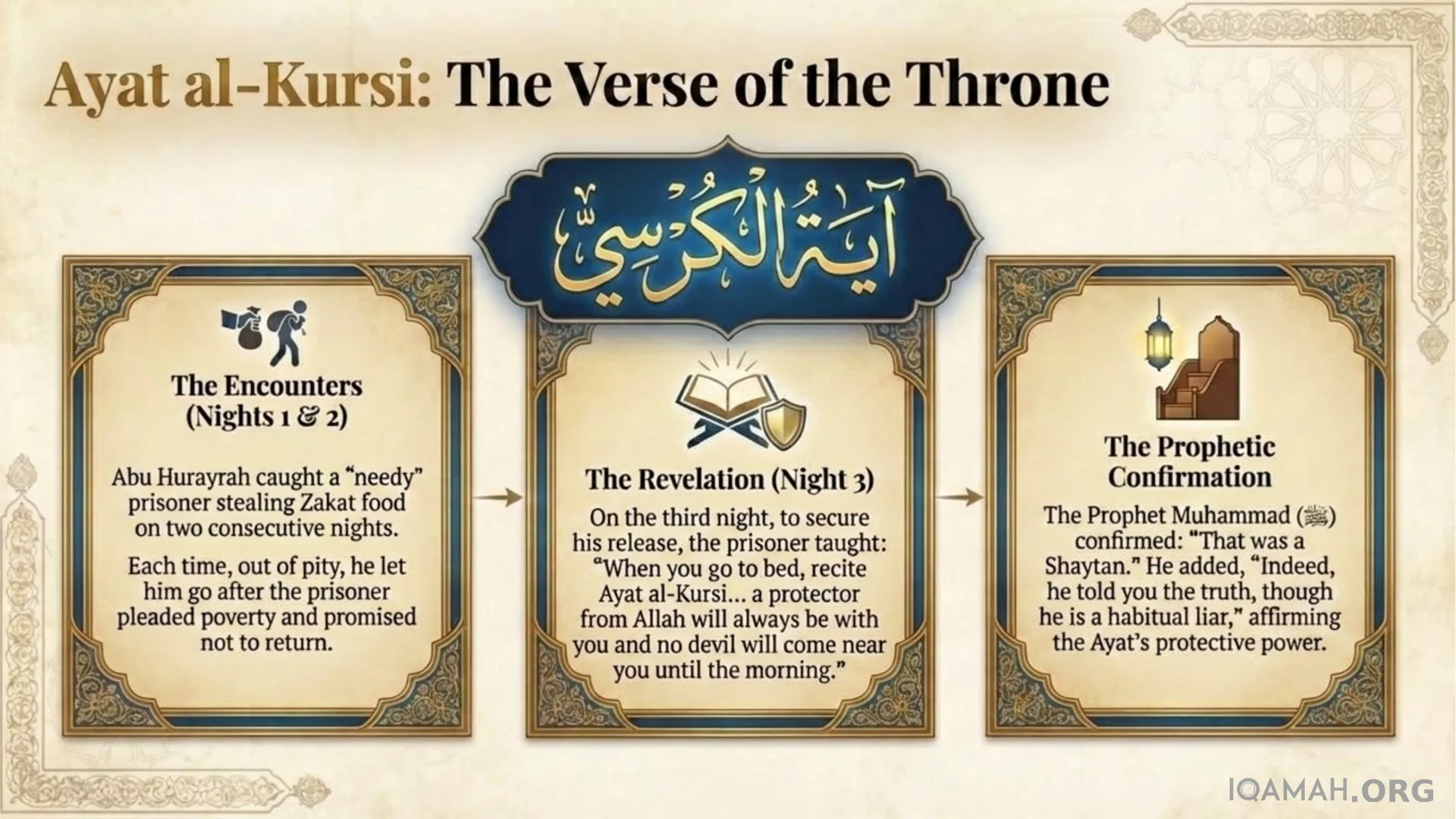
Ayat al-Kursi (The Verse of the Throne)
Ayat al-Kursi (Surah Al-Baqarah, 2:255), known as the Verse of the Throne, is universally recognized across all schools of Islamic scholarship as the most potent single verse in the Qur'an for protection. Its profound efficacy is derived from its comprehensive and majestic articulation of Allah's absolute sovereignty, His omniscience, and His sustained, tireless control over the entire cosmos. The verse systematically dismantles any notion of independent power outside of the Divine, establishing an atmosphere of absolute divine presence.
The protective mechanism of Ayat al-Kursi is unique in that it elicits direct, physical angelic guardianship. According to a renowned and highly authenticated tradition narrated by Abu Hurayrah, the Prophet Muhammad (ﷺ) confirmed that reciting Ayat al-Kursi prior to sleep results in Allah appointing a Hafiz (a specialized guardian angel) who stands over the reciter, ensuring that no Shaytan can approach the individual until the break of dawn. This dynamic indicates that the verse operates not merely as a passive repellant, but as an active summoning mechanism for a divine security detail.
Furthermore, the Jinn themselves are acutely aware of the devastating power of this verse. The aforementioned narration regarding Abu Hurayrah involved his physical capture of a Shaytani jinn who was repeatedly attempting to steal from the charity stores. To barter for his release, the desperate Jinn revealed the protective nature of Ayat al-Kursi. The Prophet (ﷺ) subsequently validated this interaction by stating, "He spoke the truth, although he is an inveterate liar".
The resonance of this verse, and the broader chapter containing it, creates an inhospitable environment for demonic forces. The Prophet (ﷺ) stated that the Shaytan flees in terror from a house in which Surah Al-Baqarah is recited. Classical scholars such as Ibn 'Uthaymin have noted that the regular recitation of this Surah establishes a long-term protective perimeter that dismantles the effects of witchcraft (Sihr) and ensures the spiritual sanitization of the domicile.
Additional notes from the slide deck
Abu Hurayrah reported: The Messenger of Allah ﷺ put me in charge of guarding the Zakat of Ramadan. Someone came and began to scoop up handfuls of food. I seized him and said, “I will surely take you to the Messenger of Allah ﷺ!” He said, “I am needy, I have a family to support, and I am in great need.” So, I let him go. The next morning, the Prophet ﷺ asked, “O Abu Hurayrah, what did your prisoner do last night?” I said, “O Messenger of Allah, he complained of great need and a family, so I took pity on him and let him go.” The Prophet ﷺ said, “Indeed, he lied to you and he will return.” I knew he would return because the Prophet ﷺ said so. I lay in wait for him. He came and again began scooping food. I seized him and said, “I will take you to the Messenger of Allah ﷺ!” He said, “Leave me, for I am needy and have a family; I will not come back.” I took pity on him and let him go. The next morning, the Prophet ﷺ asked, “O Abu Hurayrah, what did your prisoner do?” I said, “He complained of great need and a family, so I let him go.” He replied, “Indeed, he lied to you and he will return.” I waited for him a third time. He came and started scooping food. I seized him and said, “I will definitely take you to the Messenger of Allah! This is the third time; you claim you won’t return, but you do.” He said, “Let me go and I will teach you some words by which Allah will benefit you.” I asked, “What are they?” He said, “When you go to your bed, recite Ayat al-Kursi from beginning to end. If you do so, a protector from Allah will always be with you and no devil will come near you until the morning.” So, I let him go. The next morning, the Messenger of Allah ﷺ asked, “What did your prisoner do last night?” I said, “He claimed he would teach me words that would benefit me, so I let him go.” The Prophet ﷺ asked, “What were they?” I said, “He told me: ‘When you go to bed, recite Ayat al-Kursi… a protector from Allah will stay with you and no devil will approach you until morning.’” The Prophet ﷺ said: “Indeed, he told you the truth, though he is a habitual liar. Do you know who you have been speaking to for these three nights, O Abu Hurayrah?” I said, “No.” He said, “That was a Shaytan.” (Sahih al-Bukhari)
Slide 28 of 34
#
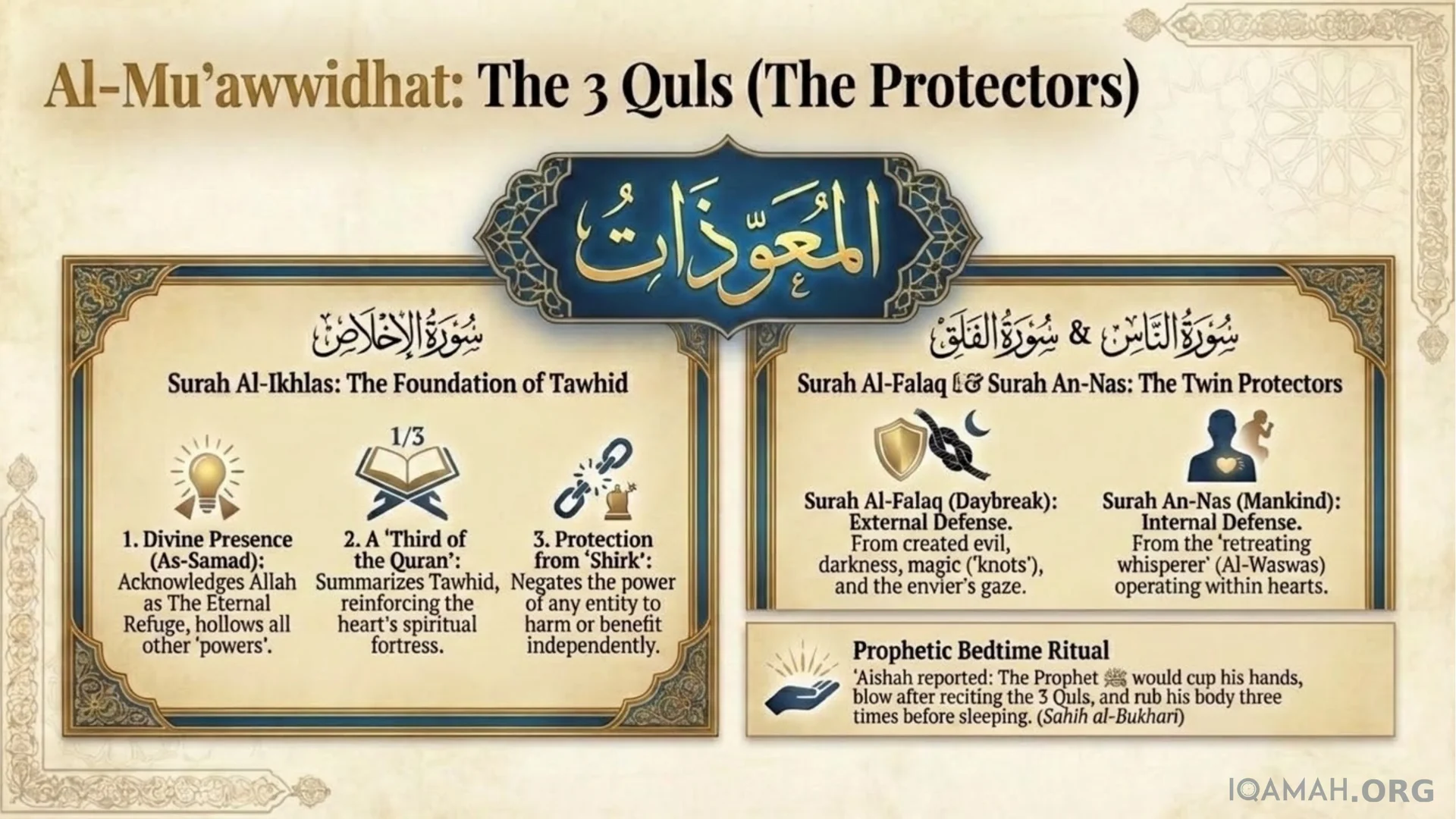
Al-Mu'awwidhat (The 3 Quls)
The Mu'awwidhatayn (the two verses of refuge: Surah Al-Falaq and Surah An-Nas), which are almost always recited in conjunction with Surah Al-Ikhlas (referred to collectively as the Three Quls), represent the pinnacle of targeted, specific spiritual defense. Revealed specifically to counteract esoteric harms, these chapters provide a comprehensive shield addressing both external, environmental evils and internal, psychological infiltrations.
Surah Al-Falaq (The Daybreak) is externally focused. It trains the believer to seek refuge in the "Lord of the Daybreak" from the evil of all that He has created, from the creeping darkness of the night as it settles, from "those who blow into knots" (a direct reference to practitioners of dark magic and sorcery), and from the destructive gaze of the envier. Surah An-Nas (Mankind) shifts the defensive focus internally. It instructs the believer to seek refuge in the Lord, Sovereign, and God of mankind from the "retreating whisperer" (Al-Waswas Al-Khannas)—the Shaytan who whispers directly into the hearts of humanity, operating from among both the Jinn and humans.
The historical and practical significance of the Mu'awwidhatayn cannot be overstated. Authentic narrations, such as those from Abu Sa'id al-Khudri, report that prior to the revelation of these specific chapters, the Prophet Muhammad (ﷺ) utilized various general supplications to protect against the evil eye and the Jinn. However, upon the revelation of the Mu'awwidhatayn, he adopted them as his primary shield and abandoned all other lesser litanies, recognizing their unparalleled comprehensiveness and divine efficacy. When recited sequentially—particularly in the morning, in the evening, and immediately prior to sleep—they form an impenetrable spiritual armor that addresses every conceivable vector of metaphysical attack.
Slide 29 of 34
#
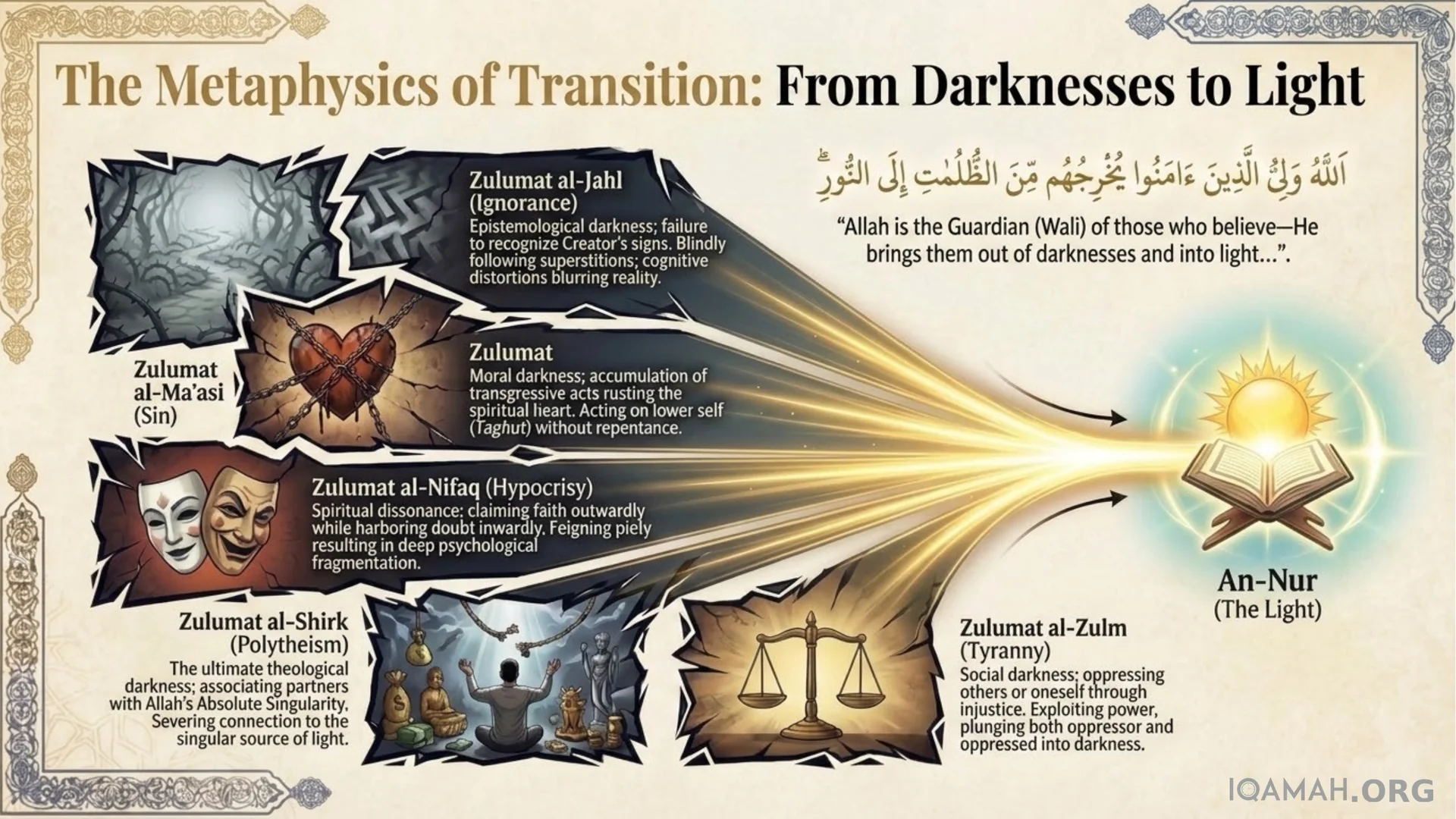
The Metaphysics of Transition: Darknesses to Light
While the apotropaic mechanisms of Islam are fundamentally concerned with neutralizing darkness and establishing safety, Islamic soteriology does not rest at mere defense. The theological goal is not simply to survive the unseen threats of the world, but to engage in an aggressive ascent toward divine illumination. This journey is encapsulated in the central Qur'anic concept of transitioning from Zulumat (darknesses) to Nur (light).
Ultimately, our spiritual journey is an extraction from Zulumat (the plural, chaotic darknesses of sin, ignorance, and hypocrisy) into Nur (the singular, indivisible Light of Allah) [Surah Al-Baqarah 2:257]: اللَّهُ وَلِيُّ الَّذِينَ آمَنُوا يُخْرِجُهُم مِّنَ الظُّلُمَاتِ إِلَى النُّورِ "Allah is the ally of those who believe. He brings them out from darknesses into the light.".
In this profound verse, Allah identifies Himself as the Wali—the intimately close Protecting Friend, Patron, and Guardian of the believers. The transition from darkness to light is therefore not framed as a solitary, unaided human endeavor; it is a divinely orchestrated rescue operation. Human agency lies in the initial, sincere act of faith, which subsequently unlocks direct divine intervention that physically, cognitively, and spiritually extracts the soul from multidimensional darkness.
A profound structural and linguistic motif across the entirety of the Qur'anic text is the consistent use of the plural form for darkness (Zulumat) and the singular form for light (Nur). The singularity of Nur signifies the absolute, indivisible nature of Truth. Because the ultimate source of truth—Allah—is singular and unitary, the path leading to Him is necessarily a single, unwavering straight line (the Sirat al-Mustaqim). Conversely, Zulumat is pluralized because falsehood is inherently fractured, chaotic, and divergent. The paths that deviate from the straight line are infinite in their variations and permutations.
Zulumat al-Jahl (Ignorance): Epistemological darkness; the fundamental absence of divine knowledge and the failure to recognize the Creator's signs. Blindly following cultural superstitions; succumbing to the cognitive distortions of the Shayateen that blur the lines between reality and illusion.
Zulumat al-Ma'asi (Sin): Moral and behavioral darkness; the accumulation of transgressive acts that rust the spiritual heart. Acting upon the desires of the lower self (Taghut); normalizing unethical behavior without seeking repentance, leading to a deadened conscience.
Zulumat al-Nifaq (Hypocrisy): Spiritual dissonance; claiming faith outwardly for social capital while harboring rejection or doubt inwardly. Feigning piety; internal alignment with false patrons while maintaining an Islamic facade, resulting in deep psychological fragmentation.
Zulumat al-Shirk (Polytheism): The ultimate theological darkness; associating partners with the Absolute Singularity of Allah. Shifting reliance from the Divine to material forces, astrological bodies, wealth, or political idols, severing the connection to the singular source of light.
Zulumat al-Zulm (Tyranny): Social and existential darkness; oppressing others or oneself through injustice and cruelty. Exploiting power dynamics; stripping others of their divine rights, plunging both the oppressor and the oppressed into systemic darkness.
Spiritual blindness, therefore, is not defined as a lack of physical ocular sight. Rather, it is the inability of the spiritual heart (Qalb) to penetrate these compounding layers of darkness to perceive the singular, radiant light of reality.
Slide 30 of 34
#
Completing the Transition: Surah Al-Ahzab
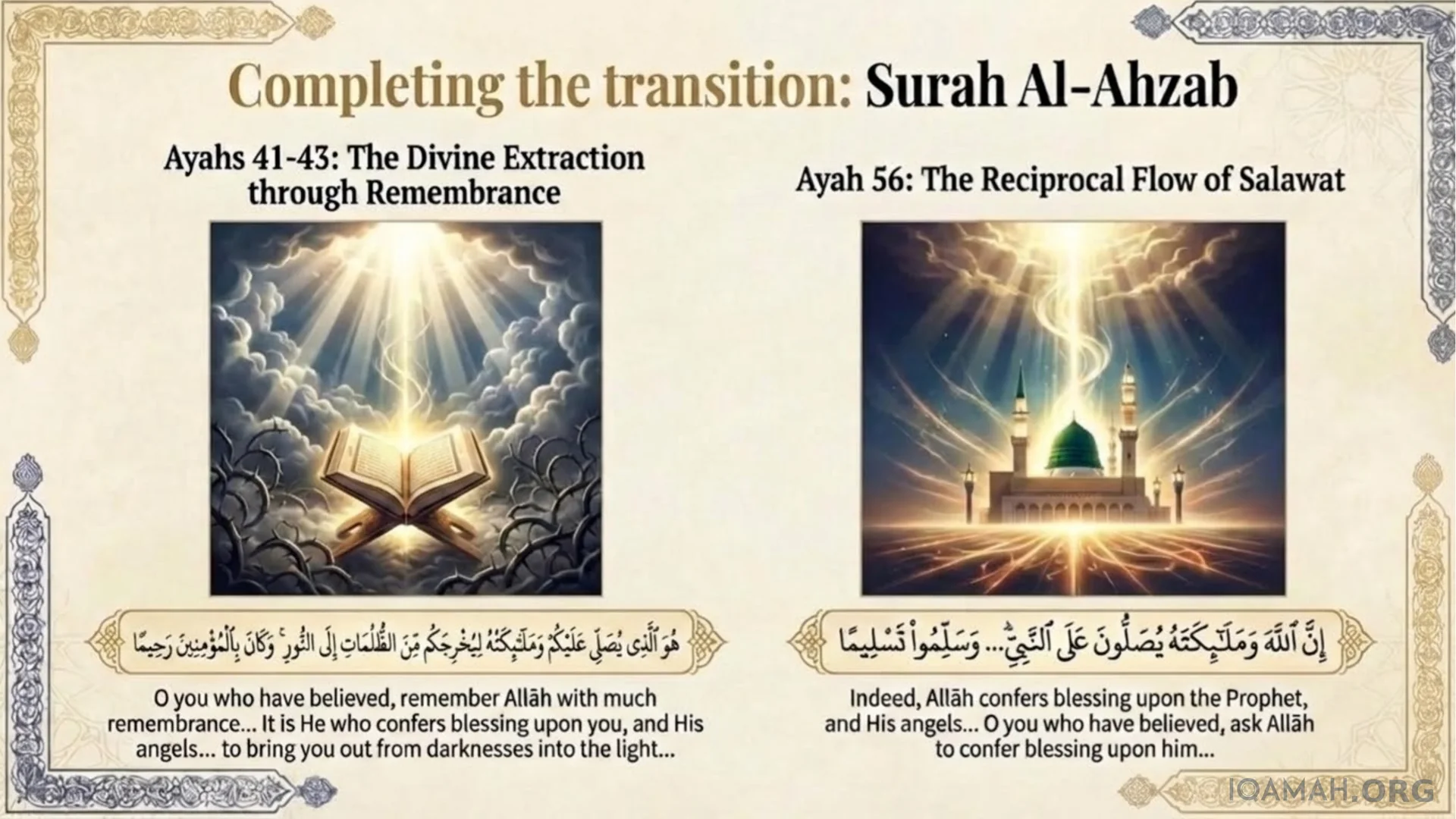
If Surah Al-Baqarah 2:257 establishes the what—the fundamental transition from darknesses to light under the guardianship of Allah—then Surah Al-Ahzab 33:43 explicitly reveals the how. This verse unveils the specific divine mechanism through which the believer is extracted from the mire of Zulumat.
The Qur'an states:
"He it is who confers blessing (yusalli) upon you, and His angels [ask Him to do so] that He may bring you out from darknesses into the light. And ever is He, to the believers, Merciful" (Surah Al-Ahzab 33:43).
In this verse, the exact Qur'anic terminology of transition (yukhrijakum min az-zulumati ilan-nur) is inextricably linked to the act of Salawat. To comprehend the magnitude of this mechanism, the theological definition of Salawat (plural of Salah) must be precisely delineated. When the term Salah is applied to Allah, it does not mean ritual prayer; rather, it signifies the bestowal of profound mercy, compassion, divine grace, and the exalting of a person's mention in the highest heavenly assemblies (Al-Mala' al-A'la). When the term is applied to the angels, it represents their intense, continuous intercession and supplication to Allah to forgive, bless, and elevate the believers.
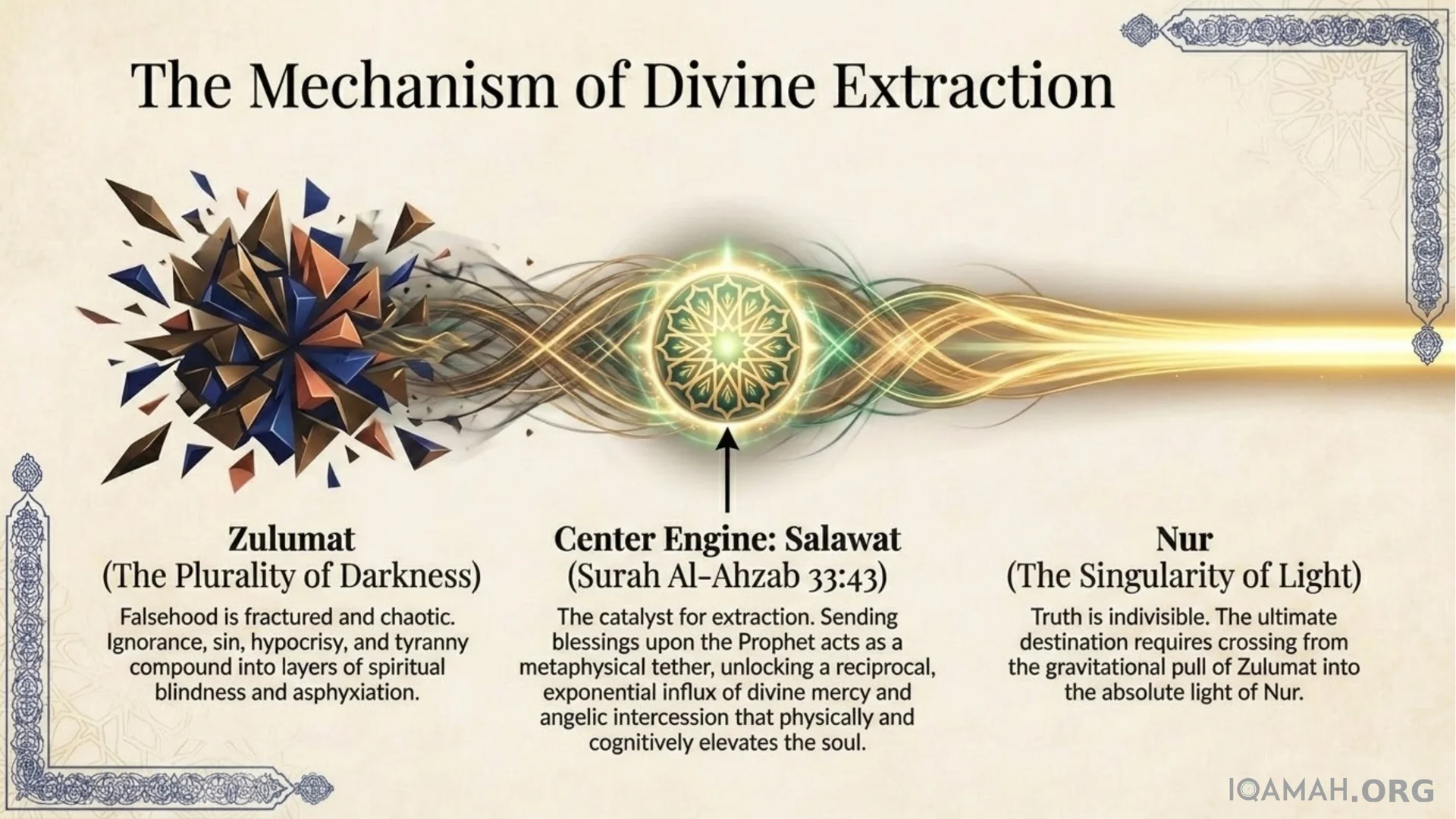
Thus, the verse asserts that the combined, overwhelming influx of Allah's divine mercy and the angels' intercessory prayers is the specific metaphysical engine that pulls the human soul out of the gravitational pull of Zulumat and thrusts it into the Nur.
Additional notes from the slide deck
يٰۤـاَيُّهَا الَّذِيۡنَ اٰمَنُوا اذۡكُرُوۡا اللّٰهَ ذِكۡرًا كَثِيۡرًا ۙ ٤١ وَّ سَبِّحُوۡهُ بُكۡرَةً وَّاَصِيۡلًا ٤٢ هُوَ الَّذِىۡ يُصَلِّىۡ عَلَيۡكُمۡ وَمَلٰٓٮِٕكَتُهٗ لِيُخۡرِجَكُمۡ مِّنَ الظُّلُمٰتِ اِلَى النُّوۡرِ ؕ وَكَانَ بِالۡمُؤۡمِنِيۡنَ رَحِيۡمًا ٤٣
Slide 31 of 34
#
Slide 31: Authentic Salawat Speaker Notes
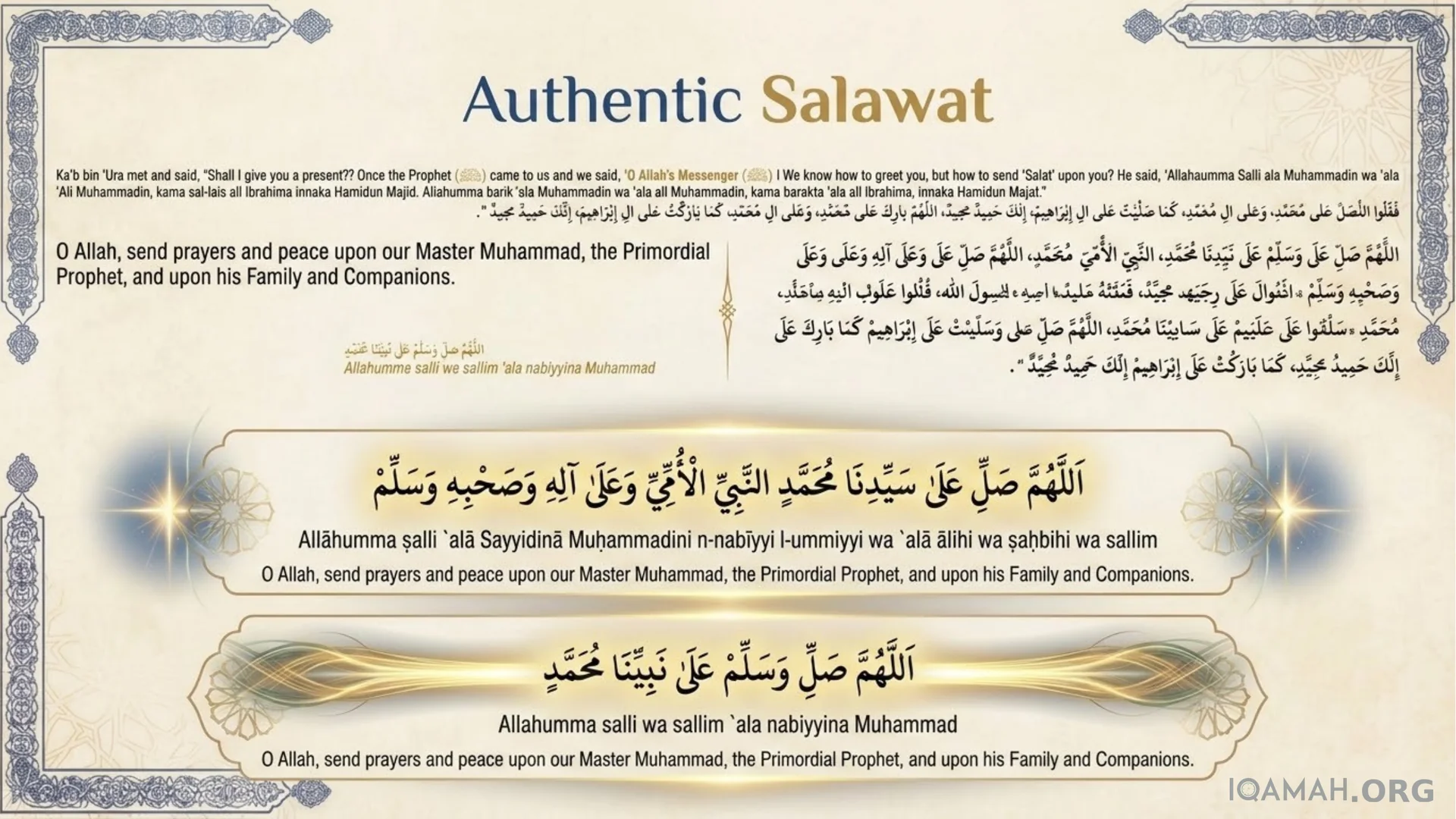
The reciprocal practice of the believer is defined slightly later in Surah Al-Ahzab 33:56 where it issues a direct command to the believers to send Salawat (blessings and salutations) upon the Prophet Muhammad (ﷺ). Traditional Islamic scholarship draws a direct, ontological link between the believer's act of sending blessings upon the Prophet (ﷺ) and the reception of the guiding light promised in verse 43.
The Prophet Muhammad (ﷺ) functions in Islamic cosmology as the supreme conduit of divine light. According to traditional orthodox scholars, as the Prophet (ﷺ) continuously receives Salawat from Allah and the angels at every moment, the Nur within his spiritual reality continuously expands and intensifies. When a believer sends Salawat upon the Prophet (ﷺ), they establish a direct spiritual tether to this concentrated source of divine illumination. In response to one blessing sent by a believer, prophetic tradition states that Allah returns ten blessings (ten manifestations of divine Salawat) upon that individual. It is through this reciprocal, exponential influx of divine blessing that the believer's personal darkness is systematically eradicated, and their heart is flooded with light.
Slide 32 of 34
#
Slide 32: The Mechanism of Divine Extraction Speaker Notes
The multifaceted metaphysical benefits of Salawat are masterfully and exhaustively cataloged by the classical scholar Imam Ibn al-Qayyim al-Jawziyyah in his seminal work Jala al-Afham fi Fadl Salat wa Salam ala Muhammad. Ibn al-Qayyim lists 40 distinct benefits of invoking blessings upon the Prophet, many of which directly map onto the eradication of specific darknesses and the acquisition of light. A few of the benefits:
Abundance of Light on the Sirat: The Sirat is the metaphysical bridge suspended over Hellfire in the Hereafter, described as being shrouded in utter darkness. Salawat manifests as tangible, physical light guiding the believer to salvation and preventing a fall into the ultimate darkness.
Protection from Hardness of the Heart: Hardness of the heart (Qaswah) is a severe form of internal Zulumat caused by sin and heedlessness. Salawat acts as a spiritual solvent, dissolving the crust of apathy and ignorance, restoring sensitivity to divine signs.
A Means of Guidance and a 'Living' Heart:: Spiritual death is the ultimate existential darkness. Consistent Salawat continuously resuscitates the soul, ensuring it remains "alive" and highly receptive to divine guidance (Nur).
Cleansing and Purification: Actively purges the soul of the Zulumat of sins. This effectively repairs the breaches in a believer's spiritual armor, closing the gaps through which Jinn and Shayateen typically launch their attacks.
Conformity with Allah and the Angels: Aligns the human will with the divine and angelic order, actively plugging the believer into the mechanism described in Surah 33:43, ensuring a continuous flow of extraction from darkness.
Traditional scholars note a profound nuance regarding Salawat compared to other forms of remembrance. While excessive or undirected forms of other spiritual litanies (dhikr) can occasionally generate an overwhelming spiritual heat or disequilibrium in a seeker's constitution, Salawat operates differently. It possesses an inherently cooling, luminous quality. It gently but effectively burns away blameworthy character traits (the Taghut of the lower self) without destabilizing the soul, systematically replacing the heat of base, fiery desires with the cool incandescence of prophetic light.
Slide 33 of 34
#
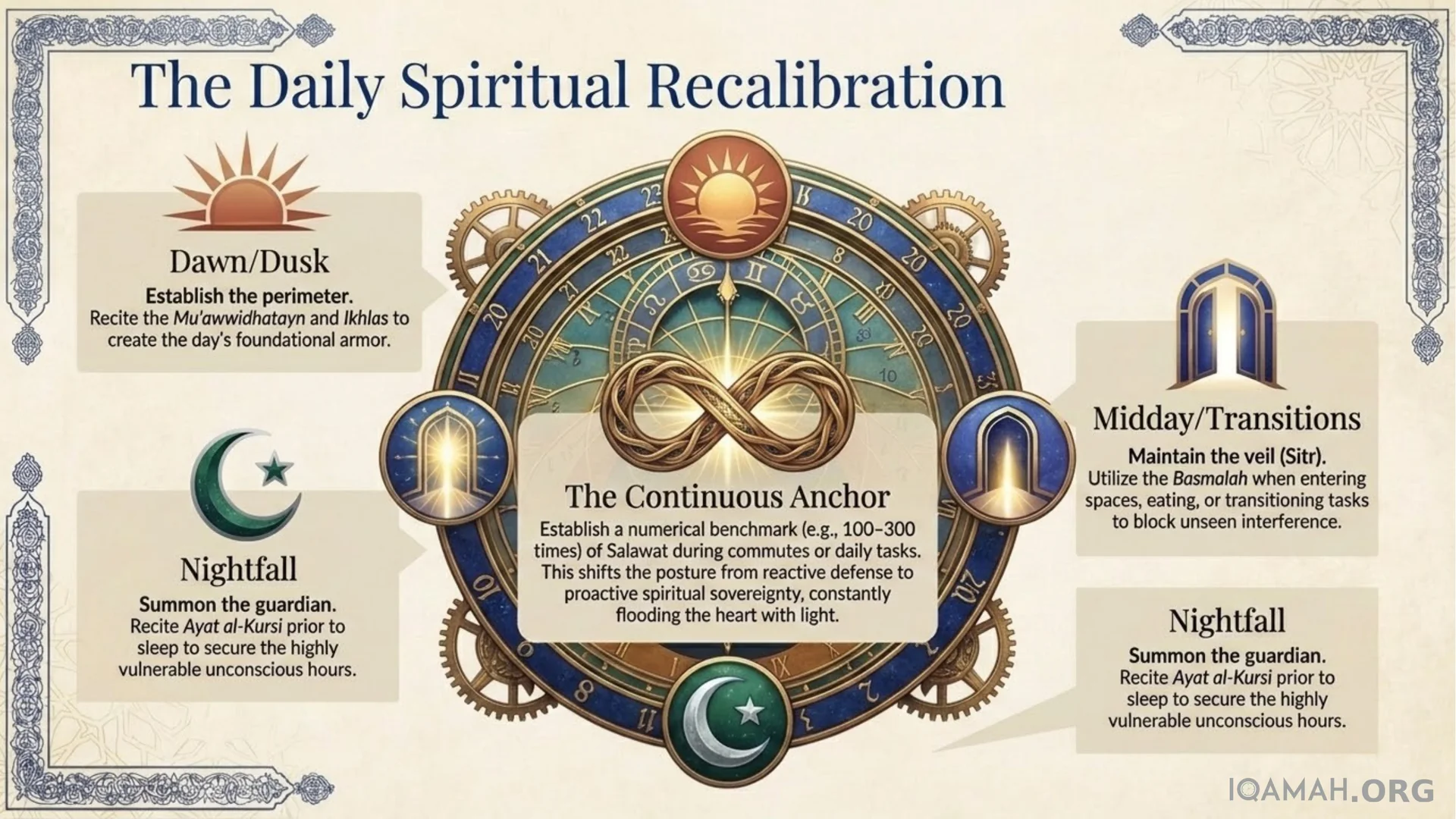
The Daily Spiritual Recalibration
Imam Abu Hamid al-Ghazali, one of the most influential theologians in Islamic history, outlines a rigorous spiritual itinerary in works such as Bidayat al-Hidayah (The Beginning of Guidance) and Kimiya-e-Sa'adat (The Alchemy of Happiness). This itinerary is meticulously designed to fortify the believer against unseen threats and invite continuous divine light.
The absolute foundation of this routine is the establishment of the five daily obligatory prayers (Salah). Al-Ghazali emphasizes that the ritual prayers act as structural pillars of light and continuous expiations for minor sins, continuously washing the believer of the spiritual filth that attracts malevolent entities, much like a river flowing past one's door five times a day.
Al-Ghazali's prescribed routine tightly weaves protective mechanisms and Salawat into the fabric of the day:
Dawn (Fajr): The spiritual day commences with waking for the Fajr prayer. Immediately following the prayer, the believer recites the Mu'awwidhatayn and Surah Al-Ikhlas to establish the morning's protective perimeter. This is followed by chanting Tasbih (glorification), Istighfar (seeking forgiveness to remove the darkness of sin), and invoking abundant Salawat upon the Prophet (ﷺ) until sunrise, capturing the most spiritually potent hours of the day.
Midday to Evening: As the believer navigates the worldly demands (dunya), balancing work and worship, they utilize the Basmalah when transitioning between tasks, eating, or entering spaces to maintain the Sitr against the Jinn.
Nightfall: The evening mirrors the morning. As the sun sets—the time when Prophetic tradition states Shayateen disperse and are most active—the believer recites the evening Adhkar (remembrances) to renew the protective seal.
Prior to Sleep: The day concludes with the recitation of Ayat al-Kursi, deliberately summoning the divine Hafiz to stand guard through the highly vulnerable, unconscious hours of sleep.
Slide 34 of 34
#
Concluding Duʻā — From Darknesses to Light
Brothers and sisters, we have walked a long road together. We began with the Qurʾān calling itself a Zikr — a reminder — and a “user manual” for the soul. We learned the principle of tasreef: how Allah rotates a single narrative across seven sūrahs so that each retelling exposes a different facet of human vulnerability and Satanic arrogance. We then walked through those seven retellings of the Adam and Iblees story, and saw the seven distinct attack vectors Iblees deploys against the children of Adam: doubt and despair, arrogance and rebellion, transgression of limits, distraction by Dunya, exposure of ʿawrah, hopelessness, and the slow erosion of prayer and remembrance. Against each, the Qurʾān names a defense — the seven manzils of daily and weekly spiritual recalibration: istiʿāzah, Bismillāh, the muʿawwidhāt, Āyat al-Kursī, Sūrat al-Ikhlāṣ, Sūrat al-Kahf, and the supreme practice — ṣalawāt upon the Prophet ﷺ.
Let us close with this dua, which weaves all of these threads together.
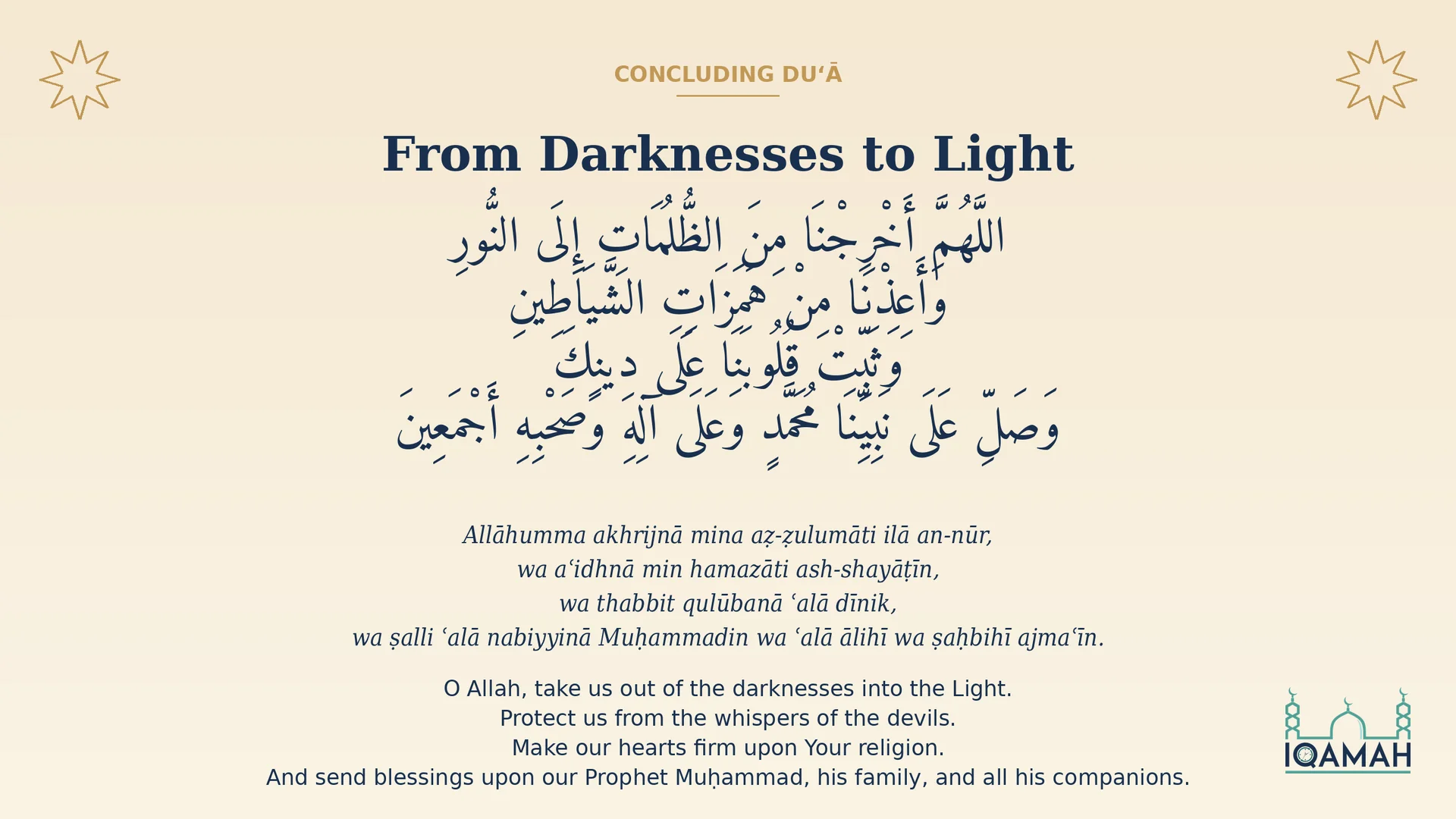
اللَّهُمَّ أَخْرِجْنَا مِنَ الظُّلُمَاتِ إِلَى النُّورِ
Allāhumma akhrijnā mina aẓ-ẓulumāti ilā an-nūr — O Allah, take us out of the darknesses into the Light.
The first line is taken from the Qurʾān’s own language. In Sūrat al-Aḥzāb 33:43 — the very verse on the previous slide — Allah promises that He and His angels send ṣalawāt upon the believers li-yukhrijakum mina aẓ-ẓulumāti ilā an-nūr — “to bring you out of the darknesses into the Light.” Notice the plural: ẓulumāt, darknesses. The darknesses of ghaflah, of doubt, of the whispers of Iblees, of unrepented sin, of attachment to Dunya. And the singular: nūr. There are many darknesses; there is only one Light.
وَأَعِذْنَا مِنْ هَمَزَاتِ الشَّيَاطِينِ
Wa aʿidhnā min hamazāti ash-shayāṭīn — Protect us from the whispers of the devils.
The second line is drawn directly from Sūrat al-Muʾminūn 23:97 — the dua Allah taught us to make when we feel Iblees approaching. Hamazāt — not arguments, not temptations, but whispers; the quiet pressure on the heart. This is exactly what we identified across the seven prism-readings.
وَثَبِّتْ قُلُوبَنَا عَلَى دِينِكَ
Wa thabbit qulūbanā ʿalā dīnik — Make our hearts firm upon Your religion.
The third line names the antidote to Iblees’s promised attack from every direction (al-Aʿrāf 7:17 — “I will come at them from before, behind, right, left”). Against an enemy who flanks us on every side, our only refuge is the One whose hand holds our hearts. The Prophet ﷺ himself made this his constant prayer: yā muqallib al-qulūb, thabbit qalbī ʿalā dīnik — O Turner of hearts, keep my heart firm on Your religion.
وَصَلِّ عَلَى نَبِيِّنَا مُحَمَّدٍ وَعَلَى آلِهِ وَصَحْبِهِ أَجْمَعِينَ
Wa ṣalli ʿalā nabiyyinā Muḥammadin wa ʿalā ālihī wa ṣaḥbihī ajmaʿīn — And send blessings upon our Prophet Muḥammad, his family, and all his companions.
We close with the very practice the previous slide named as supreme. The scholars say: when the slave sends one ṣalāh upon the Prophet ﷺ, Allah sends ten upon the slave; and Allah’s ṣalāh upon the slave is li-yukhrijakum mina aẓ-ẓulumāti ilā an-nūr. The dua is therefore not just a request — it is the request that causes its own answer the moment it is uttered.
May Allah accept this gathering, write us among those who reflect on His Book, who recognize His signs in the rotation of His verses and the rotation of our days, and who — on the Day we meet Him — are illuminated by the very Light they sought.
Jazākumullāhu khayrān.
Wa ākhiru daʿwānā ani al-ḥamdu lillāhi Rabbil-ʿālamīn.
About this session
This session opens with the Qurʾān's self-description as a Zikr and "user manual," introduces tasreef as the deliberate rotation of the same narrative across seven sūrahs (al-Baqarah, al-Aʿrāf, al-Ḥijr, al-Isrāʾ, al-Kahf, Ṭā-Hā, and Ṣād), and then walks through each retelling of the Adam and Iblees story to see what each refracts and what the composite teaches about the human path from darknesses to light. It closes with a duʿā that weaves the threads together. If you'd like to discuss the material or suggest related topics, write to admin@iqamah.org.
Hosted at https://iqamah.org/resources/sevenfold-prism-tasreef/ · Part of the Iqamah resource library. Original presentation by the Iqamah team. The seven retellings of the Adam & Iblees narrative are drawn from al-Baqarah, al-Aʿrāf, al-Ḥijr, al-Isrāʾ, al-Kahf, Ṭā-Hā, and Ṣād.