Iqamah

Resources · Surah Hud Tafsir Series

Part 1 of 5

An Illuminated Framework — Surah Hud, Part 1

A walk-through of the foundational opening 24 verses of Sūrah Hūd, drawing on Ibn al-Jawzī, Saʿdī, Sayyid Qutb, Maʿāriful Qurʾān, Zamakhsharī, and al-Wāḥidī. Part 1 of an in-depth tafsir series on the surah.

Slides 31
Format Slides + notes
Series Surah Hud Tafsir Series
Cover slide: An Illuminated Framework — Surah Hud, Part 1
Slide 1
Slide 1 of 31 #

Sūrah Hūd is one of the most pivotal Meccan sūrahs in the entire Qurʾān. It contains seven prophet-stories, but those stories sit on a foundation — the opening 24 verses, which set out the doctrinal claims the entire sūrah will then unfold across history. Today we are going to walk through that foundation carefully, because once you see what these 24 verses are doing, every prophet-story that follows reads as commentary on them. The session will cover the three movements of the opening passage: the doctrinal core (vv. 1–4), the cosmic and psychological context (vv. 5–11), and the prophetic challenge with its eschatological close (vv. 12–24). We will draw on multiple classical and modern tafsir voices throughout: Ibn al-Jawzī for the survey of classical opinions, Saʿdī for direct verse meaning, Sayyid Qutb for thematic and psychological depth, Maʿāriful Qurʾān for accessible synthesis, Zamakhsharī for linguistic and rhetorical analysis, and al-Wāḥidī for occasions of revelation. We will move briskly, can ask for slow-downs on points that need more attention. The session is dense; the goal is exposure to the material, not mastery.

Slide 2
Slide 2 of 31 #

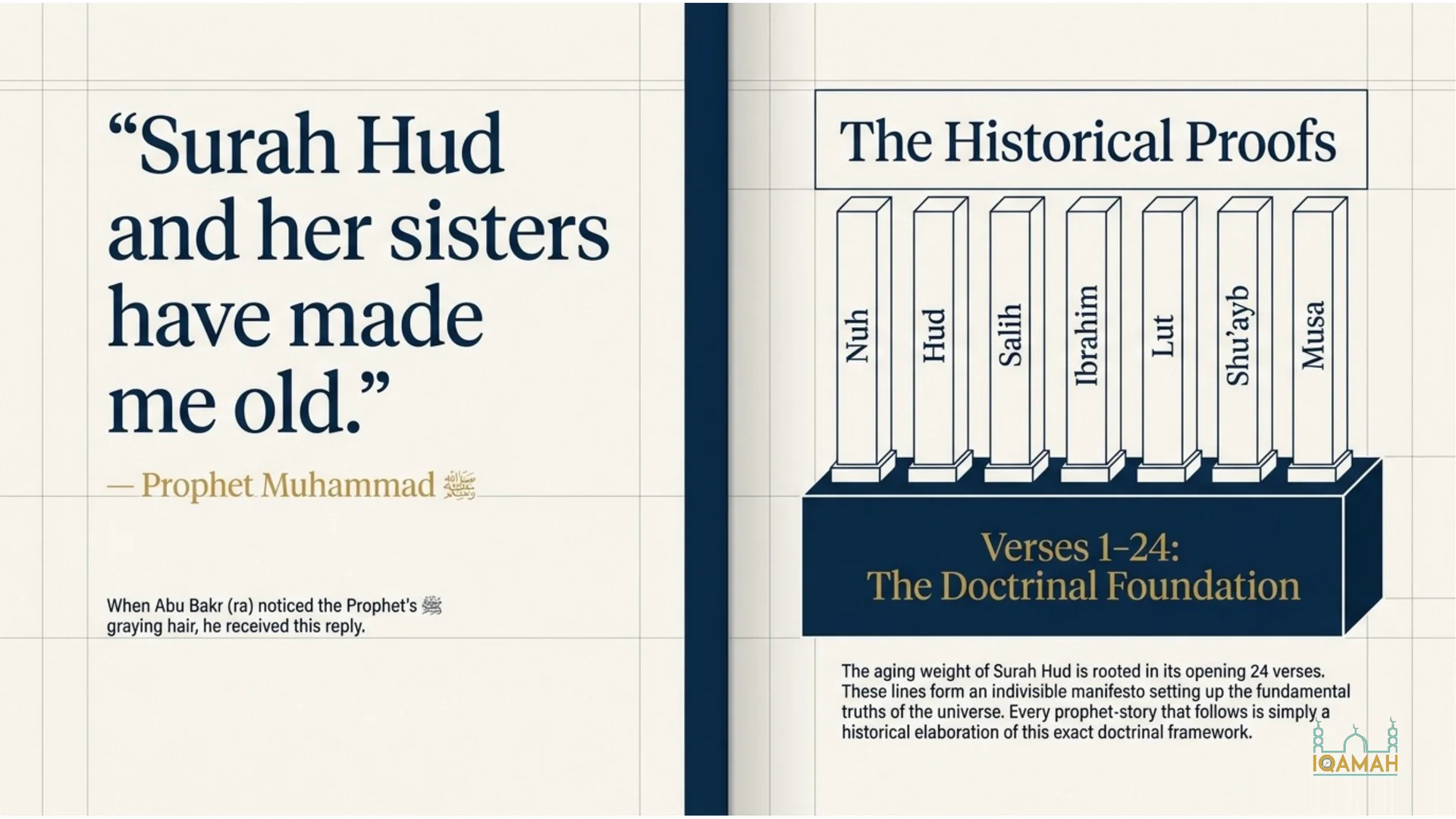
Maʿāriful Qurʾān (p. 594) and Ibn al-Jawzī (Zād al-Masīr, vol. 7, p. 189) both preserve this famous tradition. The chain runs: Abū Bakr (raḍiya Allāhu ʿanhu) saw grey hairs in the Prophet's ﷺ beard and said, "Yā Rasūlallāh, qad shibta" — "You have grown old." The Prophet ﷺ replied, "Shayyabatnī Hūd wa-akhawātuhā" — "Sūrah Hūd and her sisters have made me old." Ibn al-Jawzī specifies the "sisters": al-Ḥāqqah, al-Wāqiʿah, ʿAmma yatasāʾalūn (al-Nabaʾ), and Hal atāka ḥadīth al-ghāshiya. The tradition is recorded by Tirmidhī and al-Ḥākim. Two interpretations of what specifically caused the aging: one strand (which we see in Qurṭubī from Ibn ʿAbbās) attributes it specifically to v. 112 — "stand firm (fa-staqim) as you are commanded" — because the burden of istiqāmah is so heavy. Another strand attributes it to the destruction-narratives in the middle of the sūrah. Either way, what the hadith establishes for our purposes is that this is not a casual chapter — the Prophet ﷺ himself testified to its weight. We are about to spend an hour on its opening 24 verses, and the Prophet's ﷺ reaction is a reasonable reminder that this material should not be received lightly.

Qutb identifies three distinct movements in the opening passage, each with its own internal logic. The first movement (vv. 1–4) states the four foundational doctrines: revelation (v. 1), tawḥīd and prophethood (v. 2), istighfār with tawbah (v. 3), and the return to God (v. 4). The second movement (vv. 5–11) places the human being inside the universe these doctrines describe — a universe whose Creator knows the inside of every breast (v. 5), provides for every creature (v. 6), stages the cosmos as a moral test (v. 7), enforces consequences even when delayed (v. 8), and diagnoses the typical human instability under blessing and trial (vv. 9–11). The third movement (vv. 12–24) confronts the Quraysh objections and the choice they impose: the worldly aim with its hellfire ending (vv. 15–16) versus the path of revealed proof (v. 17), with a final eschatological courtroom (vv. 18–22) and a closing image — the blind/deaf disbeliever against the seeing/hearing believer (vv. 23–24). Tell the group: this structural map will help you locate yourself as we move. If you lose the thread on a particular verse, remember which movement we are in and what work that movement is doing.

Slide 3
Slide 3 of 31 #

Sayyid Qutb (In the Shade of the Qurʾān, vol. 9) identifies these as the five main issues the opening passage establishes — the doctrinal scaffolding on which the entire sūrah rests. He writes: "The opening passage states the basic principles of the faith: that the Qurʾān is from God, that worship must be to Him alone, that there is reward and punishment, and that all return to Him." Each of the prophet-stories that follow takes one of these claims and historicizes it: Nūḥ's daʿwah dramatizes the burden of revelation; Hūd and ʿĀd dramatize the consequences of refusing tawḥīd; Ṣāliḥ and the she-camel dramatize the test of obedience; Shuʿayb and Madyan dramatize the connection between worship and ethics; Mūsā and Pharaoh dramatize divine power and human refusal. Tell the group: as we go through the next 24 verses, ask yourself which of these five issues each verse is developing. You will see them recur, often more than once per verse. The opening passage is not a list of separate doctrines — it is a single integrated argument, and these five issues are the joints of that argument.

Slide 4
Slide 4 of 31 #

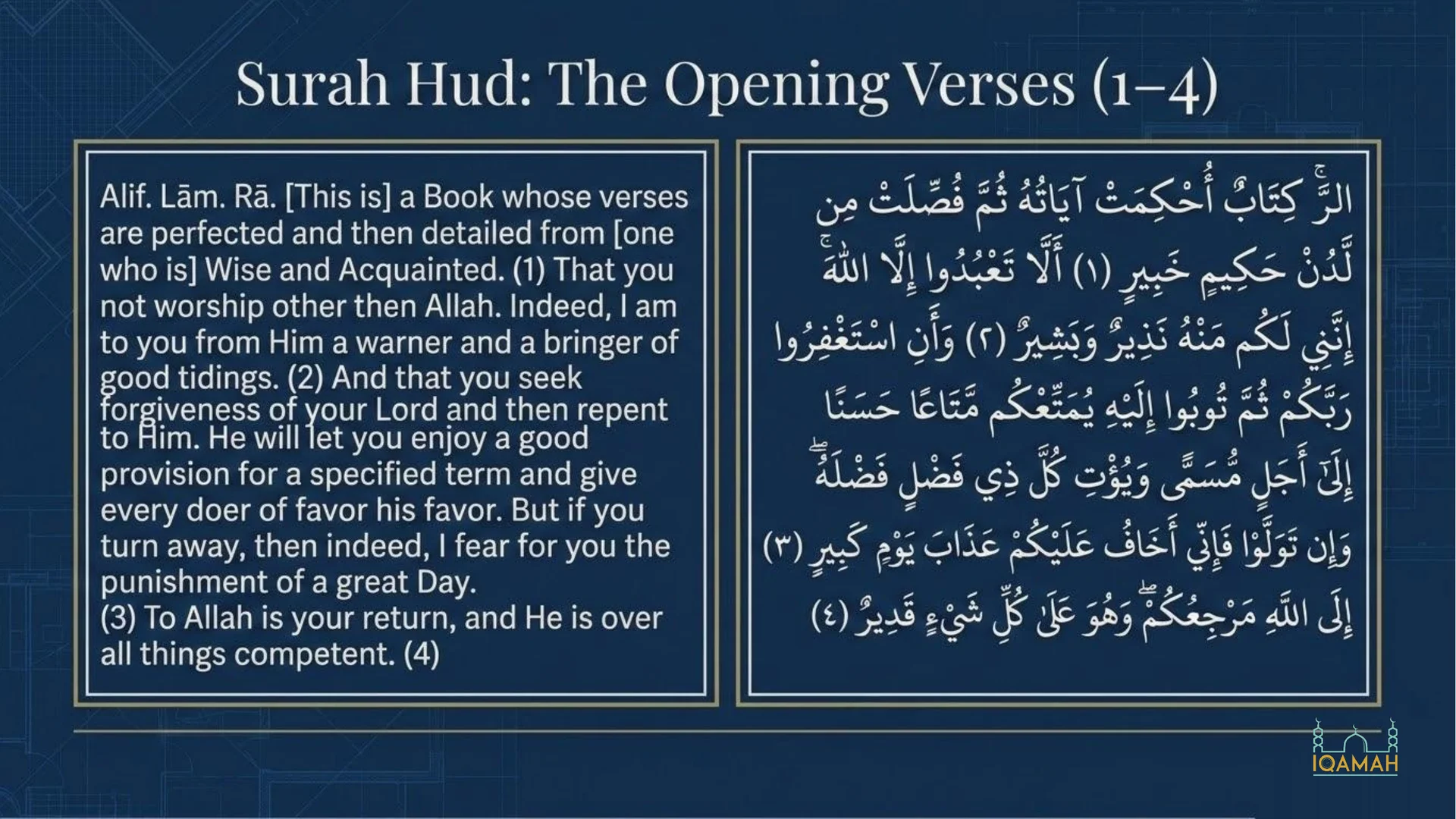
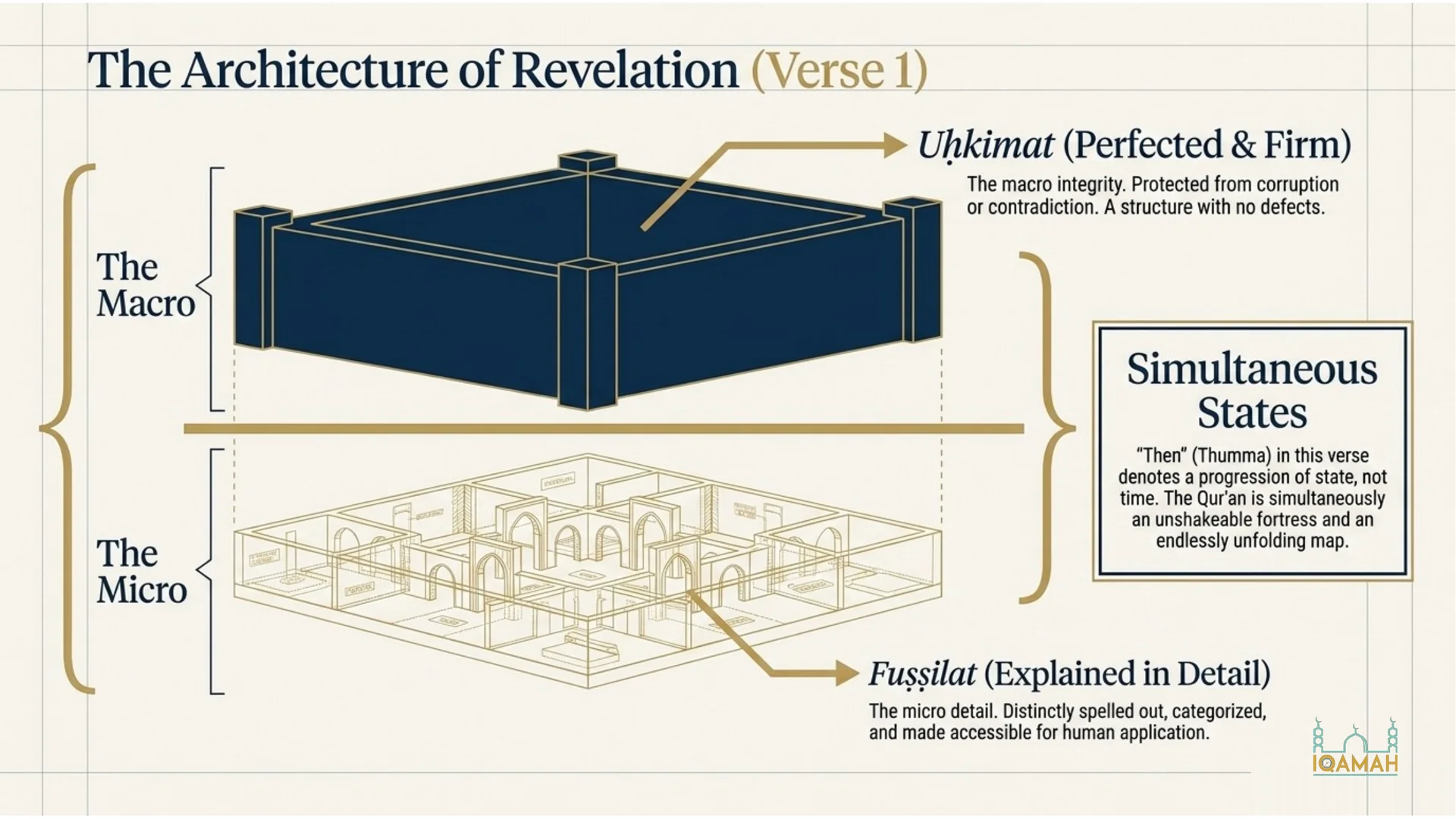
Saʿdī (p. 261) walks through the verse phrase by phrase: "This is a Book" — a great Book, a noble revelation; "the verses of which are perfected" — made precise and beautiful, truthful in what they tell, fair and just in commands and prohibitions, eloquent in turn of phrase and sublime in meaning; "then explained in detail" — made unambiguous and crystal-clear; "from One Who is All-Wise" — He does the right thing at the right time; "All-Aware" — He sees everything apparent or hidden. Saʿdī's insightful conclusion is worth quoting in full: "When the perfection and clarification come from One who is All-Wise, All-Aware, you should not ask how great or majestic this Book is or how vast its mercy." The verse functions as the sūrah's manifesto. It claims two simultaneous attributes of the Qurʾān — unshakeable structural integrity (uḥkimat) and unfolded, distinguishable accessibility (fuṣṣilat) — and it attaches both to the divine source. The next three sections unpack the linguistic depth of uḥkimat and fuṣṣilat through Ibn al-Jawzī's and Zamakhsharī's analyses.

Ibn al-Jawzī (Zād al-Masīr, vol. 7, pp. 187–188) preserves four classical opinions on uḥkimat āyātuhu, each with named transmitters. Walk through them: (1) Ibn ʿAbbās's view, chosen by Ibn Qutaybah — the verses were preserved from being copied and re-transcribed in error. (2) Al-Ḥasan and Abū'l-ʿĀliyah — made firm by command and prohibition. (3) Qatādah and Muqātil — made firm against falsehood. (4) Ibn Zayd — the iḥkām here means gathering/collection. Then raise Ibn al-Jawzī's harmonization question: if all the Qurʾān's verses are muḥkam here, how does that square with 3:7 which says only "minhu āyātun muḥkamāt" — only some verses are muḥkam? Two answers are offered: (a) the iḥkām is different in each place — here it is universal coherence and protection from corruption; there it is technical clarity of rulings; (b) the iḥkām is the same, but here described universally and there in a subset. Ibn al-Jawzī then offers five additional meanings, and the fifth is striking and should be highlighted: "iʿjāz al-naẓm wa-l-balāghah wa-taḍmīn al-ḥikam al-muʿjizah" — "the inimitability of structure and rhetoric, and the embedding of miraculous wisdoms." This is iʿjāz al-Qurʾān as a definition of iḥkām itself. The Book is muḥkam because no human can replicate it.

Ibn al-Jawzī (p. 188) preserves six distinct opinions on fuṣṣilat, more than for uḥkimat itself. Walk through each: (1) Abū Ṣāliḥ from Ibn ʿAbbās — differentiated into ḥalāl and ḥarām, marking the legal categories the Qurʾān distinguishes; (2) Jasr ibn Farqad from al-Ḥasan — differentiated by reward and punishment, marking the moral consequences; (3) Wabar from al-Ḥasan — differentiated by promise and warning (waʿd wa-waʿīd), the eschatological structure; (4) Mujāhid — fuṣṣilat in the sense of fussirat, meaning "explained" or "interpreted," which makes the verb refer to the Qurʾān's self-explanation; (5) Ibn Qutaybah — sent down piece by piece rather than all at once (a literal-temporal reading); (6) al-Zajjāj — differentiated to include everything needed by way of proofs of tawḥīd, confirmation of the prophets' missions, and the laws — a comprehensive reading. Note for the group: the diversity of these opinions is itself instructive. The classical commentators were not embarrassed by the multiplicity; they preserved it. Each reading captures a different facet of what fuṣṣilat actually accomplishes. The Qurʾān differentiates in many directions at once. Maʿāriful Qurʾān treats the verse as licensing all six readings simultaneously.

Zamakhsharī (Kashshāf, vol. on Sūrah Hūd part 1, p. 377) addresses the question this verse raises directly: what is "thumma" ("then") doing here? It looks like a temporal sequence — first the verses were perfected, then they were detailed. Zamakhsharī rejects this reading. He says: the meaning is not chronological succession in time but in state — like the Arabic expression "hādhā aḥsanu iḥkām, thumma aḥsanu tafṣīl" — "this is the finest perfection, then the finest detail." The "thumma" ranks the qualities, not the moments. The Qurʾān is, in a single act of revelation, both perfectly structured AND elaborately unfolded. The two qualities are simultaneous attributes, not sequential events. Remind the group of al-Farrāʾ's related observation we will see at v. 2: that "thumma" in this section can function as a synonym for "wāw" — simple "and" — making the conjunction additive rather than sequential. This is technical linguistic material, but it matters because it forecloses a common misreading — that the Qurʾān was first "rough" and then later "refined." No: it was perfected and detailed in one act. (We cite Zamakhsharī here strictly for his linguistic and rhetorical work; his theology is Muʿtazilī and is not authoritative for the Sunni position on other matters.)

Slide 5
Slide 5 of 31 #

Saʿdī reads v. 2 as the central content of the perfected, detailed verses just announced: "worship none but Allah — that is, all worship will be devoted to Allah alone, and nothing of His creation will be associated with Him." Note the structural symmetry Sayyid Qutb identifies: this exact formula recurs almost verbatim in each prophet-story that follows — Nūḥ at 11:26, Hūd at 11:50, Ṣāliḥ at 11:61, Shuʿayb at 11:84. The opening verse is therefore not just doctrinal but programmatic; the whole sūrah is one message rephrased seven times. Qutb makes a sharp observation in his prologue: the Qurʾān could have stated tawḥīd negatively ("no god but Allah") and left the positive command ("worship Him alone") as implied. Instead, here and many places elsewhere, it states both sides expressly. Why? Because, Qutb says, "there have been times in human history when people did not deny God or abandon worshipping Him, but they also worshipped other beings beside Him." The express command plus the express prohibition together close the loophole that polytheism in monotheistic dress might otherwise exploit. The Prophet's ﷺ dual office — bashīr wa-nadhīr, bringer of glad tidings and warner — is essential. A messenger who only warns produces despair; a messenger who only gives glad tidings produces complacency. The two together produce what Qutb calls "hope and fear, well established in human nature, which together give very strong and genuine motivation."

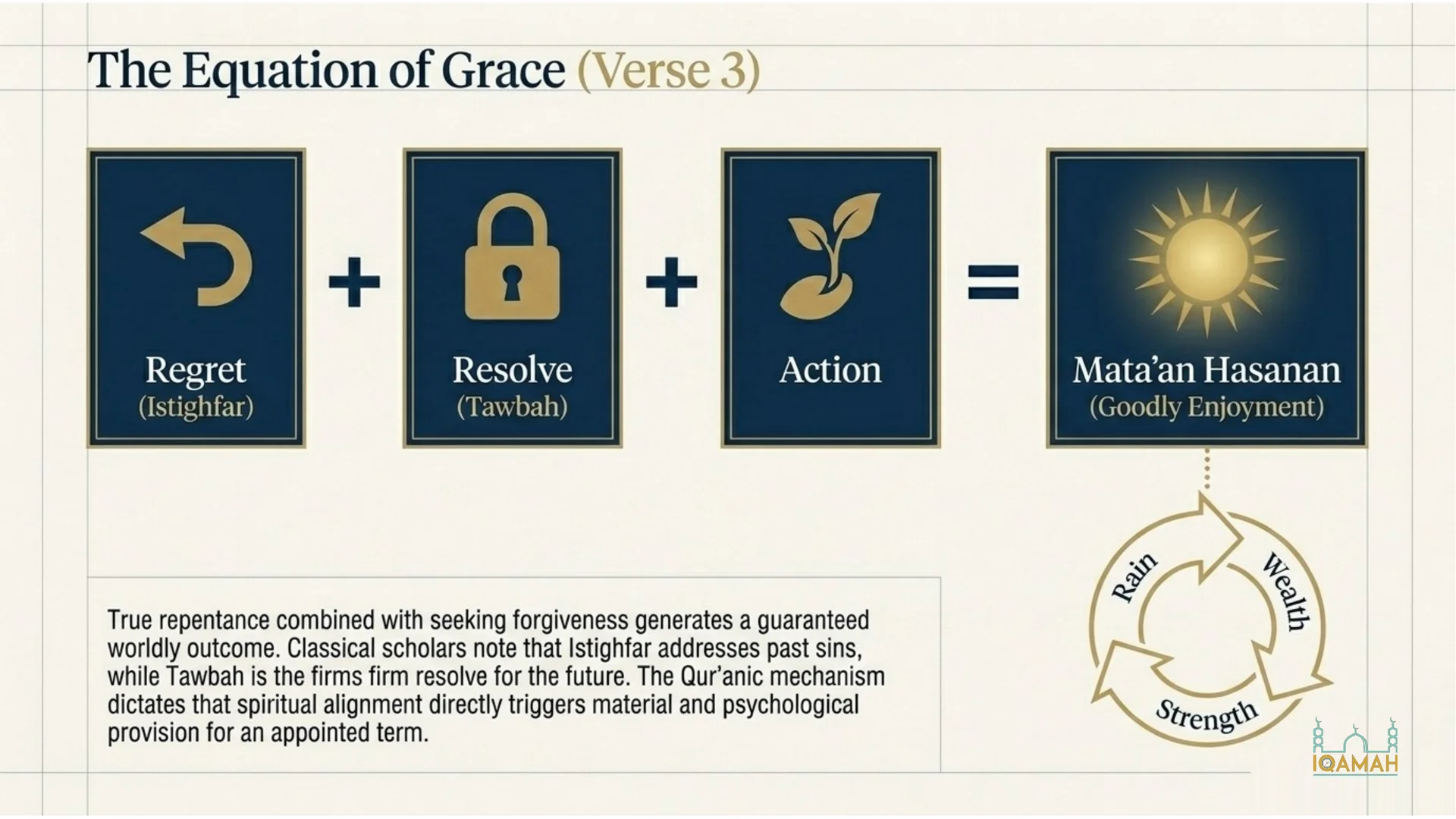
Verse 3 completes the doctrinal triad of the opening: tawḥīd (v. 2), prophethood (v. 2), and istighfār+tawbah (v. 3) as the practical commitment demanded of the believer. Saʿdī (pp. 261–262) reads: "Seek forgiveness from your Lord — for what you have committed of sins — and repent to Him — in the future, for the remainder of your lives, by turning to Him and by turning away from that which Allah dislikes and to that which He loves." The result: He grants you of His provision that which you will enjoy until the time of your death; and He bestows upon people who are good and righteous bounty and blessings as a reward for their good deeds. Note Ibn al-Jawzī's grammatical observation we covered earlier: the "thumma" between istighfār and tawbah here is read by al-Farrāʾ as a wāw — the two acts are parallel, not sequential. This same triad is repeated nearly verbatim later in the sūrah: Hūd to ʿĀd at 11:52 says exactly the same thing — "Seek forgiveness from your Lord, then turn to Him in repentance, He will cause the sky to rain abundance on you, and will add strength to your strength." That repetition is significant. Istighfār and tawbah are the universal prophetic prescription for both worldly blessing and otherworldly salvation. Verse 3 is therefore the doctrinal hinge of the entire sūrah — it states what the prophets call humanity to, and what every prophet-story will dramatize.

Maʿāriful Qurʾān (Mufti Shafiʿ, pp. 595–596) treats this section as the practical core of the opening passage. The teaching point is fundamental. Istighfār (seeking forgiveness) addresses past sins; tawbah (repentance, turning) addresses the future resolve. "Taubah relates to the resolve of not going near these anymore. A correct and true Taubah is no more than being ashamed of past sins, praying to Allah that they be forgiven, and resolving firmly that they would not be repeated in future." Early scholars warned: verbal istighfār without firm resolve and implementation is the repentance of liars. The poet captured it: "Sin laughs at my style of seeking forgiveness." True istighfār is three-part: regret for the past, firm resolve for the future, and concrete action to back the resolve. How does istighfār lead to worldly success? Maʿāriful anchors the principle on the explicit parallel in Sūrah Nūḥ 71:10–12, where Nūḥ tells his people: "Seek forgiveness from your Lord; indeed, He is Most-Forgiving. He will send the sky pouring rain upon you in abundance, and increase you in wealth and children, and provide for you gardens and rivers." The same triad — istighfār, then rain, then wealth and children — reappears in 11:52 to ʿĀd. Istighfār has a documented Qurʾānic property of opening worldly provision. Ibn Kathīr at 11:3 cites the hadith of Abū Hurayrah: "Whoever clings to istighfār, Allah will make for him a way out from every distress." This is a daily practice the verse anchors.

Ibn al-Jawzī (Zād al-Masīr, vol. 7, p. 192) preserves the classical survey of mataʿan ḥasanan with notable economy. Ibn ʿAbbās's sharh — "He benefits you with provision and ease (yumattiʿukum bi-l-rizqi wa-l-saʿah)" — anchors the first reading. Then Ibn Qutaybah's morphological note: the root of imtāʿ is elongation, prolongation. You say "shayʾ mātiʿ" for a lasting thing, "jabal mātiʿ" for a tall mountain; the verb "mataʿa al-nahār" means "the day stretched out long." This is significant: matāʿ is not "momentary enjoyment" but sustained, lasting benefit. Two opinions on "the appointed term": it is death (Abū Ṣāliḥ from Ibn ʿAbbās, al-Ḥasan, Qatādah) or the Day of Resurrection (Saʿīd ibn Jubayr). On "kulla dhī faḍlin faḍlahu", Ibn al-Jawzī identifies two opinions on the pronoun: faḍlahu = Allah's grace (so the meaning is "He gives every meritorious person Allah's grace") or faḍlahu = the servant's own merit (so the meaning is "He gives every meritorious person the reward of his own merit"). And two opinions on what the phrase means overall: (a) Paradise as His grace, or (b) the enabling-grace to do more righteous deeds — the classical principle that "the reward of a good deed is a good deed." Note: Qutb adds the counterpoint — the goodly enjoyment is often inward contentment even amid worldly hardship, not necessarily material abundance.

Verse 4 seals the doctrinal triad of vv. 1–3 with the final foundation: maʿād, the return to God, which makes all the preceding commands urgent. Saʿdī (p. 262) reads: "Among the things He is able to do is bringing the dead back to life, for He has power over all things. He has told us of that and He is the most truthful of all who speak, so that must inevitably come to pass, on the basis of both rational thought and textual evidence." The verse is therefore Saʿdī's anchor for the rational defense of resurrection: God's omnipotence plus God's truthfulness equals the certainty of the Hereafter. Qutb makes a useful linguistic note: "Returning to God occurs in this world and the next, at every moment and in all situations. However, Qurʾānic usage confirms that when this expression is used — ilā Allāhi marjiʿukum — it means the return that comes after this life is over." The phrase is a Qurʾānic technical formula for the final eschatological return. The verse's closing — "He has power over all things" — is rhetorically essential: it pre-empts the disbelievers' objection of v. 7 (resurrection as "plain sorcery") by anchoring the claim in omnipotence. Cross-reference to 22:6–7: "That is because Allah is the Truth and because He gives life to the dead and because He is over all things competent. And the Hour is coming — no doubt about it — and Allah will resurrect those in the graves."

Slide 6
Slide 6 of 31 #

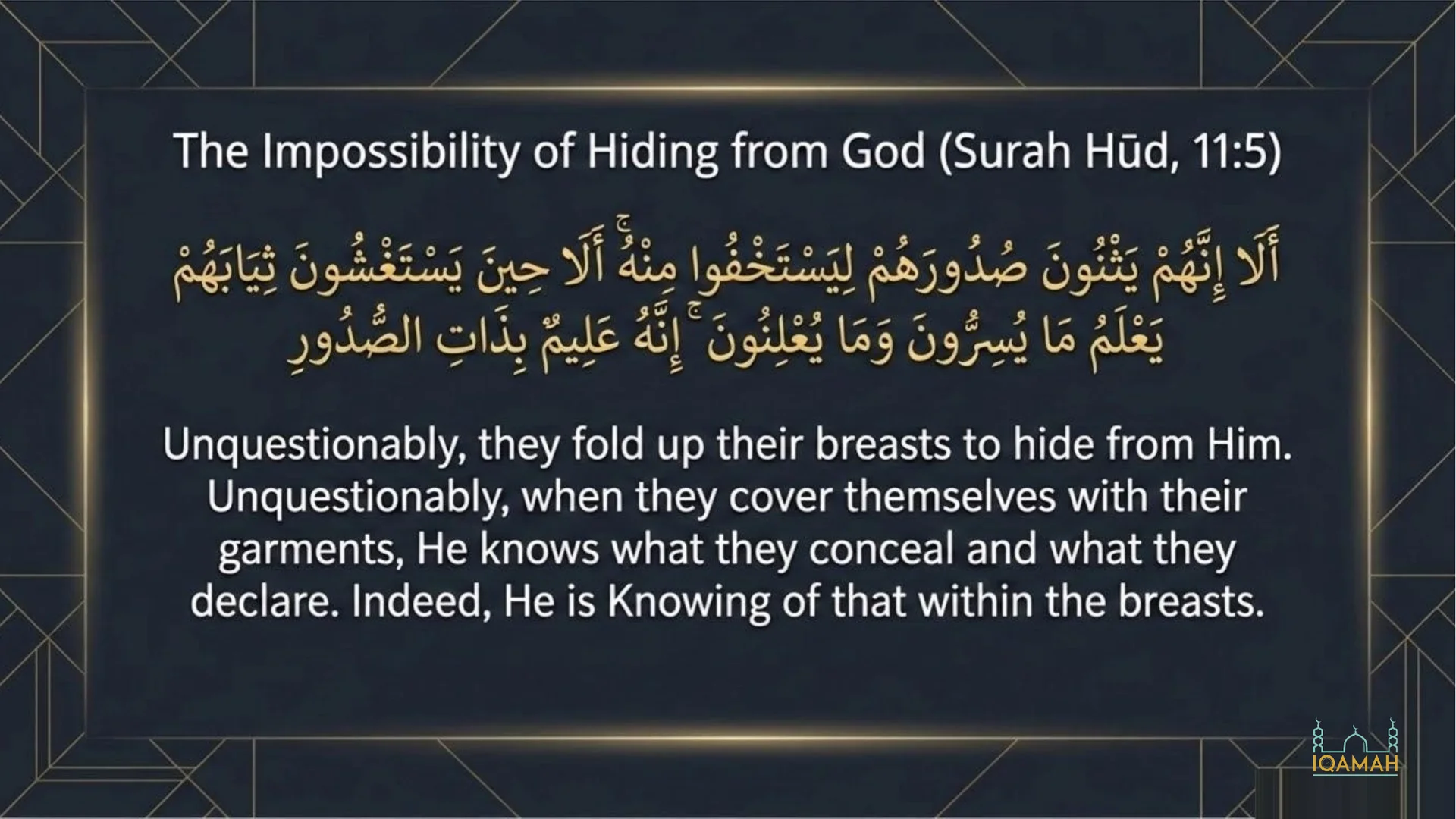
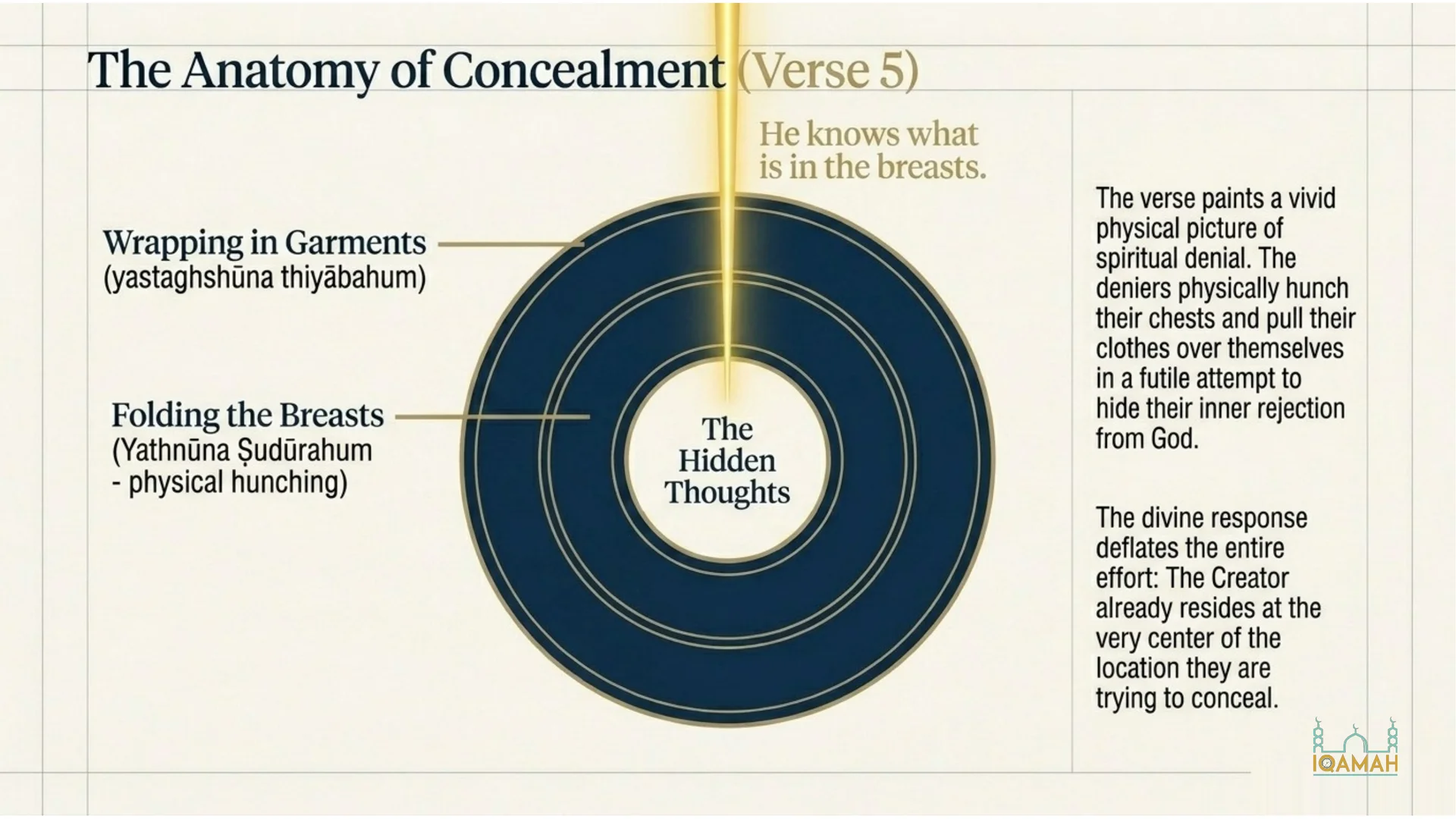
The image is physically specific: "Yathnūna" — from thanā, to fold or bend — describes a bodily posture of hunching the chest inward, drawing the body in. "Ṣudūr" is the breast but also, in Qurʾānic usage, the seat of the inner self, of thoughts and feelings. The verse is therefore both literal (a physical hiding gesture) and symbolic (a hiding of the inner state). The verse compounds the image with yastaghshūna thiyābahum — "they wrap themselves in their garments" — deepening the picture of layered concealment: hunched chest, wrapped in cloth. The verse then deflates the entire effort: He knows what is fī al-ṣudūr — "in the breasts" — the very location they thought they were hiding. This is one of the most psychologically penetrating verses in the entire opening passage. It names a universal human action: the attempt to hide some part of ourselves from God. Saʿdī gives two possible readings: either the polytheists thought their physical hiding could conceal their thoughts from God; or, alternately, they leaned forward as they passed the Prophet ﷺ so he would not see them and recite to them. Both readings are theologically resonant. The next slides examine the classical asbāb al-nuzūl, the five meanings of the phrase, and Qutb's psychological reading.

Al-Wāḥidī (Asbāb al-Nuzūl) records this account: "This verse was revealed about al-Akhnas ibn Shurayq, who was good looking and sweet talking. When he met the Messenger of Allah ﷺ, he pleased him, but he always kept in his heart that which displeased him." He adds the report of al-Kalbī: "He used to sit with the Prophet ﷺ and display things that pleased the Prophet while hiding in his heart the opposite of what he displayed. And so Allah revealed (Lo! now they fold up their breasts that they may hide their thoughts) — their thoughts of enmity to Muhammad ﷺ." Background: al-Akhnas ibn Shurayq al-Thaqafī was a chief of the Banū Zuhrah, a figure of standing in Mecca. His name "al-Akhnas" itself comes from khanasa, meaning to draw back or slip away — given to him because of his behavior at Badr, when he persuaded his clan to withdraw. He is the classical exemplar of the double-faced disbeliever — outwardly courteous, inwardly hostile. Important pedagogical note: al-Wāḥidī records asbāb for only TWO verses in the entire Sūrah Hūd — this one (v. 5) and v. 114 (about the man who fondled a woman). All other verses in 1–24 have no specific recorded occasion in al-Wāḥidī. This is itself significant: most of the opening passage is doctrinal exposition rather than a response to specific incidents. The verses set out universal foundations of faith.

Ibn al-Jawzī (Zād al-Masīr, vol. 7, pp. 195–196) preserves five distinct accounts of the occasion of revelation. (1) Al-Akhnas, as above — noting that hadith critics question this narration's isnād; Ibn ʿAṭiyyah even doubts whether al-Akhnas ever accepted Islam at all, though Ibn Ḥajar in al-Iṣābah counts him among the Companions. (2) Muḥammad ibn ʿAbbād from Ibn ʿAbbās, in al-Bukhārī: "There were people who used to feel shy to relieve themselves while exposed to the sky, or to have intercourse with their wives while exposed to the sky. This verse was revealed about them." Ibn al-Jawzī's editor identifies this as the most authentic of the five — a Bukhārī-grade tradition. (3) ʿAbd Allāh ibn Shaddād: it was revealed about a hypocrite who, when he saw the Messenger ﷺ passing, would bend his chest, lower his head, and cover his face. (4) Via al-Zajjāj: a group of polytheists who said "When we close our doors, lower our curtains, wrap ourselves in our garments, and fold our breasts over our enmity to Muḥammad ﷺ — how can He know us?" Allah informed them that He knew. (5) Via Ibn al-Anbārī: a people whose enmity was so severe that when they heard the Prophet ﷺ recite, they would fold their breasts inward, lower their heads, and wrap themselves in their garments to drive the sound of his voice away. Note: the variety of accounts itself teaches us that the verse is about a universal human tendency, not one specific incident.

Slide 7
Slide 7 of 31 #

Beyond the asbāb, Ibn al-Jawzī (p. 196) preserves five distinct interpretations of what "yathnūna ṣudūrahum" actually means as a phrase. (1) Abū Ṣāliḥ from Ibn ʿAbbās — they conceal what is in their breasts of enmity toward Muḥammad ﷺ. (2) Mujāhid — they fold their breasts "over their disbelief" (ʿalā al-kufr), i.e., the breast is a container of disbelief that they keep wrapped around. (3) Qatādah — they fold them so as "not to hear the Book of Allah" — a physical posture of blocking out the recitation. (4) Ibn Zayd — they fold them "when they confer privately with one another about the Messenger ﷺ" — the secretive huddle of conspiracy. (5) Extension of the Ibn ʿAbbās report — they fold them out of "shyness before God" (ḥayāʾan min Allāh), which converges with the Bukhārī asbāb above. Ibn al-Jawzī ends with his own synthesis: of all five meanings, two final readings emerge — the folding is either (a) literal bending of the chest, or (b) metaphorical concealment of what the breast contains. The verse comfortably bears both meanings simultaneously, which is exactly Saʿdī's reading. The image is double: physical hiding plus inward concealment, both equally answered by "He knows what is in the breasts."

Sayyid Qutb's commentary on vv. 5–6 (In the Shade of the Qurʾān, vol. 9, pp. 19–20) is among his most psychologically penetrating. Read or paraphrase: "These two verses portray an awe-inspiring scene worthy of careful study. It is enough to contemplate the fact that God has knowledge of, and power over, everything, while people of His own creation try to hide away from Him when His Messenger conveys His message. The first verse portrays what the unbelievers did when the Prophet tried to recite to them God's revelations. They covered their breasts and hung their heads down in order to hide from God, even though they felt, in the depth of their hearts, that He was the originator of this revelation." Then: "God, who sent down this revelation, is watching them as they hide and as they come out of hiding. In the inimitable style of the Qurʾān this meaning is presented in an awesome personal and private situation. When they go to bed, alone, in the darkness of the night, with all their clothes and covers on, God remains with them. He sees what takes place in such a private situation." The contemporary application is sharp: social media is an industrialization of yathnūna ṣudūrahum. We present curated outer selves and hide our real states. The verse's contemporary force is twofold: (a) God sees through every curation; (b) once you accept this, the entire economy of pretense becomes pointless, and the way is opened to a relationship that does not require concealment.

Slide 8
Slide 8 of 31 #

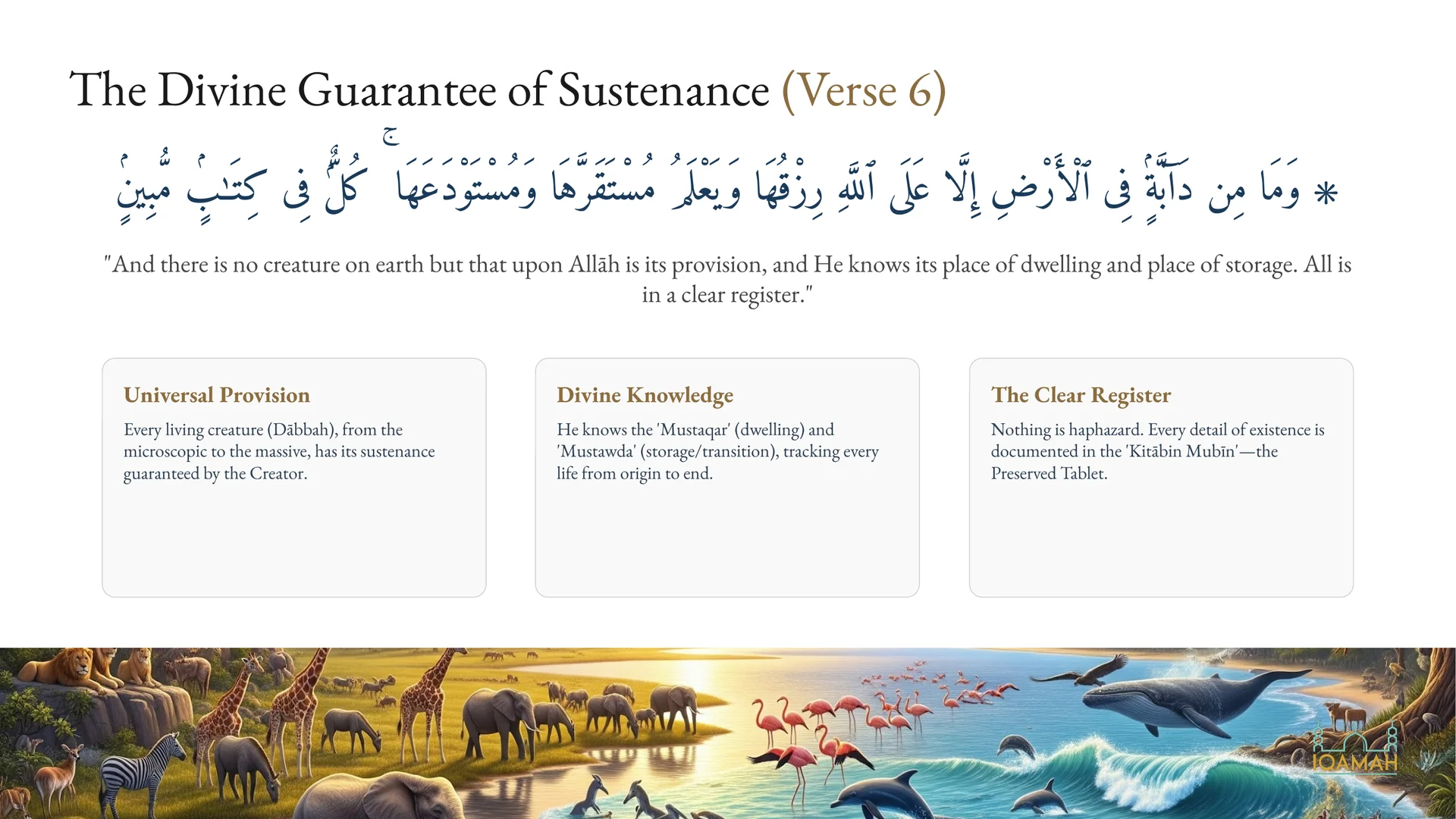
Verse 6 follows immediately on v. 5's declaration that God knows the contents of every breast — and extends that knowledge outward to every creature on earth. The logic is precise: if He knows the inside of every human heart (v. 5), then it is also true that He knows the outside of every life on earth, including its provisions and movements (v. 6). Saʿdī reads the verse as a universal declaration of divine providence. "There is no creature on earth" — every dābbah, every walking thing — "but its sustenance is upon Allah." He has taken upon Himself, as a matter of His own grace, the provision of every life. "He knows its dwelling-place (mustaqarr) and its resting-place (mustawdaʿ)" — wherever it permanently lives, wherever it temporarily lodges. "All is in a clear record" — nothing escapes. Maʿāriful Qurʾān (p. 599) makes a useful theological note: this verse establishes that provision is a matter of divine grace (faḍl) rather than obligation, and it includes even creatures who cannot procure for themselves — fetuses, infants, the disabled, animals in winter. Cross-reference to 29:60: "How many creatures there are that do not carry their own provision — Allah provides for them and for you." Qutb cautions, however, against passive reading: the verse does not absolve the human of seeking the means; it removes the anxiety, not the effort.

Maʿāriful Qurʾān (p. 599) explicitly anchors its lexical reading on Zamakhsharī's Kashshāf: "The closest reading is what Tafsīr al-Kashshāf carries. It says that mustaqarr is the place someone makes a permanent residence or home; and mustawdaʿ is a place where one stays temporarily." The Arabic morphology supports this: mustaqarr (from qarr — to settle, come to rest stably) implies a place of stable settling; mustawdaʿ (from wadaʿa — to deposit, to place temporarily) implies a place of deposit. Classical commentators applied this distinction at multiple levels of human existence. Geographical: the permanent home versus the temporary travel — Saʿdī's natural reading. Biological: the womb (mustaqarr, where the child is established) versus the loins of the father (mustawdaʿ, where the genetic deposit is temporarily held), a reading drawn from al-Anʿām 6:98. Existential: the Hereafter (the final, permanent abode) versus this world (the temporary lodging) — widely cited by Sufi commentators and applied homiletically. The teaching application: the verse trains us to read our own existence with two registers simultaneously. We have a mustaqarr — where we truly belong, where we are headed — and a mustawdaʿ — where we are presently lodged temporarily. The universal human mistake is to treat the temporary lodging as if it were the final settling, to invest in this world as if it were home. The verse names that mistake by giving us the correct vocabulary.

Slide 9
Slide 9 of 31 #

Maʿāriful Qurʾān (pp. 601–602) preserves this beautiful story. When some men of the Ashʿarī tribe — companions of Abū Mūsā al-Ashʿarī — arrived in Madinah after their hijrah, their provisions were exhausted. They sent one of their number to the Prophet ﷺ hoping for some arrangement of food. The man reached the Prophet's ﷺ door and overheard him reciting this very verse — "wa mā min dābbatin fī al-arḍi illā ʿalā Allāhi rizquhā" — "No creature on earth but its sustenance is upon Allah." Hearing this, the man thought: "Allah has taken upon Himself the provision of every life. We Ashʿarites cannot be worse than the animals in His sight. He will most certainly provide for us." He turned around and left without saying anything to the Prophet ﷺ. He returned to his companions and said, "Rejoice, the help of Allah is coming." Shortly afterward, two men arrived bearing a large tray of meat and bread, gave it to the Ashʿarites, who ate their fill. When food was still left, they sent the rest back to the Prophet ﷺ, telling him: "Yā Rasūlallāh, the food you sent was very nice." The Prophet ﷺ replied, "As for me, I never sent any food." They told him the whole story. The Prophet ﷺ said: "Not by me — this was sent by the Most Sacred Being who has taken the responsibility of providing rizq to every living creature." This is what trusting a verse looks like in practice.

Slide 10
Slide 10 of 31 #

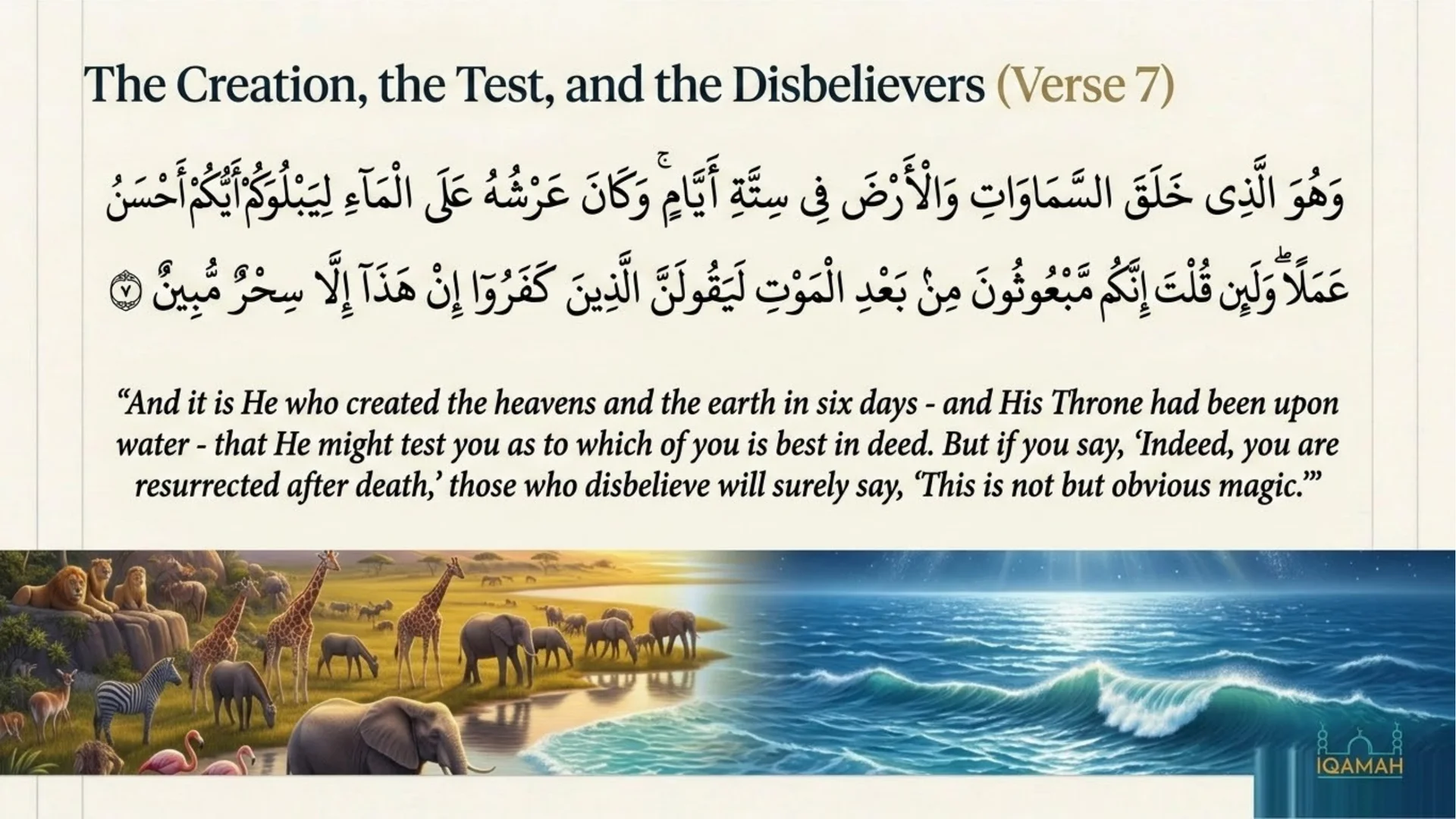
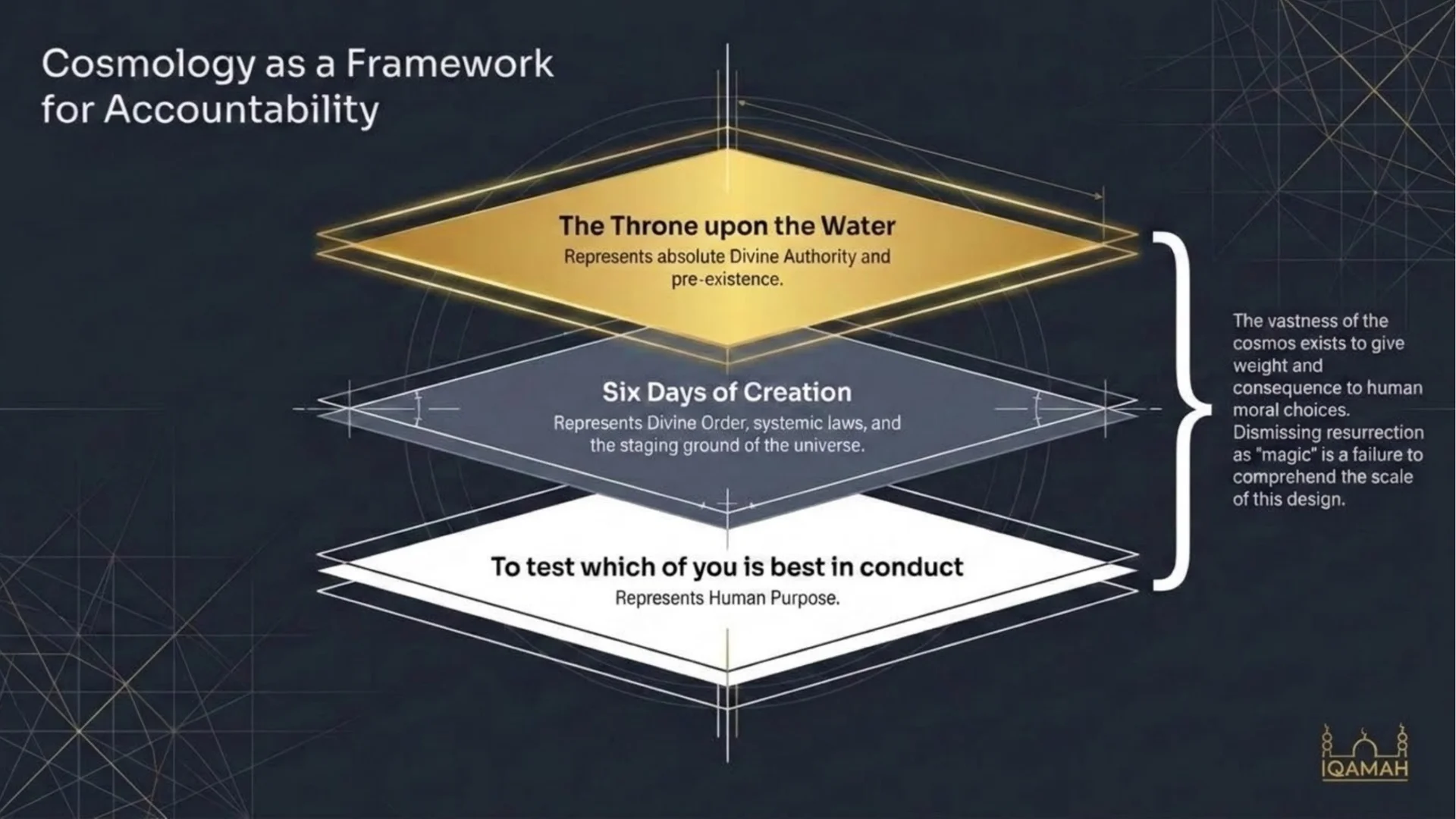
Saʿdī (p. 265): "Allah created the heavens and earth in six days — the first of which was Sunday and the last of which was Friday — and at the time when He created them, His Throne was upon the water above the seventh heaven. After He created the heavens and earth, He rose above the Throne and is controlling all affairs as He wills." Then on "best in conduct": "He created for you all that is in the heavens and on earth, so that He may try you, by means of His commands and prohibitions, to see which of you will be best in conduct." The cosmos is staged for a moral test. Note Qutb's caution about harmonizing the verse's "six days" and "Throne upon water" with scientific theories. His position is firm: the Qurʾān states facts that are true regardless of whether science discovers them; scientific theories are always provisional; harmonization in either direction undermines both. The verse's real point is moral, not cosmological: the test is to see who is "aḥsanu ʿamalan" — best in conduct, not most in deeds. The test is qualitative, not quantitative. Note the rhetorical move at the end of the verse: the disbelievers' dismissal — "this is plain sorcery" — is set against the backdrop of a universe-creating God. The contrast is devastating: a God who built the cosmos for purpose is dismissed as a magician.

Slide 11
Slide 11 of 31 #

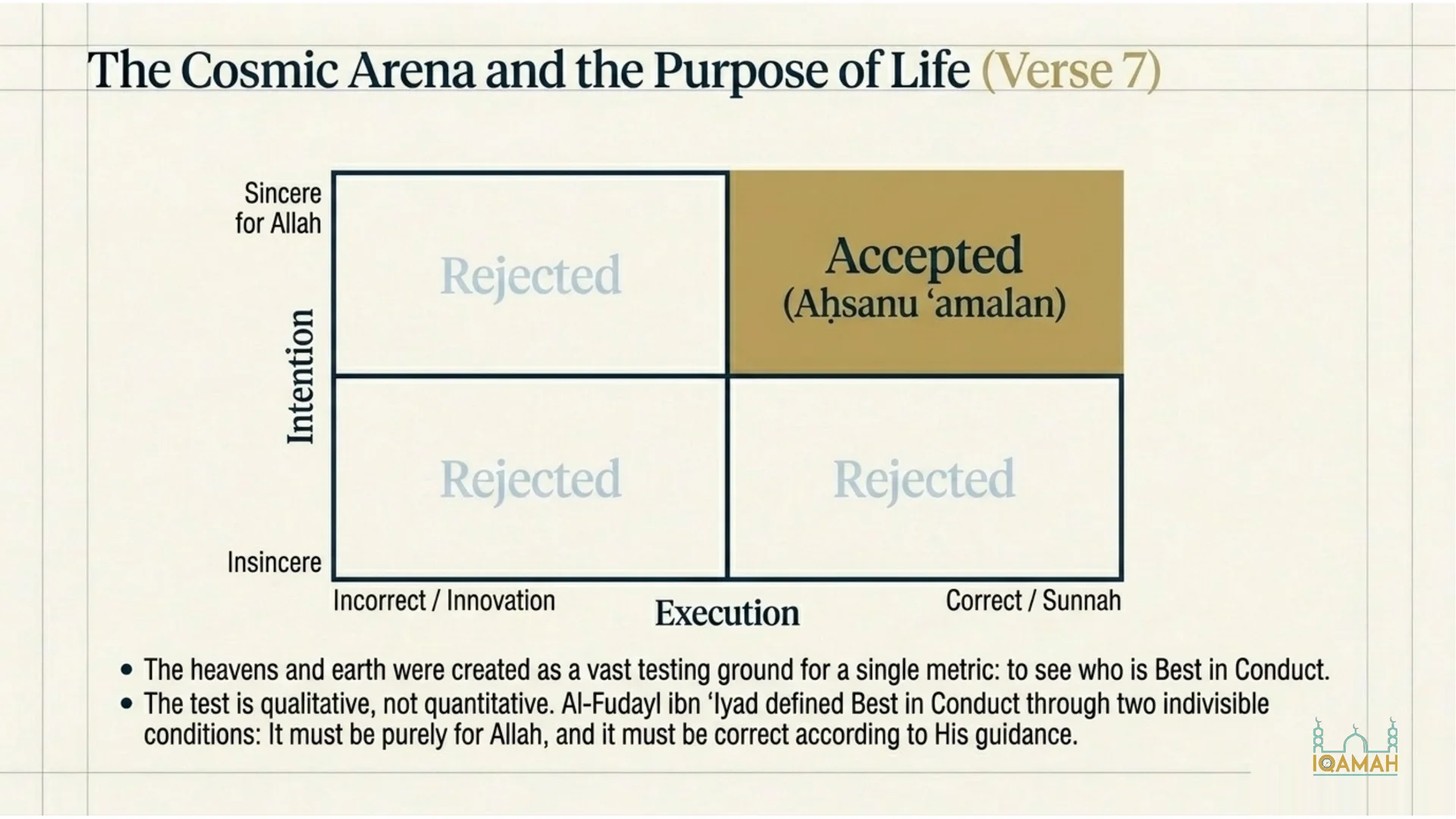
aḥsanu ʿamalan: This is one of the most famous classical commentaries in all of tafsir. Saʿdī (p. 265) and Ibn Kathīr both record it. Al-Fuḍayl ibn ʿIyāḍ — the great early ascetic and traditionist of Mecca, d. 187 AH — was asked what "best in conduct" means in this verse. He replied: "akhlaṣuhu wa-aṣwabuhu" — "the most sincere of it and the most correct of it." They asked, "O Abū ʿAlī, what does that mean?" He answered: "If a deed is sincere but not correct, it will not be accepted. If it is correct but not sincere, it will not be accepted. It will only be accepted if it is both sincere and correct. Sincere means it is done only for the sake of Allah. Correct means it is in accordance with Islamic teachings and the Sunnah." The twin-condition formula — ikhlāṣ (sincerity) plus ṣawāb (correctness) — is the single most teachable diagnostic the opening passage offers for any deed. Saʿdī's expansion: ikhlāṣ = done only for Allah; ṣawāb = according to the Sharīʿah and the Sunnah. The full formula is therefore: for Allah, according to the Prophet ﷺ. Ibn al-Jawzī also gives four classical opinions on what "best in conduct" specifically means — most active in obedience (Ibn ʿAbbās), most complete in intellect (Qatādah), most ascetic to this world (al-Ḥasan, Sufyān) — each emphasizes a facet of what makes a deed "best." Al-Fuḍayl's formula names the structure. If you only remember one thing from this session, this is it..

Slide 12
Slide 12 of 31 #

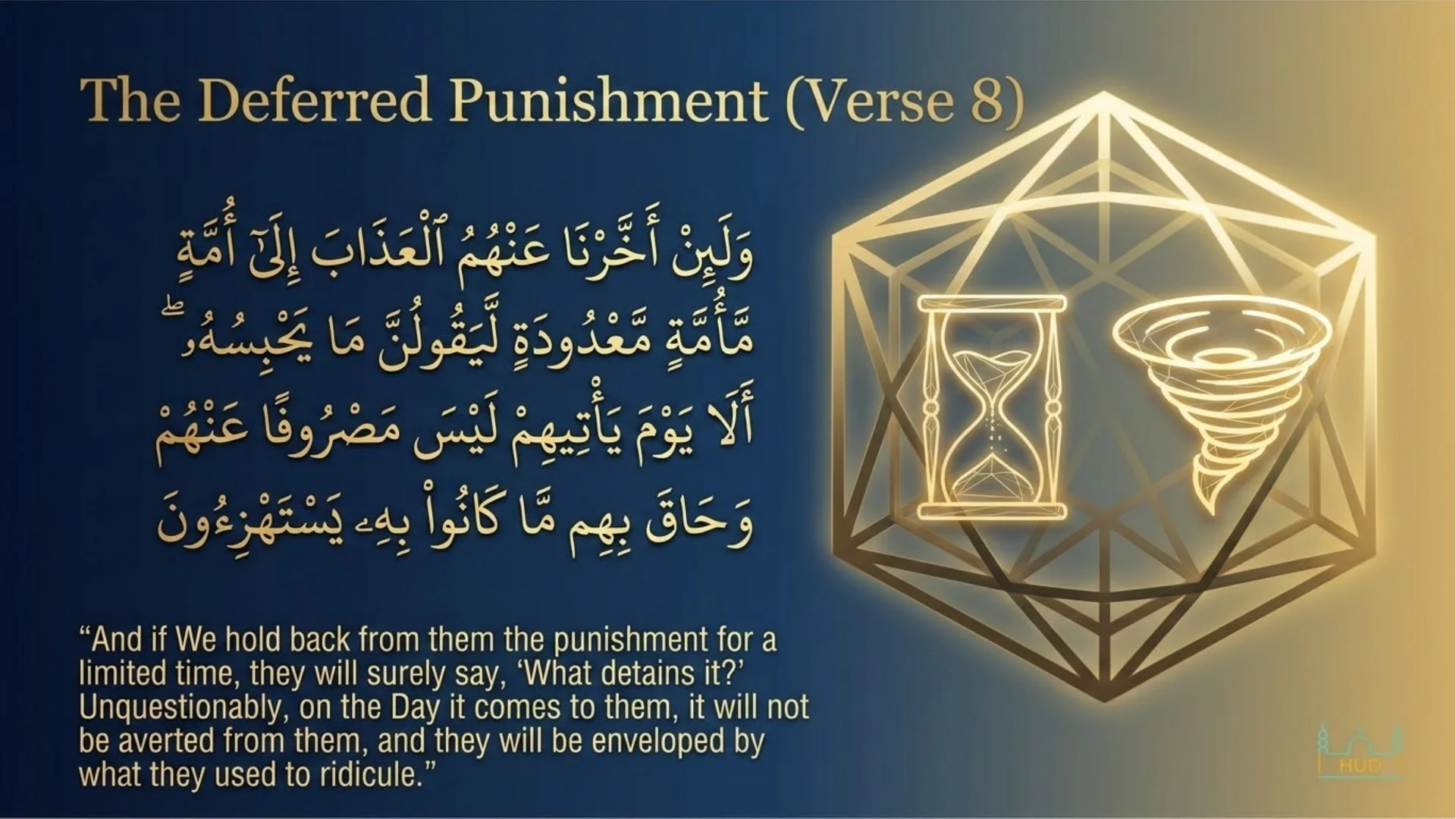
Verse 8 names a recurring Quraysh provocation: their mocking of the Prophet ﷺ for warning about punishment that never seemed to arrive. The same pattern appears in 8:32 ("O Allah, if this is indeed the truth from You, rain down stones on us") and 22:47 ("They ask you to hasten the punishment"). The verse functions as the Qurʾānic answer: divine delay is not divine indifference. Saʿdī: "If We delay the punishment for them for a limited time, they will find it slow in coming and will say, in their ignorance, 'What is holding it back?' This implies that they disbelieve in it, because they take the fact that it did not happen straightaway as an indication that the Messenger ﷺ was not telling the truth." The verb ḥāqa bihim is rhetorically loaded. Ḥāqa in classical Arabic carries the sense of something that surrounds completely, closes in from all sides — the image is of being engulfed with no exit. Note the precise structure: "wa-ḥāqa bi-him mā kānū bihī yastahziʾūn" — "the very thing they were mocking surrounded them." The thing mocked is the thing that overwhelms. The Qurʾān uses this construction repeatedly (6:10, 16:34, 21:41) to name a particular kind of poetic justice: the object of derision becomes the agent of consequence. Contemporary application: climate, debt, broken relationships, addictions — all share this structure. A slowly accruing consequence treated as no consequence at all. The verse names this as the universal disbeliever's logic.

Slide 13
Slide 13 of 31 #

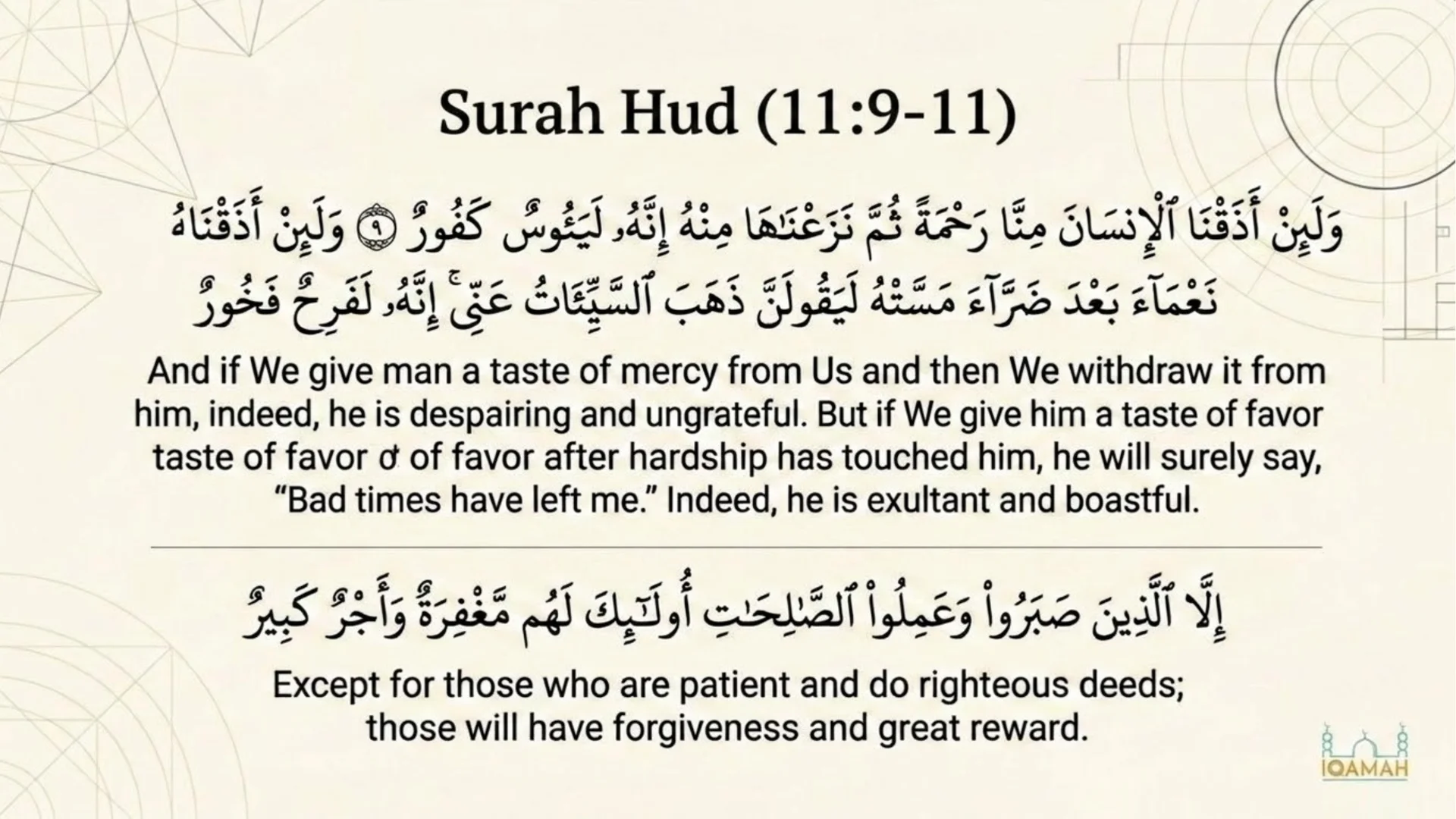
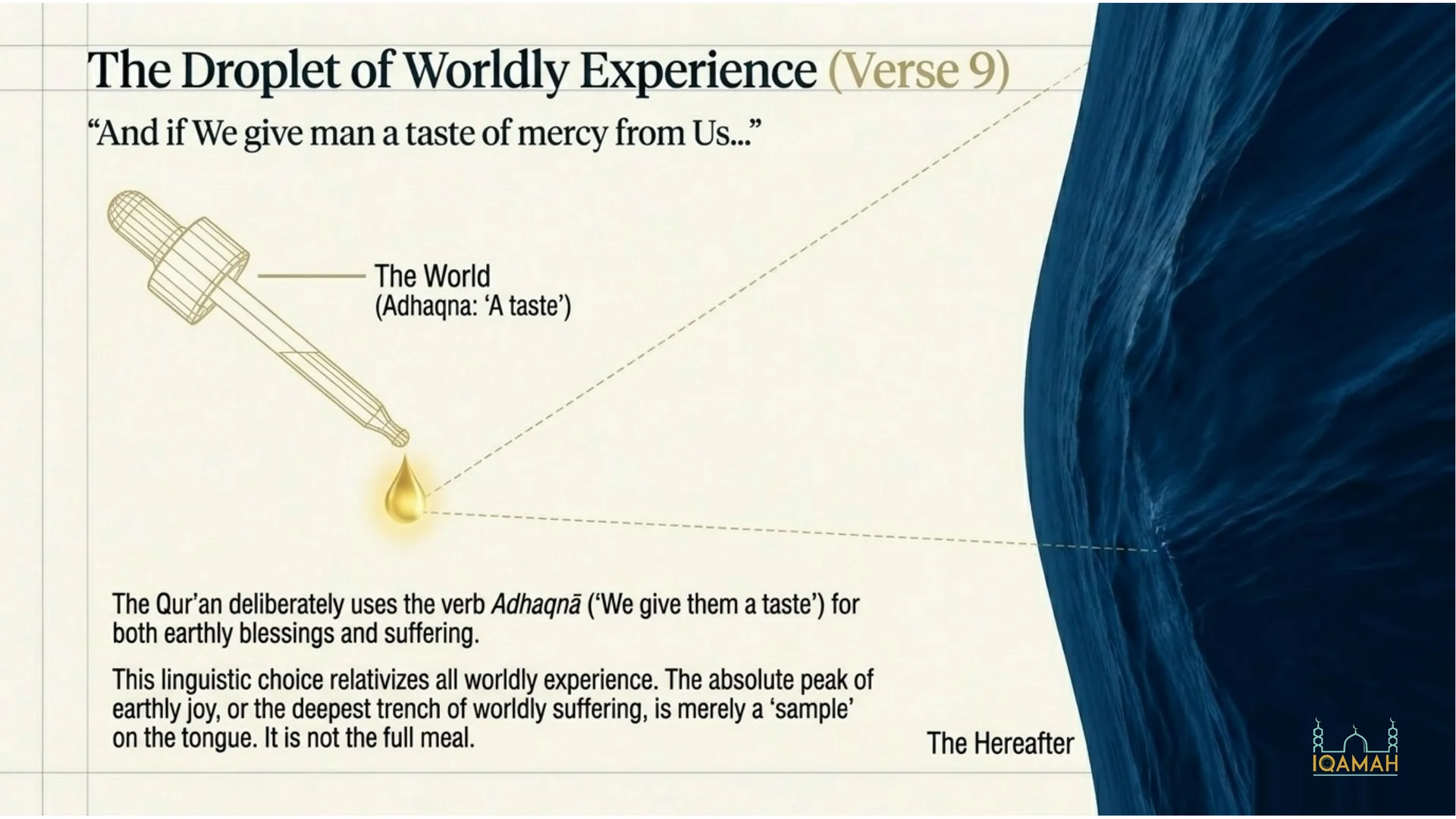
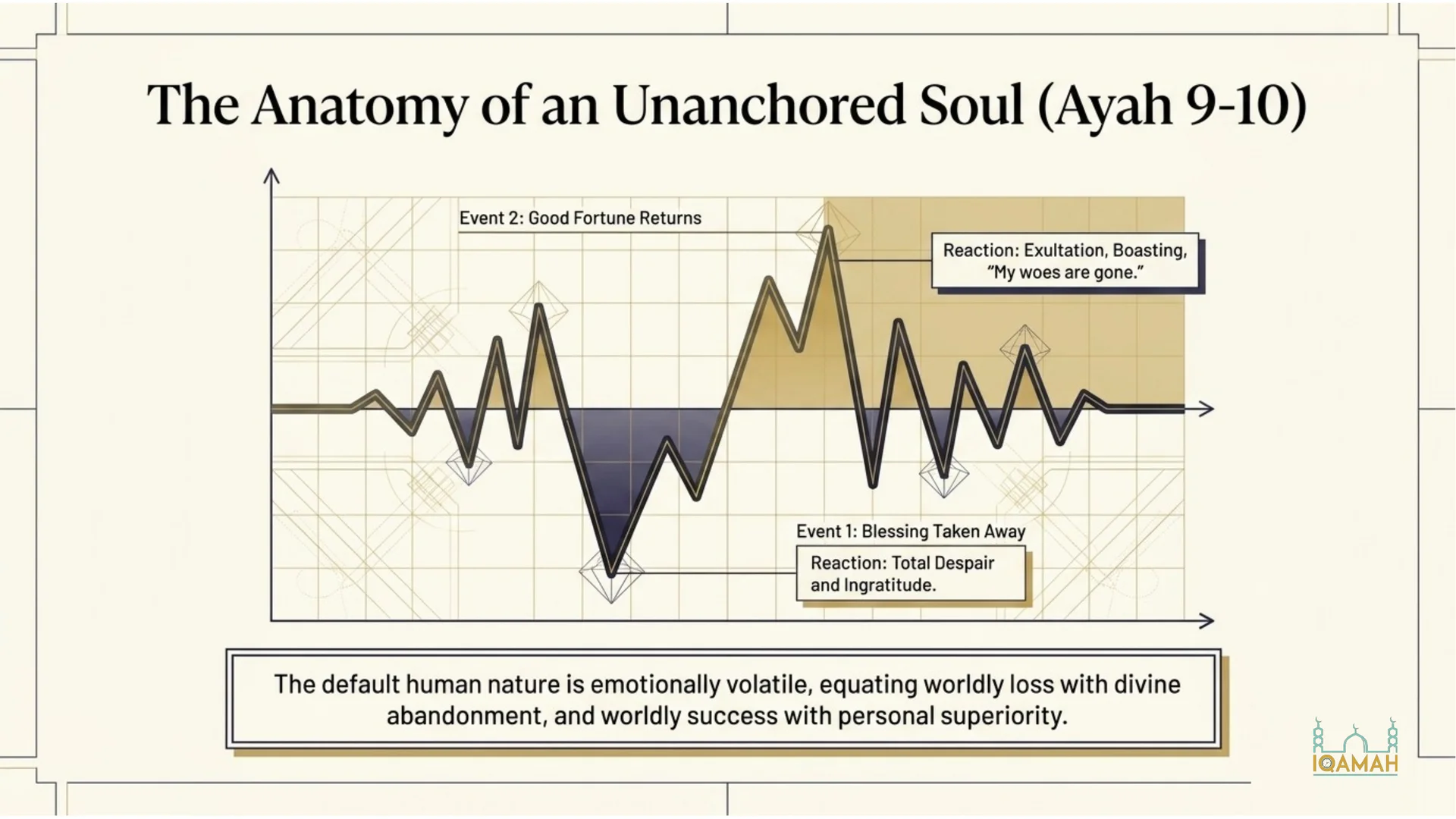
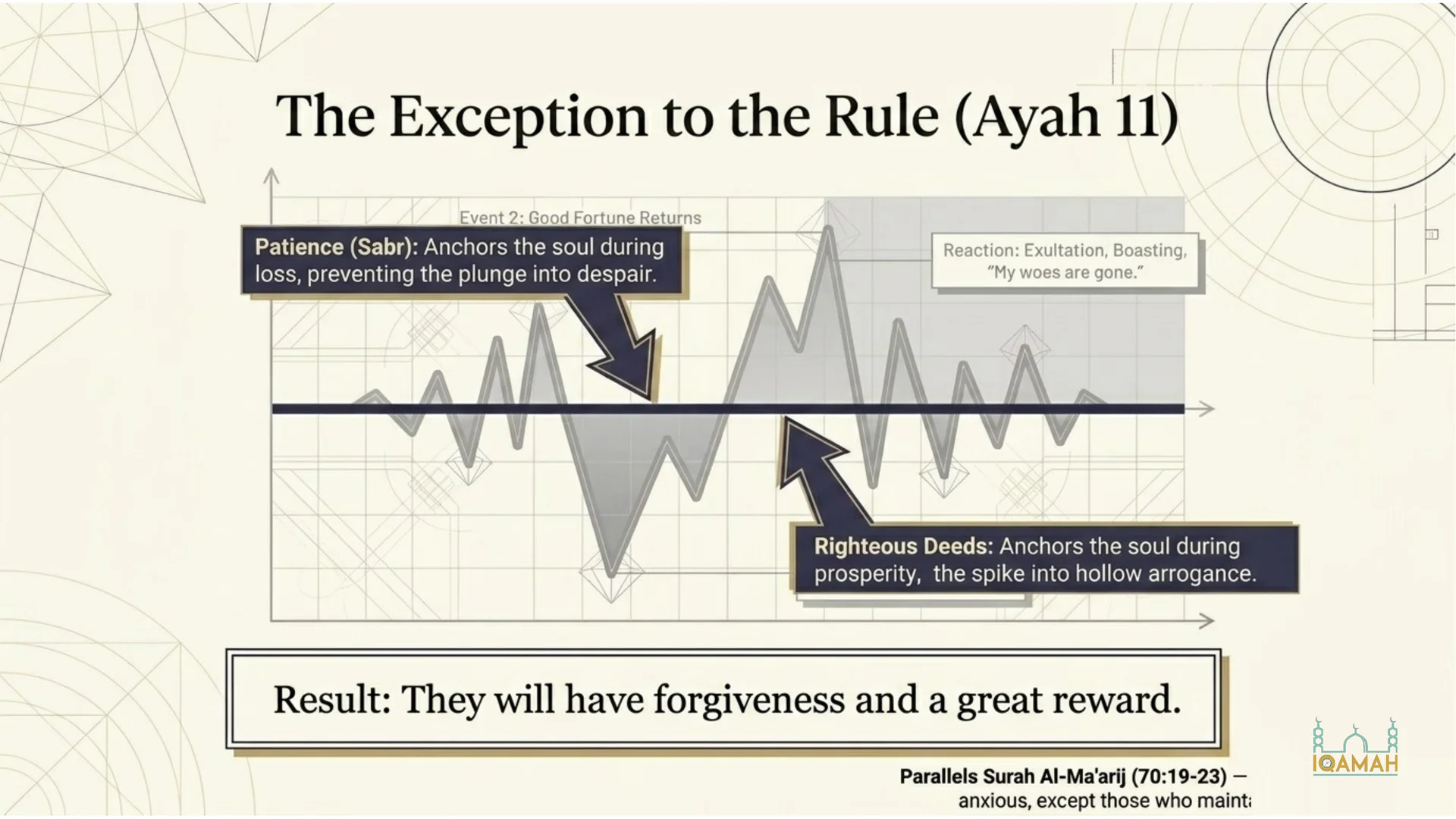
Verses 9–11 function as a single unit of Qurʾānic psychological description. Saʿdī treats them as Allah's revelation about the nature of man as created — a universal diagnostic, not a contingent occasion. Maʿāriful Qurʾān (p. 609) makes a fine observation: the Qurʾān uses the same verb adhaqnā — "we give them a taste" — for both blessing and suffering. "By this device, it was indicated that real blessing and suffering is that of the Hereafter. Neither is the comfort of the mortal world the whole of it, nor is its suffering the whole of it. Instead, it should be taken at the level of tasting and sampling so that human beings could have some idea of the blessings and sufferings of the Hereafter." The lexical choice relativizes worldly experience: it is a sample, not the meal. The structure of these three verses is a question, an answer, and a way out: the question is human instability, the answer is patient righteousness, the way out is faith expressed in steady deeds. Cross-reference to Sūrah al-Maʿārij 70:19–23: "Indeed, man was created anxious — when evil touches him, frantic; when good touches him, withholding. Except those who pray." The parallel to Hūd 11:11 is exact: same diagnostic, same exception, same exit mechanism. This is for the age of social media — the despair-content and boast-content come from the same person.

Slide 14
Slide 14 of 31 #

Saʿdī on v. 9: "Allah tells us about the nature of man, that he is ignorant and given to wrongdoing. When Allah gives him a taste of mercy from Him — such as good health, provision, children — then He takes it away from him, he gives in to despair and ends up losing all hope. He does not hope for the reward of Allah, and it never crosses his mind that Allah could restore it or give him something like it or better." The two characteristics named are yaʾūs (despairing) and kafūr (extremely ungrateful, denying). They are connected: despair is the cognitive failure of forgetting that Allah could restore; ungratefulness is the moral failure of forgetting that He gave it in the first place. Ibn al-Jawzī (commenting on this verse) cites Ibn ʿAbbās: yaʾūs = qanūṭ (one who has cut off hope); kafūr = one who denies the original blessing. Notice what the verse is doing. It does not condemn the experience of loss — every human will lose things they love. It condemns the response of yaʾūs, which is the giving-up of hope. Despair is theologically illicit; sorrow is not. The believer can grieve without despairing because the believer holds the awareness that the One who took it can give it back or replace it with something better. The verse therefore is not about emotional suppression — it is about cognitive stability under loss.

Slide 15
Slide 15 of 31 #

Saʿdī on v. 10: "If Allah gives him a taste of mercy and prosperity after some hardship that befell him, he exults in it and becomes boastful. He thinks that he will always have that goodness and he says: 'All my woes are gone from me' — that is, he rejoices in what he was given in accordance with his own whims, and he boasts of the blessings of Allah before the slaves of Allah. This makes him conceited and vain, filled with self-admiration and arrogant towards others. What misconduct could be worse than this?!" Ibn al-Jawzī (commenting on faraḥ in this verse) preserves Ibn al-Anbārī's very fine note: the Qurʾān criticizes faraḥ here, but elsewhere it praises the shuhadāʾ as fariḥīn — "rejoicing in what Allah has given them" (3:170). Why the difference? Because, Ibn al-Anbārī says, the faraḥ criticized here is faraḥ without gratitude — it does not refer back to Allah but to the self. The faraḥ praised in the shuhadāʾ verse is faraḥ in Allah's grace, joined to gratitude. The verse therefore is not against joy — it is against unmoored joy, joy that forgets its source. Notice the verse pairs faraḥ with fakhūr (boastful) deliberately. Joy that turns into showing-off is the diagnostic the verse is naming. The believer can rejoice; the believer cannot boast.

Slide 16
Slide 16 of 31 #

Saʿdī on v.11, the exception: "This is the nature of man as he was created, except for the one whom Allah guides and helps him to rid himself of this bad attitude and develop the opposite. They are the ones who make themselves be patient at times of hardship, so they do not despair, and at times of ease they do not gloat; and they do righteous deeds, both obligatory and recommended." Result: "They will have forgiveness for their sins, and they will be protected from the bad consequences thereof, and a great reward — admittance to the gardens of bliss." Qutb captures the tarbiyyah significance: "A serious view of faith, manifested in righteous deeds, is the only thing that protects man from despair during hardship and from arrogance during times of ease and plenty. It is the only factor which helps man adopt a consistent attitude in both situations. With faith man feels his link with God. He is thus not overwhelmed by adversity. Nor is he proud and insolent when he enjoys abundance. To a believer both situations are beneficial. As the Prophet ﷺ says, only a believer derives benefit from both situations." This is one of Qutb's most important lines: the believer is not the one who experiences only good or only hard, but the one whose response to both is stable. Two components are named: ṣabr (patience, the discipline of not letting conditions determine inward state) plus ʿamal ṣāliḥ (righteous deed, the practice of doing good across both states). The two together produce the stability.

Slide 17
Slide 17 of 31 #

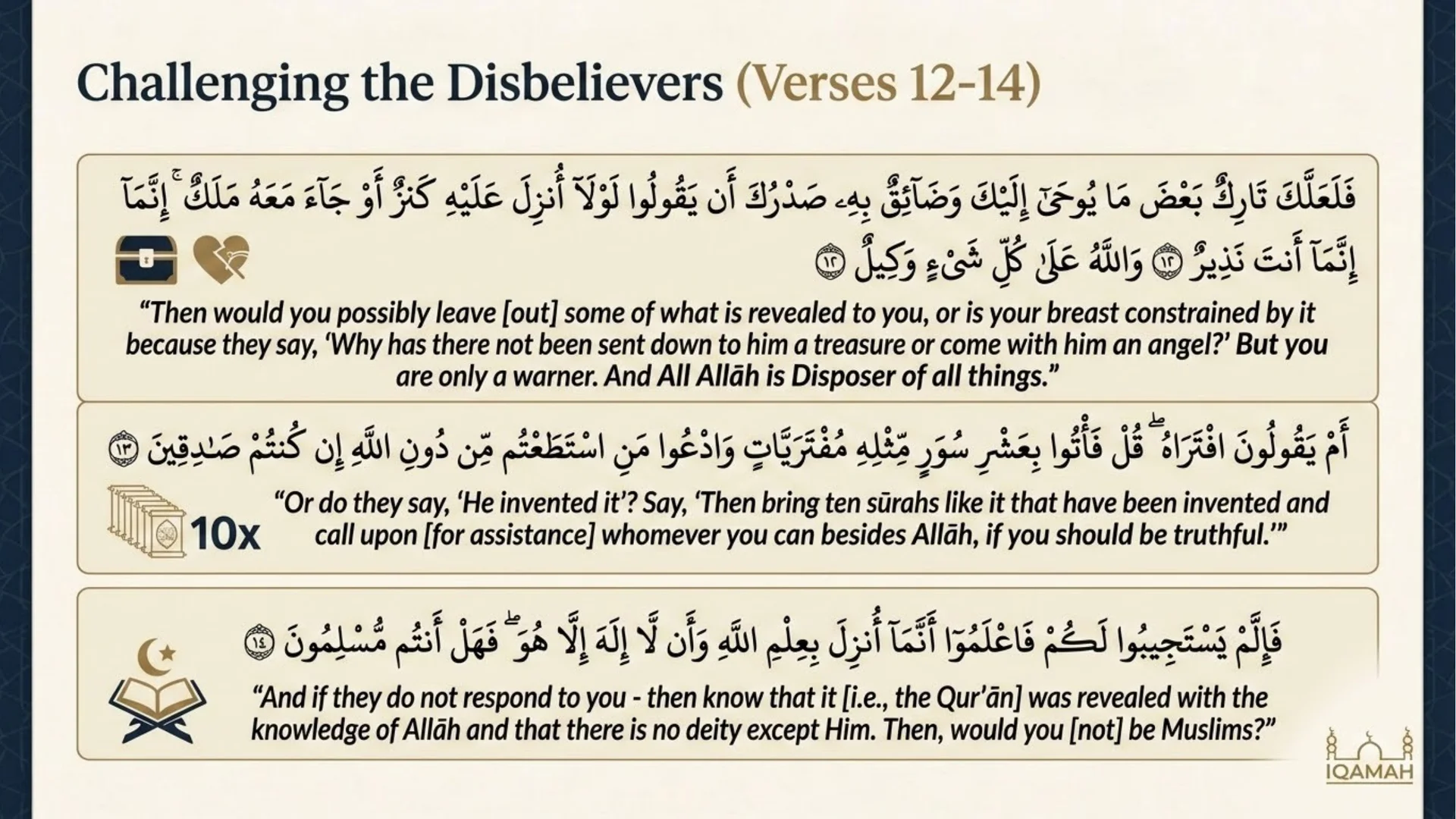
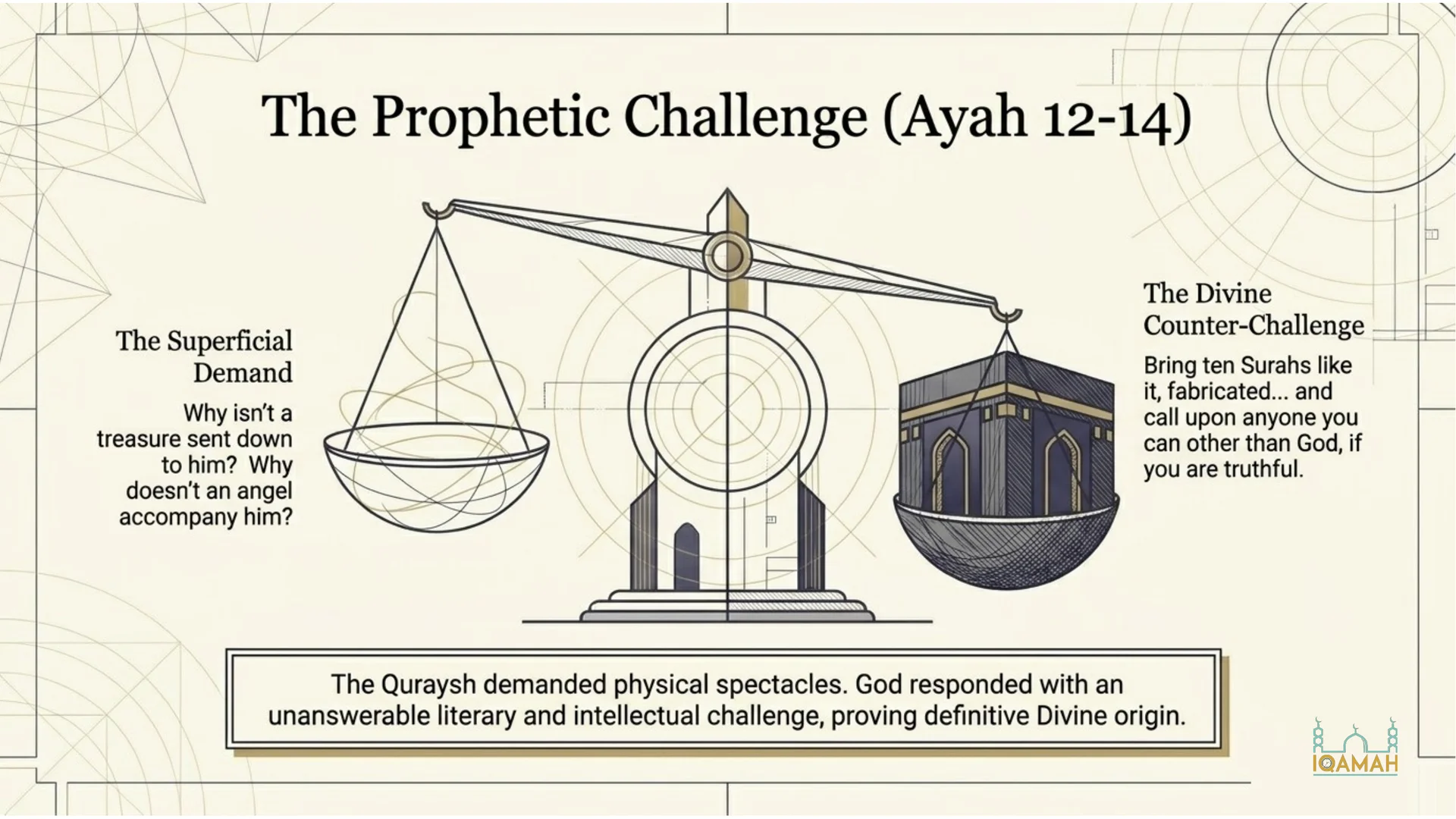
Verse 12 is one of the most psychologically revealing verses in the entire Qurʾān about the Prophet's ﷺ inner life. Maʿāriful Qurʾān (pp. 609–611) preserves the contextual reconstruction. The Quraysh disbelievers made multiple demands of the Prophet ﷺ: "Your Qurʾān maligns our gods — either bring another Qurʾān or alter this one" (cf. 10:15). And: "We will only believe if you have a treasure like a king's," or "if an angel comes down with you visibly." These demands stung the Prophet ﷺ — not because he was tempted to alter the Qurʾān, but because his concern for his people's salvation made the failure of his daʿwah grievous to him. The verse is Allah's direct response to that grief. Saʿdī: "It is not befitting for one such as you to let what they say affect you and turn you away from your mission, so that you omit some of that which is revealed to you. These words stem from stubbornness, wrongdoing, obstinacy, and ignorance. So carry on with your efforts and do not let these worthless ideas deter you." The construction with laʿalla ("perhaps") is rhetorical: it does not actually expect that the Prophet ﷺ would omit anything; rather, it asks the question precisely to establish that he is free from doing so. The closing relief is significant: "You are only a warner; Allah has everything in His care." The burden of outcomes is not the Prophet's ﷺ — it is Allah's.

Qutb writes: "This last verse lets us know the difficulties the Prophet faced at this time, and how he felt his burden to be very heavy indeed. It reminds us of the unbelievers' intransigence, hostility and conceit. Few were they at this time who responded favourably to the Prophet's call, and they endured great hardship. Yet, revelations continued to be bestowed on him from on high providing encouragement and reassurance." The verse therefore opens a window into the Prophet's ﷺ inner life: he was not invulnerable to his people's rejection — it caused him real grief — but the revelation itself was the structure that held him steady. Cross-reference to 17:73–75, where the same Quraysh strategy is named more sharply: "Indeed, they were about to tempt you away from that which We revealed to you, that you might invent about Us something other than it. Then they would have taken you as a friend. Had We not strengthened you, you would nearly have inclined to them a little." The pattern is consistent across Meccan sūrahs: the Quraysh tried to negotiate the content of the revelation, and Allah's answer is always to strengthen the Prophet ﷺ in his refusal. Tarbiyyah application: every age tries to negotiate with revelation — leave out the parts about hellfire, about gender, about jihad. The verse names this temptation as recurrent. Allah's response is constant: "You are only a warner." The teacher's burden is only to transmit faithfully; the burden of outcomes belongs elsewhere.

Verse 13 responds to the standing Quraysh claim that the Qurʾān was a fabrication (iftirāʾ) of Muḥammad ﷺ. Note the relationship to v. 1: the opening verse claimed the Qurʾān is "from One Who is All-Wise, All-Aware"; v. 13 issues the empirical test of that claim — if it is truly fabricated by a human, then humans should be able to produce something like it. The challenge here is for ten sūrahs. As we will see next, the challenge descends across the Qurʾān to one sūrah and then to the entire book — but the structure is always the same: if you doubt the divine origin, produce a competitor. Saʿdī: "Say to them: bring just ten sūrahs like it, of any subject matter, fabricated by your own selves and not from Allah — and call upon whomever you can other than Allah to help you in this fabrication, if you are truthful in claiming that Muḥammad ﷺ has fabricated it." The challenge is rhetorical and historical: in 1400 years no one has produced even a remotely successful imitation. Maʿāriful (p. 612) notes Musaylimah the Liar's famous failed attempts during the Prophet's ﷺ own lifetime — his "verses" are quoted in classical sources as proof of how unattainable even mediocre imitation of the Qurʾān is. The verse's deep claim is therefore practical, not just doctrinal: the divine origin of the Qurʾān is testable, and the test stands.

The Qurʾān issues its inimitability (iʿjāz) challenge in three places, and the bar descends each time. (1) In Hūd 11:13 (our verse), the demand is for ten sūrahs. (2) In Yūnus 10:38 and Baqarah 2:23, the demand drops to a single sūrah ("then bring forth a sūrah like it"). (3) In al-Isrāʾ 17:88, the demand goes the opposite direction — the entire Qurʾān: "If mankind and the jinn were to gather to produce the like of this Qurʾān, they could not produce the like of it, even if they assisted one another." The rhetorical force of the descending bar is deliberate. The Qurʾān starts with the hard demand, then offers an easier one, then names the impossibility of even the largest attempt. The challenge becomes progressively gentler and progressively unmet. Maʿāriful Qurʾān (p. 612) cites Ibn Kathīr's note that the Quraysh themselves never attempted a serious response. The greatest poets of pre-Islamic Arabia — al-Walīd ibn al-Mughīrah, ʿUtbah ibn Rabīʿah — explicitly refused to produce any imitation, knowing it was impossible; al-Walīd famously said: "By Allah, what he says does not resemble any poetry. By Allah, the speech which he utters is sweet and graceful, fruitful at the top, copious at the bottom; it has the upper hand and nothing has the upper hand over it." Note: this is the verse's confidence — it does not just claim inimitability, it puts the claim to test.

Verse 14 closes the iʿjāz challenge with a logical argument. If the disbelievers cannot produce ten sūrahs like the Qurʾān — and they manifestly cannot — then the only remaining inference is that the Qurʾān was indeed revealed by divine knowledge, and that the One who revealed it is uniquely God. Saʿdī (p. 271): "If they do not respond to your demand to bring forth ten sūrahs like the Qurʾān, then know — O believers, and let them know — that this Qurʾān was sent down with Allah's knowledge, not by way of human composition; and that there is no god worthy of worship but He." Qutb adds the da‘wah challenge: once you accept this argument intellectually, are you prepared to act on it? "Fa-hal antum muslimūn" — "Will you then submit?" The Qurʾān expects the intellectual conclusion to translate into existential surrender. The gap between intellectual recognition and operational submission is, Qutb notes, the gap where most disbelief actually lives. People do not usually disbelieve because they have evidence against; they disbelieve because they refuse the implications of the evidence they have. The verse therefore is not merely asking for cognitive assent — it is asking for the act of islām, of handing oneself over to the One whose revelation has just been verified.

Slide 18
Slide 18 of 31 #

The Qurʾān issues its inimitability (iʿjāz) challenge in three places, and the bar descends each time. (1) In Hūd 11:13 (our verse), the demand is for ten sūrahs. (2) In Yūnus 10:38 and Baqarah 2:23, the demand drops to a single sūrah ("then bring forth a sūrah like it"). (3) In al-Isrāʾ 17:88, the demand goes the opposite direction — the entire Qurʾān: "If mankind and the jinn were to gather to produce the like of this Qurʾān, they could not produce the like of it, even if they assisted one another." The rhetorical force of the descending bar is deliberate. The Qurʾān starts with the hard demand, then offers an easier one, then names the impossibility of even the largest attempt. The challenge becomes progressively gentler and progressively unmet. Maʿāriful Qurʾān (p. 612) cites Ibn Kathīr's note that the Quraysh themselves never attempted a serious response. The greatest poets of pre-Islamic Arabia — al-Walīd ibn al-Mughīrah, ʿUtbah ibn Rabīʿah — explicitly refused to produce any imitation, knowing it was impossible; al-Walīd famously said: "By Allah, what he says does not resemble any poetry. By Allah, the speech which he utters is sweet and graceful, fruitful at the top, copious at the bottom; it has the upper hand and nothing has the upper hand over it." Note: this is the verse's confidence — it does not just claim inimitability, it puts the claim to test.

Slide 19
Slide 19 of 31 #

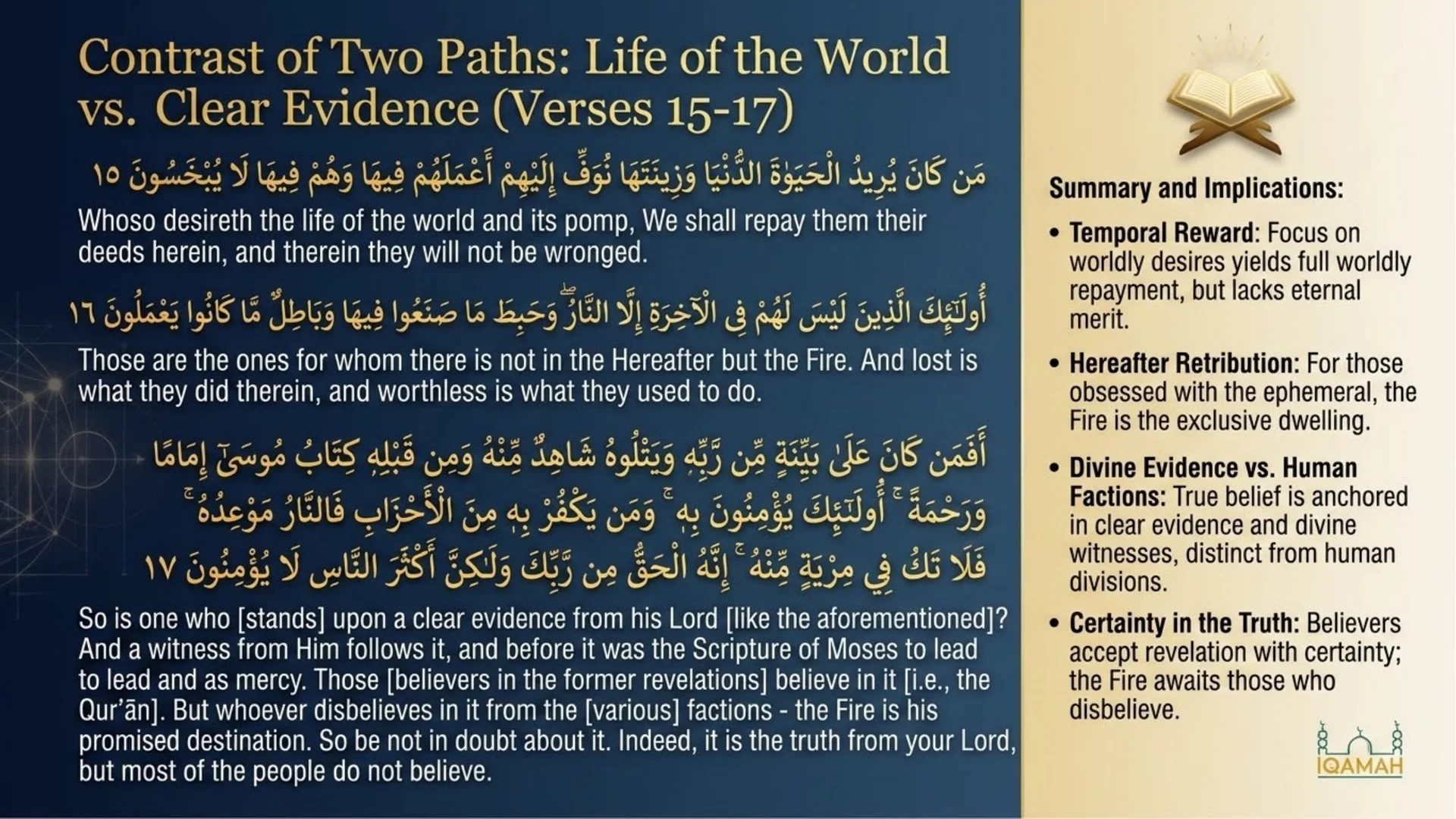
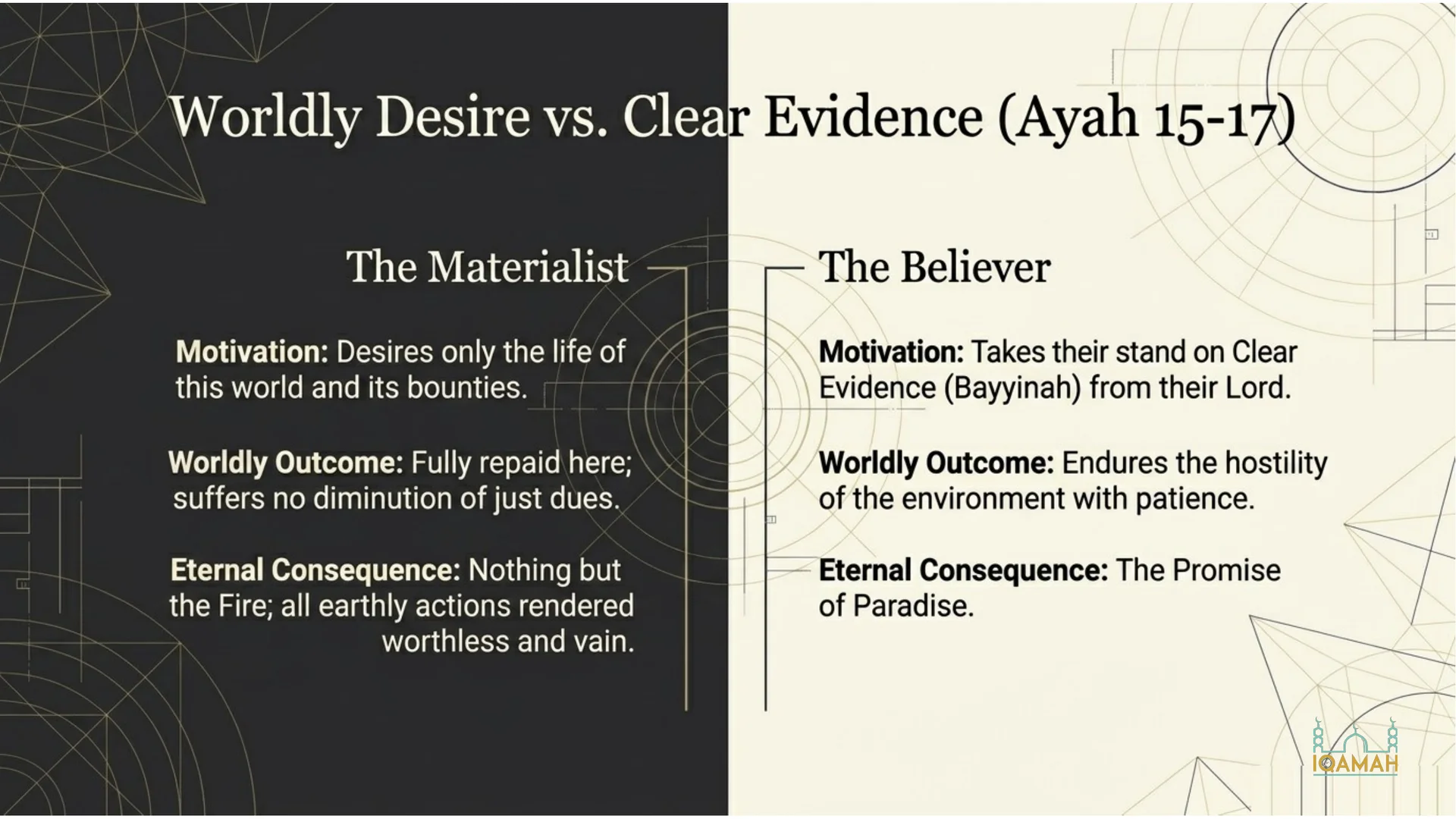
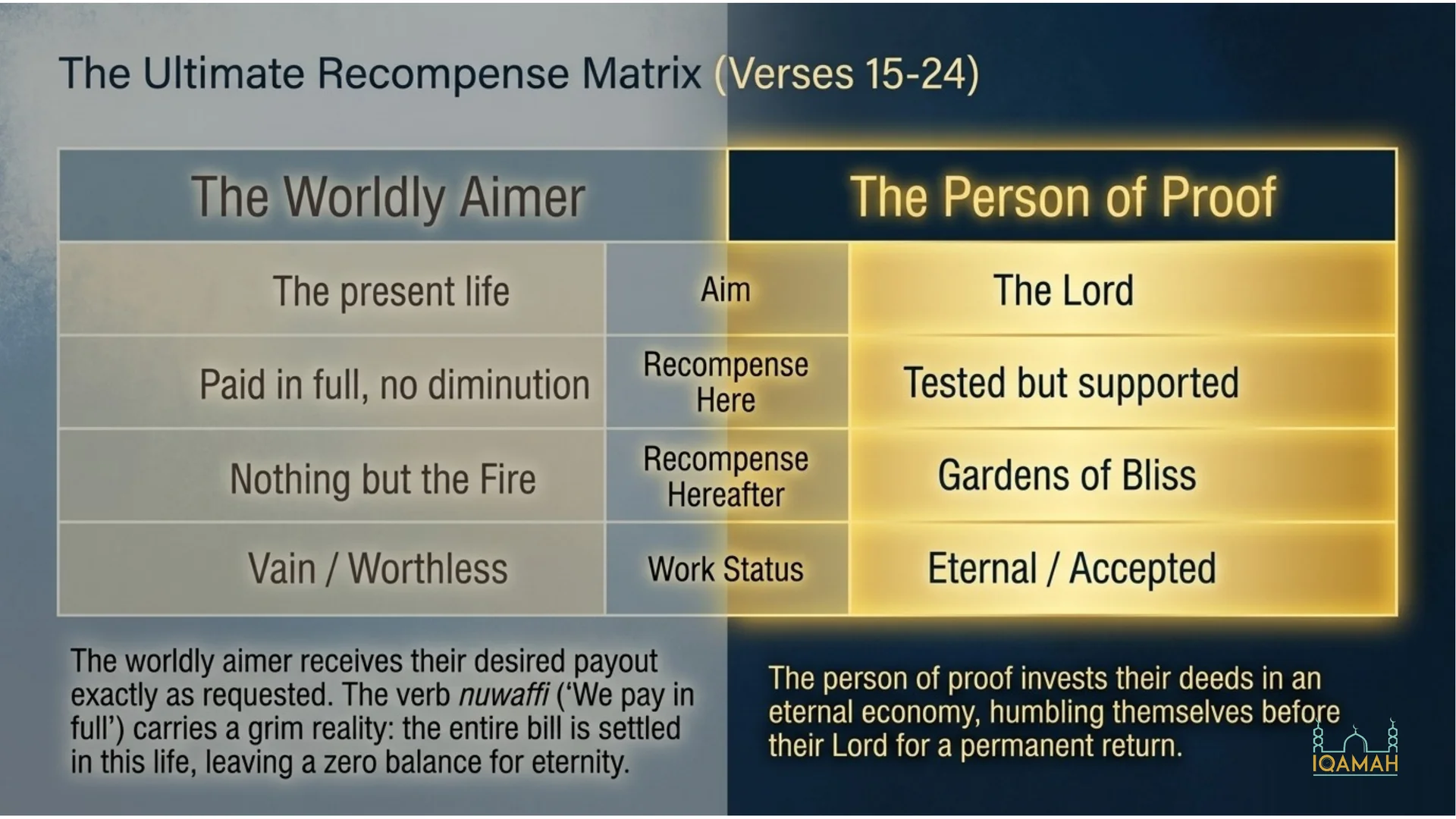
Verses 15–16 are the doctrinal companion to v. 14: having issued the falsification challenge and the call to submission, the Qurʾān now identifies the alternative — those whose entire aim is the worldly life. Saʿdī (pp. 271–272) provides the sharpest reading: "All their aspirations are limited to the life of this world and its adornments — such as women and sons, heaped-up hoards of gold and silver, fine horses, livestock, and well-tilled land (cf. 3:14). Thus they focus their ambitions, efforts, and striving on these things, and they do not aspire to the hereafter at all. Such a person can be nothing but a disbeliever, because if he were a believer, his faith would have prevented him from focusing all his attention on this world." Result: "We will give them what was allocated for them in al-Lawḥ al-Maḥfūẓ of the reward of this world, and nothing will be detracted — but that will be all they get." The verb waffā is precise: not "we will pay" but "we will pay in full" — there is no shortfall in worldly recompense. The grim implication is that the entire bill is paid here, leaving nothing for the Hereafter. Qutb's nuance is spiritually foundational: this verse is not against worldly effort; it is against worldly aim. The same act, with different intention, produces different outcomes. The believer can be a businessperson, a doctor, a farmer — and have all of those activities count for the Hereafter, if the intention is right.

Slide 20
Slide 20 of 31 #

Ibn al-Jawzī (Zād al-Masīr, vol. 7, p. 211) preserves four classical opinions on whom verse 15 was revealed about. Let’s walk through them: (1) The majority view — the verse is universal (ʿāmmah fī jamīʿ al-khalq), applying to every human being whose aim is this-worldly. (2) Abū Ṣāliḥ from Ibn ʿAbbās — the verse applies specifically to ahl al-qiblah, i.e., to nominal Muslims whose orientation is wrong. This is a sharp opinion: it reads the verse not as a description of disbelievers but as a warning to ostensible Muslims. (3) Anas — the verse is about Jews and Christians. (4) Mujāhid — the verse is about people of riyāʾ (ostentation, showing-off), those who do religious deeds for worldly reputation rather than for Allah. Ibn al-Jawzī adds a further nuance from ʿAṭāʾ on Ibn ʿAbbās: "Whoever desires the immediate world does not believe in the resurrection and the requital" — making the verse a diagnostic of underlying disbelief. The opposing view he records: "It applies only to the disbeliever, because the believer desires both this world and the hereafter." That last opinion is Qutb's position too — the believer pursuing worldly success alongside the hereafter is not condemned by this verse; only the one whose exclusive aim is this world. Note: the four opinions identify different applications of the same principle. The most useful from a tarbiyya perspective is Mujāhid's reading — riyāʾ. It warns the apparently religious person that the worldly aim can be wearing a religious mask. Ibn al-Jawzī also gives the standard interpretation on "We shall pay them in full": Saʿīd ibn Jubayr — "They are given the reward for whatever good they did, in this world." Mujāhid — "Whoever does an act of kindness or charity not seeking the face of Allah; Allah gives him its reward in this world."

Slide 21
Slide 21 of 31 #

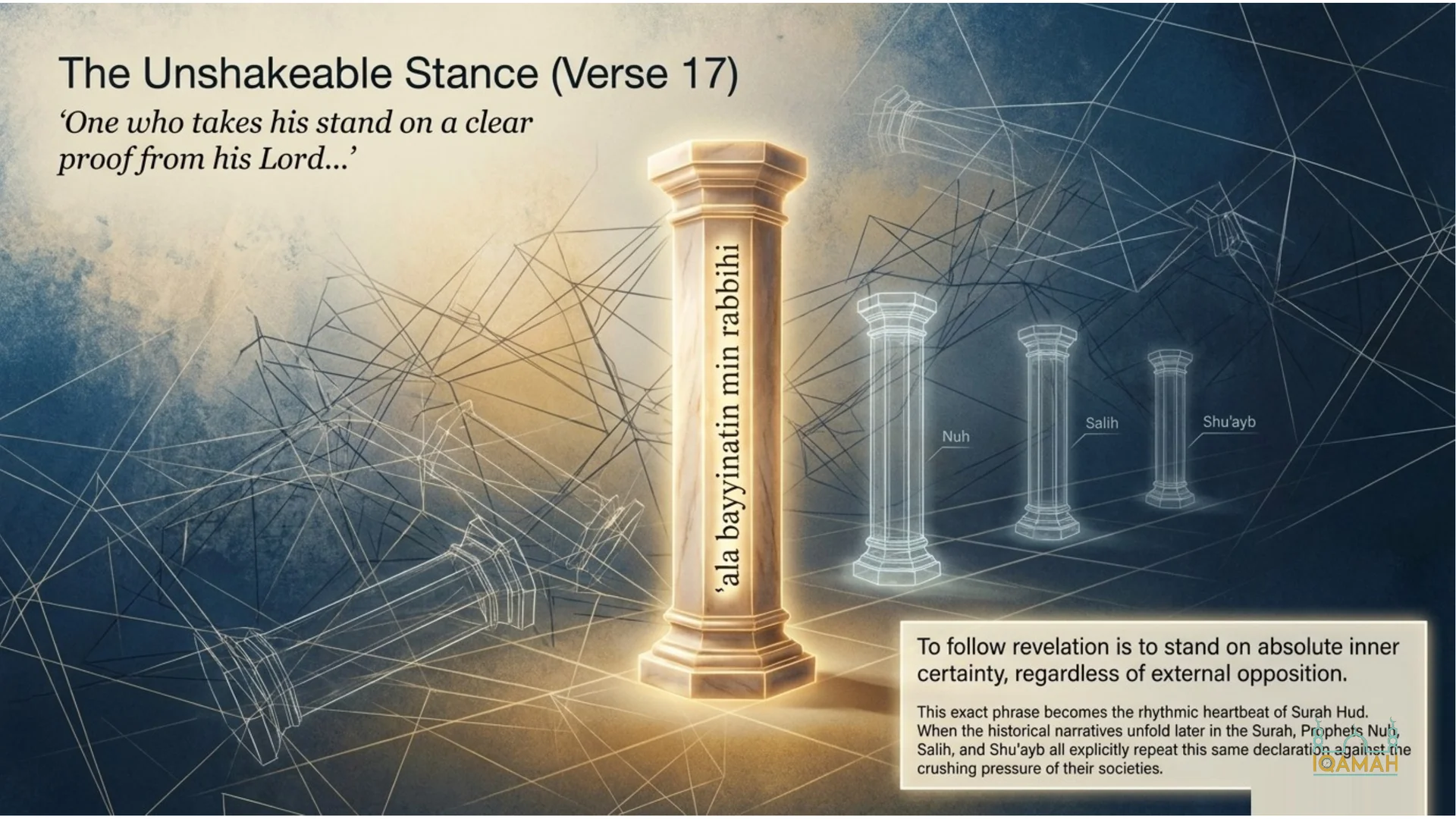
Verse 17 contrasts the worldly-aim disbelievers of vv. 15–16 with another class entirely — those who stand on revealed proof. Saʿdī (pp. 272–273) reads: "Here Allah describes the situation of His Messenger Muhammad ﷺ and those who followed in his footsteps, calling others to His religion and the proofs that they believed in. 'One who has clear proof from his Lord' — namely the revelation that Allah sent down to explain important matters and give clear proofs thereof, and he is certain of those proofs." Qutb identifies a deep structural pattern. The phrase ʿalā bayyinatin min rabbihi ("on clear proof from his Lord") recurs almost verbatim across the prophet-stories of this very sūrah: Nūḥ at 11:28, Ṣāliḥ at 11:63, Shuʿayb at 11:88. The phrase is not just about the Prophet Muḥammad ﷺ — it identifies the universal posture of the believing prophet: standing on inner certainty derived from revelation, no matter how few the followers. The verse therefore enfolds a chain of three witnesses: the Prophet ﷺ stands on the bayyinah; the Qurʾān bears witness from Allah; and the Torah confirms the message from before. The believer is supported by a three-fold testimony that the worldly-aim disbeliever has rejected sight unseen. Cross-reference: 5:46–47 records that Mūsā and ʿĪsā gave glad tidings of the Prophet ﷺ in the Torah and Injīl. The verse therefore frames Islam as the culmination of a single revealed tradition, not a break from it.

"Shāhidun minhu" — three opinions on the pronoun Ibn al-Jawzī (Zād al-Masīr, vol. 7, p. 215) sets out the technical question with characteristic precision. On the pronoun in "shāhidun minhu" (a witness from him), he records three opinions: (1) it refers back to Allah Most High; (2) it refers to the Prophet ﷺ; (3) it refers to the bayyinah (the clear proof) itself. Then on "wa min qablih" (and before it), he records three more opinions: (1) it refers back to the Prophet ﷺ — Mujāhid's view; (2) it refers to the Qurʾān — Ibn Zayd's view; (3) it refers to the Injīl — i.e., "and before the Injīl, the Book of Mūsā" — a view Ibn al-Anbārī records. Ibn al-Jawzī cites al-Zajjāj concluding the lexical analysis: "The meaning is: before this is the Book of Mūsā, a proof of the Prophet's ﷺ mission — because Mūsā and ʿĪsā gave glad tidings of the Prophet ﷺ in the Torah and Injīl." The verse therefore enfolds a chain of three witnesses: the Prophet ﷺ stands on the bayyinah, the Qurʾān bears witness from Allah, and the Torah confirms it from before. Note: the classical commentators did not feel obliged to resolve every pronoun to a single referent. The verse comfortably bears multiple readings because the Qurʾān's testimony comes from multiple directions at once. The tarbiyyah application: when we recite this verse, we are reciting a verse that is true in three or more ways simultaneously.

Slide 22
Slide 22 of 31 #

Verses 18–22 form a single eschatological scene that the Qurʾān stages with cinematic care. The pronoun shifts from the worldly-aim disbeliever to a courtroom: they are presented before their Lord (yuʿraḍūna ʿalā rabbihim), and the witnesses say "These are the ones who lied about their Lord — surely Allah's curse is upon the wrongdoers." Maʿāriful Qurʾān reads this as a deliberate move from doctrinal description (vv. 15–17) to dramatic enactment (vv. 18–22). The classical commentators identify multiple tiers of witnesses (al-ashhād): the prophets, the angels, the believers, the limbs of the human body itself (cf. 41:21–22), and the earth they walked on (cf. 99:4–5). Ibn al-Jawzī gives five opinions on who the witnesses are: (1) the Prophets — Abū Ṣāliḥ from Ibn ʿAbbās; (2) the angels — Mujāhid, Qatādah; (3) all creation — also reported from Qatādah; (4) the Prophet ﷺ and the believing community; (5) Ibn Zayd: the limbs of the human body. The verse therefore stages the most public shaming imaginable. The same person who folded his breast around his hidden enmity (v. 5) now stands exposed before every conceivable witness. The structure is exact: the inner concealment of v. 5 is met by the outer exposure of v. 18.

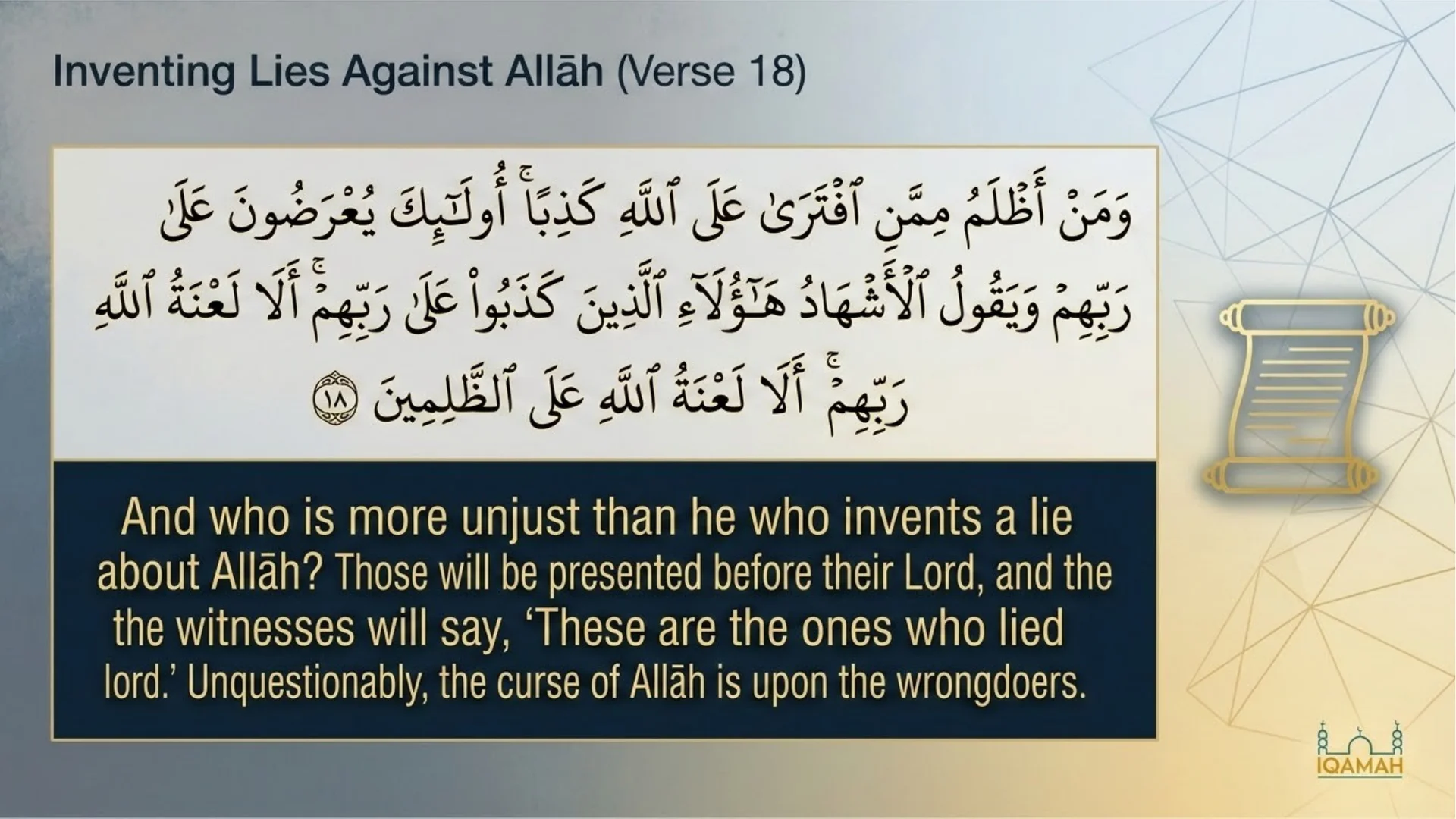
Verse 18 names the worst wrongdoing in the entire moral universe: fabrication (iftirāʾ) of lies against Allah. Saʿdī (pp. 273–274) reads it sharply: "Who could be more unjust (aẓlam) than the one who fabricates lies against Allah, attributing to Him things He did not say, claims to receive revelation when he does not, or invents a religion not authorized by Him? There is no greater wrongdoing than this." The fabrication can take many forms: claiming false prophethood, declaring lawful what Allah has prohibited or unlawful what He has permitted, attributing children or partners to Allah, claiming that one's own preferred practices are part of Islam when they are not. The verse uses the verbal structure iftarā — to compose or invent. The same verb is what the Quraysh hurled at the Prophet ﷺ in v. 13 ("they say: he has fabricated it"). The verse therefore is a sharp irony: those who accused the Prophet ﷺ of fabrication are themselves the true fabricators against Allah. Note the witnesses' testimony: "These are the ones who lied about their Lord." Not just "these are wrongdoers" — but specifically "these lied about their Lord." The lying is the indictment. The closing curse — "Allah's curse is on the wrongdoers" — is identical in structure to 11:60 (curse on ʿĀd) and 11:68 (curse on Thamūd). The Qurʾān is establishing that all fabricators against Allah end the same way.

Slide 23
Slide 23 of 31 #

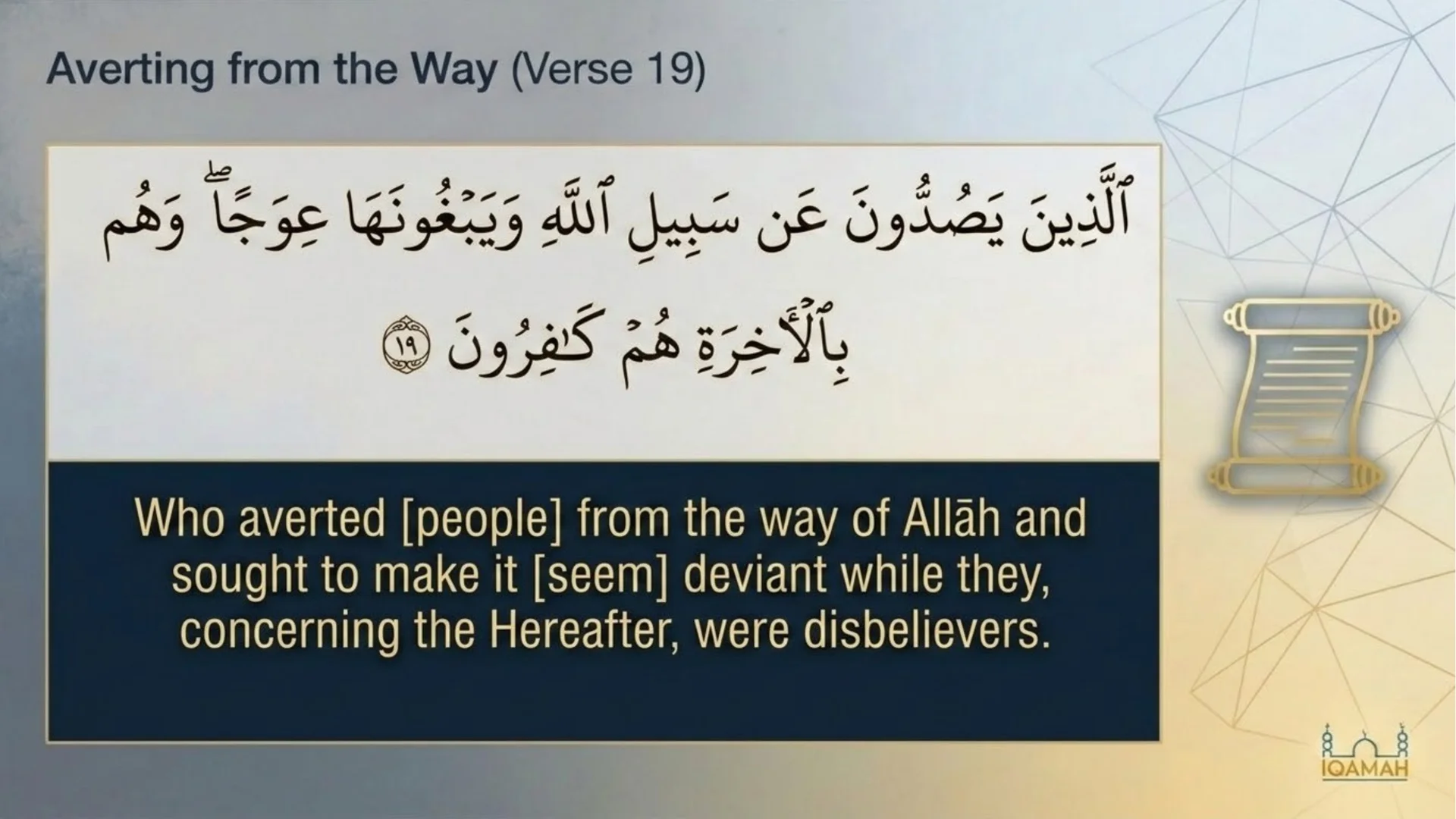
Verse 19 describes the wrongdoers of v. 18 in further detail. They are not merely people who walk away from Allah's path; they are people who actively try to bend the path itself in others' perception. Saʿdī (p. 274): "Yabghūnahā ʿiwajan — they seek to make the straight path appear crooked. They do this to confuse people, distort their understanding, and turn them away from following it." The verb yabghūnahā (they seek for it) plus ʿiwajan (crookedness) is rhetorically loaded: they are not crooked walkers but path-twisters. The image is of someone trying to convince others that the straight road is bent and the bent road is straight. Maʿāriful Qurʾān cross-references 14:3 — same construction, same diagnosis of the same disease. Contemporary application: the verse names a specific kind of corruption that goes beyond personal sin. Personal sin is the failure to walk straight; ʿiwajan-seeking is the active labor of inverting moral perception. The verse identifies the worst version of disbelief as not just refusal but propaganda. Note also: the verse pairs the active twisting with disbelief in the Hereafter. The connection is causal: those who do not believe in eschatological accountability are precisely those willing to invert the moral order, because they do not expect to be held to it. Tarbiyyah lesson: when a society undertakes systematic moral inversion — naming evil as good and good as evil — the verse names the underlying disease as disbelief in the Day of Judgement.

Slide 24
Slide 24 of 31 #

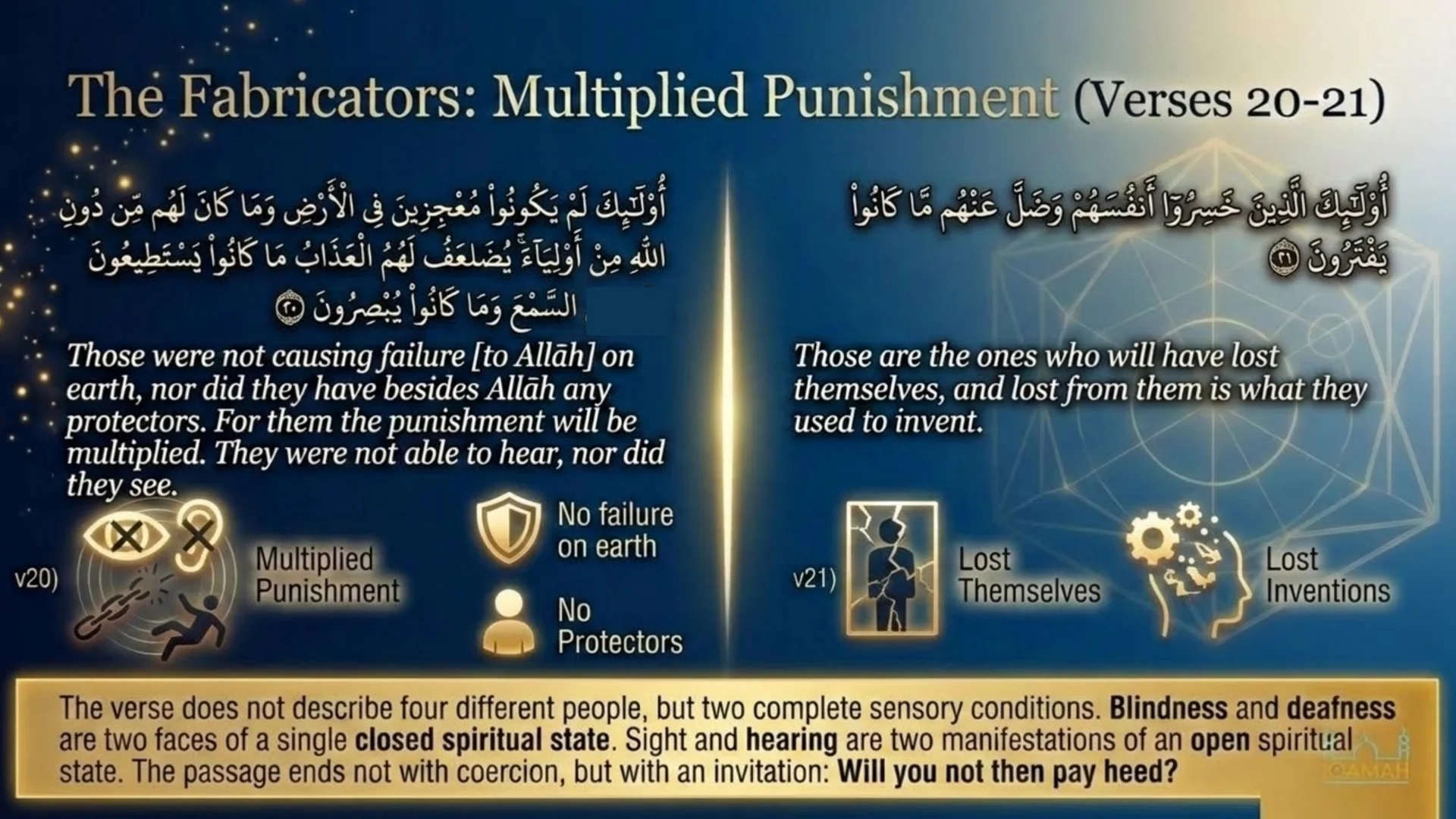
Verse 20 announces a striking principle: the punishment of v. 19's path-twisters is doubled (yuḍāʿaf lahum al-ʿadhāb). Saʿdī (p. 275) explains: "Their punishment is doubled because they themselves disbelieved, and because they led others astray. They bear their own sin and the sin of those they misled, without anything being reduced from the sins of the misled themselves." The verse states the converse of Bukhārī's famous hadith: "Whoever calls people to guidance has its reward and the reward of those who follow him, without any of their rewards being diminished." The principle is symmetric: leading others to good multiplies one's reward; leading others to evil multiplies one's punishment. Ibn Kathīr cross-references 16:25: "On the Day of Resurrection they will bear their burdens in full, and a share of the burdens of those they led astray without knowledge." The closing of v. 20 — "they could not hear, they could not see" — is significant: it anticipates v. 24's image of the blind and deaf. The verse names that the path-twisters' deafness and blindness were constitutive of their disbelief; they had ears that did not function as ears, eyes that did not function as eyes. Tarbiyyah application: the verse has direct implications for teachers, parents, and public figures. Whoever has influence has elevated responsibility. The teacher's role is therefore not neutral — it either leads to multiplied reward or multiplied punishment depending on what is taught.

Slide 25
Slide 25 of 31 #

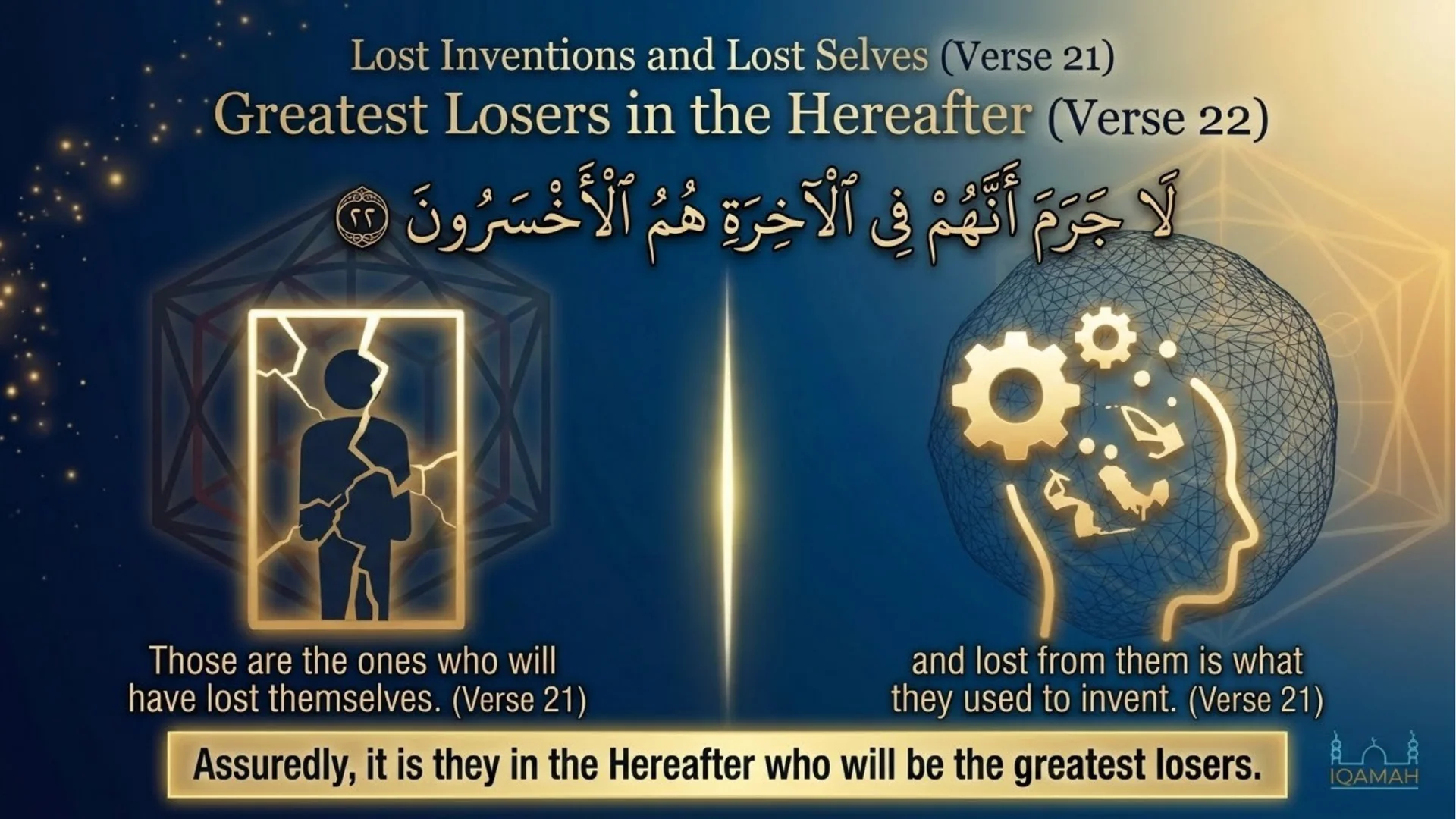
Verses 21–22 close the courtroom scene with the verdict. Saʿdī (p. 275): "They have lost themselves (khasirū anfusahum) — that is, they have lost the greatest possible thing: their own souls and salvation. And what they had invented — the false deities, the worldly aims, the corrupted teachings — has deserted them. They sought refuge in these inventions and found that the inventions cannot help them at the moment of need." The Arabic akhsarūn in v. 22 is a superlative form: not just "they are losers" but "they are the greatest of losers." Maʿāriful Qurʾān (p. 615) connects this to a haunting hadith on the Day of Resurrection: "Some who worshipped Allah in this life for the sake of being seen by others will be brought forth on that day, and Allah will say: did I not give you the praise of men in the world? Take your reward there — and they will have nothing here." The verse uses lā jarama — an emphatic asseverative — "inevitably," "necessarily," "there is no escape from the fact that." The construction is rare in the Qurʾān and reserved for unconditional truths. Cross-reference: the same superlative al-akhsarūn appears at 18:103–104 — "Shall we tell you who are the greatest losers in deeds? Those whose effort goes astray in the worldly life while they think they are doing good." The two verses share the same diagnosis: not a casual mistake, but a complete misorientation of life.

Slide 26
Slide 26 of 31 #

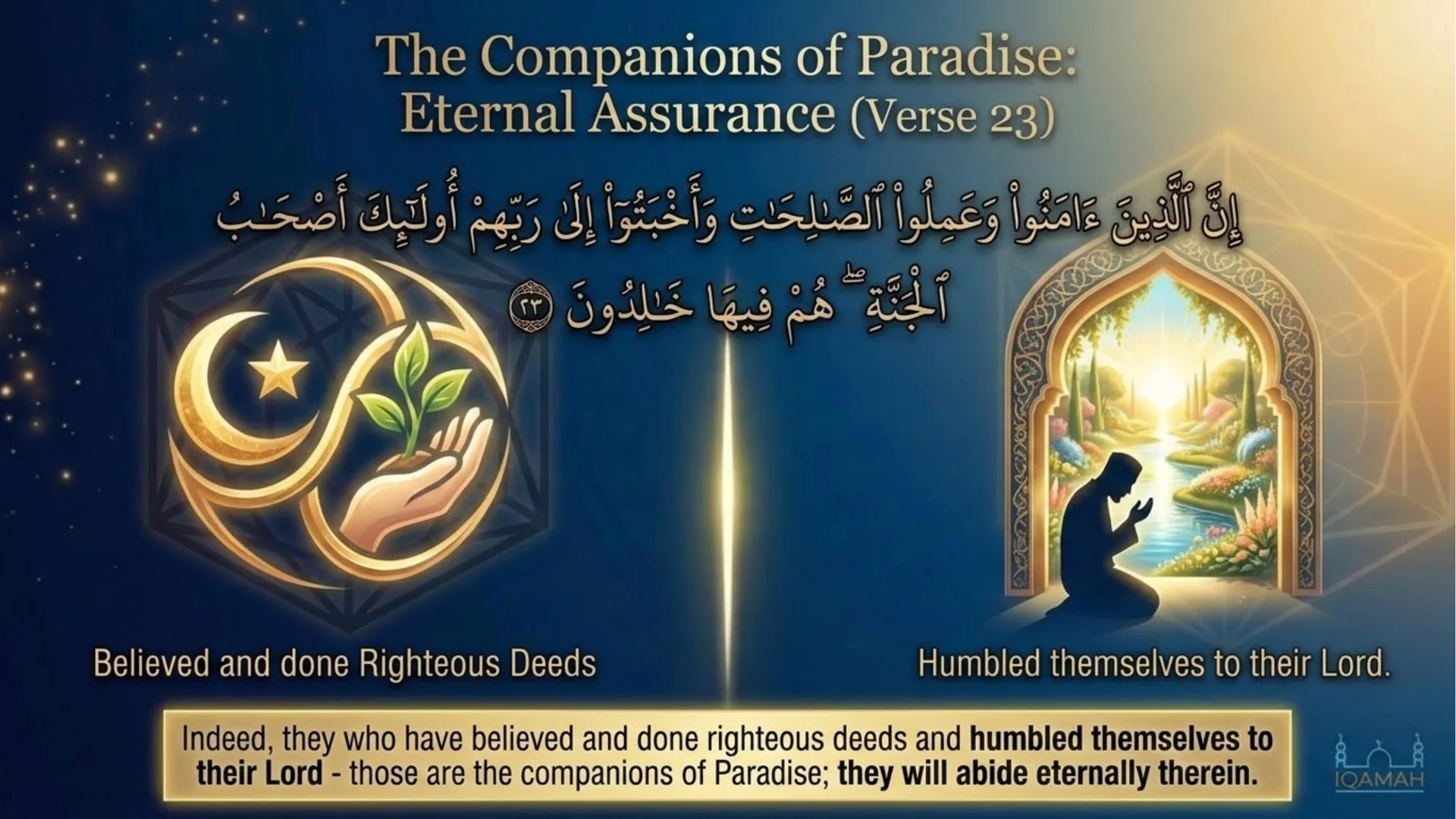
Verse 23 contrasts with vv. 18–22 by naming the opposite class: the people of paradise. Saʿdī (p. 277) identifies three conditions: (1) āmanū — they believe with their hearts; (2) ʿamilū al-ṣāliḥāt — they do righteous deeds (both obligatory and recommended); (3) akhbatū ilā rabbihim — they humble themselves before their Lord. The third condition is the deepest. The Arabic akhbata (from khabt, low ground that holds water) carries the sense of settling, becoming firmly rooted, lowering oneself. Saʿdī unpacks it: "Their hearts are tranquil in their faith — they do not waver in doubt. They love their Lord, they fear Him, they hope in Him. They acknowledge their dependence on Him." It is therefore not just humility as feeling but humility as posture — a complete bodily-spiritual orientation. Ibn al-Jawzī's commentary on this term in our other library sources records seven classical opinions on akhbatū: feared their Lord (Ibn ʿAbbās), turned back to their Lord (Qatādah), inclined toward their Lord (Mujāhid), sincere to Allah (Muqātil), humbled before Him (al-Farrāʾ), submitted (Ibn Qutaybah). All converge: it is the inward correlative of the outer righteous deed. Saʿdī's note: "The result of these three conditions is the gardens of bliss, abiding therein forever — for these qualities, by which Allah's faithful slaves are distinguished, deserve the highest and most generous of rewards."

Slide 27
Slide 27 of 31 #

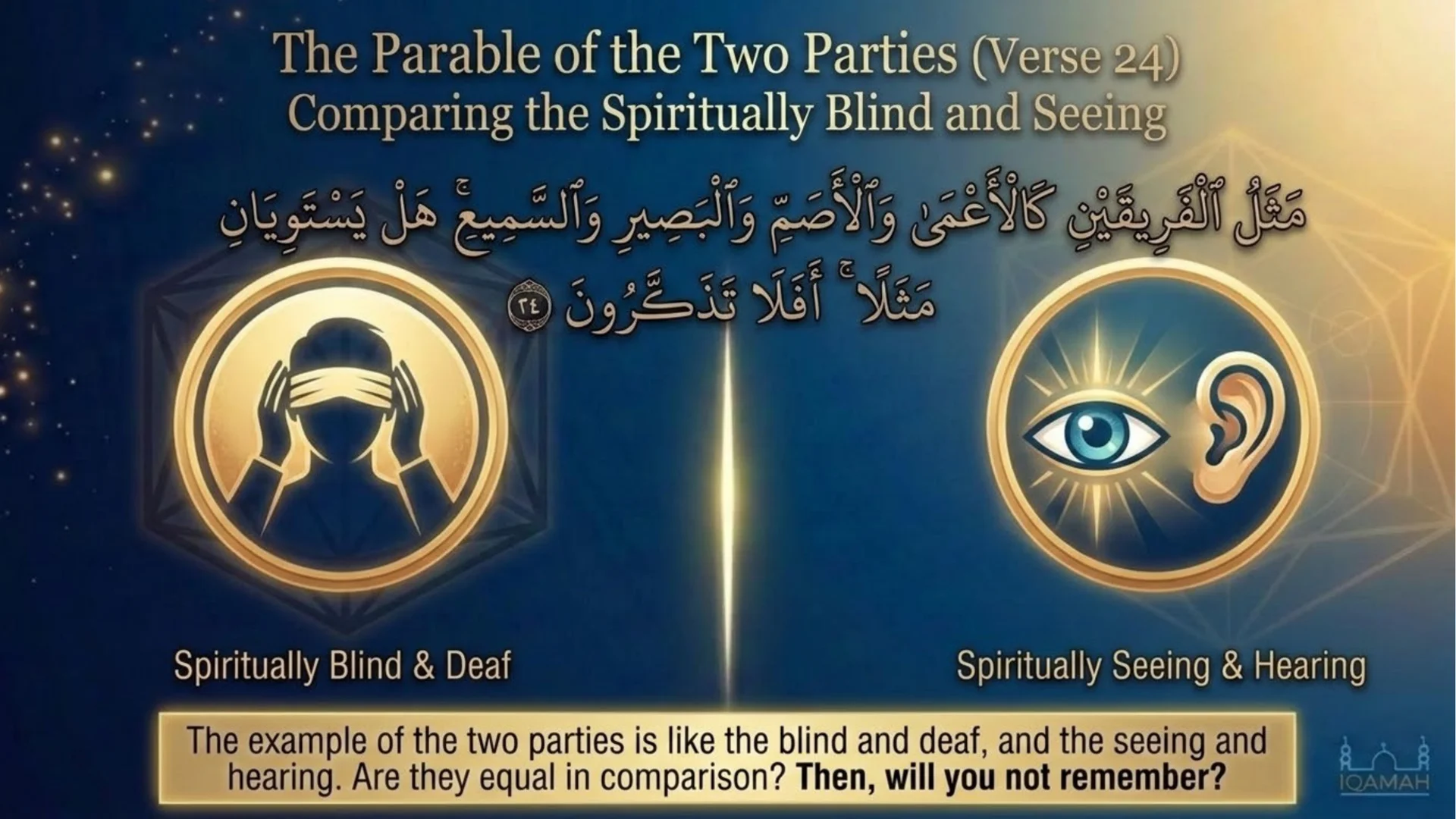
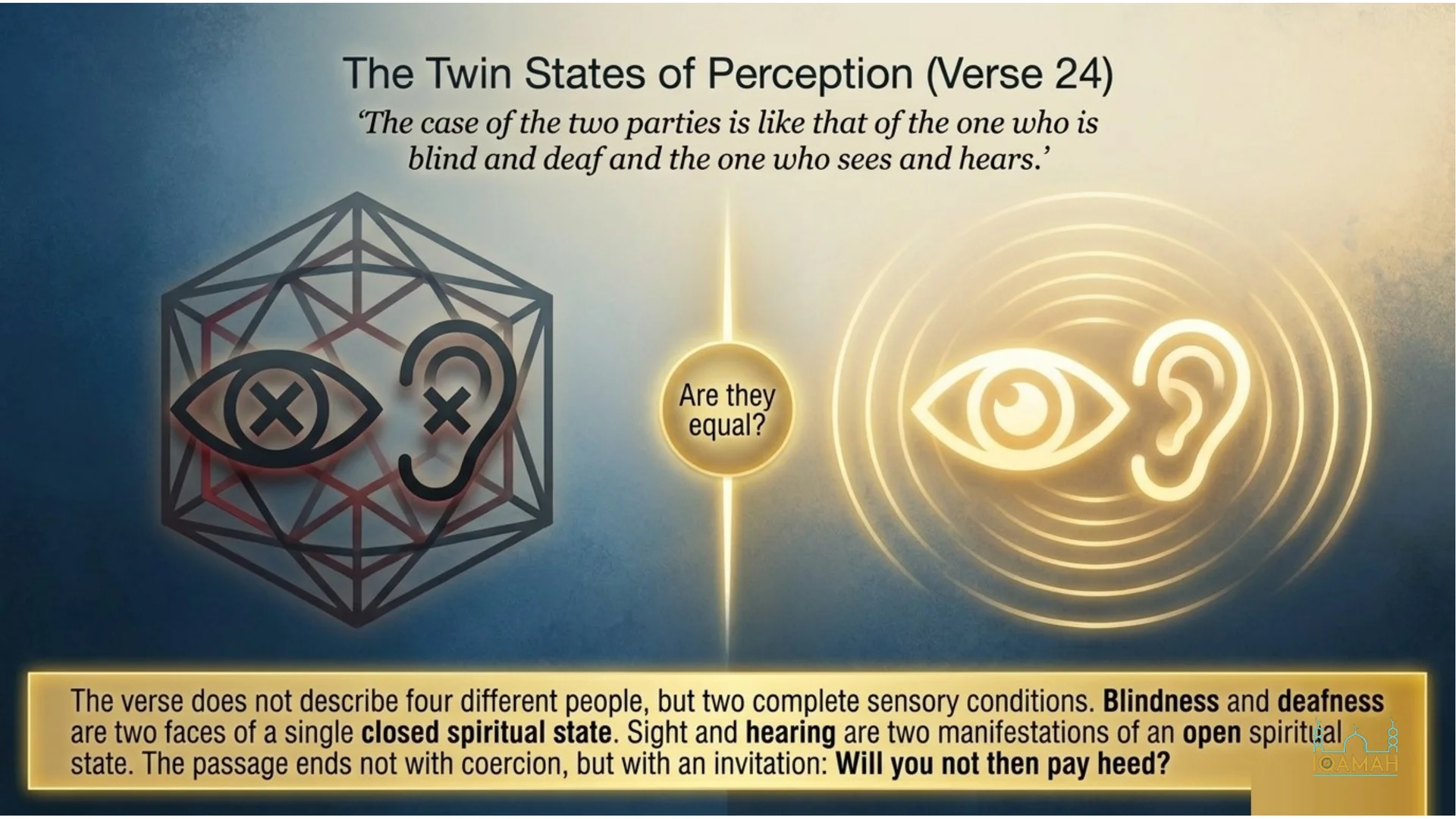
Verse 24 closes the opening 24 verses with one of the most powerful contrast-images in the entire Qurʾān. Saʿdī (p. 278) reads: "The likeness of the two groups — the doomed and the blessed — is that of one who is blind and deaf (the doomed) and one who sees and hears (the blessed). Are they equal? They are not equal; rather the difference between them is indescribable. Will you not then take heed — to the deeds that will benefit you, so that you do them, and to the deeds that will harm you, so that you refrain from them?" The contrast uses two pairs: al-aʿmā (the blind) plus al-aṣamm (the deaf) versus al-baṣīr (the seer) plus al-samīʿ (the hearer). The image is not of two ordinary persons but of two complete sensory conditions. Maʿāriful Qurʾān (pp. 618–619) is sharp on this point: a person who has neither sight nor hearing has effectively no access to the world. The disbeliever is in this condition vis-à-vis the spiritual world — not partially blind, but blind; not partially deaf, but deaf. The believer is the opposite: fully seeing, fully hearing. The image refuses gradation. Cross-reference to 35:19–22: "Not equal are the blind and the seeing, nor the depths of darkness and the light, nor the shade and the heat, nor are the living and the dead." The Qurʾānic image-cluster of contrast-pairs is consistent across sūrahs — the believer and the disbeliever are not on a spectrum but in two qualitatively different states.

Slide 28
Slide 28 of 31 #

Ibn al-Jawzī (Zād al-Masīr, vol. 7, p. 230) preserves a rare and beautiful grammatical observation from Ibn al-Anbārī about v. 24. The verse names four attributes — blind, deaf, seeing, hearing — and yet the verb takes the singular predicate. Ibn al-Anbārī asks why this is, and answers: "al-aʿmā and al-aṣamm are two attributes for the disbeliever; al-samīʿ and al-baṣīr are two attributes for the believer. The verb has been singularized in reference to the persons described with all four attributes — as one says: 'the wise man (al-ʿāqil) and the just (al-ʿālim), the ignorant (al-jāhil) and the unjust (al-ẓālim), were present at my gathering'. The predicate comes back as singular after listing four attributes, because the wise is the same person as the just, and the ignorant is the same person as the unjust. So even though the attributes are four, the persons described are two." Lesson: this grammatical point has real spiritual weight. Blindness and deafness are not two separate failures — they are two faces of one condition. Likewise, sight and hearing are not two separate gifts but two manifestations of one state. The verse therefore is not naming four kinds of people but two: the spiritually shut, and the spiritually open. Each condition closes (or opens) both faculties at once. The disbeliever does not have a partial spiritual disability — he has a complete one. And the believer does not have a partial spiritual gift — he has a complete one.

Slide 29
Slide 29 of 31 #

The Ultimate Recompense Matrix, stages the two opposing paths set out in the third movement of the sūrah, verses 15 through 24.1 The Worldly Aimer (Verses 15–16): This person limits all their aspirations to the life and adornments of this world, not aspiring to the Hereafter at all. The Qurʾān notes that these deeds are paid in full in this life. The verb nuwaffi ("We pay in full") carries the grim implication that the entire bill for any good deeds is settled here, leaving nothing for eternity, and rendering all their worldly actions worthless and vain. This diagnosis applies universally, including as a warning to nominal Muslims whose orientation is wrong or those who perform religious deeds for worldly reputation (riyāʾ).12 The Person of Proof (Verse 17): This person takes their stand on a Bayyinah (clear proof) from their Lord. This is the universal posture of the believing prophet—standing on inner certainty derived from revelation, enduring hostility with patience.21 The Ultimate Recompense (Verse 23): The saved class is defined by three conditions: they āmanū (believe with their hearts), they ʿamilū al-ṣāliḥāt (do righteous deeds), and they akhbatū ilā rabbihim (humble themselves before their Lord). The term akhbatū signifies that their hearts are tranquil and firmly rooted in faith, a complete spiritual orientation of lowliness. The result of these three qualities is admittance to the gardens of bliss, where they abide forever.1 The Final Contrast (Verse 24): The passage closes by contrasting the two parties with the image of the blind and deaf against the seer and hearer. Blindness and deafness are presented not as separate failures, but as two faces of a single, complete closed spiritual state, whereas sight and hearing are two manifestations of one open spiritual state. The two groups are therefore in qualitatively different states of existence.1

Slide 30
Slide 30 of 31 #

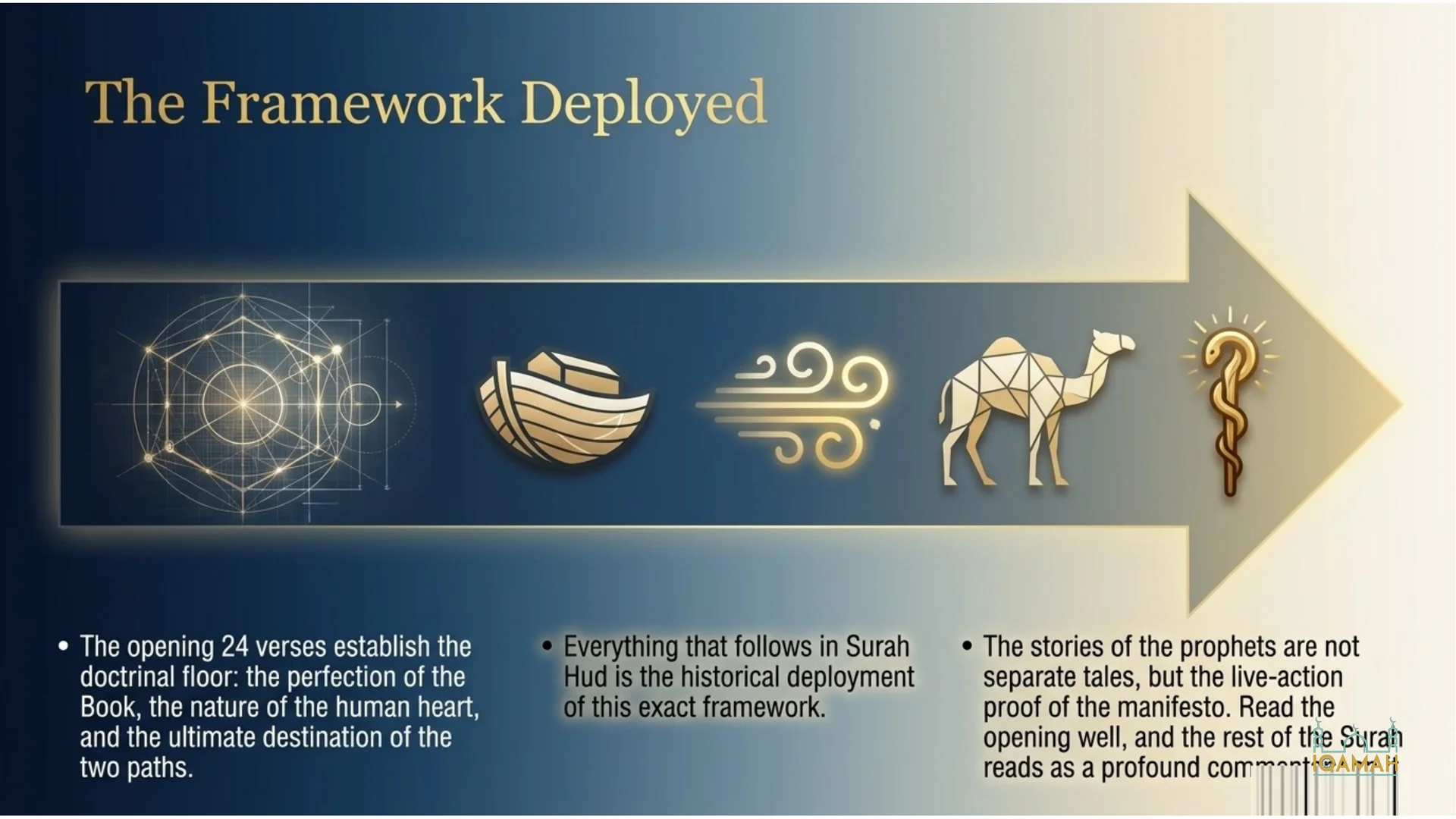
Recap: the entire passage is one continuous argument. Verses 1–4 stated the doctrinal floor: a perfected, detailed Book; worship Him alone; seek His forgiveness and turn to Him; return to Him. Verses 5–8 located the human being inside a universe that knows him through and through (v. 5), provides for every life including his (v. 6), is staged for his moral testing (v. 7), and whose consequences are real even when delayed (v. 8). Verses 9–11 diagnosed his typical instability under the cycle of blessing and trial — and named the exception: those who are patient and do good. Verses 12–17 staged the prophetic challenge against Quraysh objections and identified the two paths — the worldly aim (vv. 15–16) versus the path of revealed proof (v. 17). Verses 18–22 closed with the courtroom of Akhirah: fabricators of lies, path-twisters, doubled punishment, the greatest losers. Verses 23–24 named the saved class — those who believe, do righteous deeds, and humble themselves before their Lord — and ended with a single image: the blind and deaf against the seer and hearer. Note: every prophet-story that follows in the sūrah — Nūḥ, Hūd, Ṣāliḥ, Ibrāhīm, Lūṭ, Shuʿayb, Mūsā — is a historical instantiation of the doctrinal claims set out in these 24 verses. The opening passage is not preamble; it is the entire argument, of which the prophet-stories are the demonstrations.

Slide 31
Slide 31 of 31 #

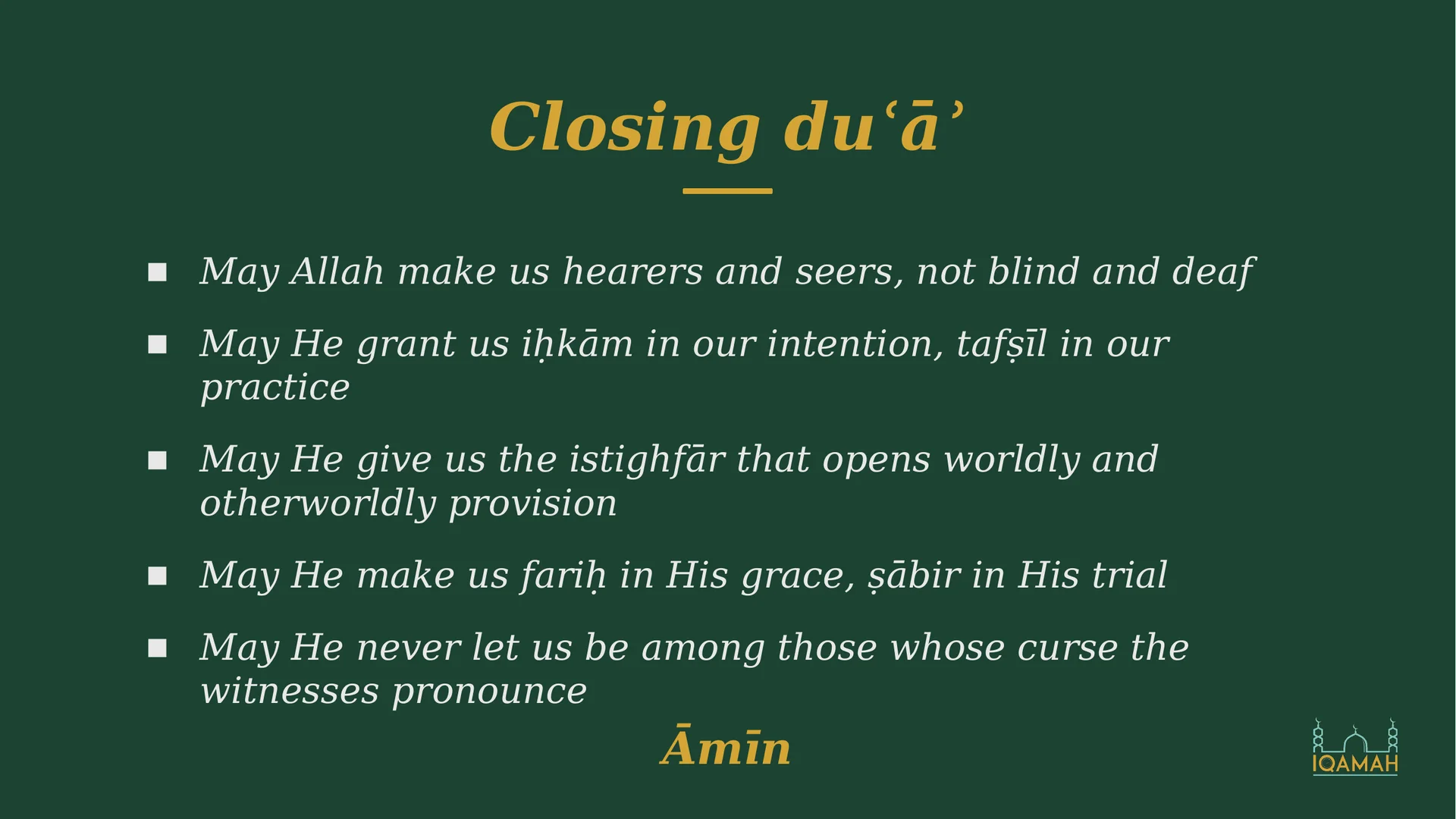
Yā Allāh, You who revealed this Book muḥkam and fuṣṣilat — make our intentions muḥkam in their orientation toward You, and our practice fuṣṣilat in its concrete details. Yā Rabbanā, give us the istighfār that opens the heavens and the tawbah that turns the heart. Let us not fold our breasts against Your seeing; instead, let us akhbat before You, settled and open and ready. Make us fariḥ in Your grace and ṣābir in Your trial, and let us be neither yaʾūs in loss nor fakhūr in plenty. Make us doers of deeds that are akhlaṣ and aṣwab — most sincere and most correct. On the Day when the witnesses are called, let us not be among those of whom they say kadhabū ʿalā rabbihim — they lied against their Lord. Rather, let us be among the people of v. 23 — those who believe, do righteous deeds, and humble themselves before You. Let us be of those who see and hear, not those who are blind and deaf. Āmīn.

About this series

This is the first session in a planned five-part series walking through the tafsir of Sūrah Hūd. Each part builds on the previous: Part 1 establishes the framework of vv. 1–24; subsequent parts treat the prophet-stories that follow (Nūḥ, Hūd and ʿĀd, Ṣāliḥ, Shuʿayb, and Mūsā), and the closing exhortation. Subscribe to launch updates via the Iqamah homepage to be notified when later parts are published.

  1. 1
    An Illuminated Framework vv. 1–24 — Doctrinal core, cosmic context, prophetic challenge
    You are here
  2. 2
    Coming soon Nūḥ's daʿwah and the burden of revelation
  3. 3
    Coming soon Hūd, Ṣāliḥ, and the consequences of refusing tawḥīd
  4. 4
    Coming soon Shuʿayb and Madyan — worship and ethics
  5. 5
    Coming soon Mūsā, Pharaoh, and the closing istiqāmah