Bismillah hir Rahman nir Raheem. Nahmaduhu wa nusalli 'ala Rasulihil Kareem. Assalamu Alaikum wa Rahmatullahi wa Barakatuh. Welcome, respected brothers and sisters. Today, we are embarking on a journey of Tadabbur—deep reflection—into the absolute miracle, the I'jaz, of the Quran. We'll be looking at 'Iltifaat', a profound linguistic feature that shows us how Allah (SWT) doesn't just give us information, but shifts our perspective to awaken our hearts.
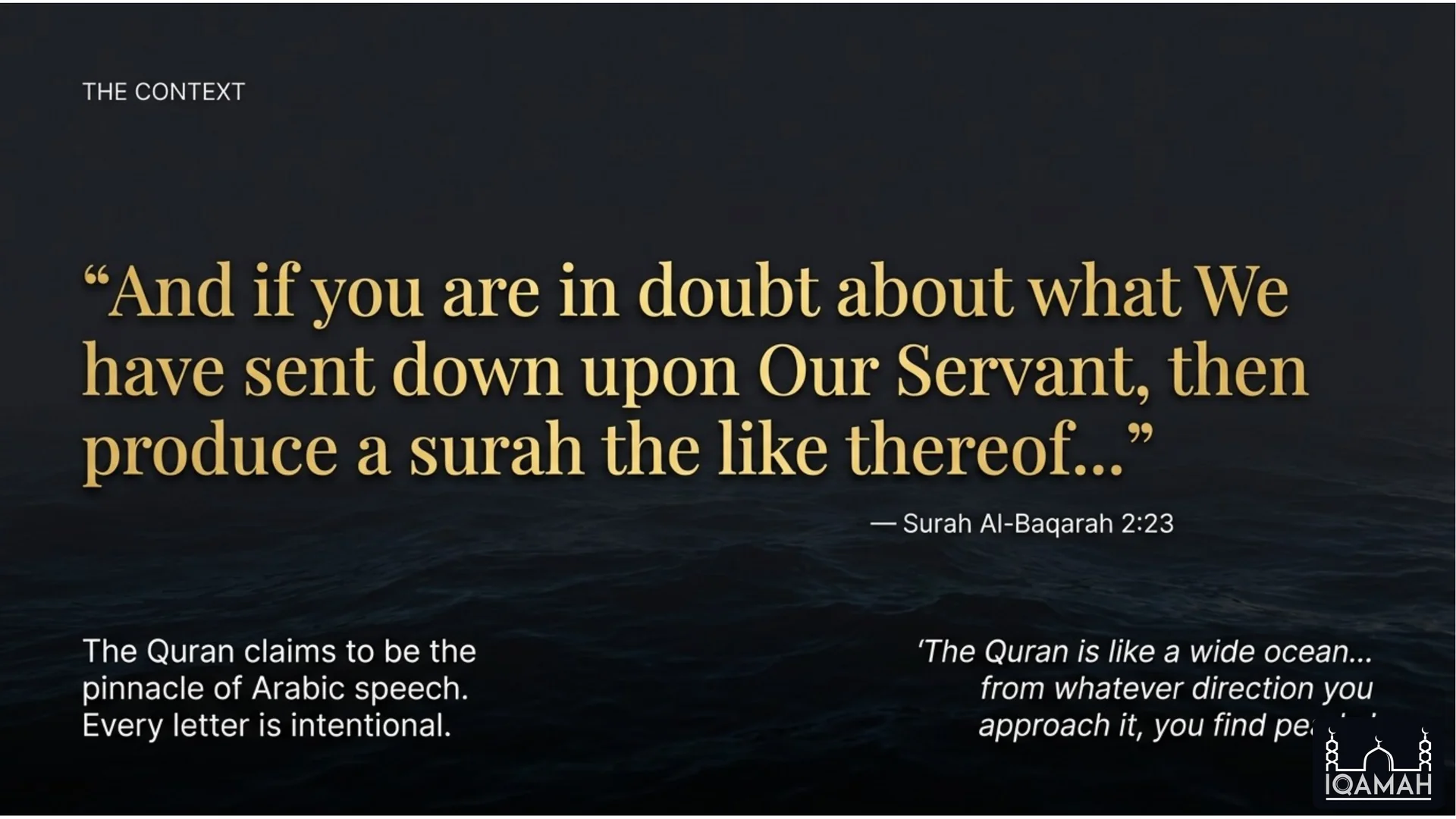
Before we dive into an Ayah, we must remind ourselves of the Mu'jiza (miracle) of this Book. The Quran challenges all of humanity in Surah Al-Baqarah: produce even a single surah like it. It is the absolute pinnacle of Balagha (eloquence). Our classical 'Ulama used to say the Quran is like a limitless ocean—wherever you dive, you find pearls. In the Kalaam-e-Ilahi (Word of Allah), every single harf (letter) and pronoun is placed with divine precision
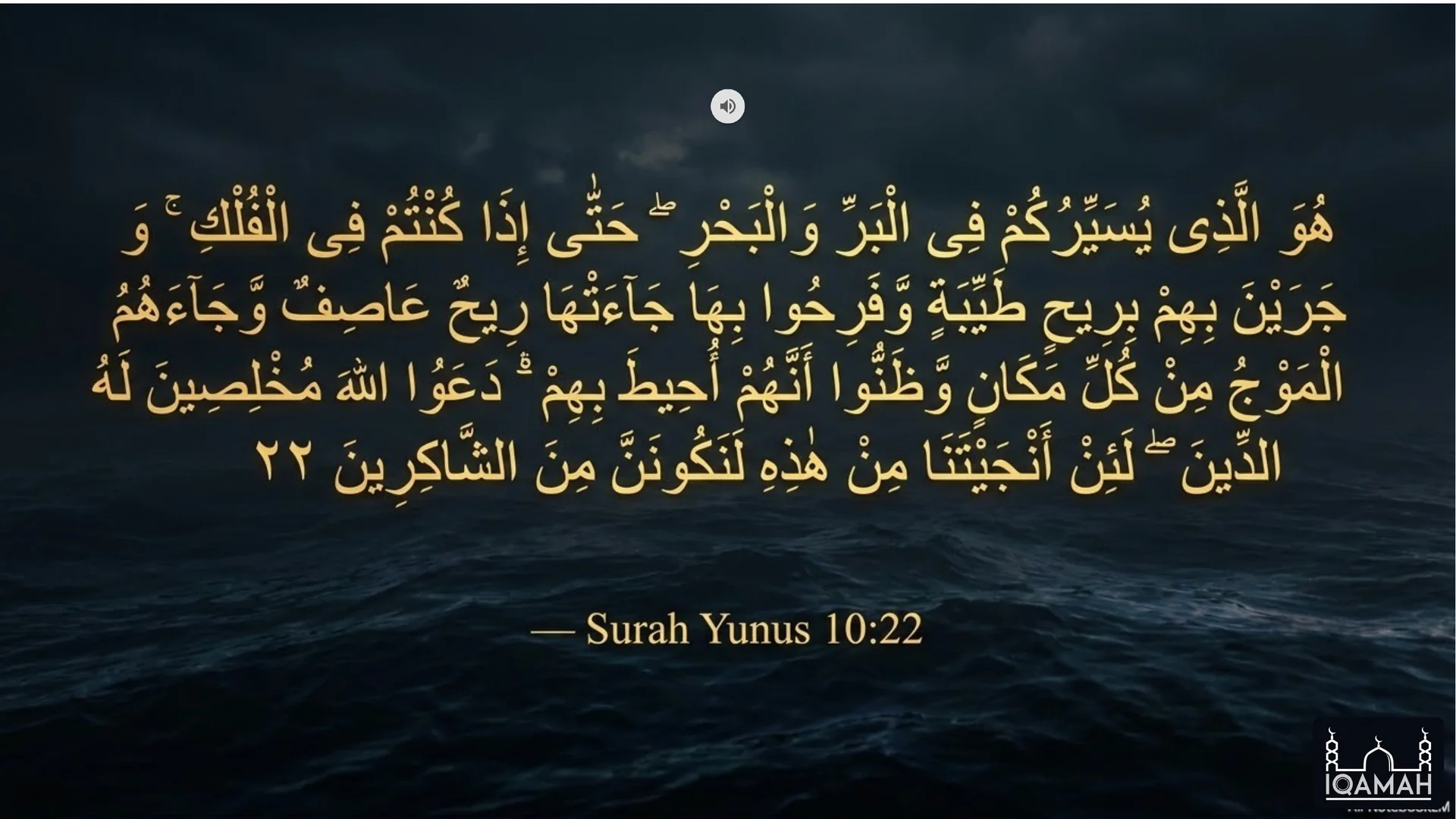
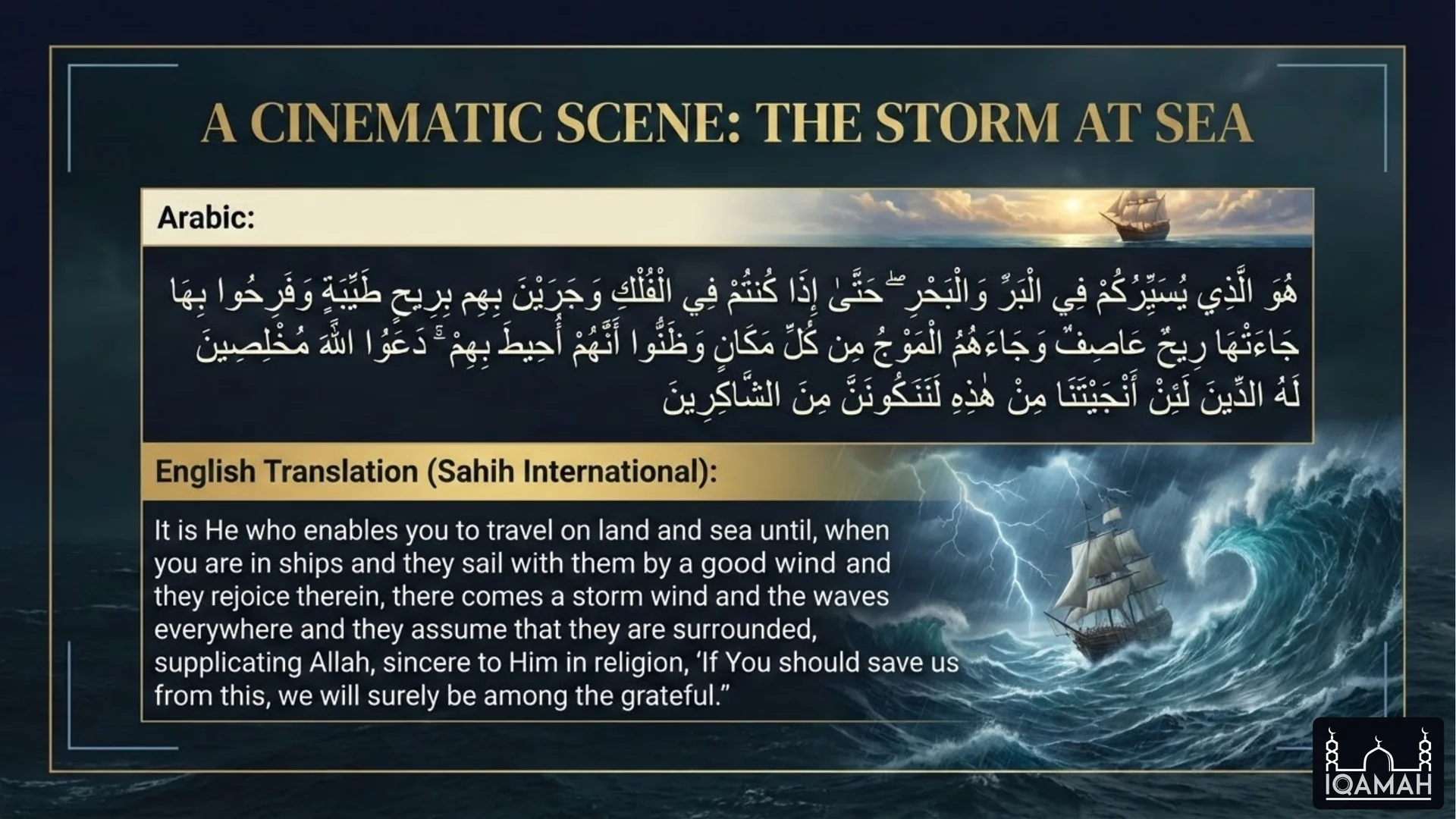
Let’s look at one of these magnificent pearls from Surah Yunus, Ayah 22. For those who read Arabic, please follow along with the Tilawah (recitation).
This slide presents the verse for tilāwah; no speaker notes attached.
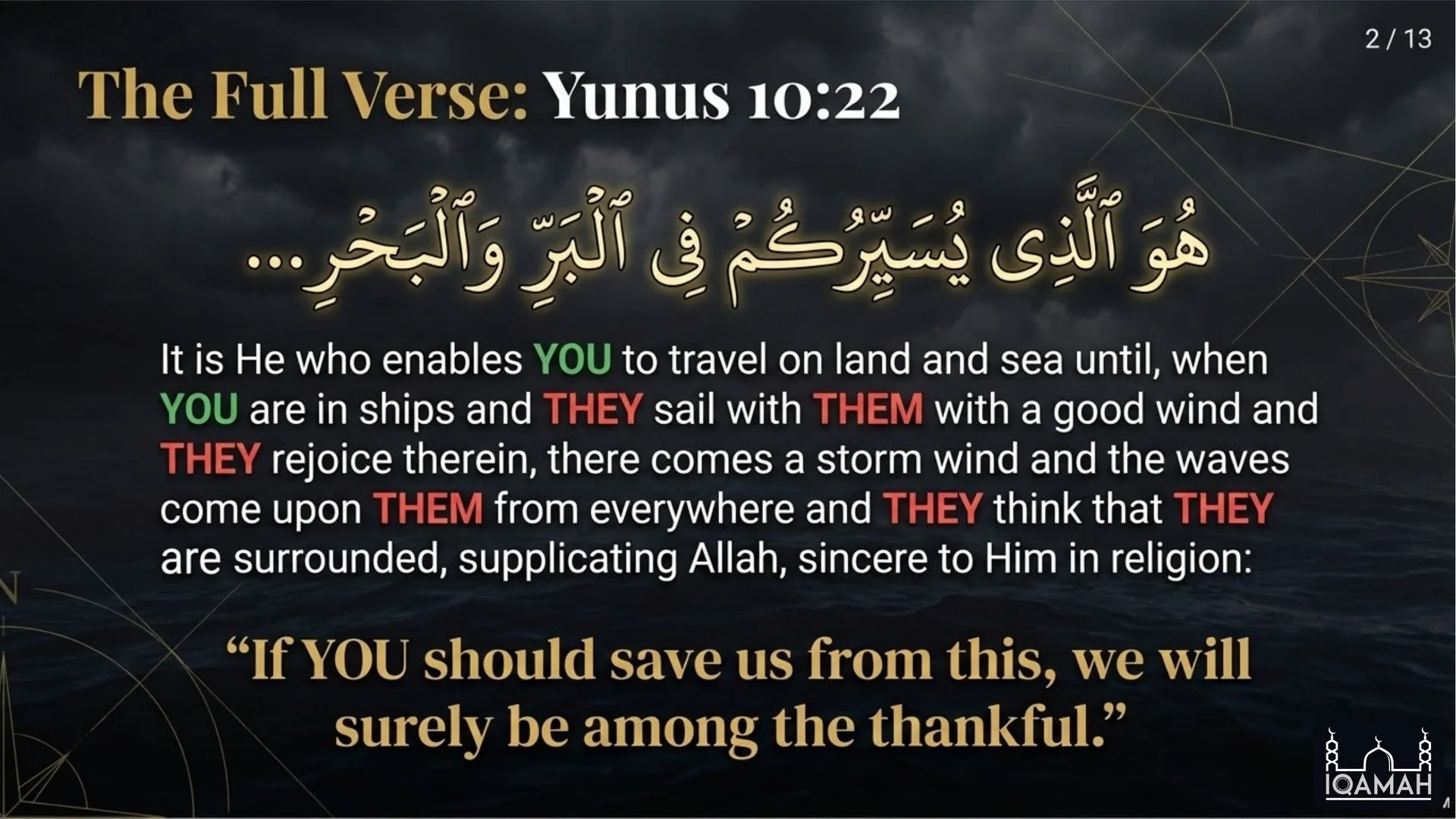
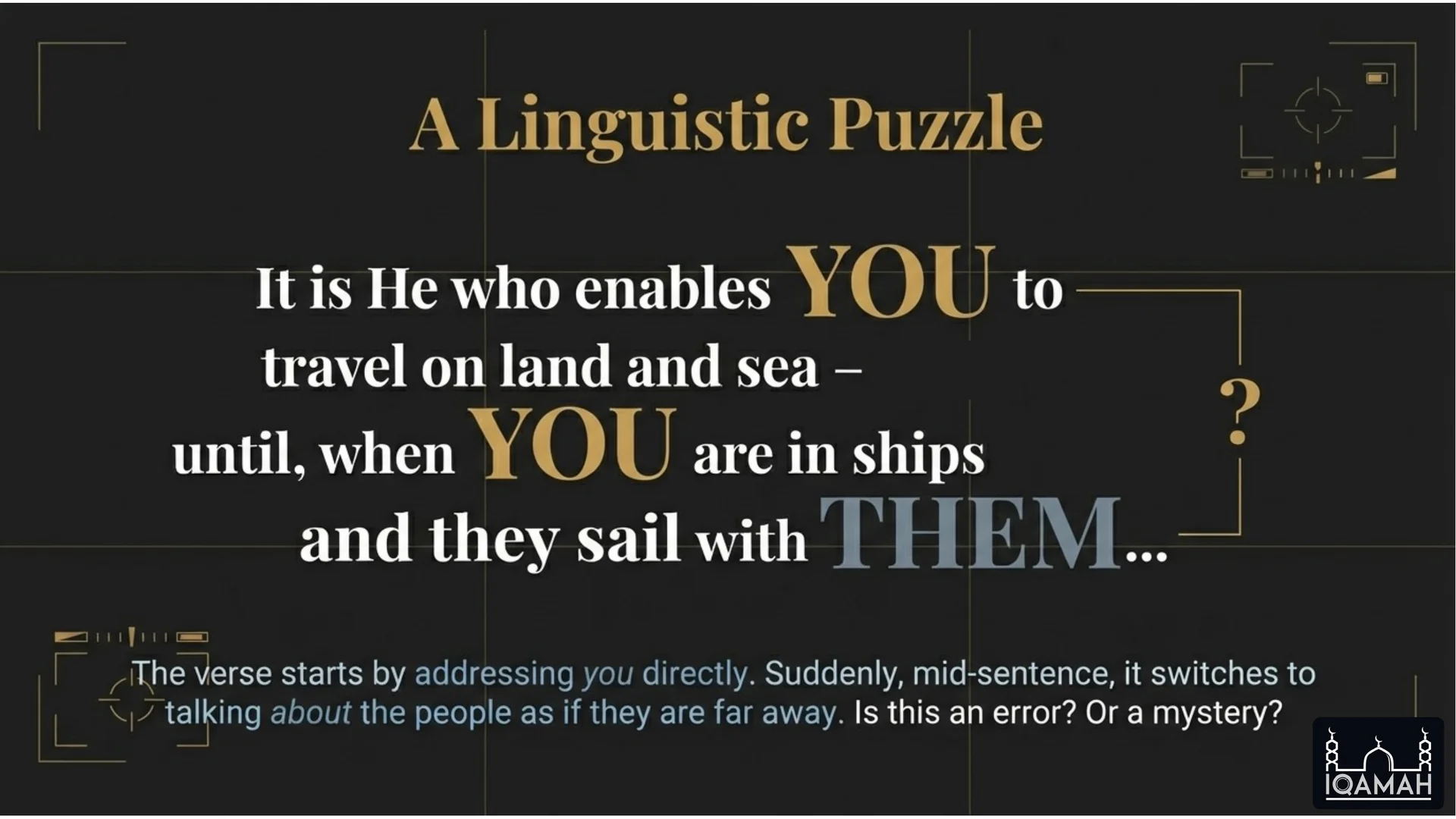
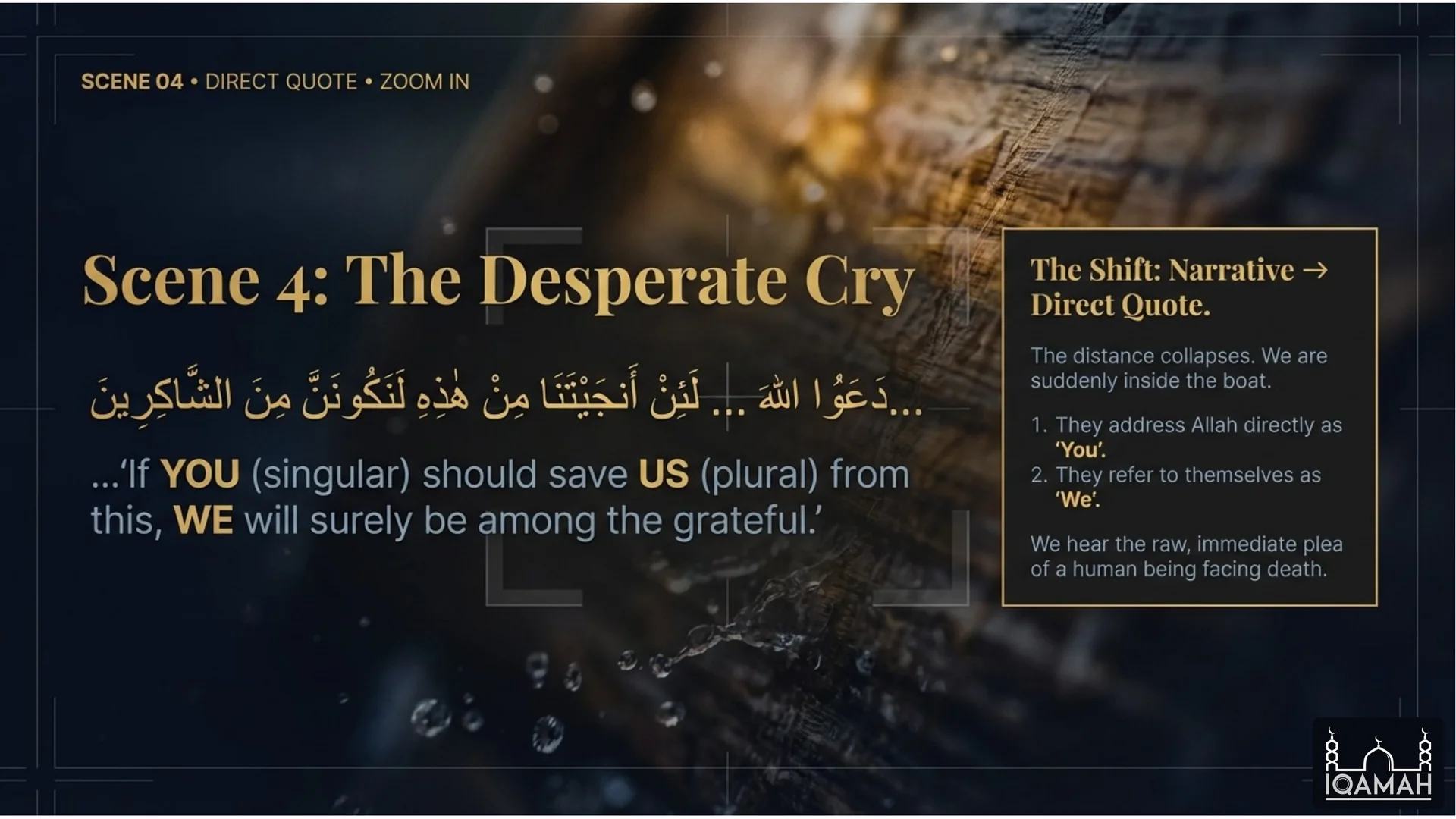
Here is the translation. I want you to pay close attention to the highlighted pronouns. 'It is He who enables YOU to travel... until, when YOU are in ships and THEY sail with THEM... and THEY rejoice... waves come upon THEM... THEY think that THEY are surrounded...' and finally, in their desperation, 'If YOU should save US... WE will surely be among the thankful'.
Now, if you are reading this carefully, you immediately encounter a profound puzzle. The Ayah starts by addressing 'YOU' directly. But suddenly, right in the middle, Allah (SWT) switches to talking about the people as 'THEM'—as if they are suddenly far away. To a secular linguist, this might look like a grammatical break. But in the Kalaam of Allah, what is the divine Hikmah (wisdom) here? SubhanAllah, there is a deep lesson.
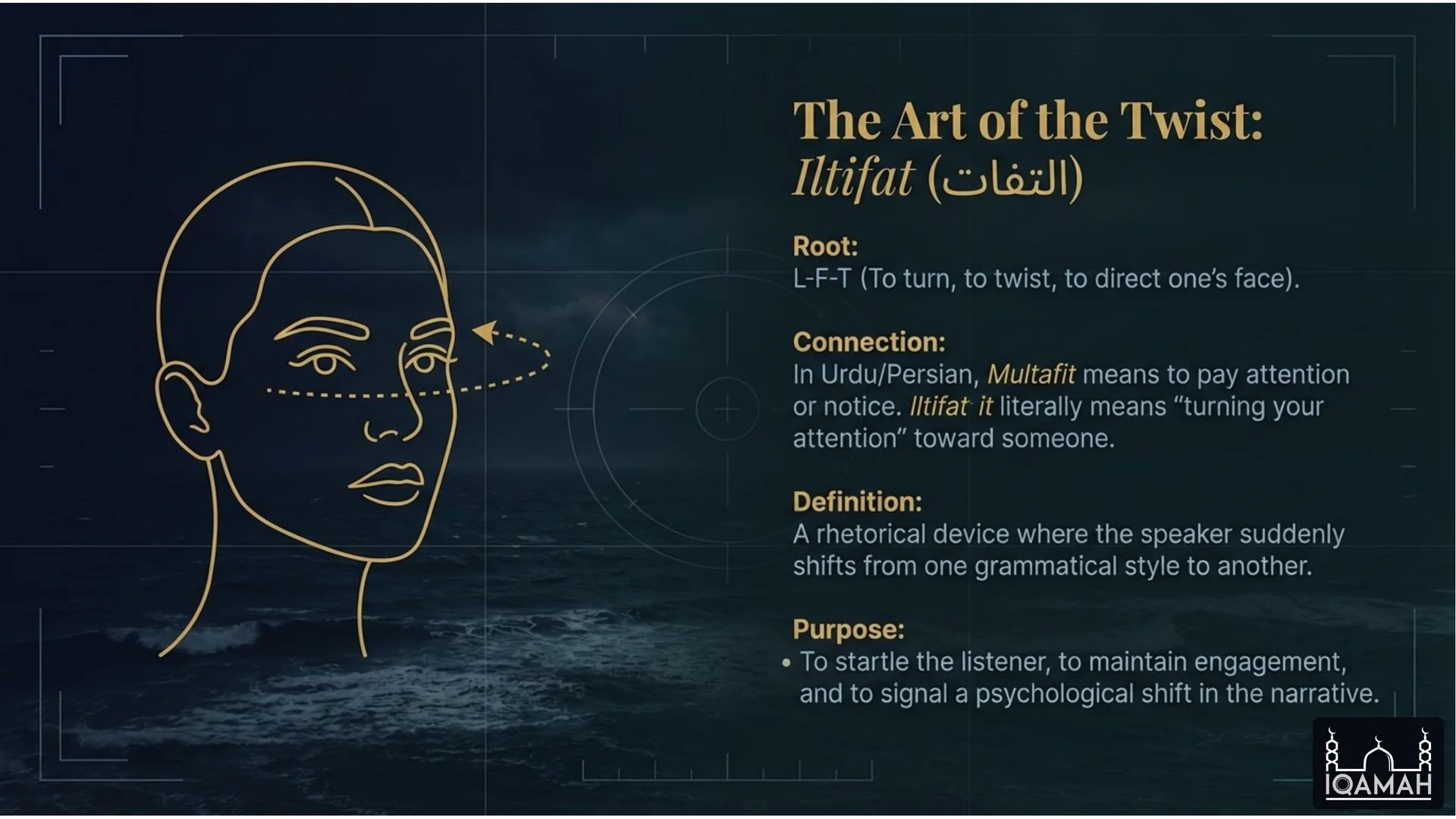
This is a highly advanced, miraculous rhetorical device known as Iltifaat. The root is L-F-T, which means to turn, to twist, or to direct one's face toward something. Those of us who speak Urdu or Persian know the word Multafit (ملتفت)—when someone pays attention or turns their gaze to you. Iltifaat is a sudden shift in grammar. Why? To wake the listener up from Ghaflah (heedlessness), to keep the heart engaged, and to signal a massive psychological shift in the Manzar (scene).
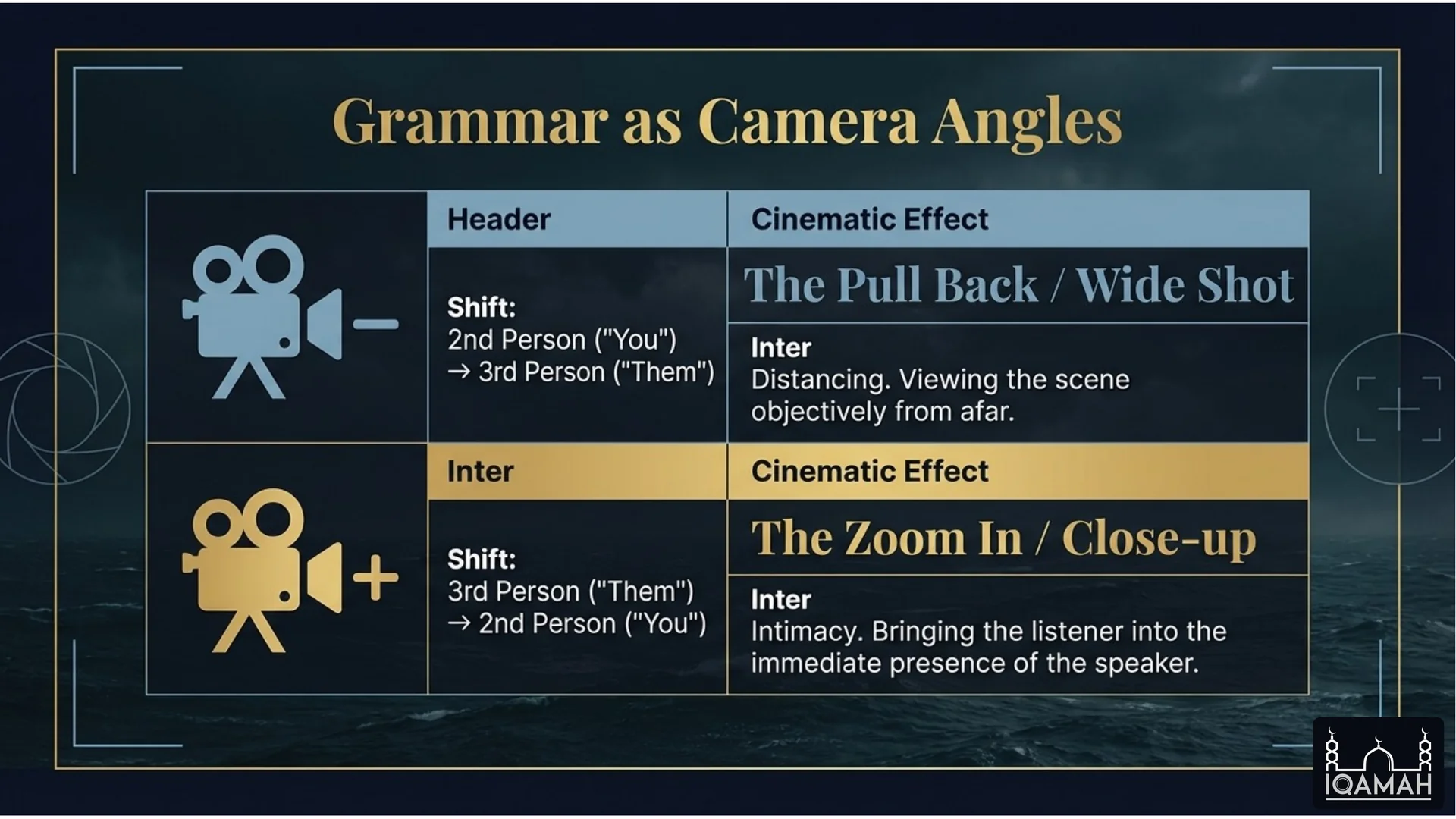
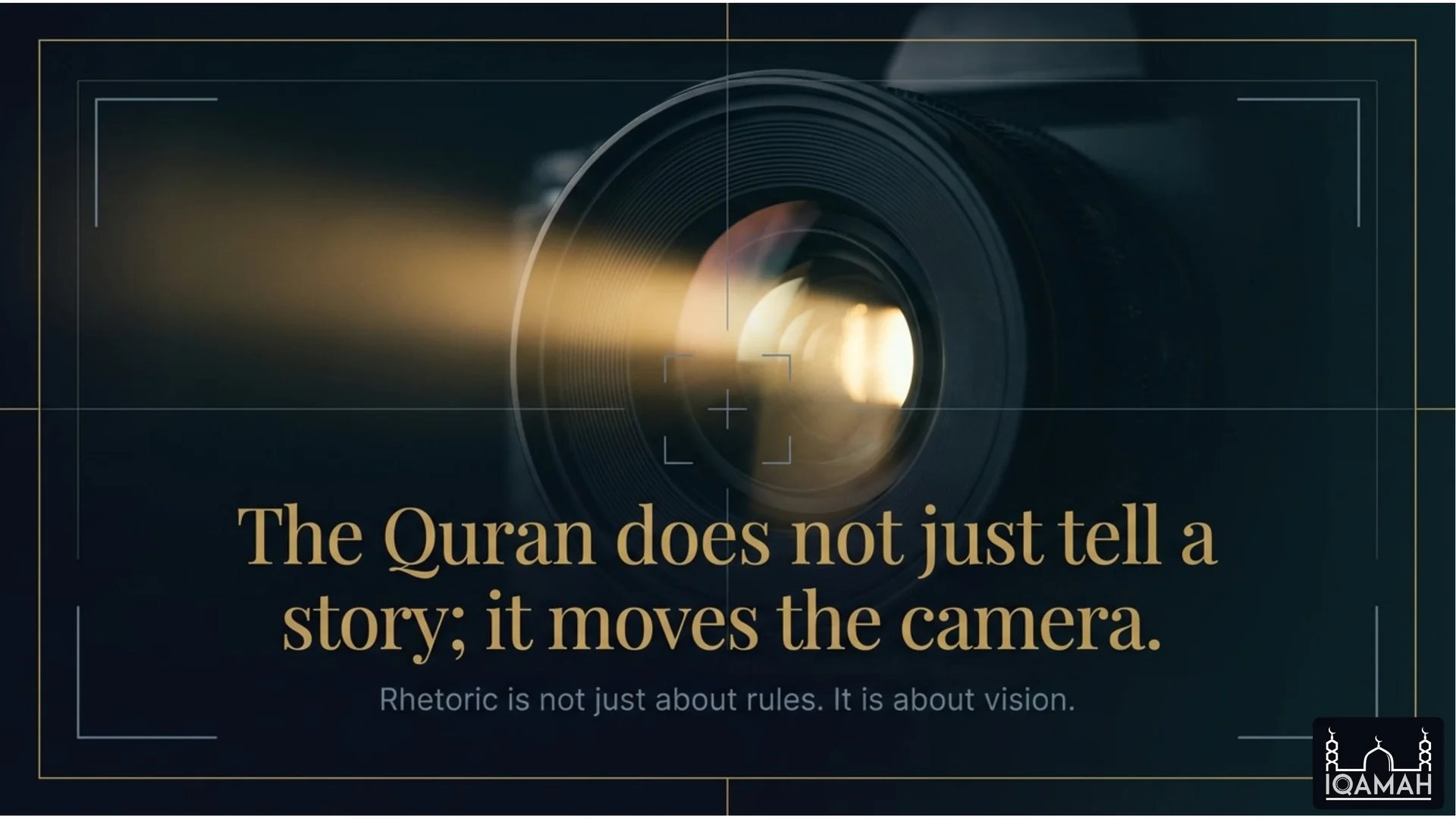
To truly appreciate Iltifaat, think of it like the lens of your own heart or a cinematic camera. When Allah shifts from the 2nd person ('You') to the 3rd person ('Them'), it is a distancing effect. It’s as if Allah is pulling away, showing His displeasure. Conversely, shifting from 'Them' to 'You' is an incredible zooming in, bringing the slave into the intimate, immediate presence of Rab-ul-Aalameen.
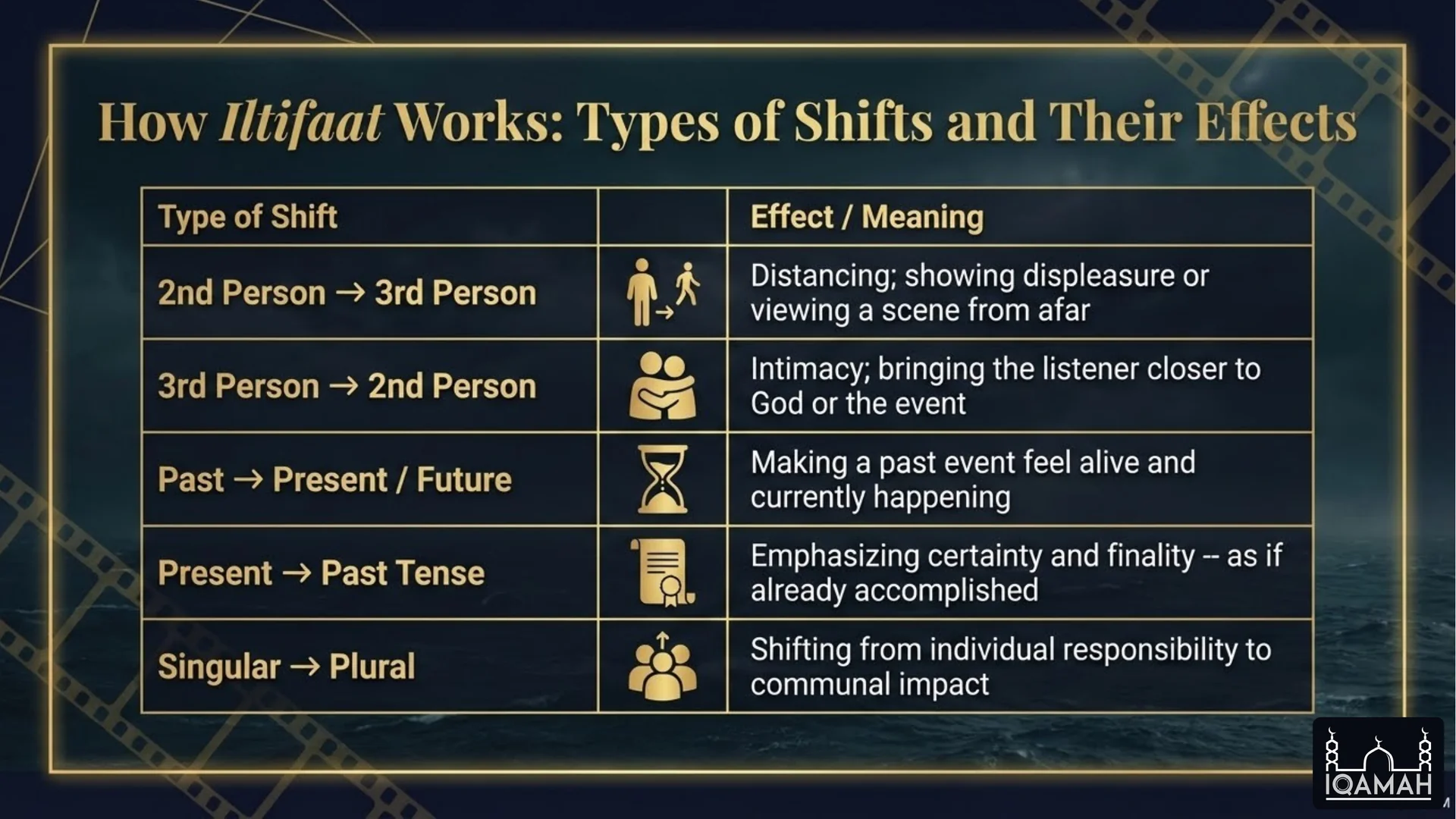
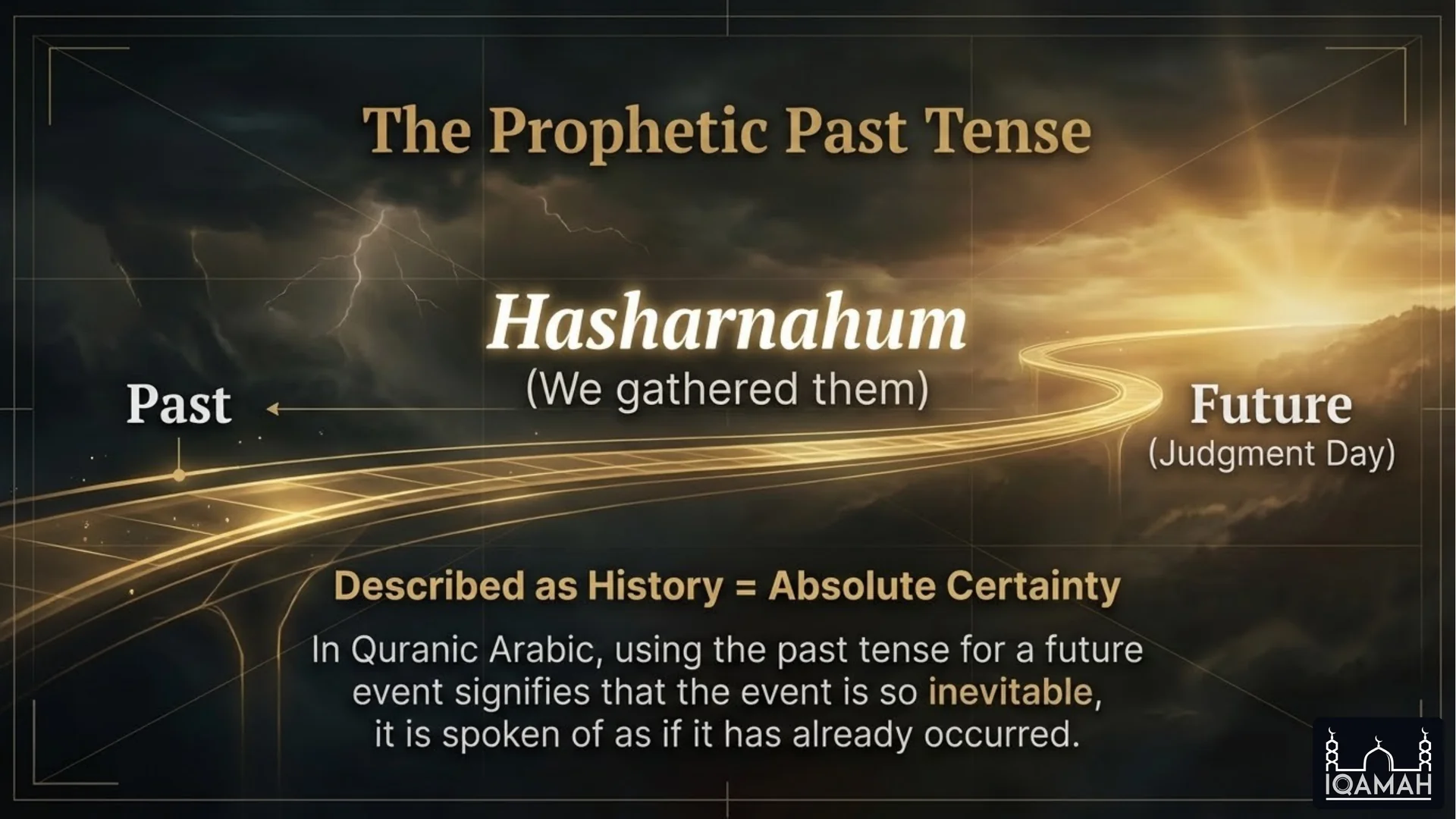
Here is how this divine lens operates. A shift to the 3rd person creates distance or shows divine displeasure. A shift to the 2nd person creates Qurb (intimacy and closeness). Shifting from the past tense to the present or future makes an event feel alive and immediate. And shifting to the past tense for a future event—like Qiyamah—emphasizes absolute, undeniable certainty (Yaqeen).
Let's put on these '3D glasses' of Balagha and return to the boat in Surah Yunus to witness this miracle scene by scene.
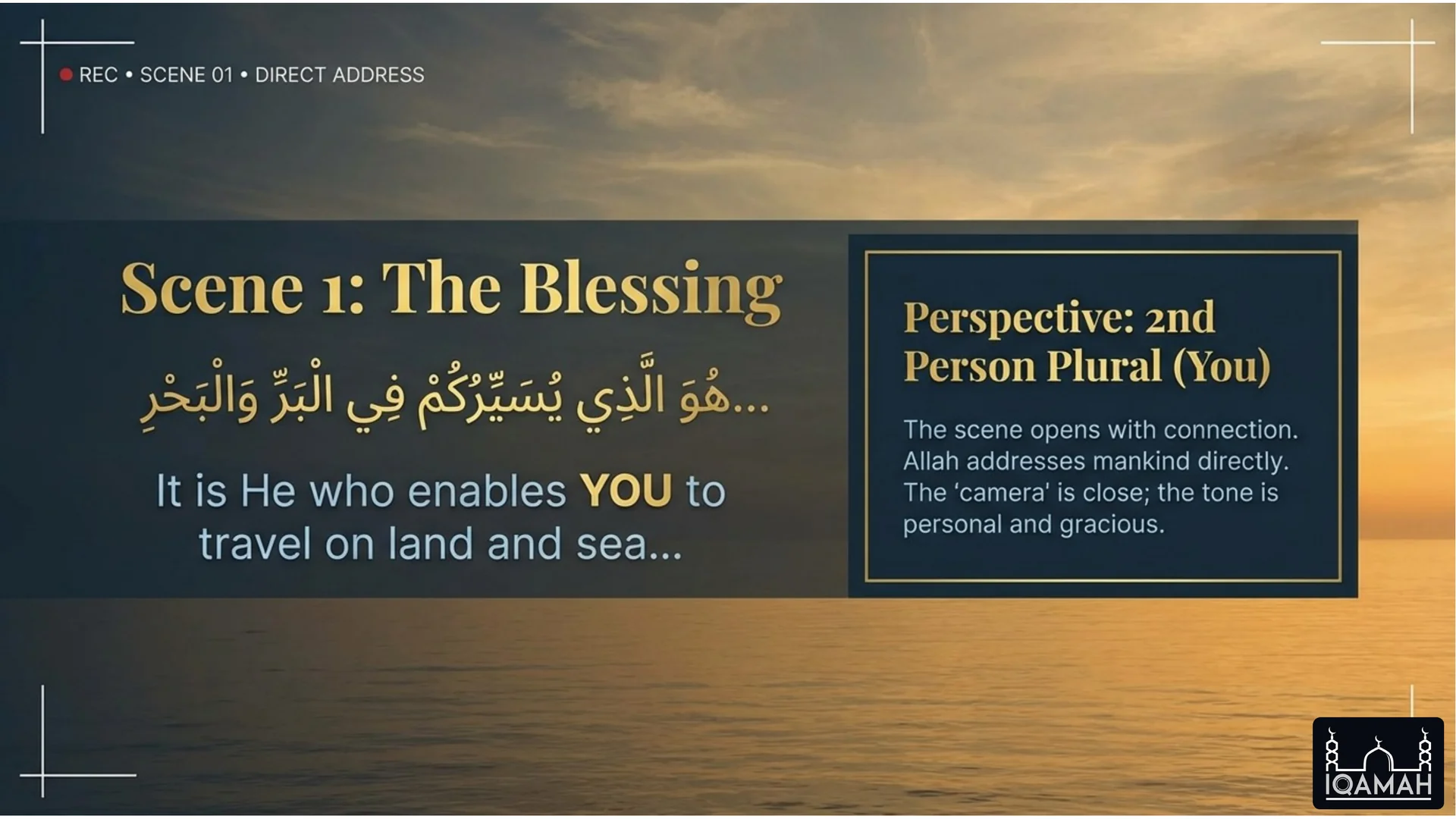
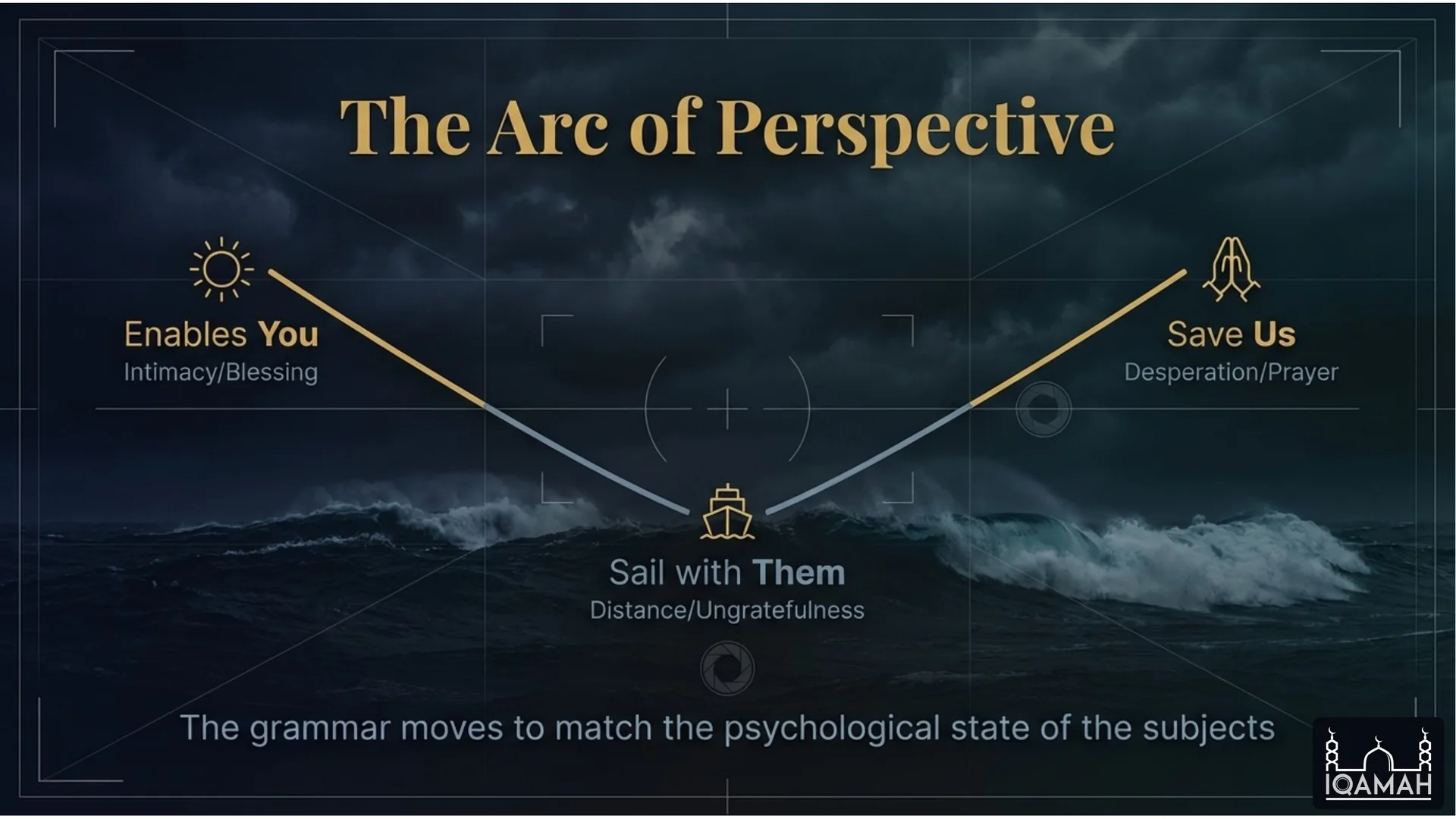
Scene 1 opens with Rahmat and connection. 'It is He who enables YOU to travel...'. Allah is addressing mankind directly. The tone is highly personal, gracious, and loving.
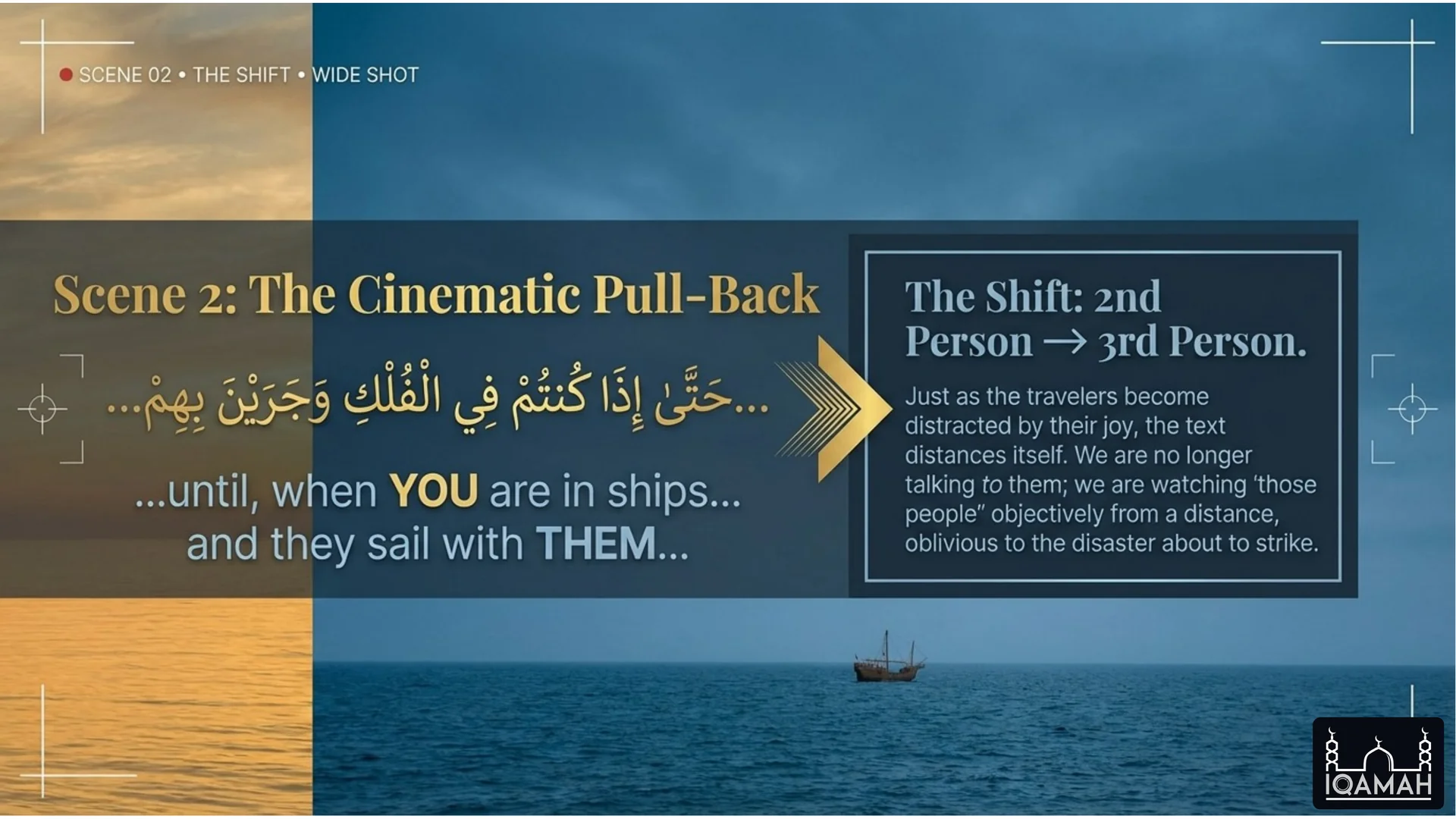
Then comes Scene 2. The shift. '...until, when YOU are in ships... and they sail with THEM...'. SubhanAllah. Just as the travelers become distracted by the Dunya, by the good wind, they forget Allah. So, the text distances itself. Allah turns His face away from them. He is no longer talking to them. We are now watching 'those ungrateful people' from a distance, totally oblivious to the Azaab (storm/punishment) about to strike.
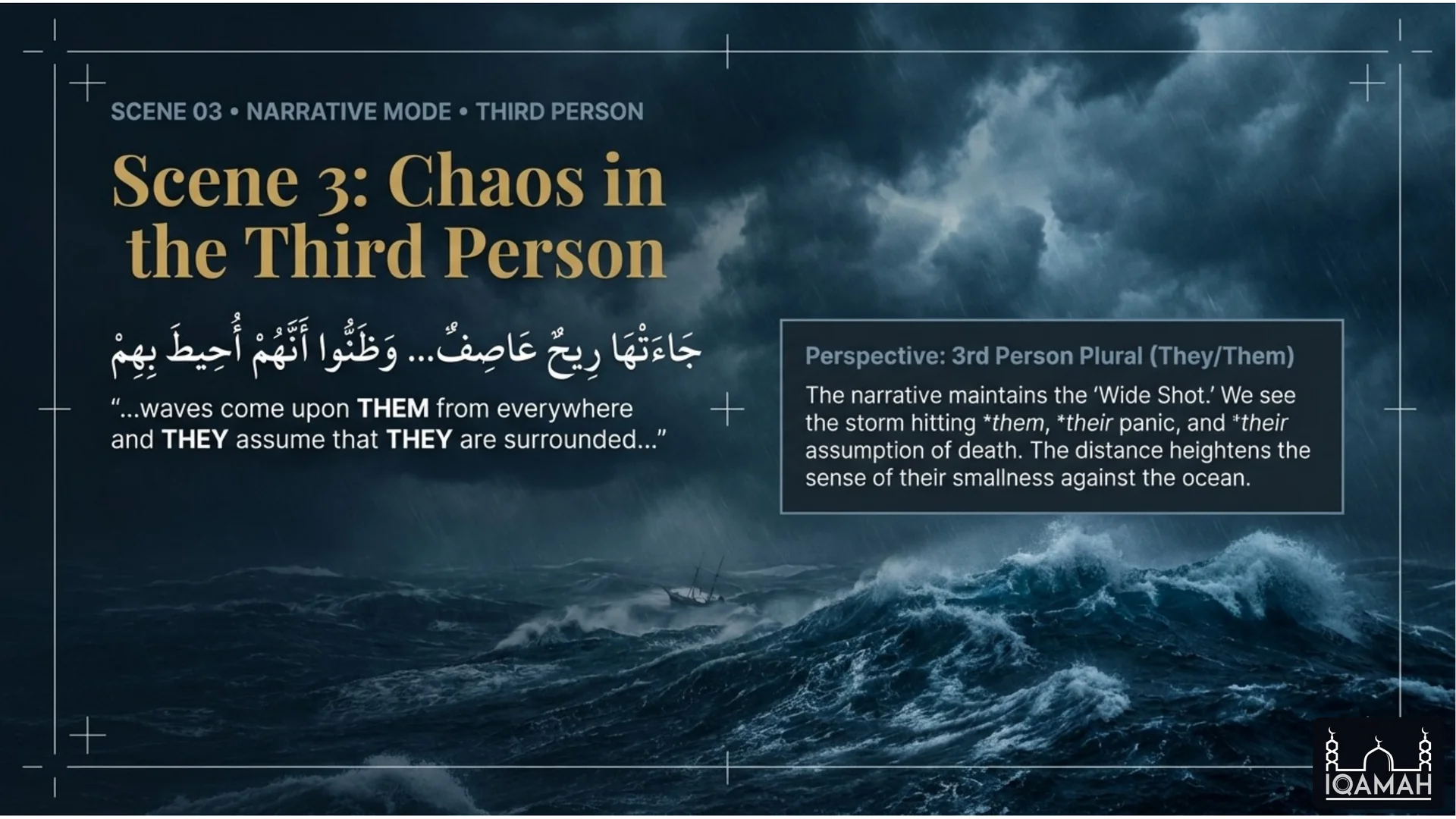
Scene 3 holds this distant shot. '...waves come upon THEM... THEY assume THEY are surrounded'. By keeping them in the 3rd person, Allah shows us their absolute helplessness and insignificance against the mighty ocean. They are cut off from His direct address.
Finally, Scene 4. When their arrogance shatters, they turn back to Allah. The narrative shifts to a direct Dua: 'If YOU should save US... WE will surely be grateful'. All distance collapses. We are suddenly inside the boat, hearing the raw, desperate plea of a slave crying out to their Rabb.
Look at this visual arc. We start with the intimacy of Allah's blessing, we drop into the cold distance of human ungratefulness, and we spike back into the desperate intimacy of Dua. The grammar of the Quran pulses in exact harmony with the spiritual state of the human heart. Allahu Akbar.
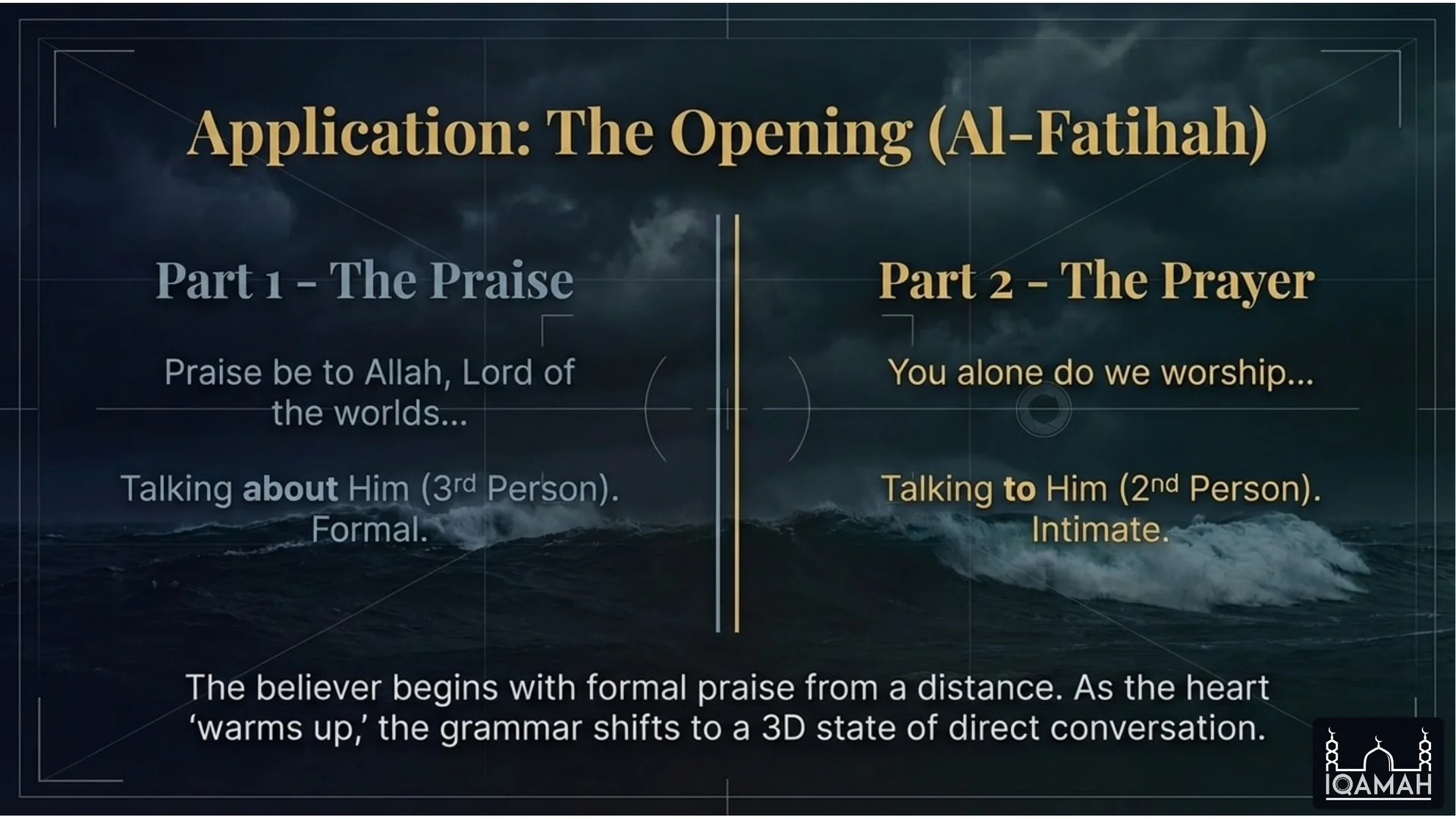
We actually experience this miracle at least 17 times a day in Surah Al-Fatihah! We begin by praising Allah in the third person: Alhamdulillahi Rabbil Aalameen (Praise be to Allah, Lord of the worlds). It’s formal praise. But as our hearts awaken and fill with awe, the grammar shifts to the second person: Iyyaka na'budu wa iyyaka nasta'een (YOU alone do we worship). You have stepped out of talking about God, and into a direct, intimate Munaajaat (whispered conversation) with Him.
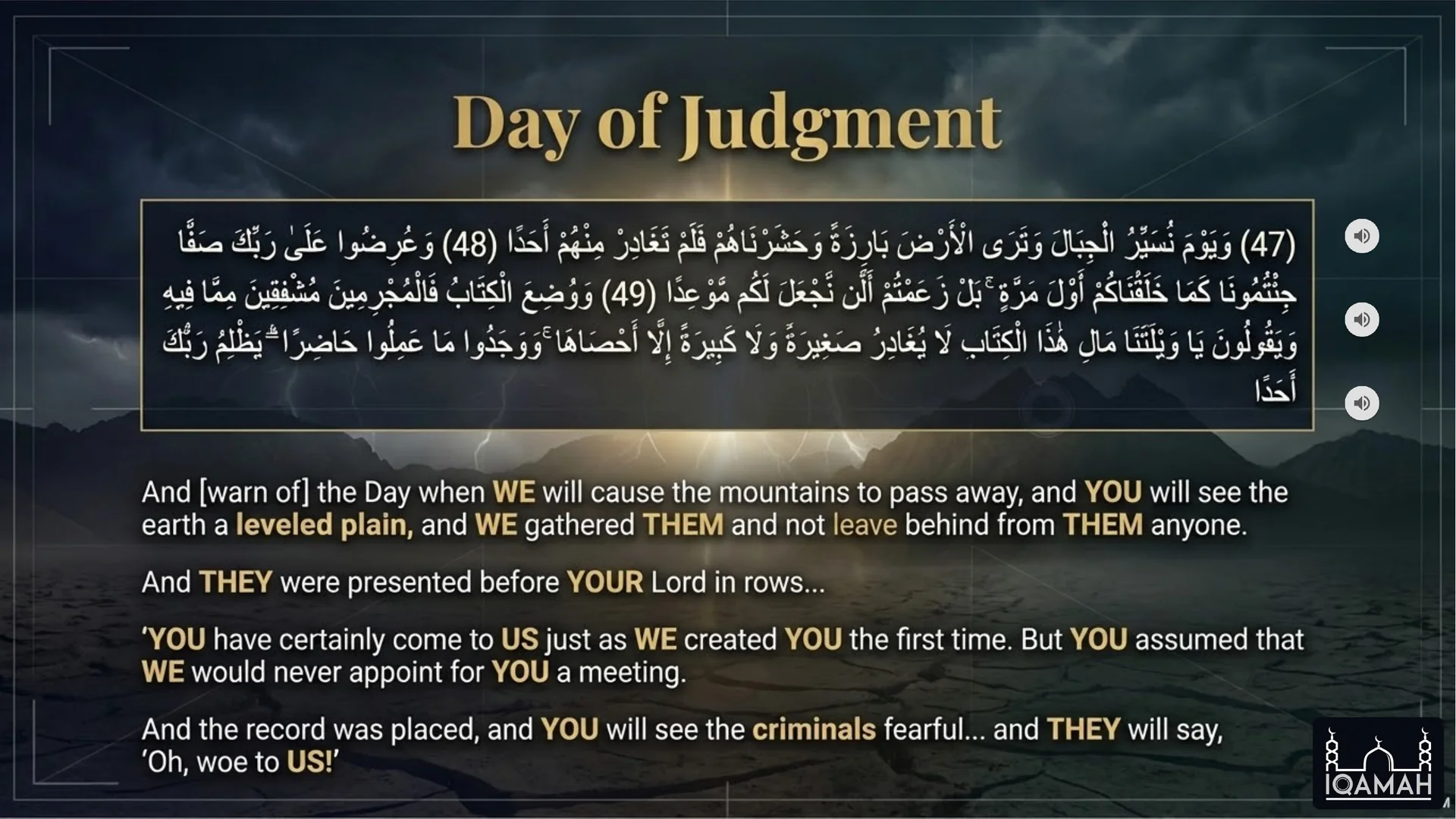
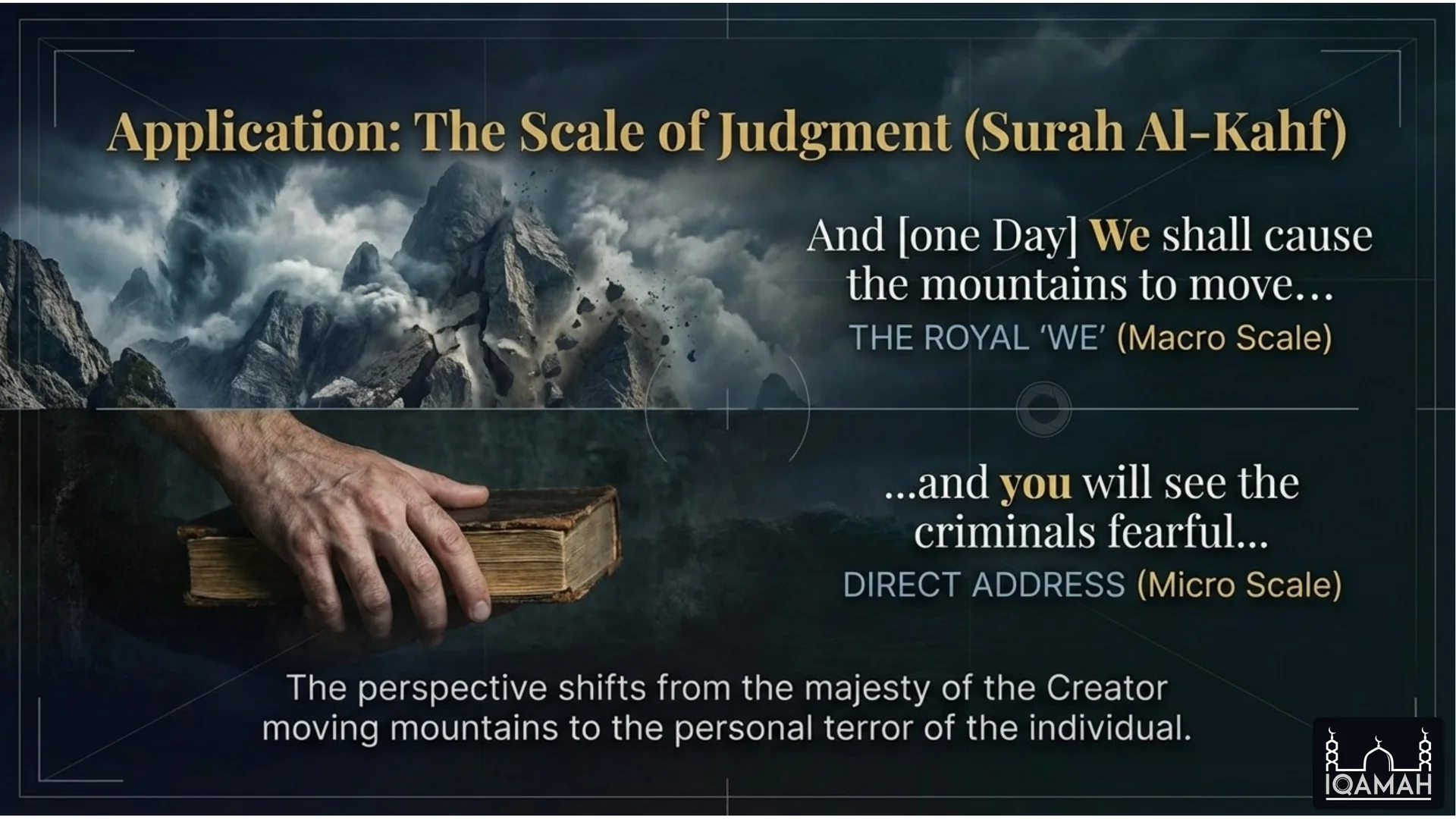
Now, let's look at an even heavier application: the terrifying reality of Yaum-ul-Qiyamah (The Day of Judgment) in Surah Al-Kahf, Ayaat 47 through 49.
n these beautiful Ayaat, the perspective violently shifts from the macro scale—the absolute Jalaal (Majesty) of Allah moving mountains—to the micro scale of an individual's personal terror.
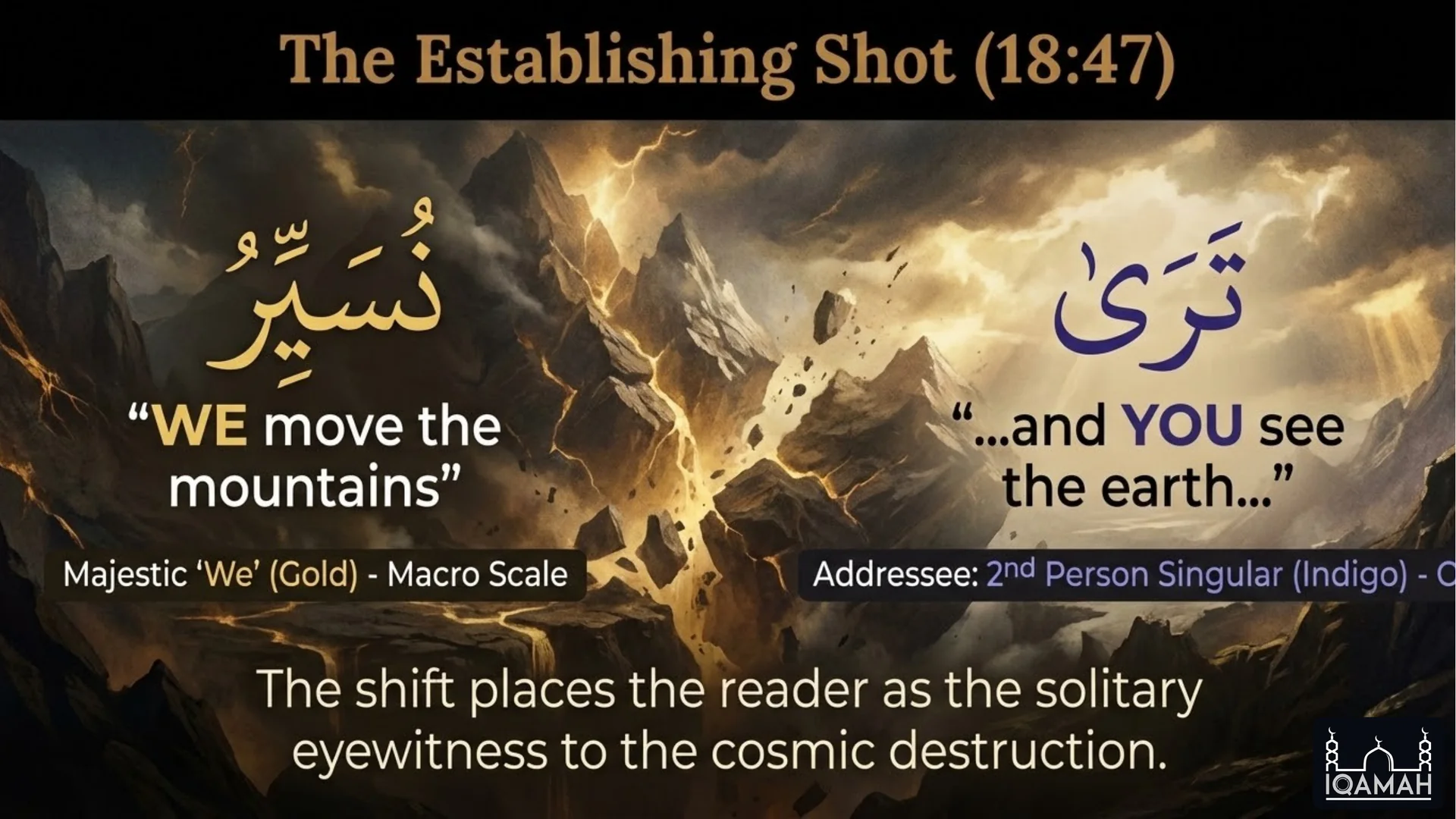
It begins with the majestic, royal 'We': 'WE move the mountains.' But immediately, Allah grabs our attention: '...and YOU see the earth...'. He pulls you, the reader, into the scene. You are standing there, as a solitary eyewitness to the end of the world.
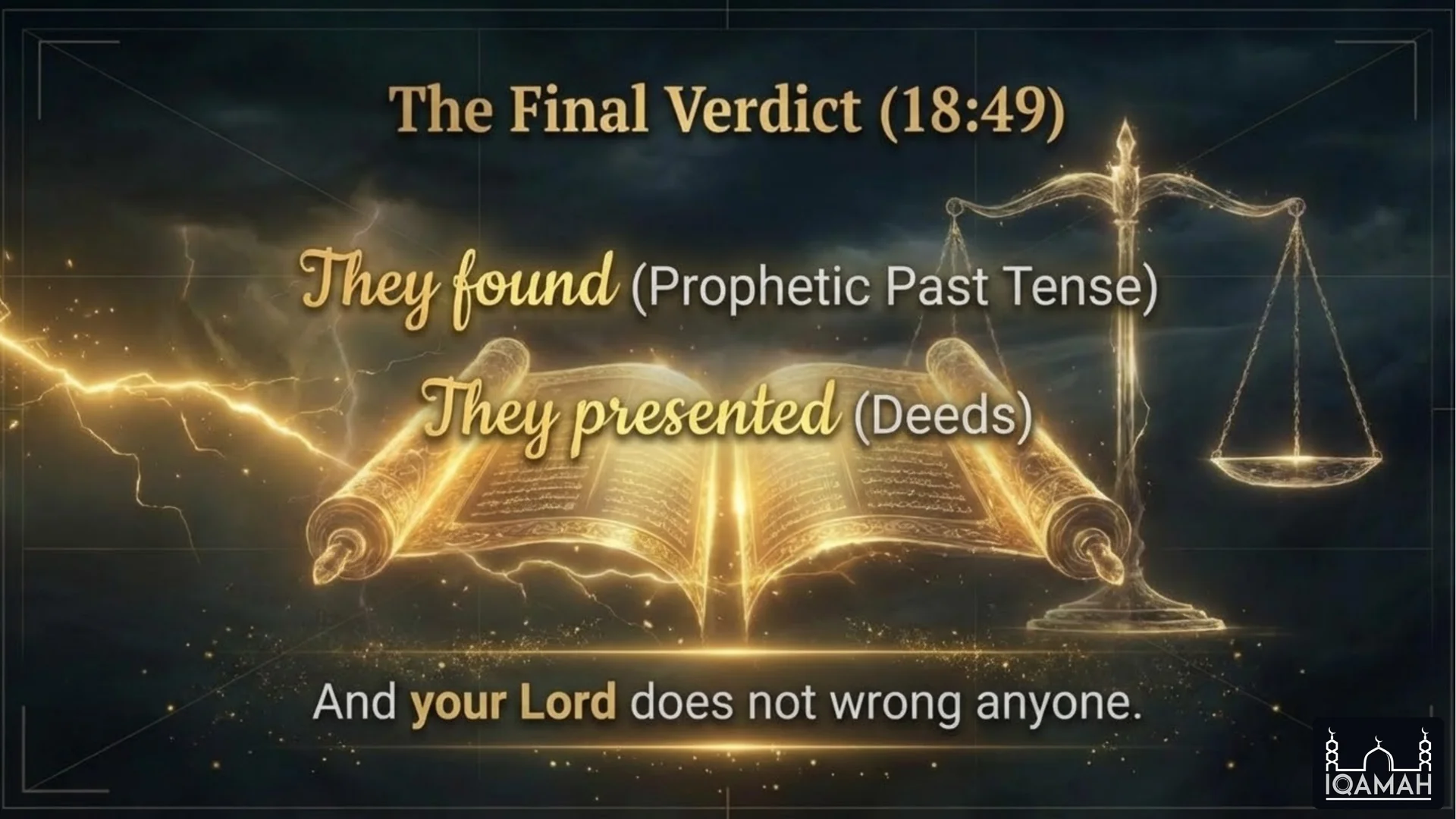
Notice the word Hasharnahum—'We gathered them'. This is Qiyamah, a future event! Why the past tense? In the Balagha of the Quran, a future event so absolutely inevitable and certain is spoken of as if it has already happened. There is zero doubt.
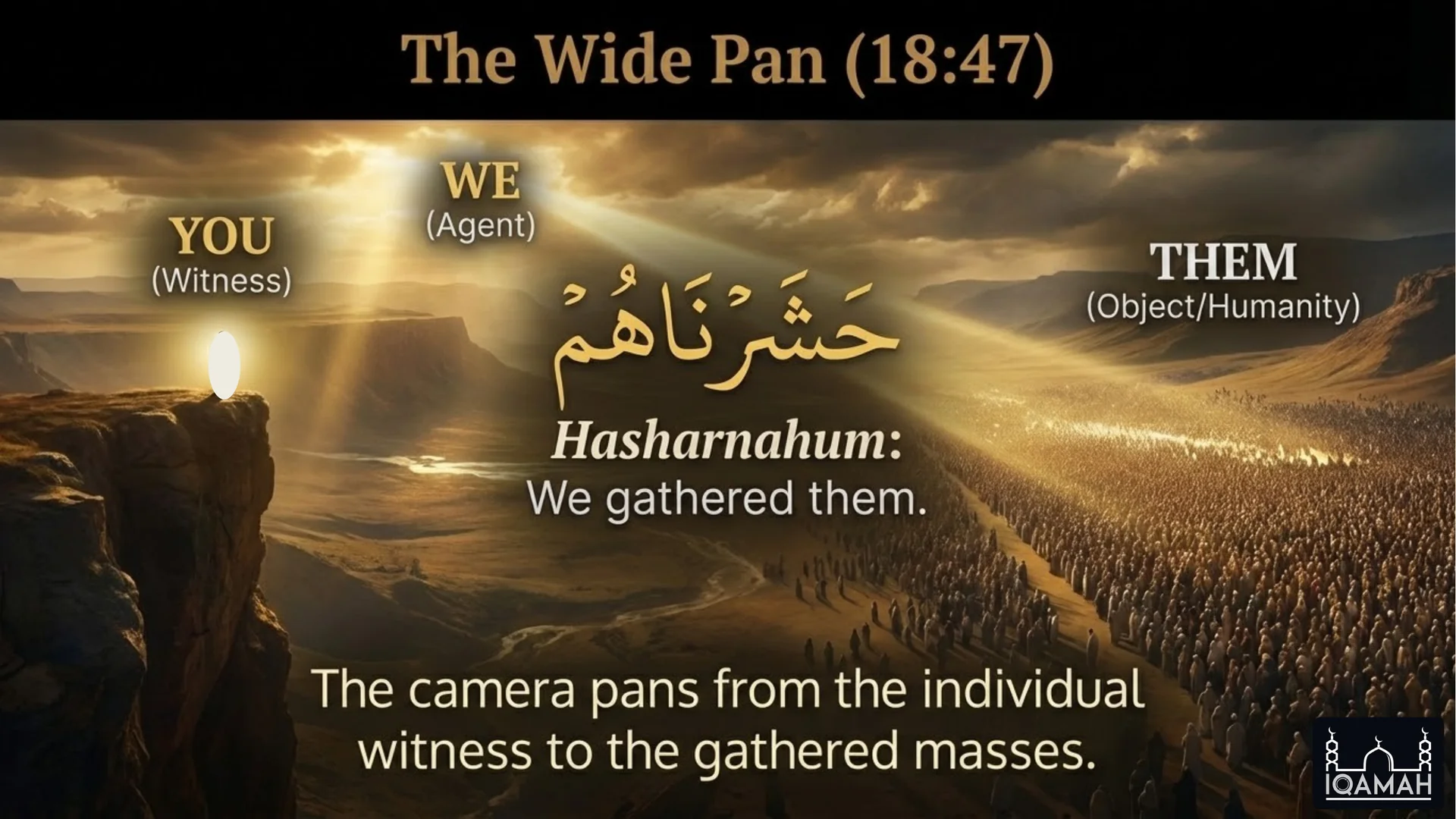
Here, the lens pans from you as the individual witness ('YOU'), to the Divine Agent ('WE'), all the way to the massive sea of resurrected humanity ('THEM' - Hasharnahum). Notice how the witness stands apart from humanity - the travails that apply to the whole assembled gathering of mankind do not seem to apply to this witness. Who is the witness? The mufassirin read this as the Prophet (saw), witnessing the scene from the Maqam Mahmood that Allah has promised him.
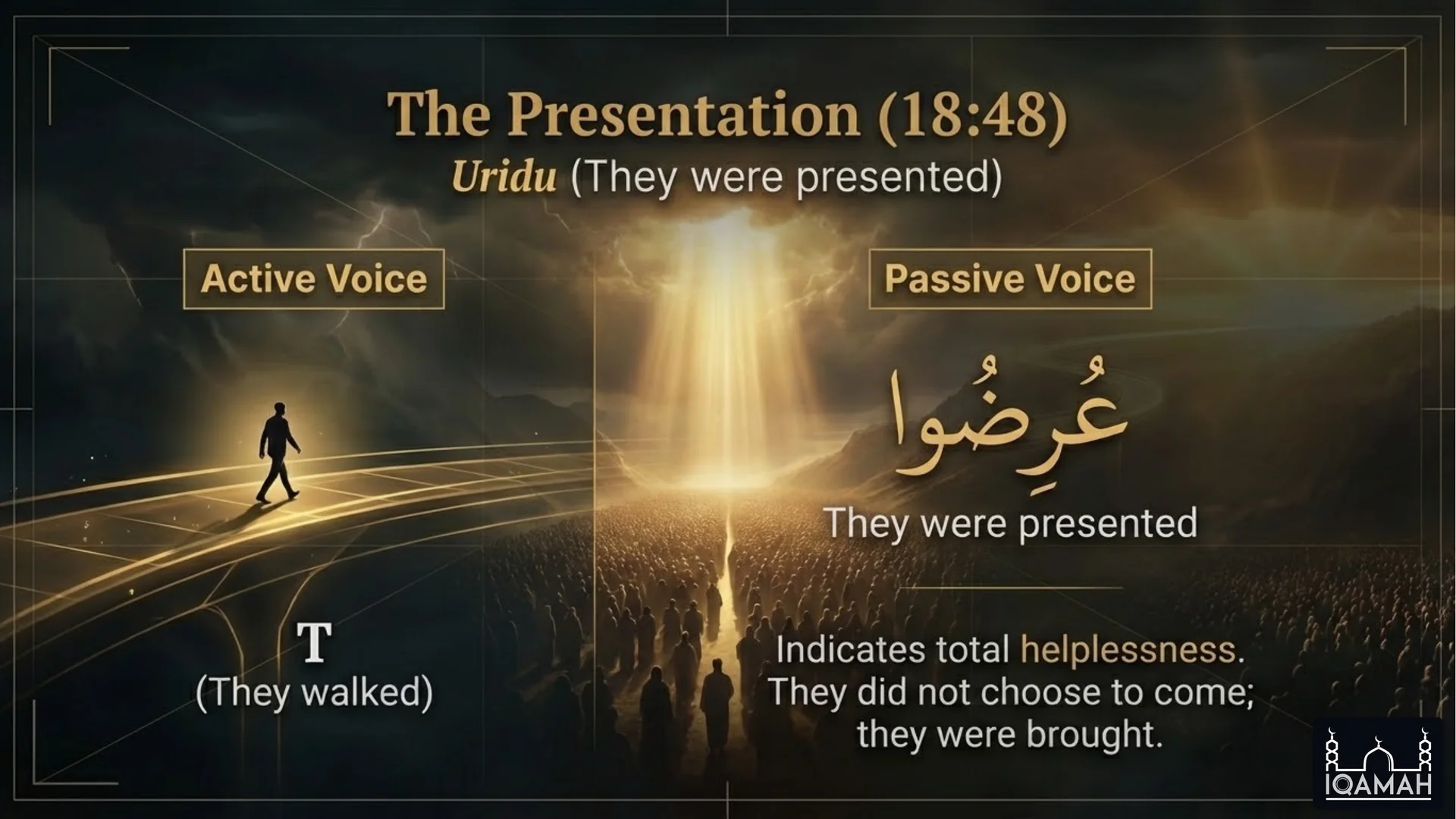
In Ayah 48, it shifts to the passive voice: Uridu ('They were presented'). It doesn't say they walked. The passive voice shows utter helplessness. They have no power, no choice. They are dragged before their Lord.
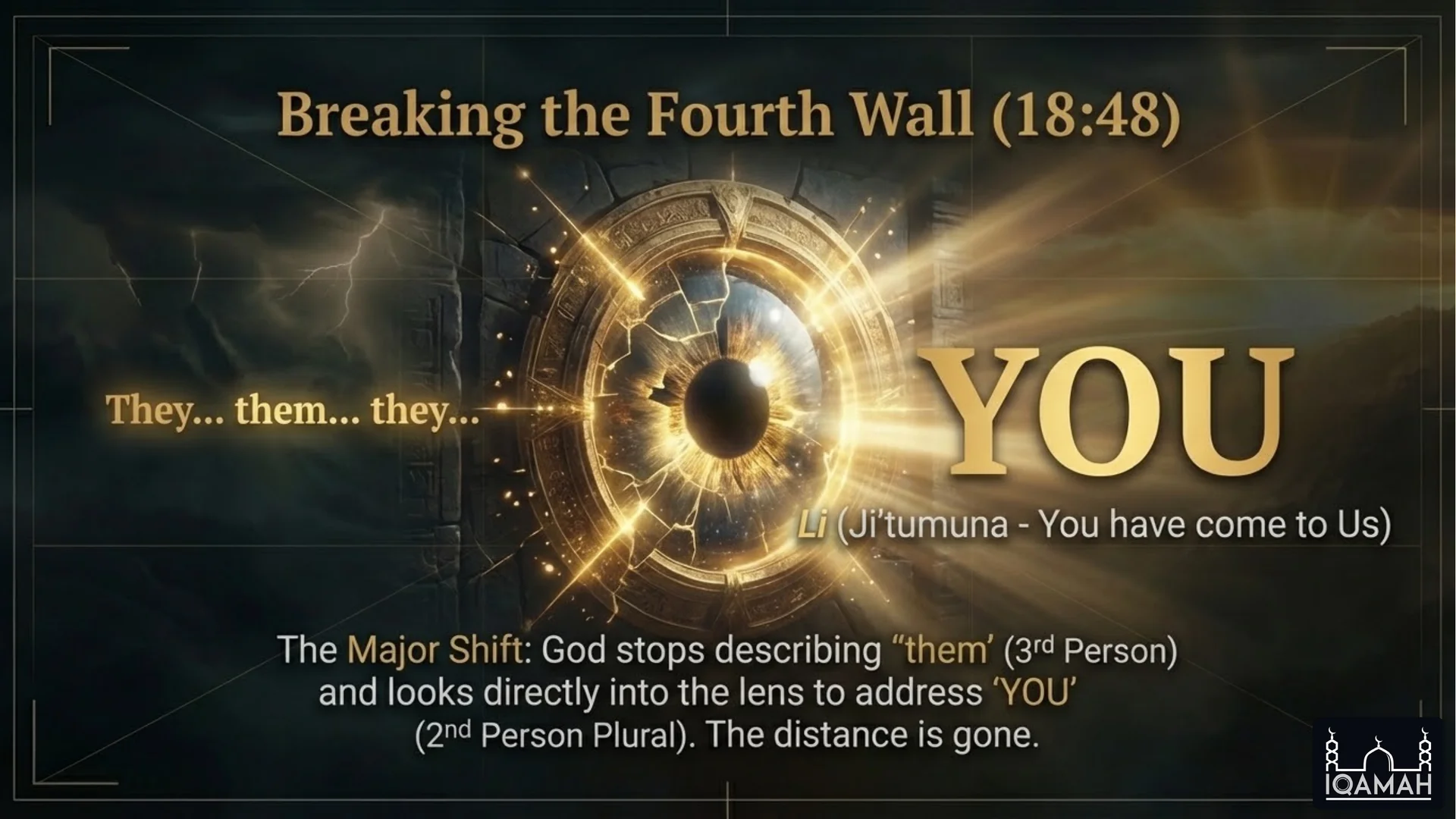
And then, a terrifying shift. Allah stops describing humanity in the 3rd person ('them') and looks directly at 'YOU' in the 2nd person plural: Ji'tumuna ('You have come to Us'). The illusion of distance is destroyed.
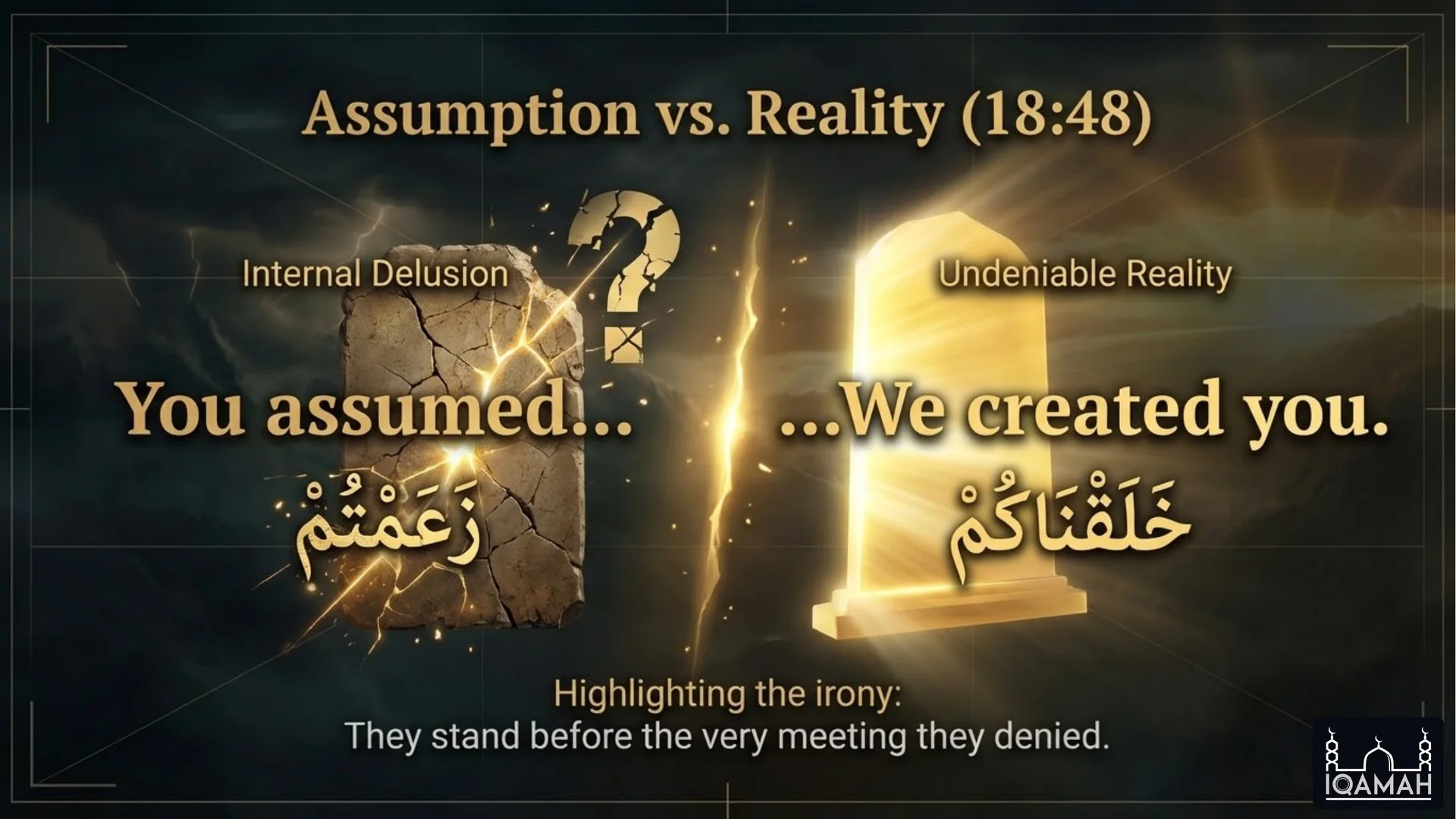
This exposes a tragic irony. Za'amtum ('YOU assumed...') represents their worldly delusion, contrasted immediately with the undeniable reality of Khalaqnakum ('...WE created you'). They are standing directly before the very Akhirah they thought was a myth.
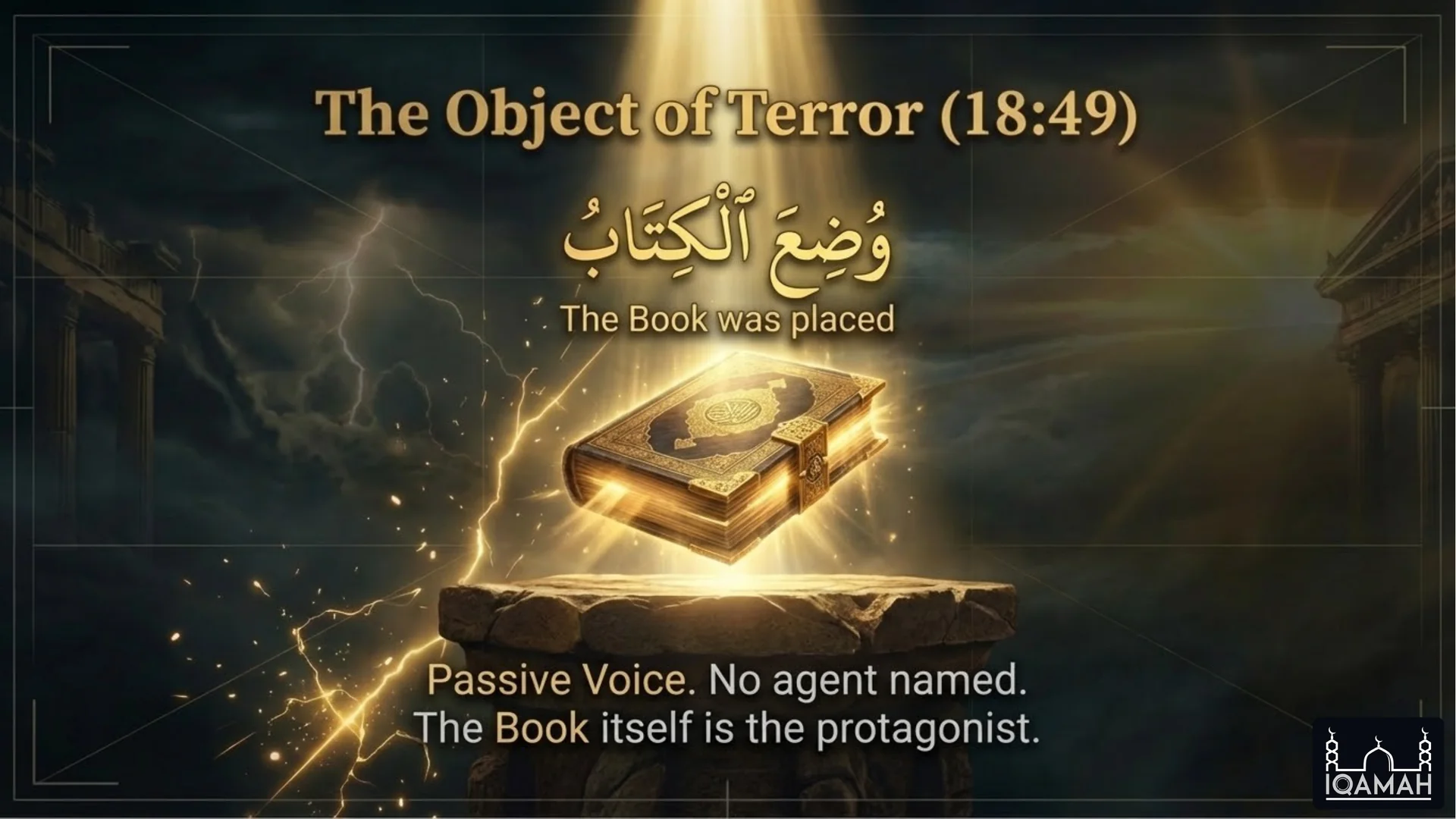
In Ayah 49, Wudi'al Kitaab ('The Book was placed'). Again, passive voice. No angel or agent is named. The Nama-e-Amaal (Book of Deeds) itself becomes the terrifying focus of the scene.
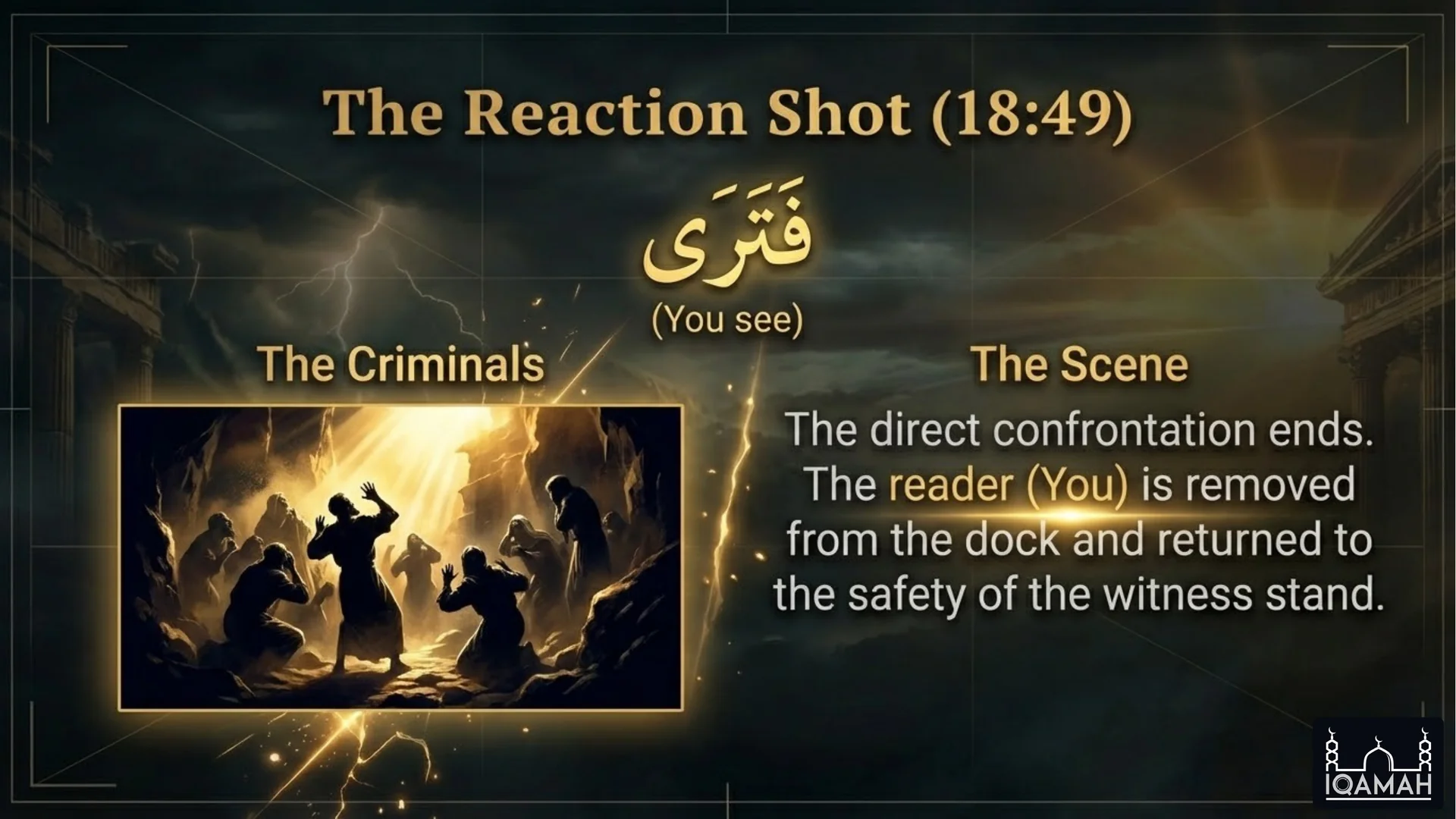
Then we get the reaction: Fatara ('You see' the criminals). Allah removes you from the dock, returning you to the safety of a witness, watching the Mujrimeen (criminals) tremble.
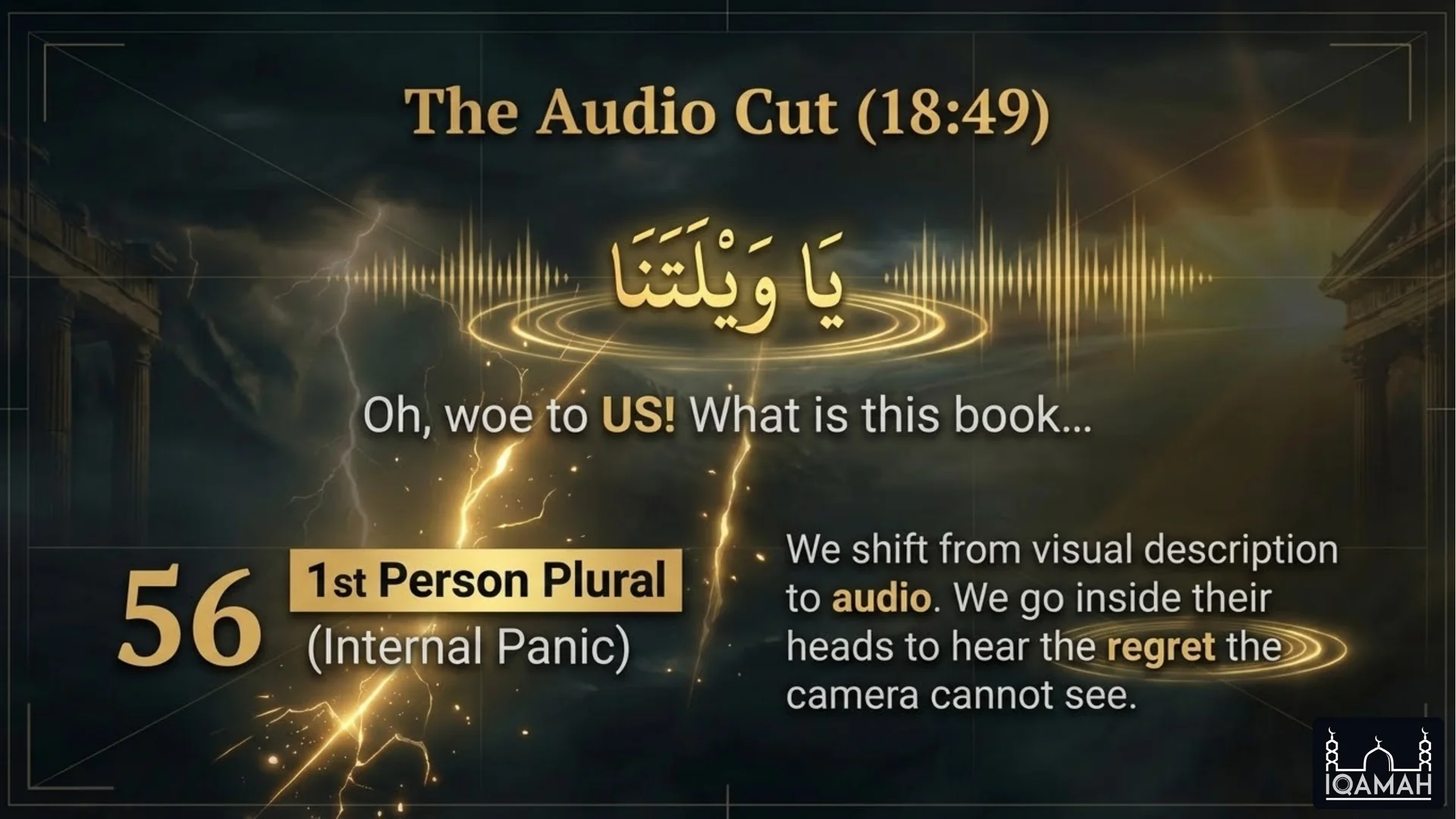
Next, an audio cut. We go right inside their panicking hearts to hear their desperate 1st person cry: Ya Waylatanaa! ('Oh, woe to US!'). We hear the regret that no camera could ever capture.
The Ayah concludes with the ultimate, chilling justice of Allah: Wa laa yazlimu Rabbuka ahadaa ('And your Lord does not wrong anyone'). Complete, divine justice.
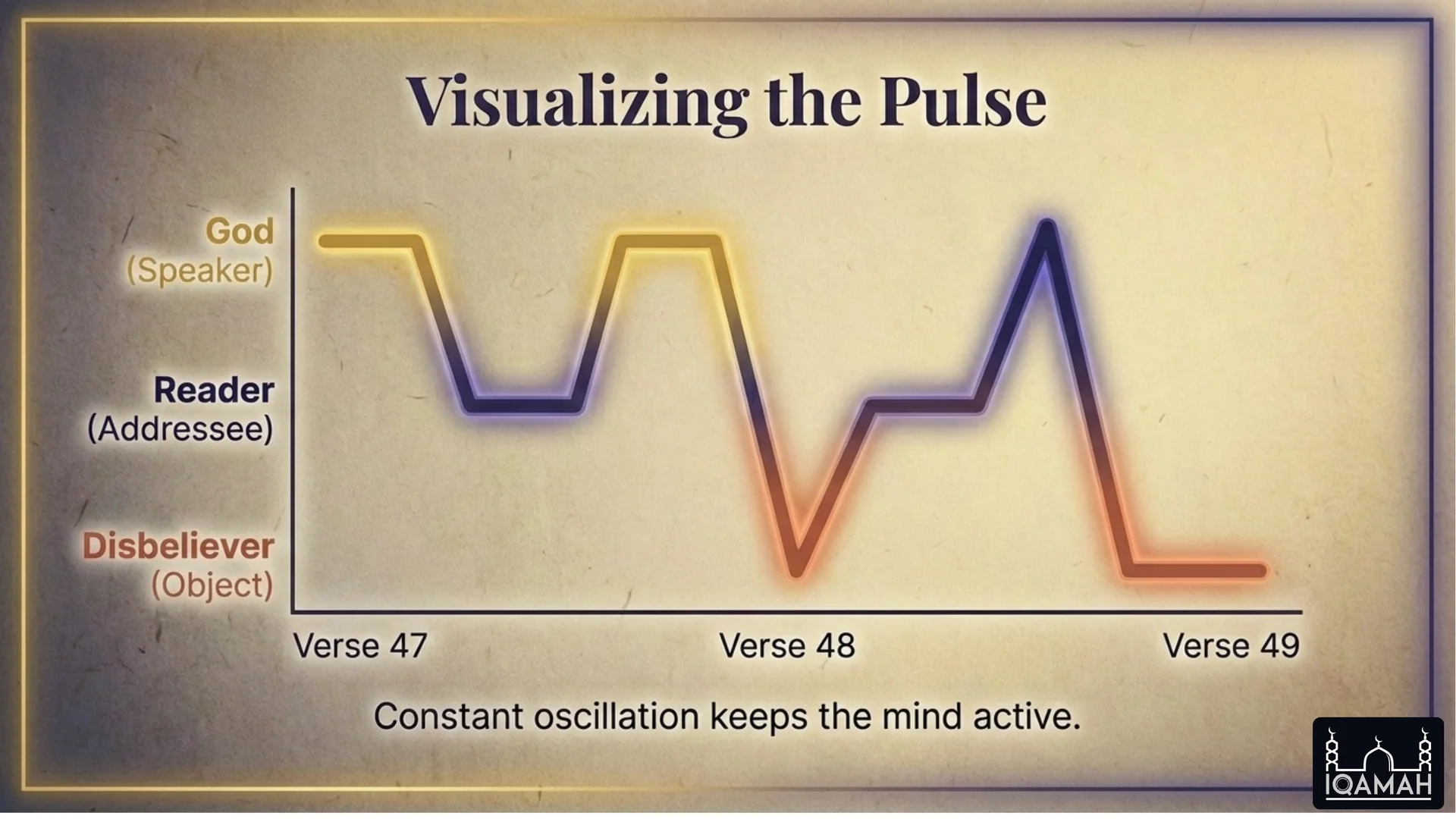
If we map these Ayaat, we see this constant pulse. Moving between the Creator, the Addressee (Us), and the Disbelievers. It keeps our spiritual hearts awake. The Quran does not allow you to fall asleep while reading it.
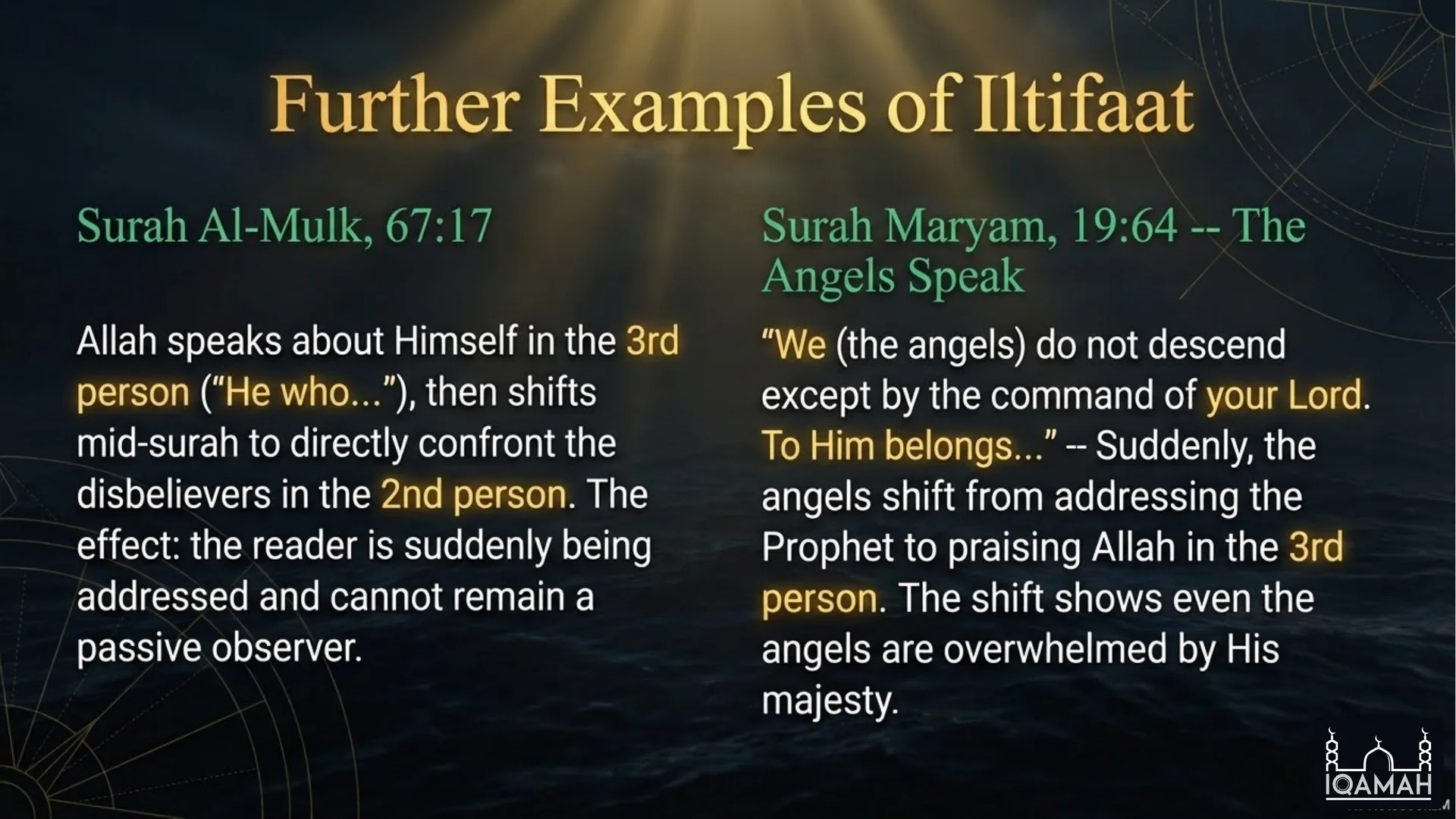
This miracle of Iltifaat is everywhere. In Surah Al-Mulk, Allah speaks of Himself in the 3rd person, then shifts mid-surah to directly confront the disbelievers in the 2nd person—shaking them awake. In Surah Maryam, even the angels shift from addressing the Prophet (SAW) to praising Allah in the 3rd person, overwhelmed by His Jalaal.
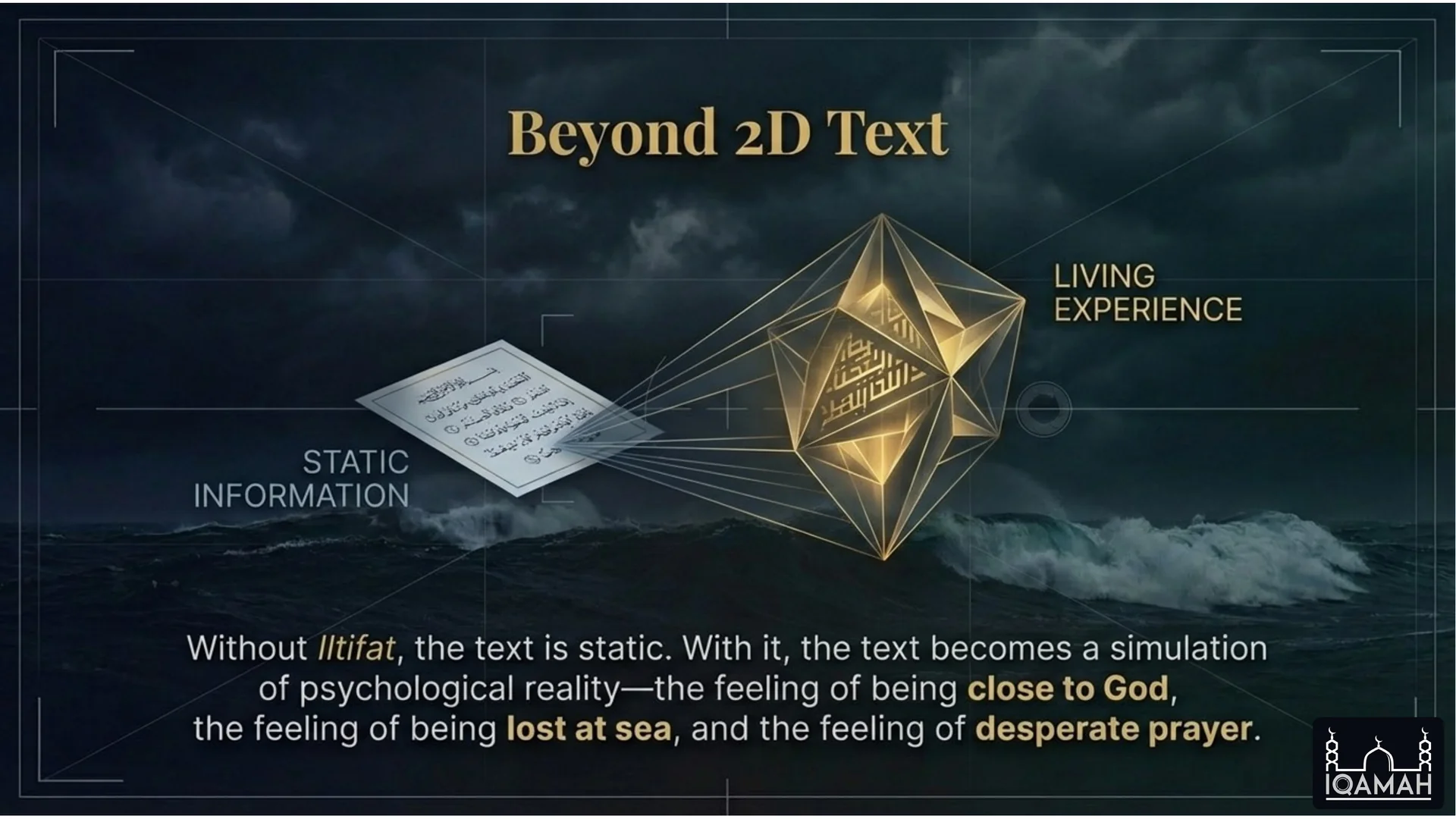
Without Iltifaat, a text is just static information. With it, the Quran becomes a living, breathing reality. You don't just read it; you feel the Qurb (closeness) of Allah, you feel the terror of being lost at sea, and you feel the desperation of a sincere Dua.
To conclude, respected audience: The Quran does not just tell us stories of the past. It actively moves the lens of our hearts. The I'jaz of the Quran is that its grammar is a perfect mirror for the human soul. May Allah (SWT) grant us true Fahm (understanding) of His Book and make us among the people of the Quran. Ameen. Jazakumullahu Khayran.
About this session
This session pairs two Qurʾānic passages (Sūrah Yūnus 10:22 and
Sūrah al-Kahf 18:47–49) to show how iltifāt — the
rhetorical pivot between pronouns, persons, and tenses — functions
as a kind of cinematic camera, moving the heart between distance and
intimacy, witness and confrontation. If you'd like to discuss the
material or suggest related topics, write to
admin@iqamah.org.