Iqamah

Resources · Surah Hud Tafsir Series

Part 2 of 6

The Ark and the Oven — Surah Hud, Part 2

The Cinematic Grammar of Surah Hud

Sūrah Hūd, Part 2 — a linguistic and theological walk through the daʿwah of Nūḥ (ʿalayhi al-salām) and the Flood (vv. 25–49). Five movements: the Call and Rejection, the Prophetic Posture, the Breakdown, the Verdict and the Ark, and the Tides of Decree. Draws on Saʿdī, Sayyid Qutb, Maʿāriful Qurʾān, Ibn al-Jawzī, and the Arabic balāghah of the verbs themselves.

Slides 48
Format Slides + notes
Series Surah Hud Tafsir Series
Cover slide: The Ark and the Oven — Surah Hud, Part 2
Slide 1
Slide 1 of 48 #

This is the second session in our walk-through of Sūrah Hūd. Part 1 established the doctrinal foundation of the sūrah across vv. 1–24; today we enter the first and longest of its seven prophet-stories: the daʿwah of Nūḥ (ʿalayhi al-salām) and the Flood, vv. 25–49. Recall the principle we settled last time — every prophet-story in this sūrah is the historical instantiation of the opening passage. Sayyid Qutb (In the Shade of the Qurʾān, vol. 9) shows that one message-formula recurs almost verbatim for each prophet: worship none but God, with the messenger as warner and bearer of glad tidings — Nūḥ at 11:26, Hūd at 11:50, Ṣāliḥ at 11:61, Shuʿayb at 11:84. Nūḥ's account is the fullest template, so learning its shape equips us to read the rest.

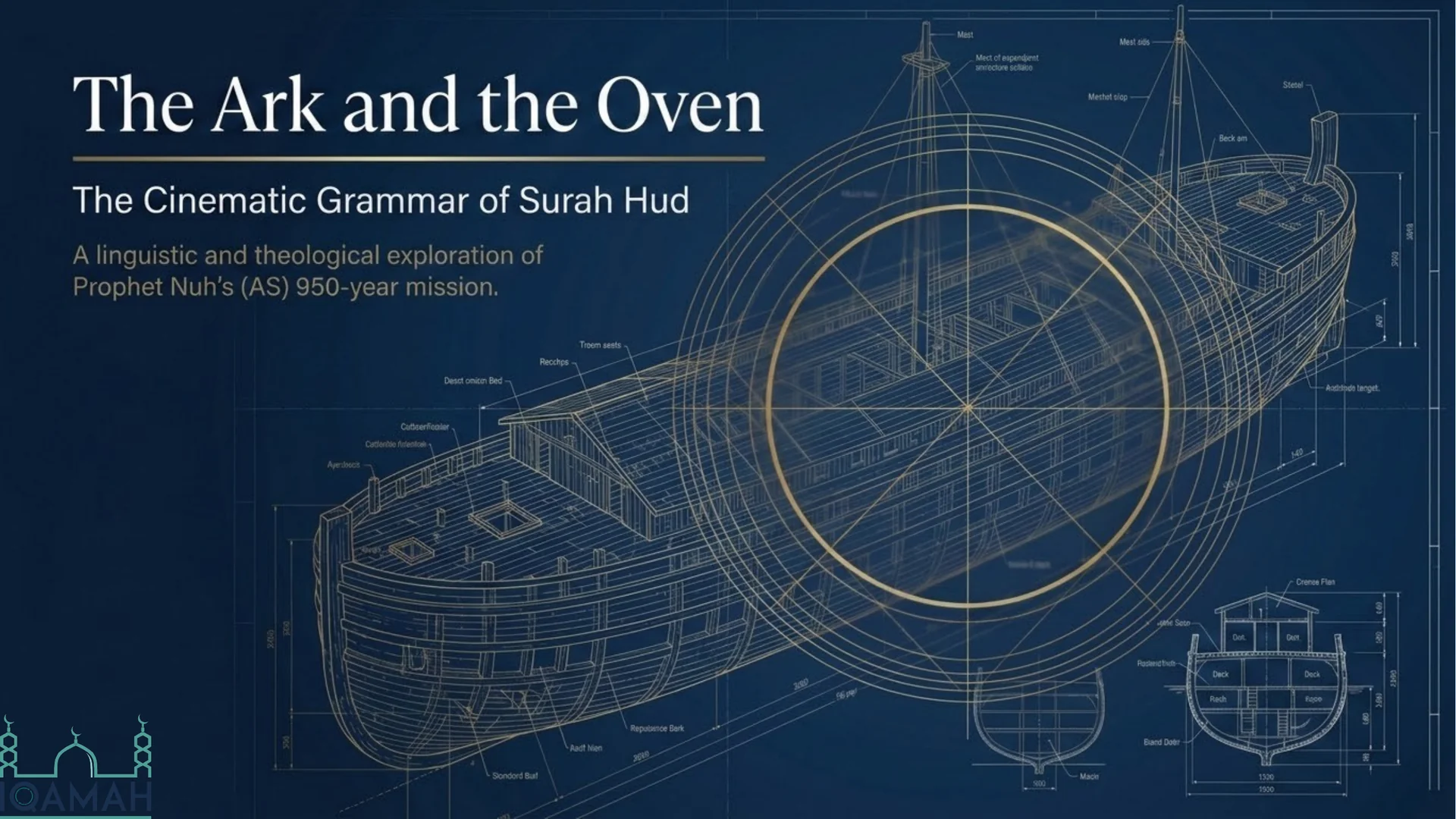
The two images of the title bracket the entire story: the Ark (al-fulk), the God-given means of survival, and the Oven (al-tannūr, v. 40), the signal that the flood had begun. Nūḥ's mission lasted 950 years (cf. 29:14), yet Qutb notes the believing remnant numbered, by some reports, no more than a dozen. The phrase 'cinematic grammar' points to something we will attend to directly in the flood sequence — the Qurʾān's shift into vivid, present-tense scene-painting (tajrī, v. 42) that makes the events feel as though they unfold before our eyes.

We draw on the same voices as Part 1: Saʿdī for the direct meaning of each verse, Maʿāriful Qurʾān for accessible synthesis and fiqh notes, Sayyid Qutb for thematic and psychological depth, al-Wāḥidī for occasions of revelation, and — strictly for balāghah — Zamakhsharī and Ibn ʿĀshūr. The session is dense; as before, the goal is exposure and tadabbur, not mastery. Ask for slow-downs where a point needs more room.
Slide 2
Slide 2 of 48 #

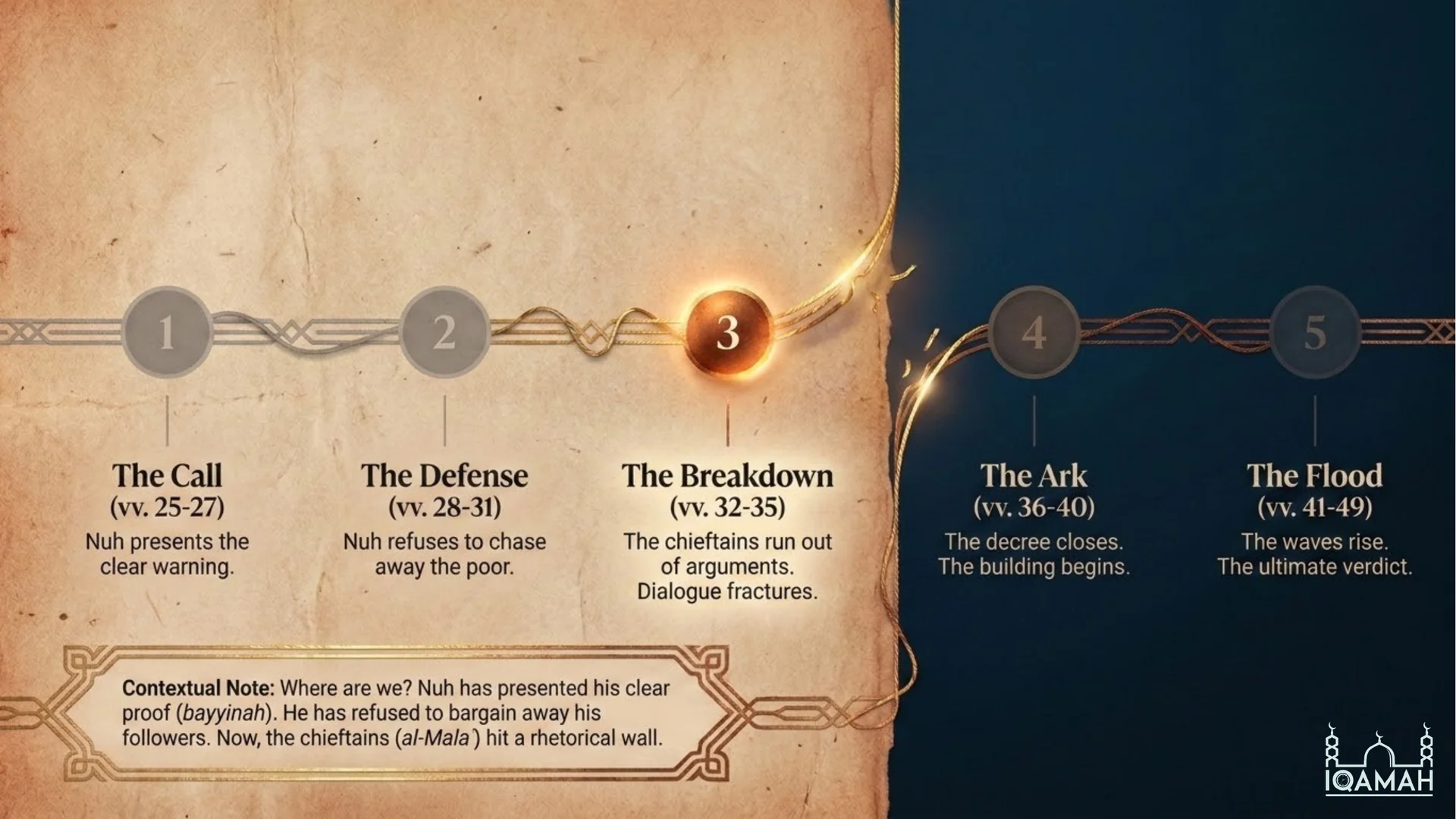
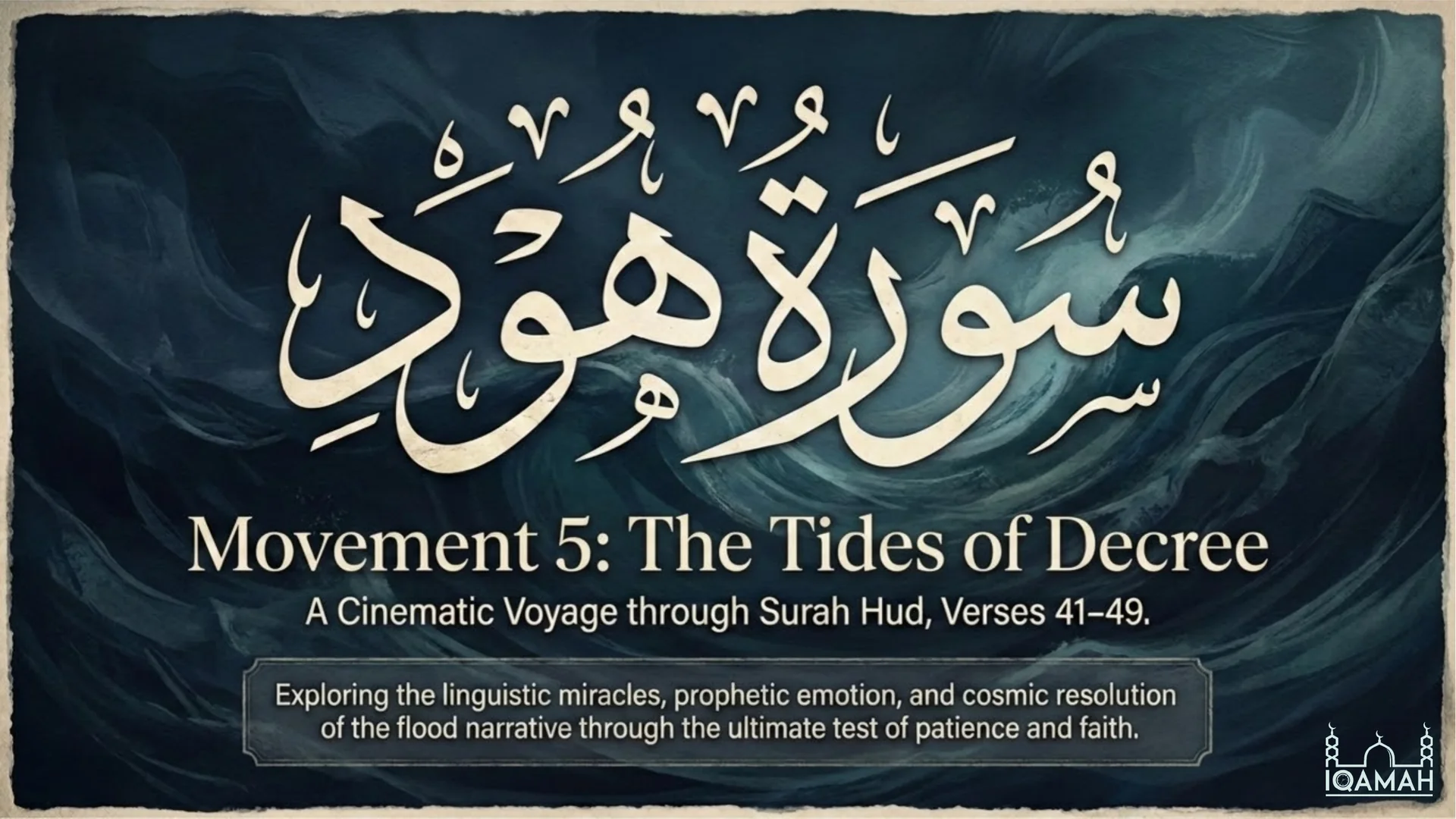
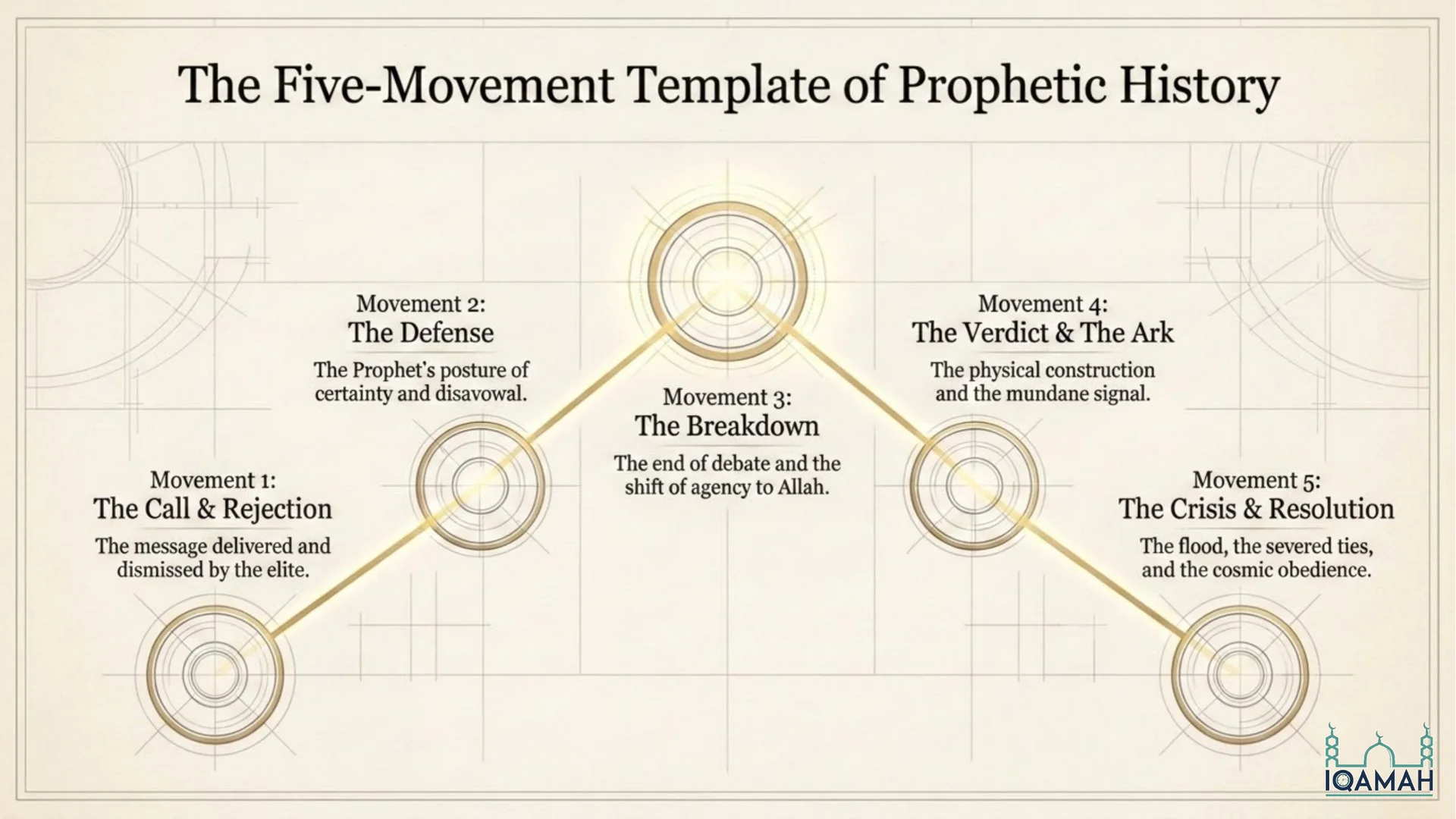
This five-movement map is the structural spine of the session. Where the opening passage had three movements, the Nūḥ narrative unfolds in five: (1) the Call and the Rejection (vv. 25–27); (2) the Prophetic Posture, or Nūḥ's defense (vv. 28–31); (3) the Breakdown of dialogue (vv. 32–35); (4) the Verdict and the Ark (vv. 36–40); and (5) the Tides of Decree — the flood and its aftermath (vv. 40–49). Tell the group: keep this map in view. If you lose the thread on a particular verse, locate which movement we are in and what work that movement is doing.

The template is not imposed from outside. Because the surah repeats one message across seven prophets, Qutb reads it as a single message rephrased seven times. Nūḥ's is the fullest version; Hūd, Ṣāliḥ, Shuʿayb, and Mūsā are variations on it. Notice that the shape itself — call, patient defense, breakdown, decree, and the vindication of the few — is part of the argument the sūrah is making about how prophetic history always runs.

Slide 3
Slide 3 of 48 #

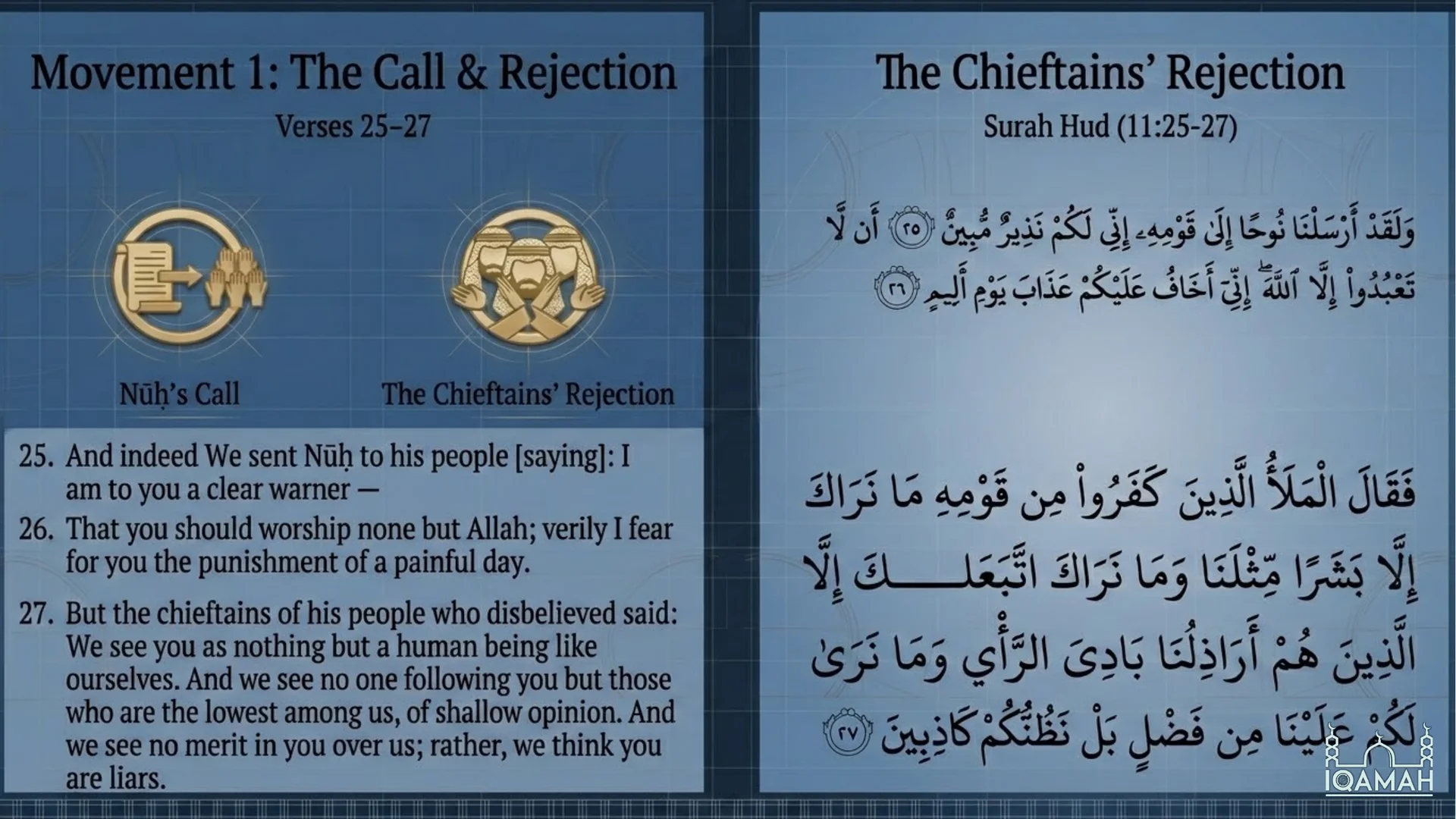
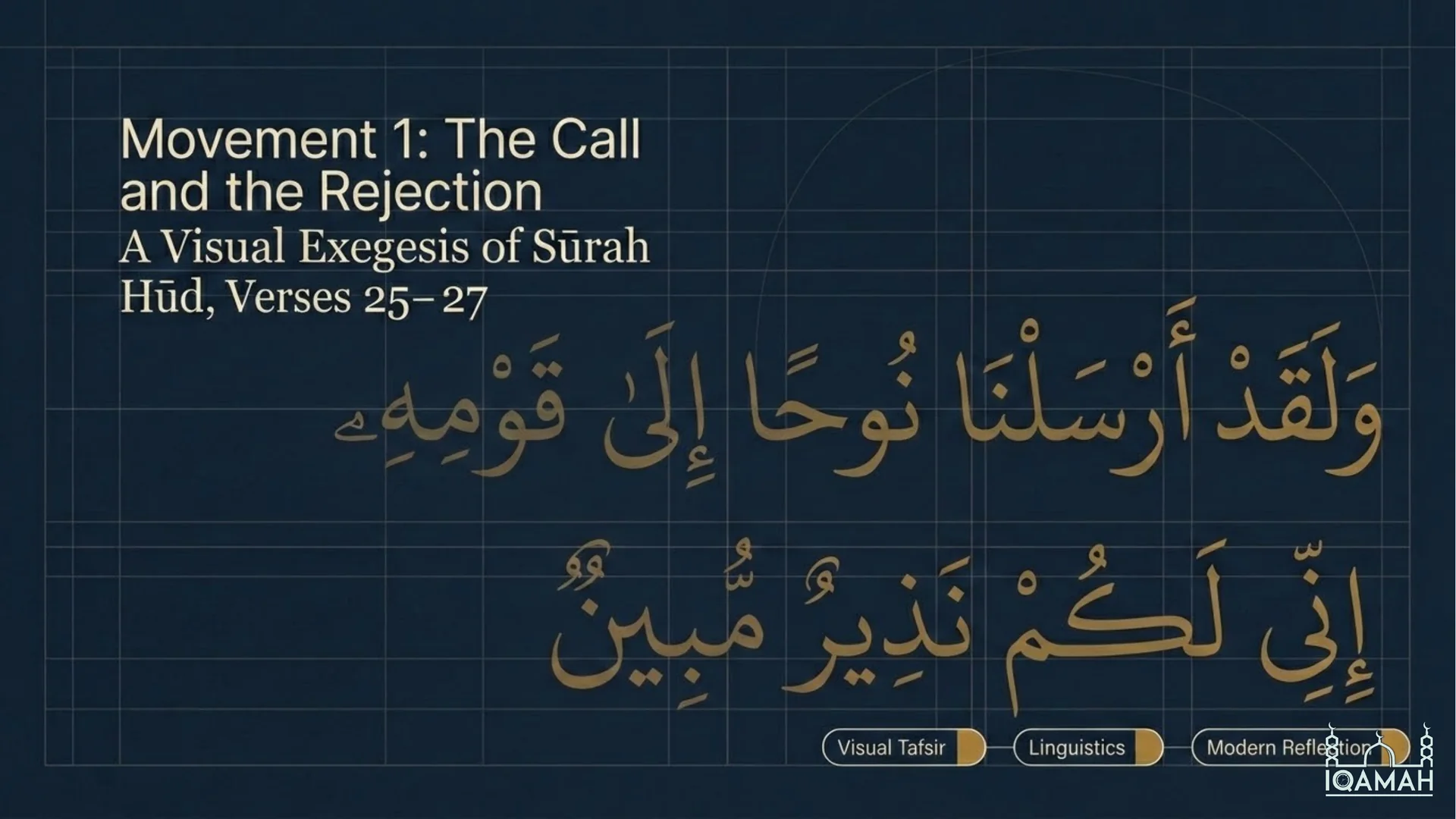
Saʿdī (p. 278) identifies Nūḥ here as the first of the messengers (awwal al-rusul), sent to call his people to Allah and to forbid them from associating partners with Him. The phrase 'I have come to you as a clear warner' (innī lakum nadhīr mubīn) means, on his reading, that Nūḥ made fully explicit what he was warning them of, so that no confusion could remain. Movement 1 has two halves, treated on the next slides: the content of the call (vv. 25–26) and the shape of the rejection (v. 27).
Set up the dynamic now. A sincere, lucid call is met not with honest inquiry but with social ranking. Hold a question for the group before we read their reply: what would a fair-minded response to a sincere caller actually look like? Saʿdī answers it almost word-for-word two slides on, when he contrasts the chieftains' defiance with the reasonable response they could have given.

Slide 4
Slide 4 of 48 #

Maʿāriful Qurʾān unpacks the vocabulary of v. 27 with care. al-malaʾ is the assembly of nobles and chiefs; bashar means a mere mortal; al-aradhil (singular ardhal) means the low-status, those without social standing; and bādī al-raʾy means a surface-level, first-glance opinion. Saʿdī (p. 278) observes that it is the nobles and leaders who reject first — as is usually the case with their kind.

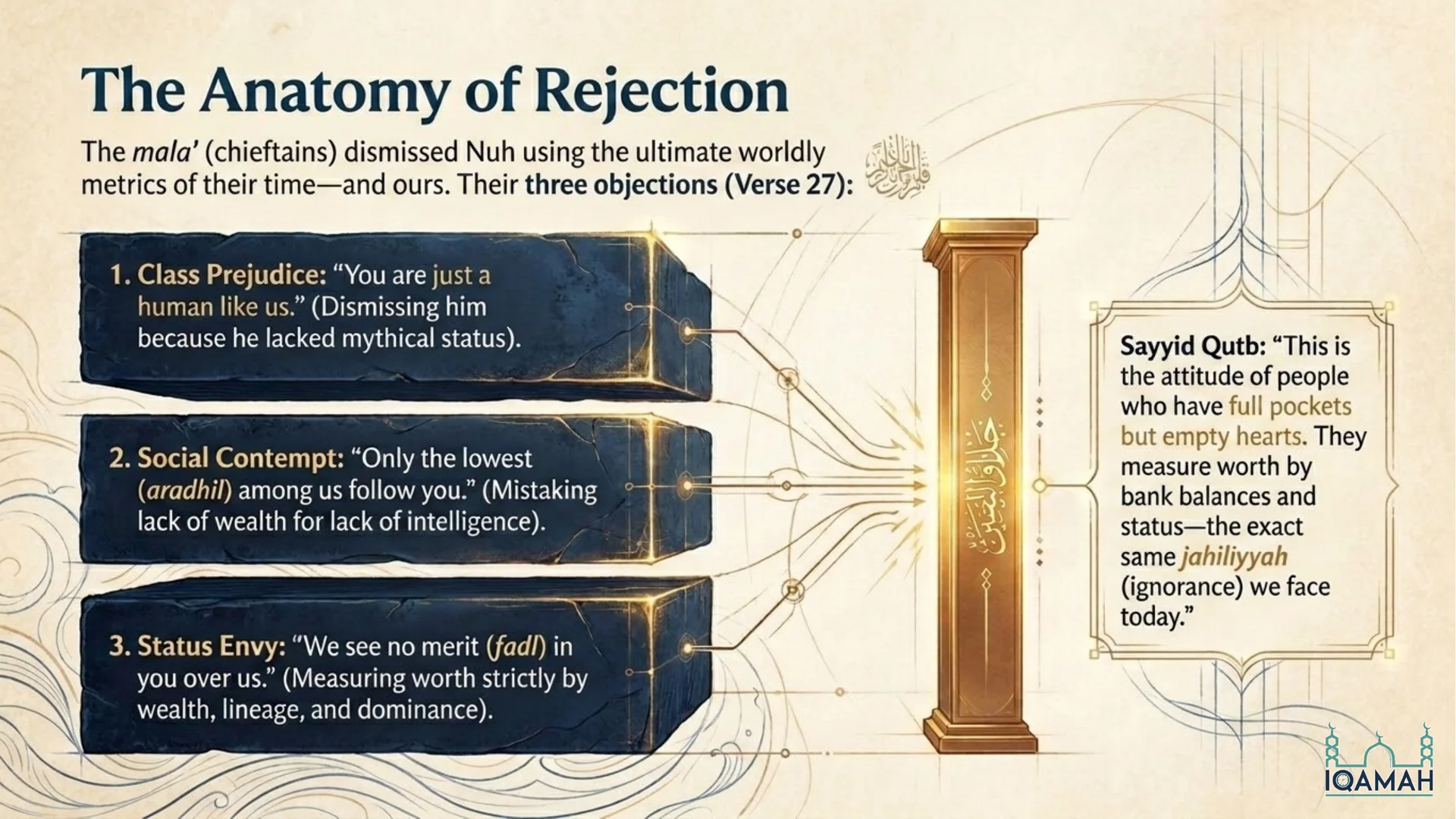
Their three objections form an escalating sequence: (1) 'you are only a human like us' — a denial that a mortal could carry revelation; (2) 'only the lowest among us follow you, and only at first glance' — a class objection that disqualifies the message by the status of its audience; (3) 'we see no merit in you; rather we think you are liars' — the leap from doubt to slander. Note for the group: not one of these is an argument about the truth of the message. Every one is sociological, not rational.

The objection 'a human like us' recurs against every prophet in the Qurʾān. The consistent answer is that messengers are human by design, so that they can be imitated and followed; the later demand for an angel (v. 31) is therefore a deflection, not a sincere condition. Cross-reference 14:10–11, where earlier communities raise the identical objection and receive the identical reply.

Slide 5
Slide 5 of 48 #

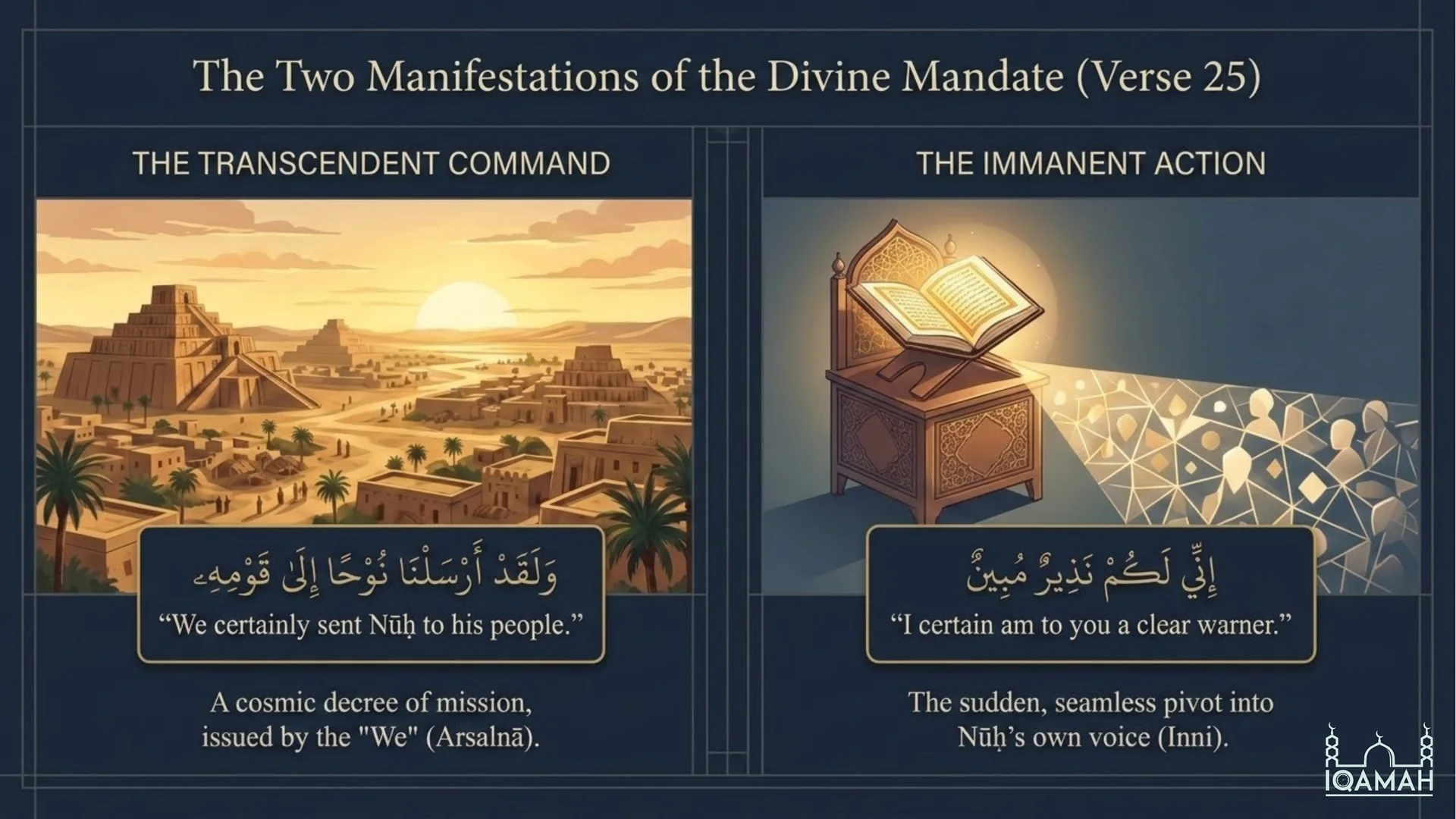
The slide reads v. 25 in two registers, and both are in the verse itself. The transcendent announcement — 'I have come to you as a clear warner' (innī lakum nadhīr mubīn) — is the messenger declaring his commission; the active mandate flows directly into v. 26's command to worship none but Allah. Saʿdī reads nadhīr mubīn as warning made wholly unambiguous: nothing is hidden in what is being warned of.

Qutb's larger point (In the Shade, vol. 9) is that the call opens with warning because the danger is real — 'suffering on a grievous day' (v. 26) — but the prophet is never only a warner. He is also bashīr, a bearer of glad tidings, and the two offices together produce the balance of hope and fear that moves the human heart, exactly as we saw at v. 2 in Part 1. The tarbiyyah note: authentic daʿwah is clear before it is forceful. The first prophetic act is to make the message unmistakable, not to overwhelm.

Slide 6
Slide 6 of 48 #

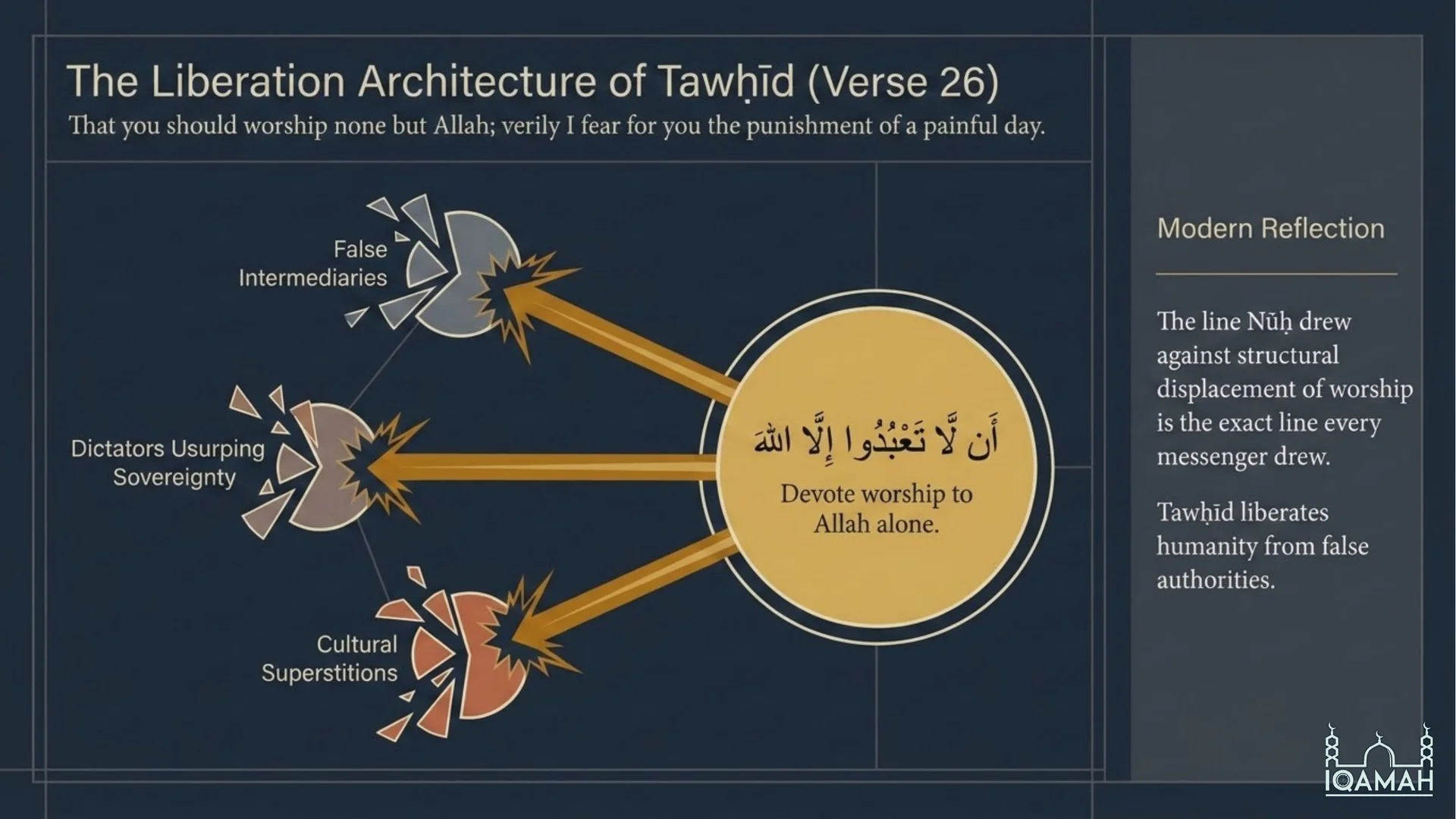
'That you worship none but Allah' (an lā taʿbudū illā Allāh). Saʿdī reads it plainly: devote all worship to Allah alone and abandon everything worshipped besides Him. The slide's 'liberation architecture' framing is well grounded in Qutb, who insists that worship here is not merely ritual but total submission — and therefore a release from submission to every false lord, tyrant, and social authority.

This is Qutb's distinctive thematic contribution (In the Shade, vol. 9), and we should cite it as his emphasis, held alongside the broader classical scope of ʿibādah. On his reading, the crime of the destroyed nations was never merely neglecting rituals; it was 'following the bidding of every arrogant tyrant' (cf. v. 59 on ʿĀd). Tawḥīd, in this sense, frees a person from every counterfeit master. Present this as bracing and valuable, while noting it does not narrow worship to politics — it widens it to the whole of life.

A question for the group: in what ways can a person say lā ilāha illā Allāh with the tongue while, in practice, still submitting to other 'lords' — status, the market, public opinion, the algorithm? This is precisely the loophole Qutb says the doubled command — worship Him, and worship none but Him — was designed to close.

Slide 7
Slide 7 of 48 #

The slide diagnoses three reflexes — class prejudice ('only the low-status follow you'), status anxiety ('we see no superior merit in you'), and the leap to slander ('we think you are liars') — all of which sit in Saʿdī's and Maʿāriful's reading of the chieftains' speech. Saʿdī's sharp observation (p. 278) is that their rejection rests on no evidence at all. They did not refute Nūḥ; they ranked him. The disqualifier was simply that the 'wrong sort' of people had believed.

The line on the slide expresses Qutb's thematic point that this is the posture of those whose criterion has become worldly standing rather than truth; cite it as his framing. The contemporary application is direct: we still gauge a message by the perceived status of its messenger and its audience — 'who actually believes this?' The verse warns that this very instinct is what blinded the elite of Nūḥ's people.

Slide 8
Slide 8 of 48 #

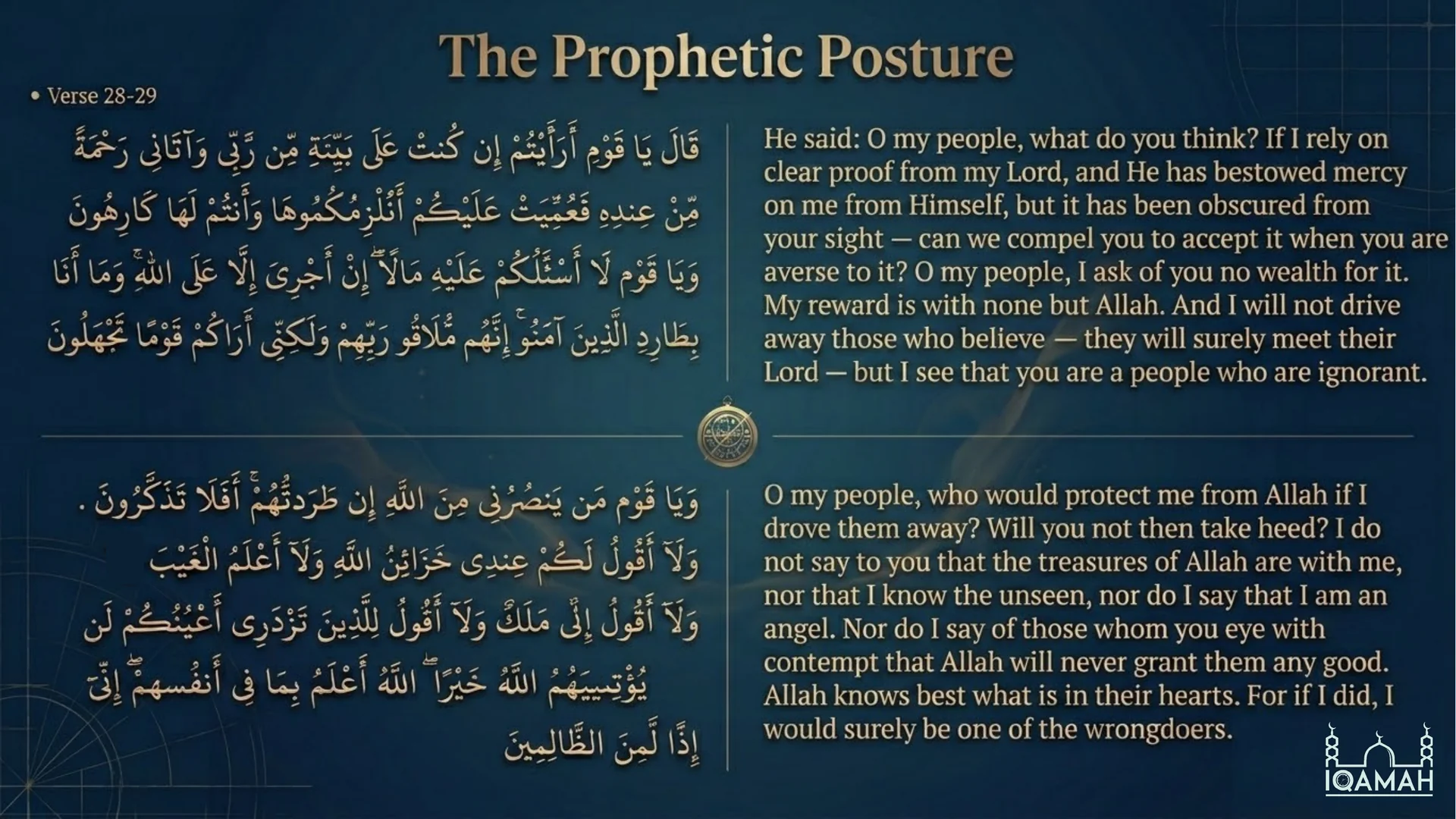
This movement is Nūḥ's reply, and it is a masterclass in how a caller carries himself under contempt. Qutb's summary (In the Shade, vol. 9): Nūḥ disowns every false claim and pretence, presents the message as real and free of falsehood, and faces his people with a friendliness that is not joined to submission — gentle without being servile.

Across vv. 28–31, Nūḥ establishes five facets of a single dignified stance: he stands on a clear proof (bayyinah, v. 28); he refuses to coerce (v. 28); he seeks no payment (v. 29); he will not betray the weak believers (vv. 29–30); and he claims no superhuman powers (v. 31). The next slides take each in turn. Tell the group to watch how confidence and humility coexist here — the surest man in the room is also the gentlest.

Slide 9
Slide 9 of 48 #

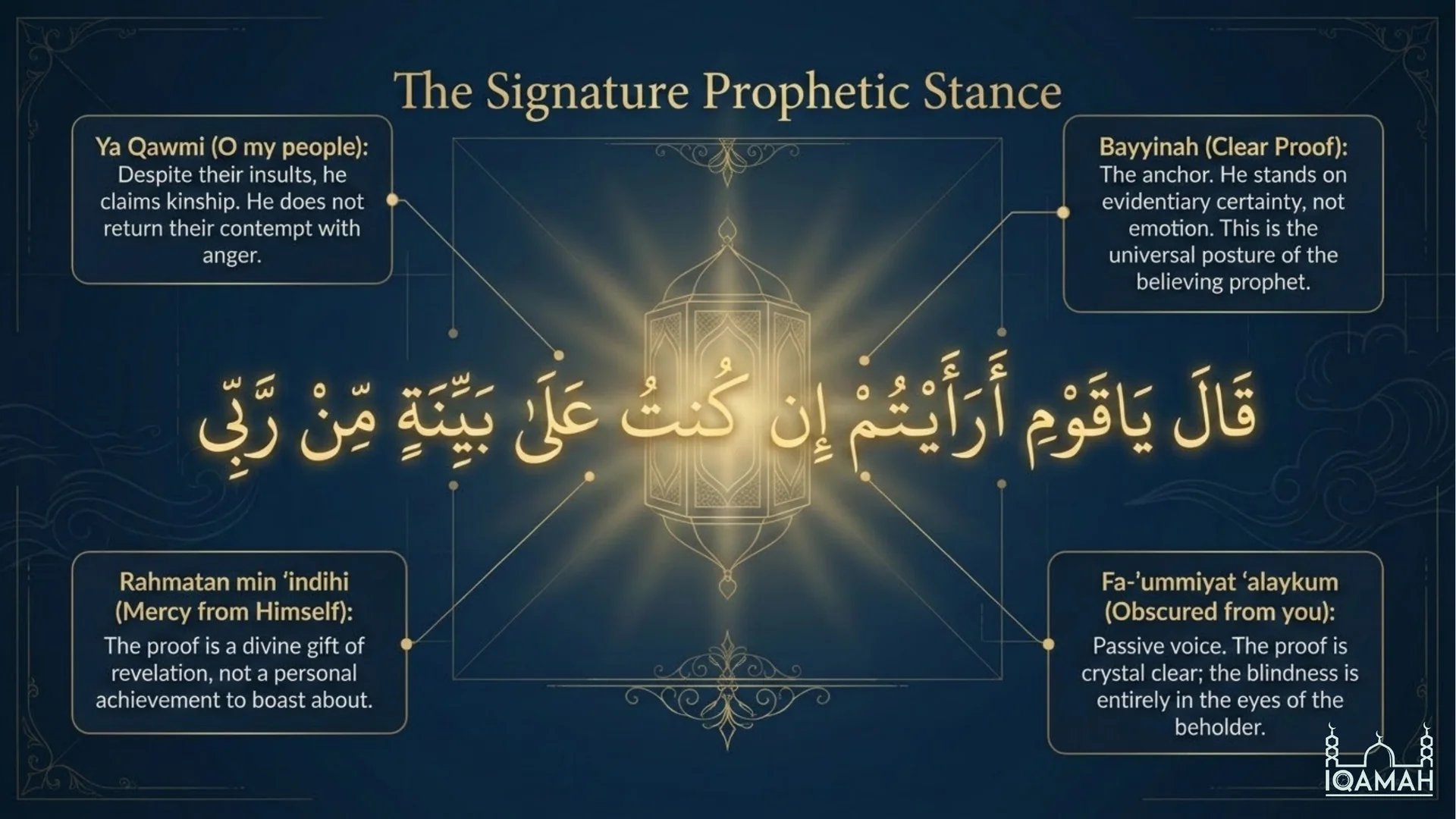
'What do you think — if I stand on a clear proof (bayyinah) from my Lord, and He has given me a mercy from Himself that has been obscured from your sight — can we compel you to it while you are averse?' Saʿdī (p. 280) reads bayyinah as certainty: Nūḥ is an exemplary leader 'whom the resolute messengers would follow,' and his very claim to stand on a bayyinah is itself a testimony to his truthfulness.

There are two halves to teach. First, the source of his confidence is revelation, not personality or wealth. Second — and this is the striking move — the conclusion he draws from that confidence is restraint: 'can we compel you?' Certainty does not license force. Qutb dwells on this fusion of strength and gentleness as the prophetic signature.

A question for the group: why does deep certainty so often produce coercion in people, yet here produces its opposite? What does that reveal about the difference between conviction and arrogance? We will return to this anti-coercion principle on slide 13.

Slide 10
Slide 10 of 48 #

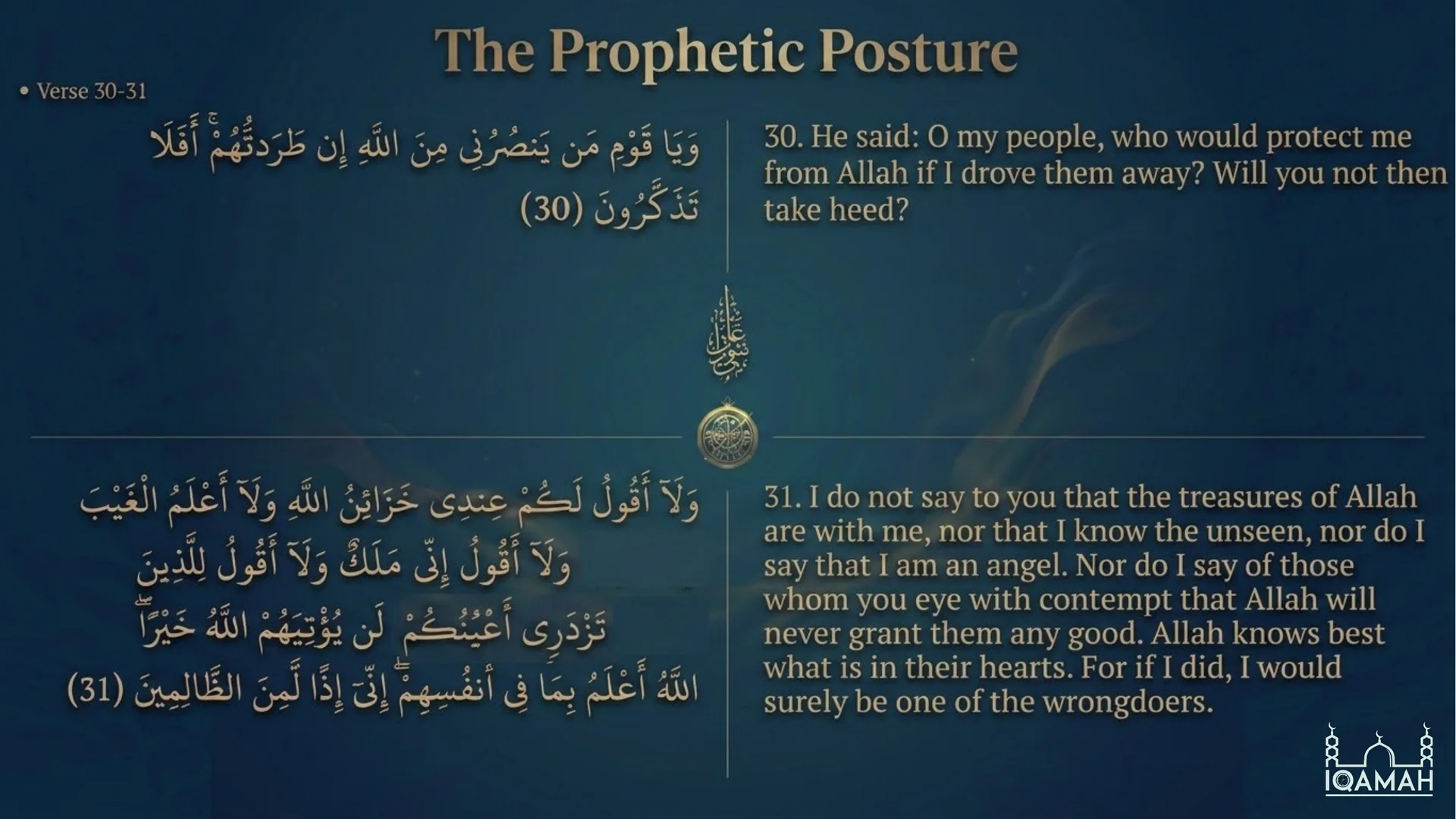
Three further facets land here. v. 29: 'I ask of you no wealth; my reward is only with Allah; and I will not drive away those who believe — they will surely meet their Lord.' v. 30: 'Who would protect me from Allah if I drove them away? Will you not reflect?' v. 31: the five disavowals, treated on slides 16 and 17.

Maʿāriful draws the daʿwah principle from v. 29: the prophets uniformly refuse payment, because a call delivered for a fee tends to leave hearts unchanged — those who take wages for their sermons, it notes, often leave their audiences unmoved. Saʿdī highlights vv. 29–30 as Nūḥ's refusal to sacrifice the poor believers in order to court the elite: he will not clear the room of the marginalized to make the message palatable to the powerful.

The tarbiyyah lesson: a caller's integrity is tested at the margins — whether he protects the low-status believers precisely when their presence is the elite's stated obstacle.

Slide 11
Slide 11 of 48 #

The slide isolates the recurring formula, 'Think, my people! If I stand on a clear proof from my Lord...' Qutb points out (In the Shade, vol. 9) that this same opening recurs from Ṣāliḥ (v. 63) and Shuʿayb (v. 88) — it is the prophets' shared rhetorical signature. The opening verb (a-raʾaytum, 'have you considered?') is an invitation to reflection, not a demand for assent.

The teaching value is that the formula models a method: lead with an invitation to consider, anchor your authority in revelation rather than in self, and leave the listener free. It recurs across prophets precisely because it is the divinely-modelled posture, not one man's habit. Cross-reference v. 17 of Part 1, where the identical phrase ʿalā bayyinatin min rabbihi marked the believer's stance.

Slide 12
Slide 12 of 48 #

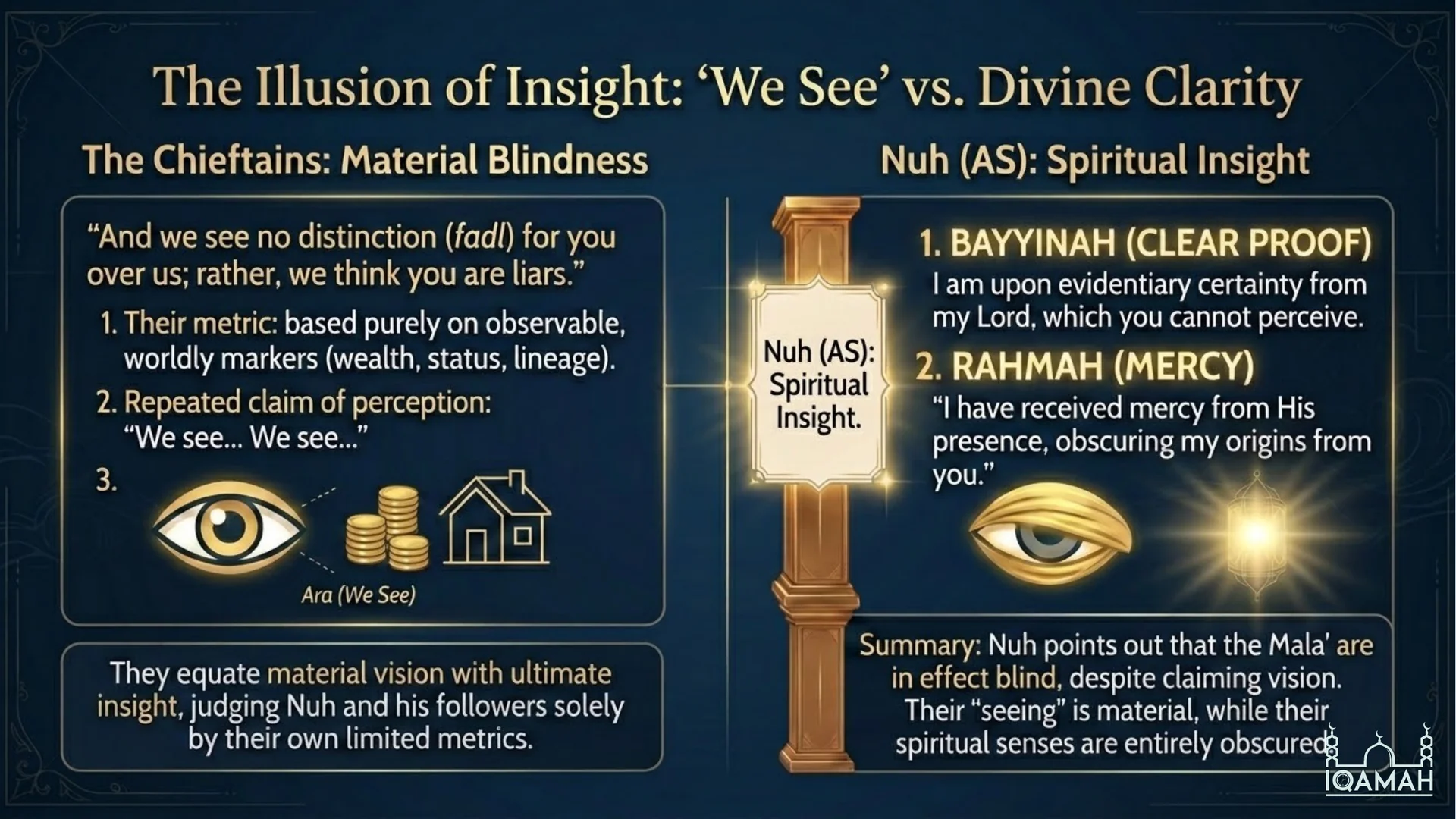
This slide turns on a deliberate contrast of verbs. The chieftains said three times in v. 27, 'we do not see (mā narā) you as anything but...' — their seeing is purely material and sociological. Nūḥ in v. 28 speaks of a bayyinah and a mercy 'obscured from your sight' — a clarity they are structurally unable to perceive while their criterion stays worldly.

This is the slide's 'material blindness versus spiritual insight.' The irony that Saʿdī and Qutb both press: those most confident in their seeing — 'we see clearly that you are nothing special' — are precisely the ones who see least; their 'insight' is the very veil. Cross-reference v. 24 of Part 1 — the blind and deaf against the seeing and hearing — which is the same diagnosis rendered as an image.

A question for the group: where does confidence in our own perception — 'I can see exactly what this is' — function as a veil rather than a window?

Slide 13
Slide 13 of 48 #

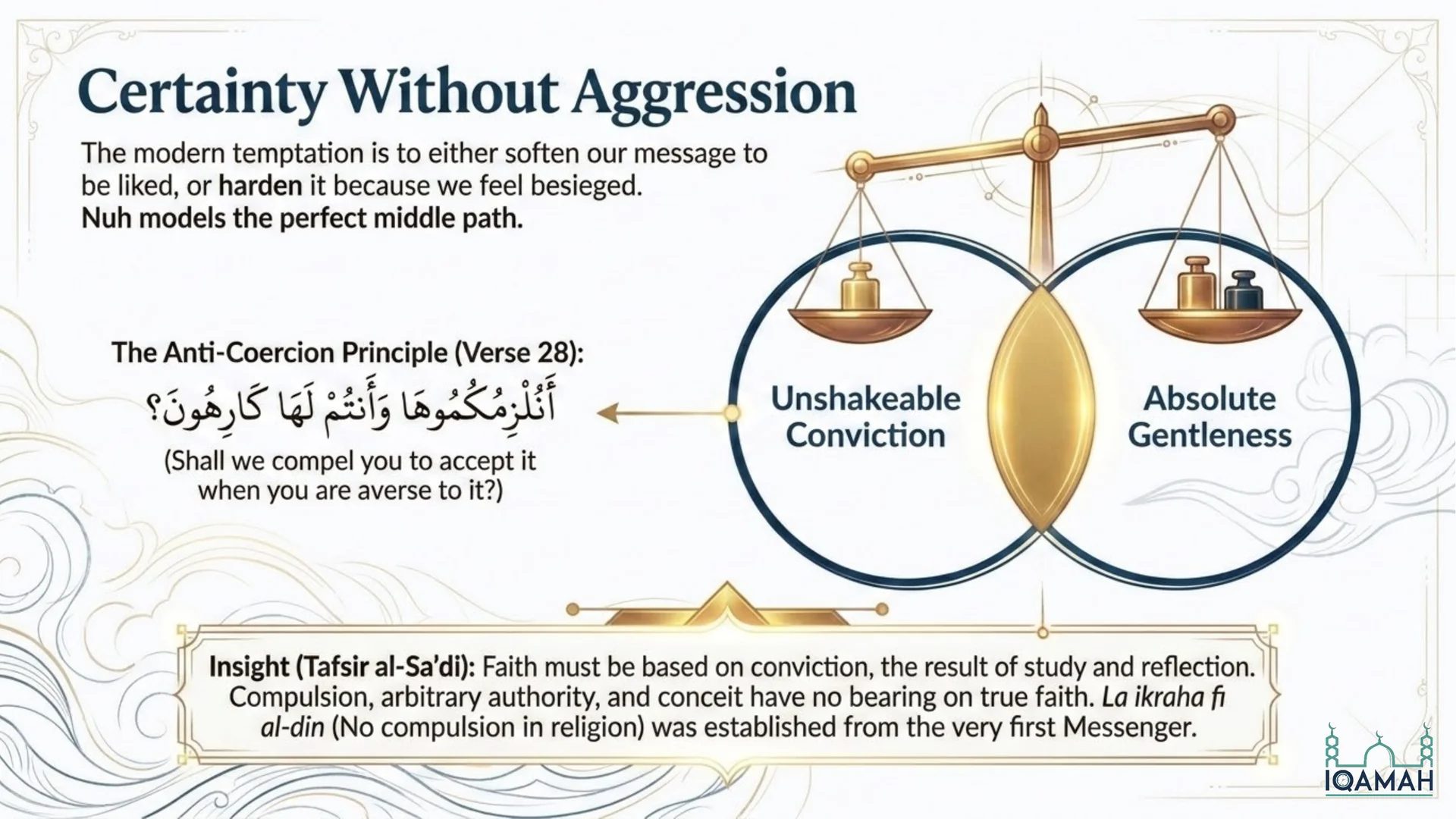
'Can we compel you to it while you are averse?' (a-nulzimukumūhā wa antum lahā kārihūn). The slide's 'anti-coercion principle' is exactly the verse's logic: even possessing the truth with certainty does not authorize forcing it on others. This anticipates the broader Qurʾānic principle lā ikrāha fī al-dīn (2:256).

The pastoral point, in Saʿdī's register, is that true faith rests on insight and willing conviction, not on pressure — which is why the strongest believer here is also the gentlest caller. Stress that the gentleness flows from the strength of his certainty, not from any doubt. The contemporary application: coercion betrays the very truth it claims to defend; a faith worth holding must be entered freely.

Slide 14
Slide 14 of 48 #

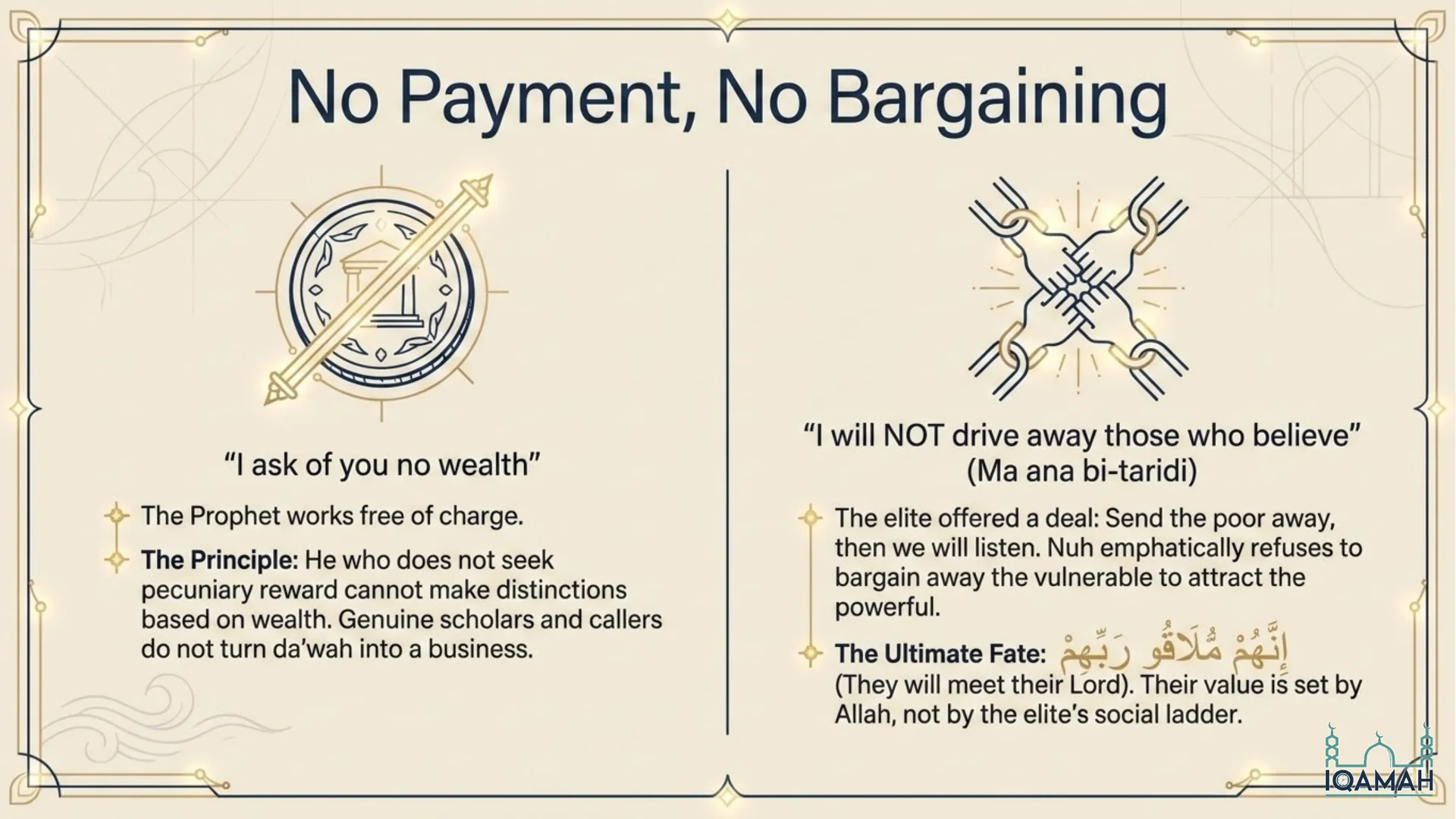
'I ask of you no wealth for it; my reward (ajr) is only with Allah.' Maʿāriful turns this into a working principle: nearly every prophet declares he seeks no payment, because daʿwah taken up for a fee tends to leave its audience unmoved.

The slide's 'no bargaining' angle reads two refusals at once: Nūḥ will not trade away the believers (the elite's price for listening) and he will not monetize the message. Both keep the call uncorrupted — the message must carry its own weight, with nothing attached to it that could be cashed in. The tarbiyyah lesson: when truth is for sale, or for trade, it stops being received as truth.

Slide 15
Slide 15 of 48 #

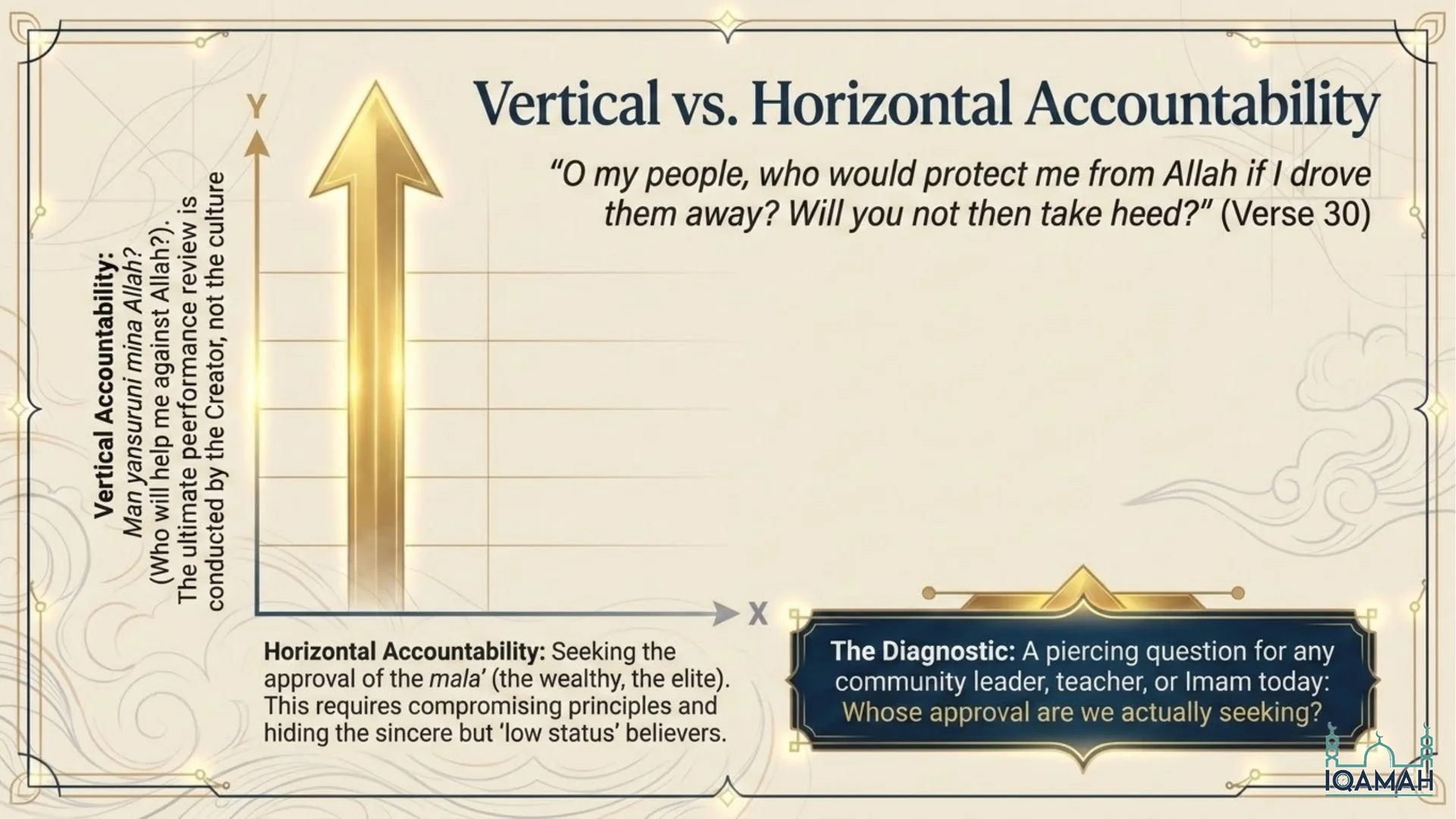
'Who would protect me from Allah if I drove them away?' The slide's framing is exact: Nūḥ measures his conduct against God (the vertical), not against the social pressure of the chieftains (the horizontal). The elite want him accountable to them — to expel the poor believers as the price of dialogue. Nūḥ answers that his only real exposure is to Allah.

Saʿdī's reading: to abandon sincere believers in order to court the powerful would itself be the wrongdoing he must answer for. The rhetorical question silences the demand by relocating the court of judgment. A question for the group: whose approval are we actually organizing our decisions around — and what changes when the 'court' moves from people to Allah?

Slide 16
Slide 16 of 48 #

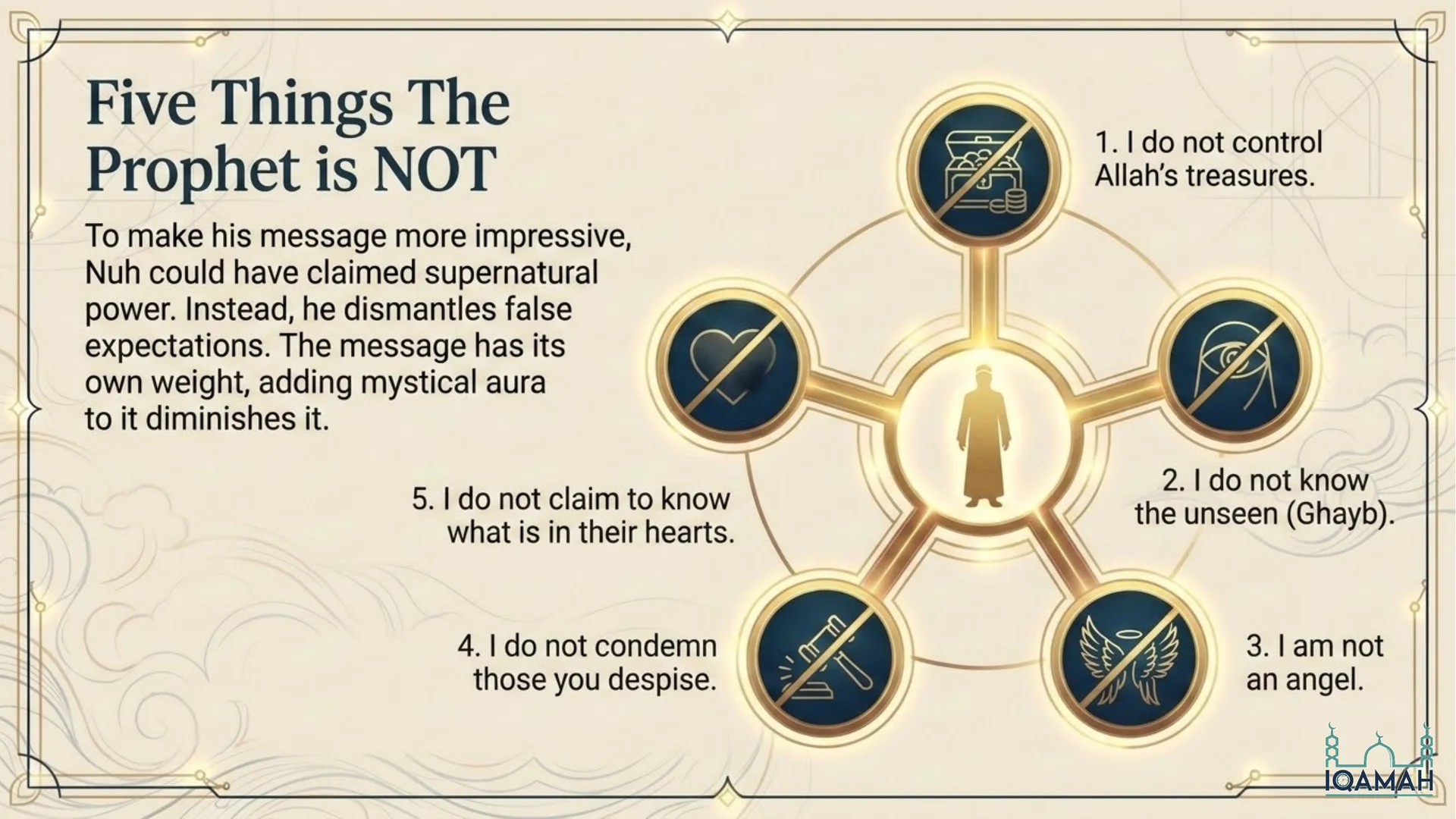
Nūḥ strips away five claims he could have used to inflate his authority: (1) I do not hold the treasuries of Allah (khazāʾin Allāh); (2) I do not know the unseen (al-ghayb); (3) I am not an angel; (4) I do not say of those your eyes despise that Allah will give them no good; and (5) I do not claim to know what is in their hearts — 'Allah knows best what is in them.'

The slide's thesis — that adding a mystical aura diminishes the message — matches Qutb: Nūḥ refuses every supernatural prop so that the truth stands on its own weight. Note carefully that disavowals four and five are as important as the first three: he declines even the negative claims. He will not pronounce on anyone's inner state or final destiny, 'for then I would be among the wrongdoers' (innī idhan la-min al-ẓālimīn). The prophet refuses the power to damn people, not only the power to dazzle them.

The tarbiyyah lesson: real authority subtracts false claims rather than adding them. And no caller is licensed to judge another's heart — that verdict Nūḥ explicitly hands back to Allah.

Slide 17
Slide 17 of 48 #

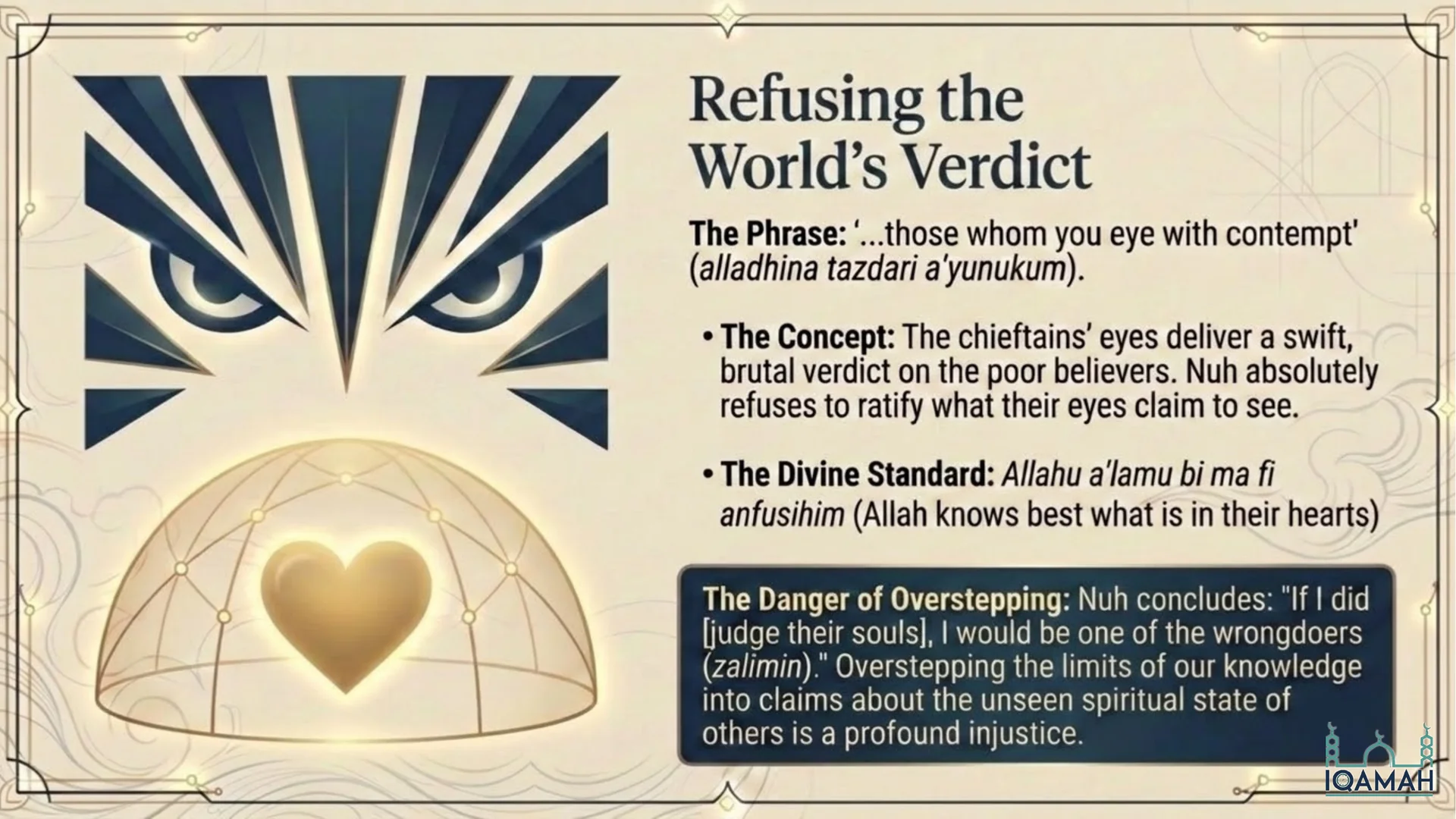
Stay with the fourth disavowal: 'Nor do I say of those whom your eyes look upon with contempt (alladhīna tazdarī aʿyunukum) that Allah will never grant them good.' The chieftains had pronounced the poor believers worthless (al-aradhil, v. 27); Nūḥ refuses to ratify their verdict.

Saʿdī's pastoral note is that to declare the marginalized incapable of receiving good from Allah is itself a grave injustice, because only Allah knows hearts. Nūḥ will not borrow the world's ranking of human worth. The danger the verse names is overstepping — presuming to know God's judgment on people whom God has not condemned. The contemporary application: the pressure to write off 'those kinds of people' as beyond hope is ancient, and the prophetic stance leaves every verdict on a soul to Allah.

Slide 18
Slide 18 of 48 #

The dialogue now collapses. Having lost the argument, the chieftains stop reasoning and issue a dare. Qutb names the move precisely: their challenge is a display of strength meant to mask their dread of the truth's strength — deceit covering weakness. This movement marks the pivot from persuasion to confrontation.

Across vv. 32–35 we will see their taunt ('bring what you threaten,' v. 32), Nūḥ's reply that punishment is Allah's prerogative (v. 33), the limits of counsel (v. 34), and the parenthetical turn to the Prophet Muḥammad ﷺ (v. 35). The next slides break these out.

Slide 19
Slide 19 of 48 #

Use this timeline to consolidate the first three movements before we reach the verdict: the Call (vv. 25–27), the Defense or Posture (vv. 28–31), the Breakdown (vv. 32–35), then the Ark (vv. 36–40) and the Flood (vv. 40–49). It mirrors the five-movement map from slide 2.

This is a natural mid-session checkpoint. Ask the group to state, in one sentence each, what changed between the Call, the Defense, and the Breakdown. The key shift is that the chieftains move from objecting to daring — the conversation is over, even though Nūḥ keeps speaking the truth to the very last (v. 33). That is itself a lesson in adab: the breakdown is on their side, not his.

Slide 20
Slide 20 of 48 #

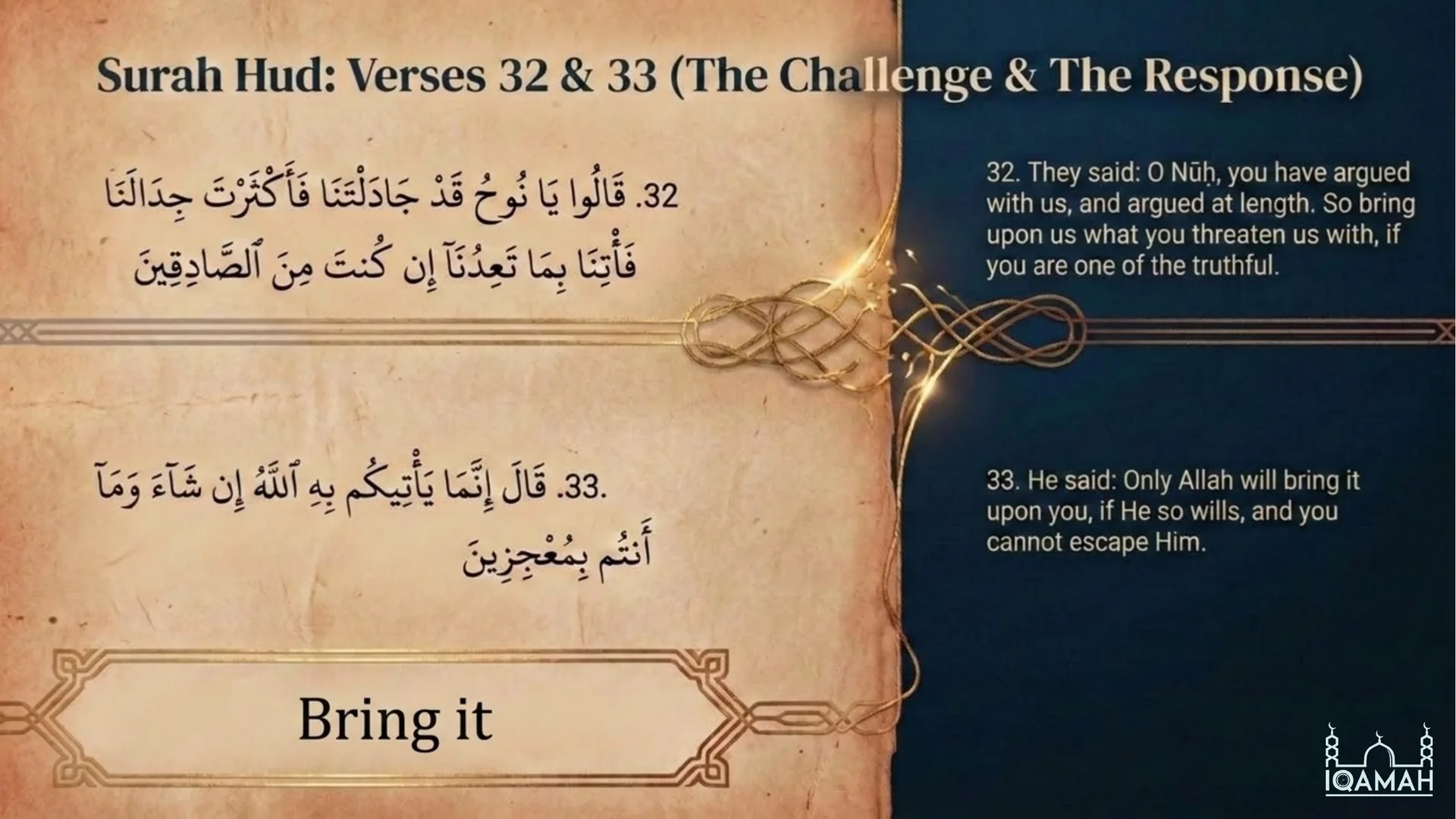
v. 32: 'O Nūḥ, you have argued with us and argued to excess (qad jādaltanā fa-aktharta jidālanā); bring us what you threaten, if you are truthful.' v. 33: 'Only Allah will bring it to you, if He wills, and you cannot escape (muʿjizīn).'

Saʿdī's contrast (p. 283) is the heart of it. A sincere person who found the call unclear would have asked for clarification; instead they demanded the punishment — which proves their rejection was defiance, not doubt. Nūḥ's reply keeps the boundary clean: he is the messenger; the timing and the punishment belong to Allah alone, not to the messenger's ego or impatience. The tarbiyyah lesson: when people demand the 'proof' of disaster instead of asking honest questions, the obstacle is the will, not the evidence.

Slide 21
Slide 21 of 48 #

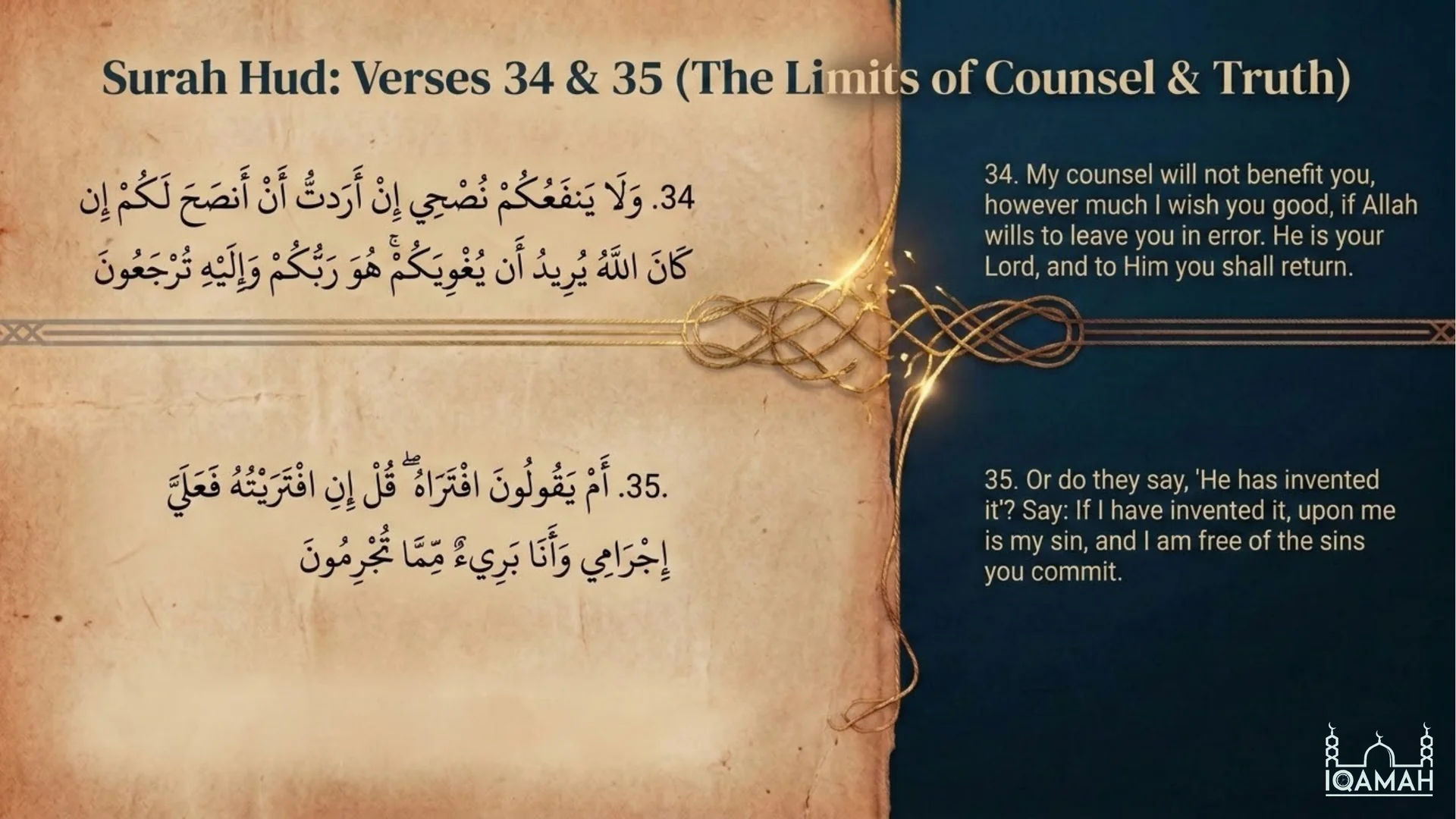
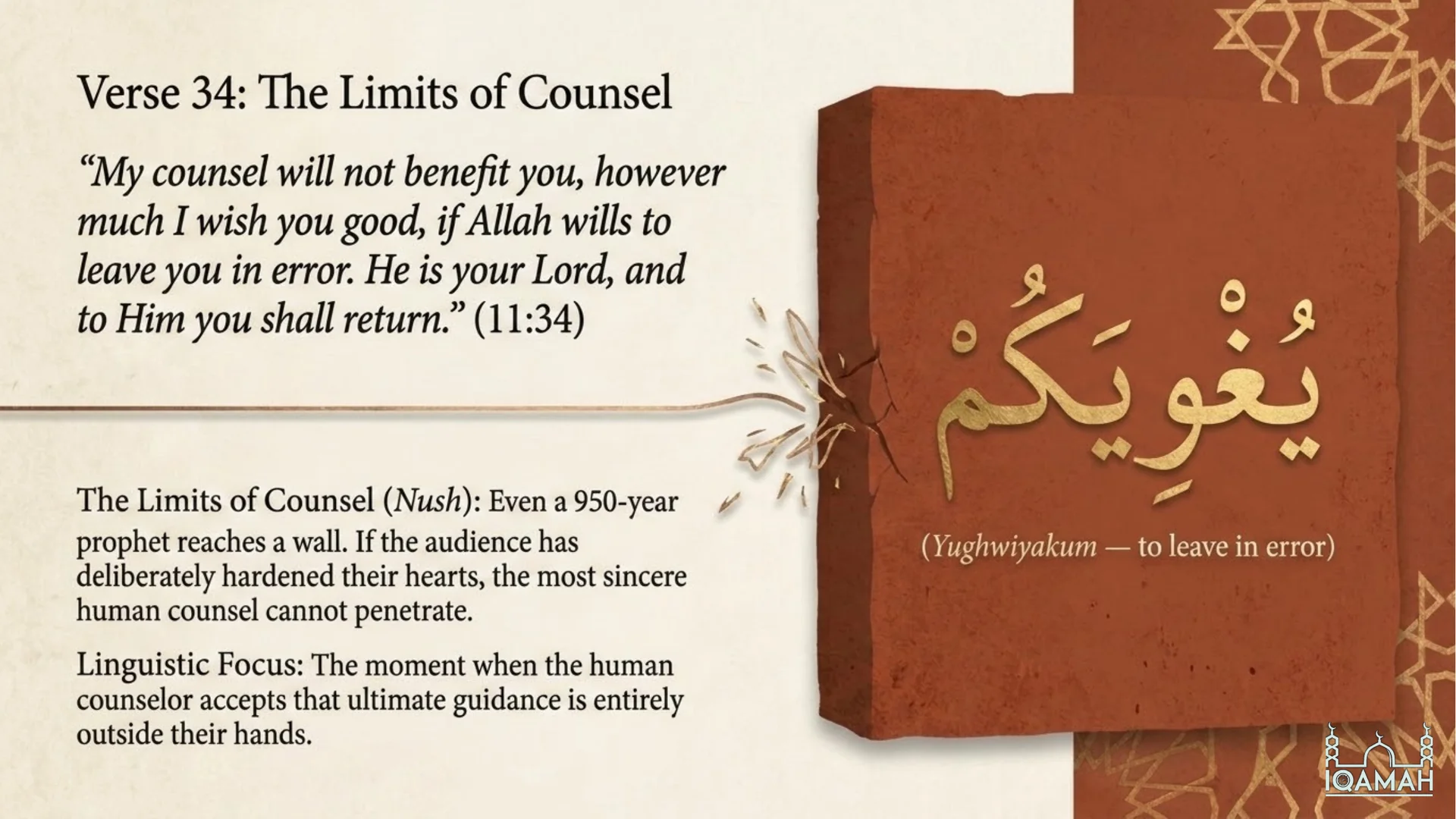
v. 34: 'My counsel (nuṣḥ) will not benefit you, however much I wish to counsel you, if Allah wills to let you go astray. He is your Lord, and to Him you will return.' v. 35 then turns to the Prophet ﷺ: 'Or do they say he has forged it? Say: if I forged it, my sin is mine; and I am innocent of the crimes you commit.'

Two lessons sit side by side here. First, in Saʿdī's register: the caller is responsible for sincere effort, not for results; guidance is finally Allah's gift. Second, v. 35 is the sūrah briefly lifting its eyes from Nūḥ's people to the Quraysh, showing the parallel we treat on the next slide. Keep the two verses distinct in teaching — one closes Nūḥ's dialogue, the other opens onto the Prophet's ﷺ.

Slide 22
Slide 22 of 48 #

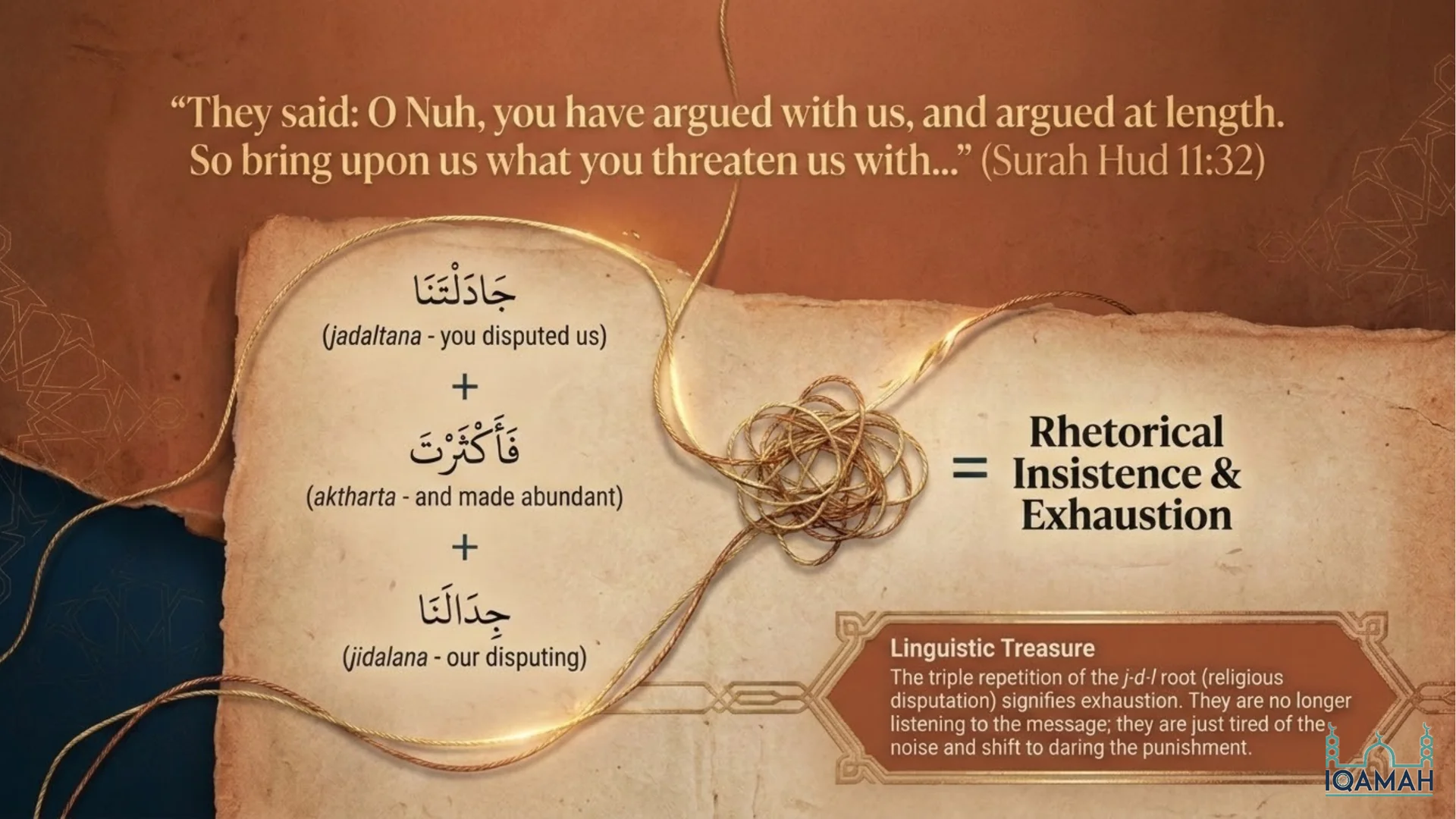
The slide's 'rhetorical insistence and exhaustion' reads the doubled phrase, 'you have argued... and argued to excess.' A balāghah note for those who want it — and a teacher may consult Zamakhsharī's al-Kashshāf or Ibn ʿĀshūr's al-Taḥrīr wa-l-Tanwīr here, cited strictly for their linguistic value: the repetition of the root j-d-l dramatizes the chieftains' fatigue with the argument itself, not any flaw in it.

Qutb names the move as a mask — a display of strength to hide their dread of the truth's strength. They reframe sincere persistence as mere nagging, a familiar tactic for ending a conversation one is losing. A question for the group: 'You've made your point — enough already.' When is that a fair request, and when is it a way to dodge a truth one cannot answer?

Slide 23
Slide 23 of 48 #

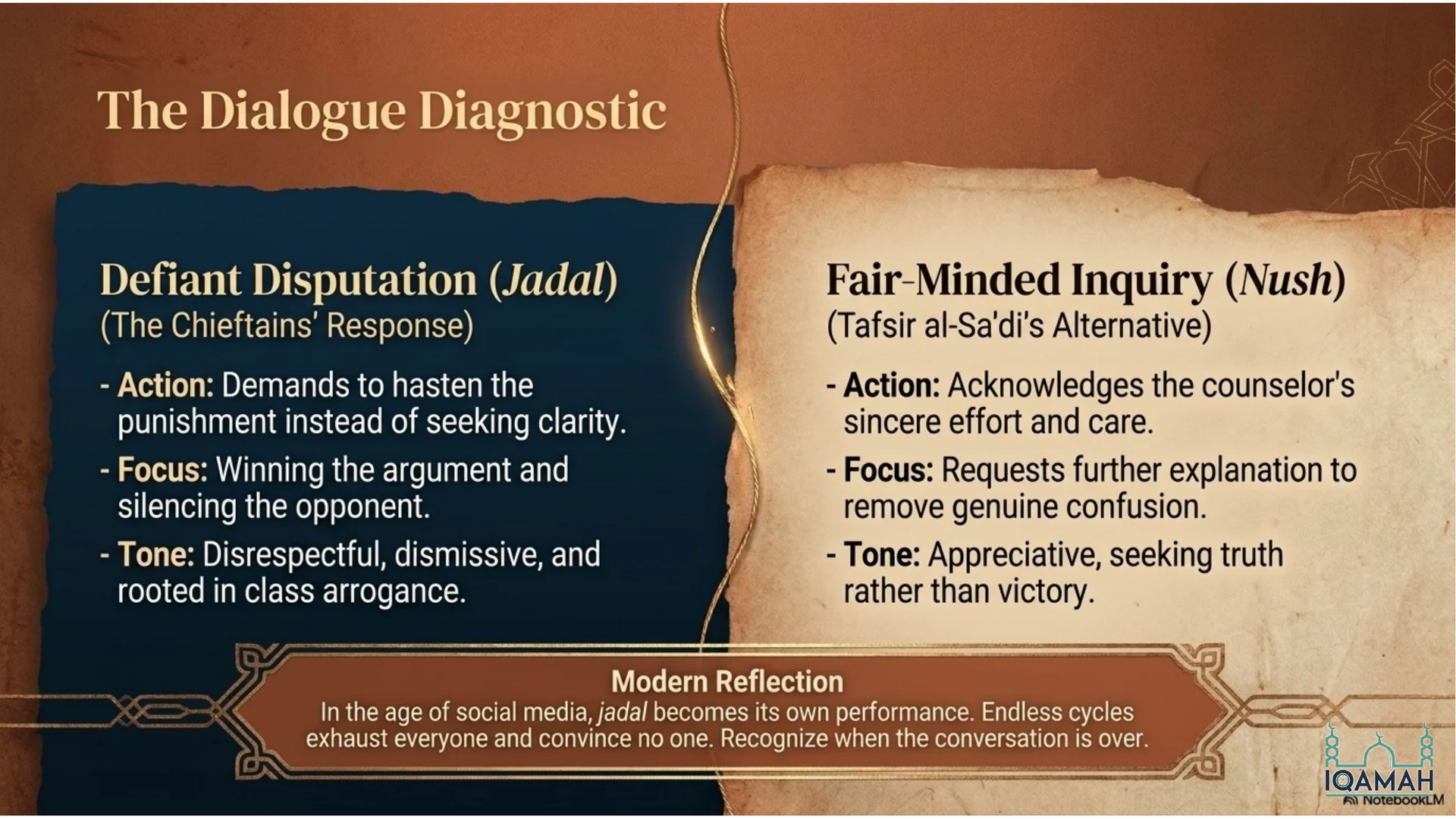
This contrast is taken almost directly from Saʿdī on v. 32 (p. 283). He spells out the fair-minded response the chieftains could have given: in effect, 'Nūḥ, you have been sincere and caring toward us, but this is unclear — explain it so we may follow.' Defiant disputation (jadal) seeks to win and to silence; fair inquiry — the receptive posture of one open to nuṣḥ — seeks to understand.

The slide's three columns are a clean grid. Defiant: hasten the punishment / win the argument / dismissive, class-bound arrogance. Fair-minded: acknowledge the counselor's sincerity / request clarification / appreciative, seeking truth rather than victory. Note that the difference is not intelligence or information; it is the posture of the heart toward the truth.

The contemporary application is sharp. Online, jadal becomes performance — endless cycles that exhaust everyone and convince no one. A practical skill, modelled by Nūḥ himself, is recognizing when a conversation has stopped being inquiry and become combat, then stating the truth plainly and entrusting the outcome to Allah (v. 33).

Slide 24
Slide 24 of 48 #

'My counsel will not benefit you... if Allah wills to let you go astray.' The slide's heading is exact: there is a ceiling on what even the most sincere counselor can achieve. Nūḥ has done everything right for nine and a half centuries; the result is not in his hands.

The pastoral weight, in Saʿdī's register, is that this protects the caller from both despair and self-blame. The duty is balāgh — faithful delivery — and after that, 'to Him you will return.' Set this beside the Prophet's ﷺ own consolation at the close of the passage (v. 49, 'be patient'). The tarbiyyah lesson: you are accountable for the sincerity and clarity of your counsel, not for whether hearts open; releasing the outcome to Allah is part of the work, not a failure of it.

Slide 25
Slide 25 of 48 #

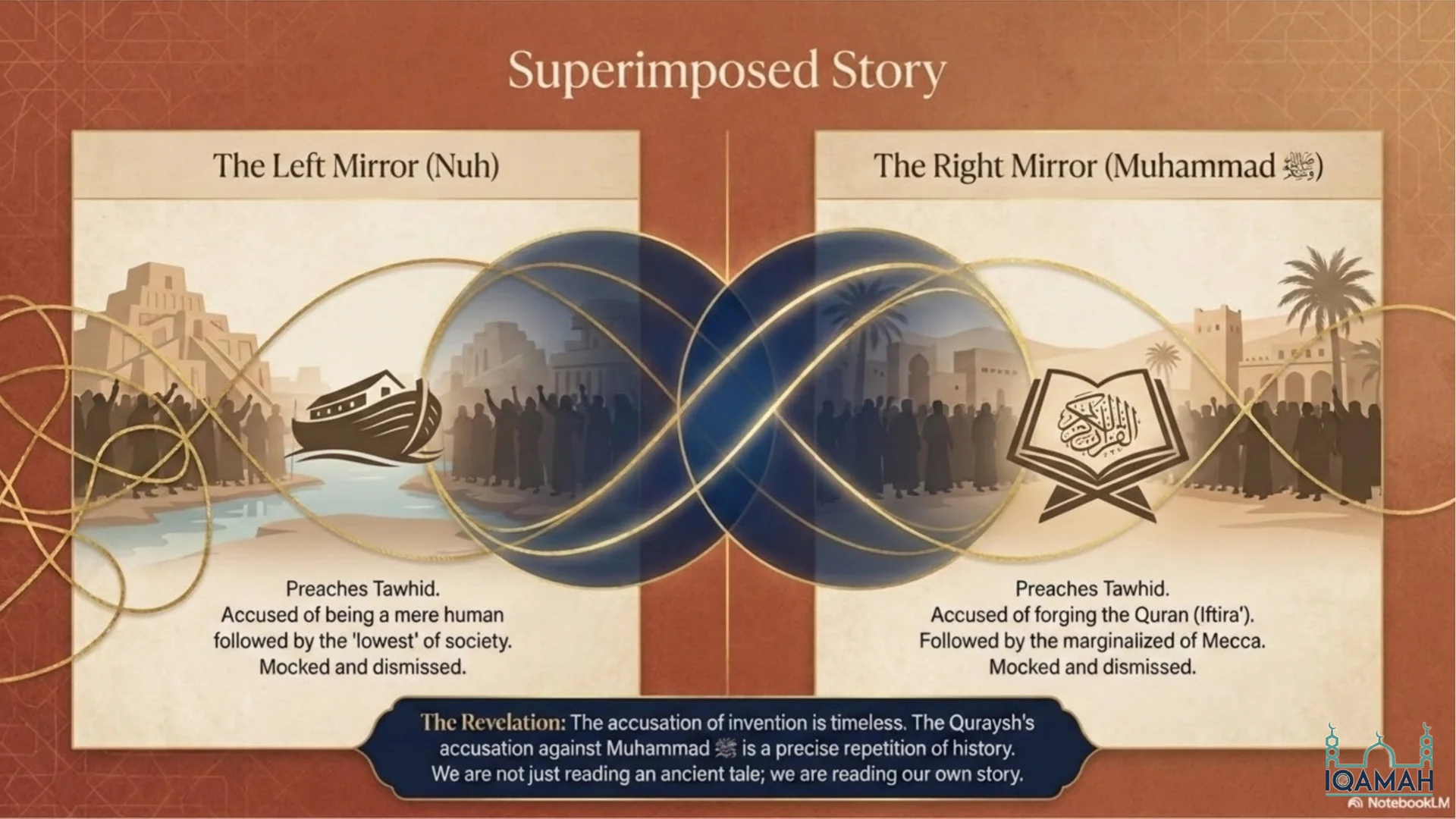
v. 35 — 'Or do they say he has forged it?' — briefly overlays the Prophet Muḥammad ﷺ onto Nūḥ's frame. The slide's 'two mirrors' image is apt: the Meccan elite's charge of forgery (iftirāʾ) against Muḥammad ﷺ mirrors the chieftains' charge of lying against Nūḥ. The instruction, 'say: if I forged it, my sin is mine,' models calm, non-defensive truthfulness.

This is also the hinge to v. 49's 'tidings of the unseen': the whole Nūḥ story is being told to a Prophet ﷺ who could not have known it except by revelation. The parallel is the sūrah's own argument — the same message, the same objections, the same vindication, across the ages. Cross-reference v. 13 of Part 1, where the identical accusation of iftirāʾ was met with the challenge to produce ten sūrahs.

Slide 26
Slide 26 of 48 #

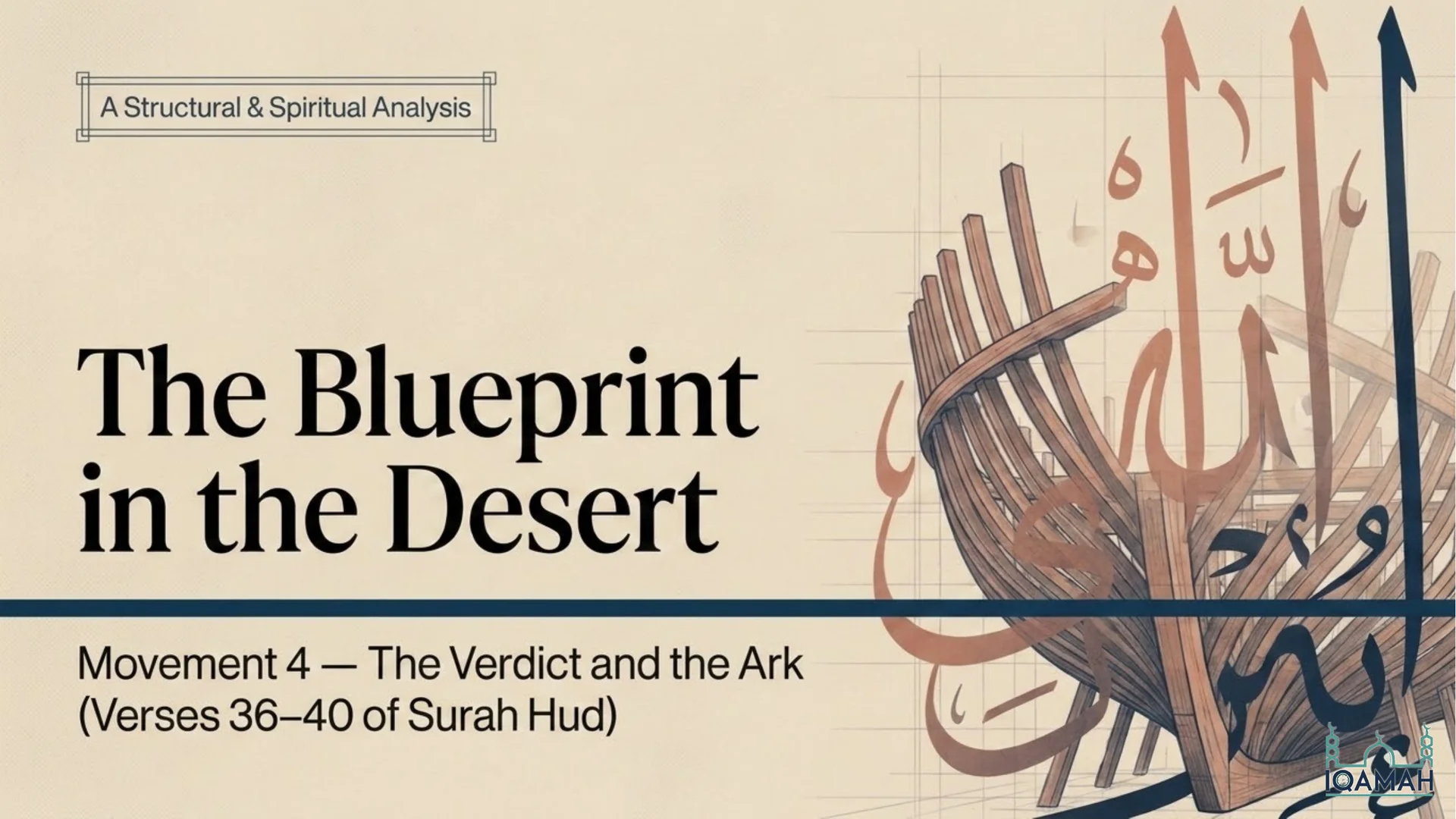
The mode now shifts from speech to action: revelation that the calling is over (v. 36), the command to build the ark (v. 37), construction under mockery (vv. 38–39), and the flood's onset (v. 40). The 'blueprint in the desert' image captures the absurdity, to onlookers, of building a great ship on dry land.

Qutb's big-picture reading for this movement (In the Shade, vol. 9): the tiny believing remnant matters so much in God's scale that He overturns the natural order for its sake — drowning a whole civilization to preserve a 'second seed' of mankind. Frame the ark as the visible sign that daʿwah has ended and decree has begun.

Slide 27
Slide 27 of 48 #

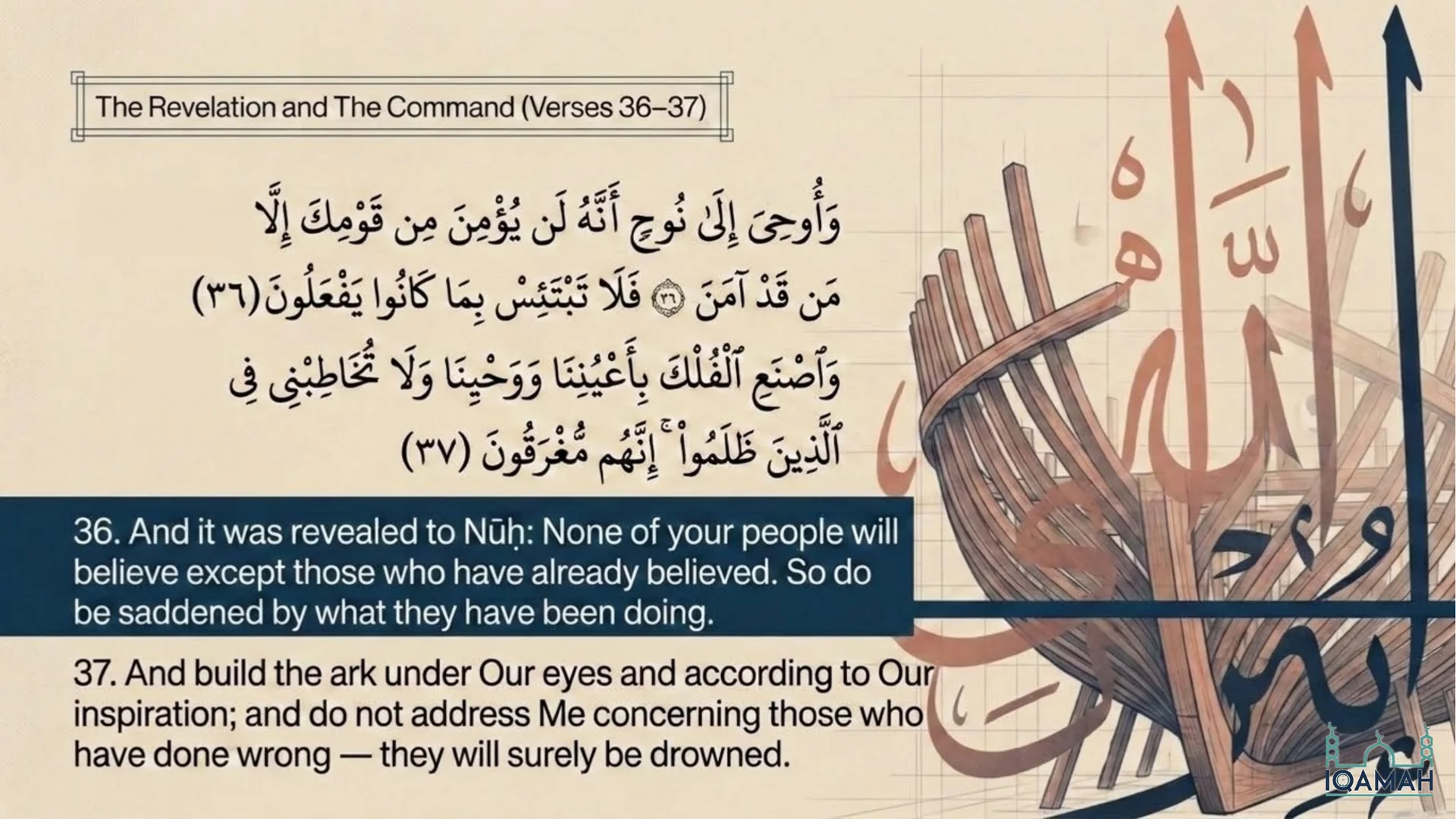
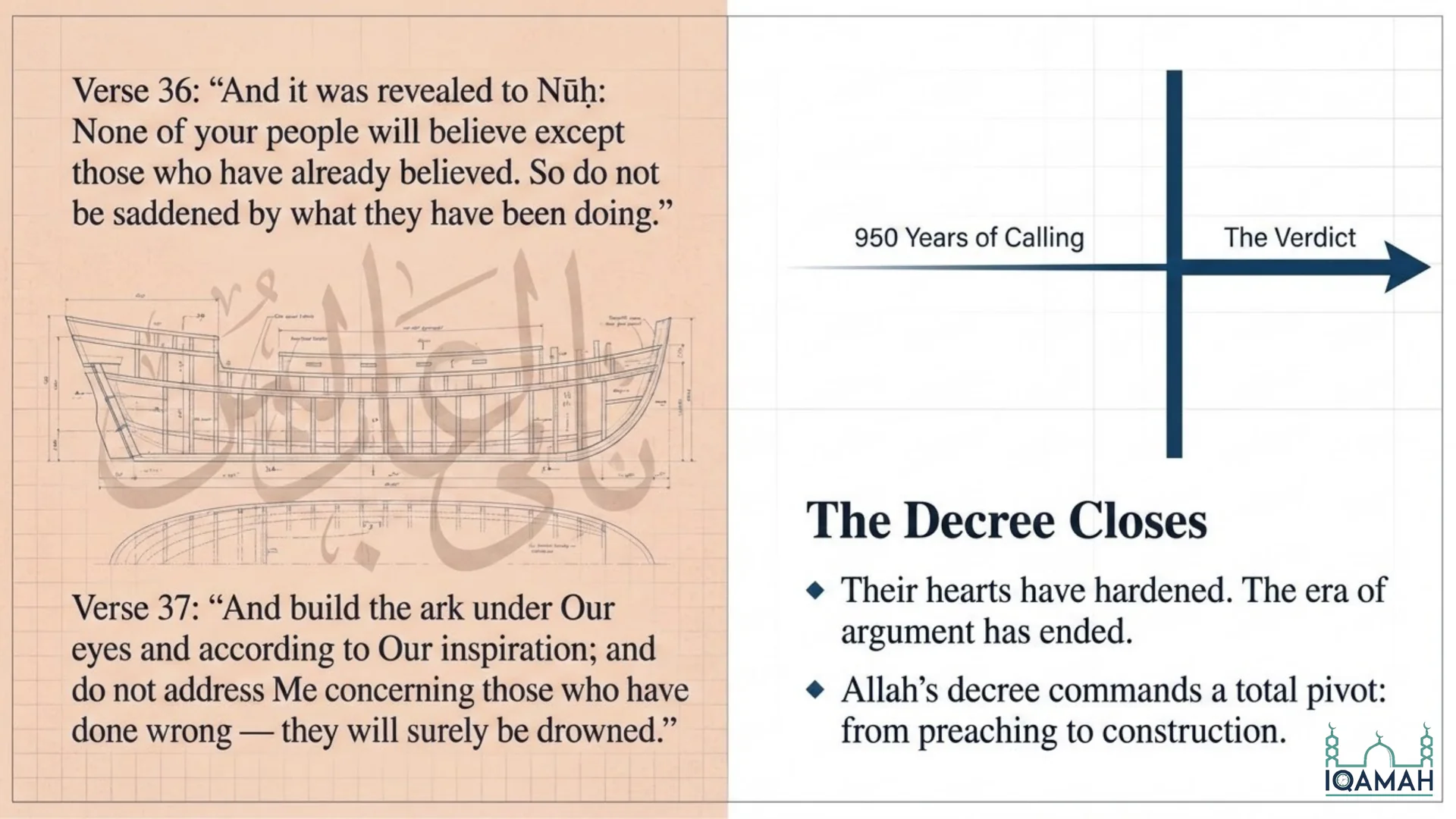
v. 36: 'It was revealed to Nūḥ: none of your people will believe except those who already have, so do not be distressed at what they do.' v. 37: 'Build the ark under Our eyes (bi-aʿyuninā) and Our inspiration, and do not plead with Me for the wrongdoers; they will be drowned.'

Saʿdī (pp. 286–287): their hearts have hardened; the verdict is set and cannot be averted, so Nūḥ is released from grief over them. Maʿāriful adds the consoling psychology — one only grieves where one still expects good; once that expectation is honestly closed, there is a kind of relief in it. 'Under Our eyes' (bi-aʿyuninā) means under Allah's direct care, view, and approval — the project is divinely supervised, not left to Nūḥ's engineering alone.

Note the prohibition, 'do not plead for the wrongdoers.' It becomes important at v. 45, when Nūḥ, in paternal grief, comes close to doing exactly that for his son — and is gently corrected. The seed of that scene is planted right here.

Slide 28
Slide 28 of 48 #

This slide isolates the turning point: the era of calling has ended. The line that the door of argument has closed is precise — after 950 years, revelation itself certifies that no further hearts will turn. The command pivots from preaching to construction.

A necessary teaching caution belongs here. This is a verdict delivered by revelation, to a specific prophet, about a specific people, after an exhausted, centuries-long call. It is not a license for any caller today to write off people as hopeless — only Allah closes that door, and v. 31 already forbade Nūḥ himself from pronouncing on others' hearts. Make this distinction explicitly, lest the lesson be misapplied.

Slide 29
Slide 29 of 48 #

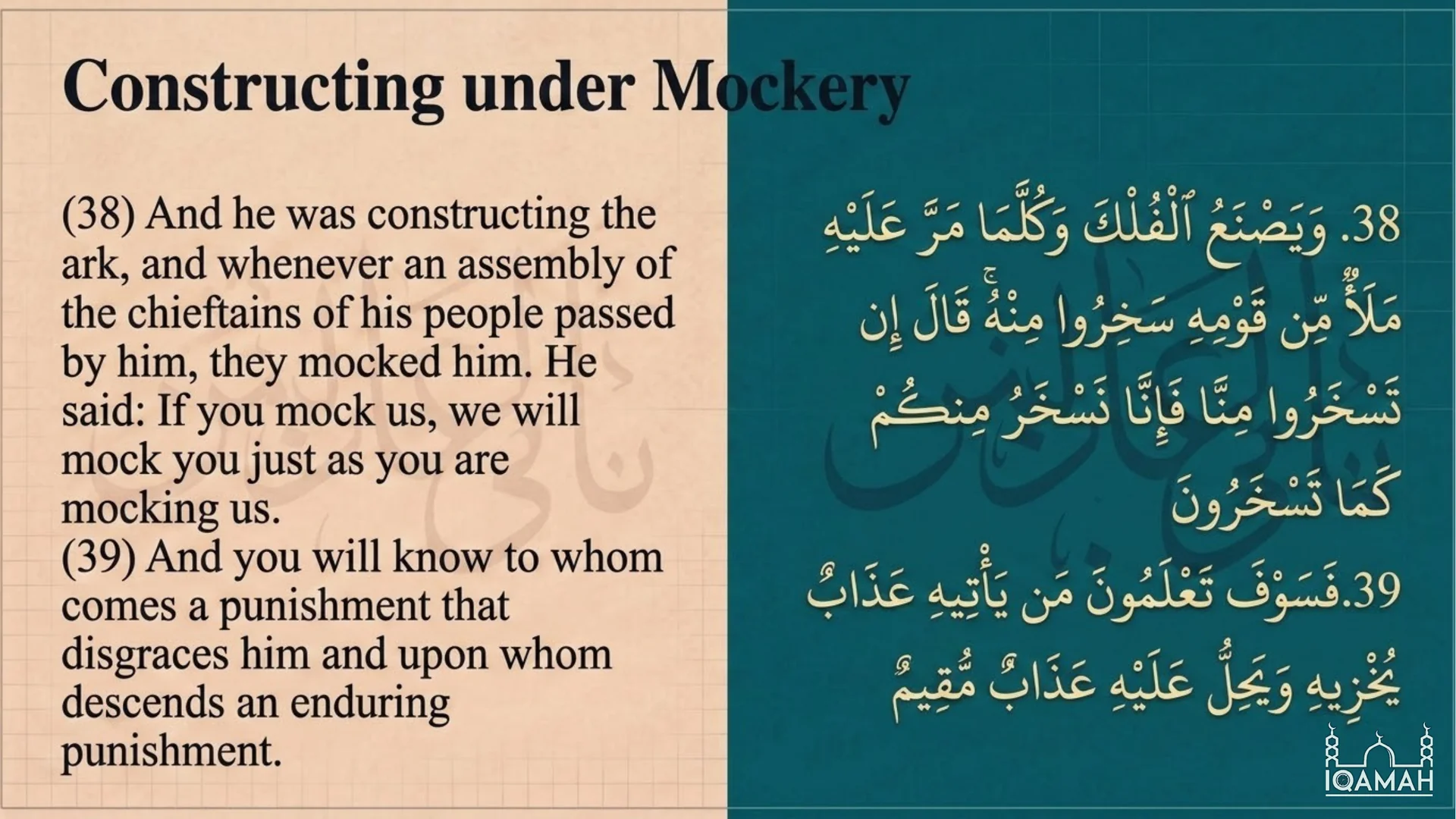
'He began to build the ark, and whenever the chieftains of his people passed by, they ridiculed him. He said: if you ridicule us, we will ridicule you as you ridicule us. You will come to know who receives a punishment that disgraces him, and upon whom a lasting punishment descends.' Saʿdī (p. 287) confirms the mockery was at the sheer sight of ship-building on dry land.

Qutb notes that Nūḥ answers with calm confidence, not anger — their mockery will rebound. The point is durable: obedience often looks ridiculous before its vindication, and the believer acts on revelation even when the action seems to contradict visible reality. A question for the group: when has doing the right thing required you to look foolish to onlookers — and what sustained you through the gap between obedience and vindication?

Slide 30
Slide 30 of 48 #

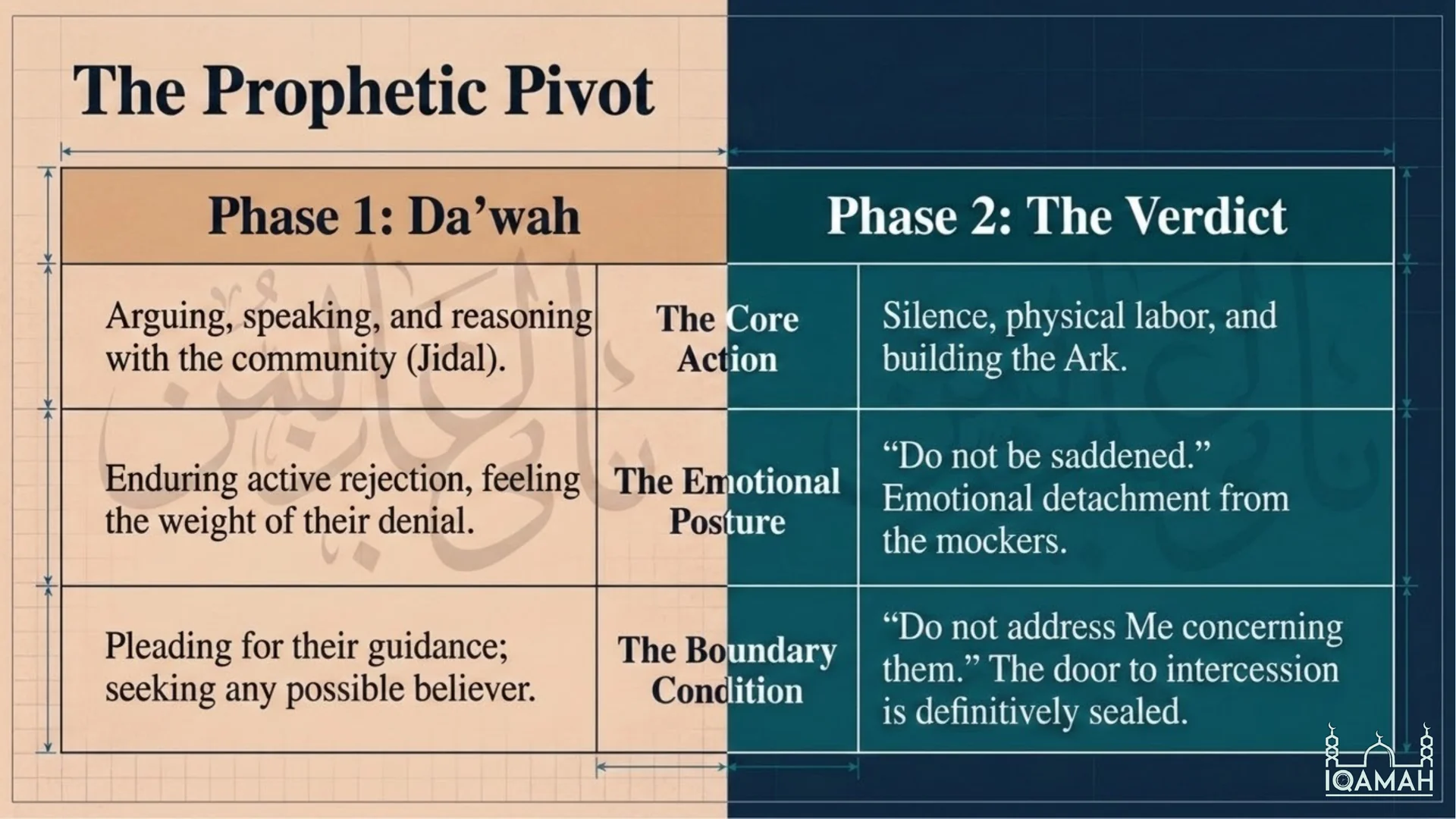
This slide formalizes the hinge of the whole story. Phase 1 (daʿwah) is arguing, reasoning, pleading, enduring denial, hoping for every possible believer; Phase 2 (the verdict) begins only when revelation closes the door (v. 36). The shift is not Nūḥ's impatience — it is divinely timed.

The key guardrail, tied to slide 28: the boundary condition that ends Phase 1 is set by Allah, never by the caller's frustration. Nūḥ kept calling for 950 years and kept speaking the truth even after the dare (v. 33). The pivot to building came by command, not by his giving up. The tarbiyyah lesson: there is a time to call and a time to build — but only Allah declares the calling closed, and patience is required right up to that line.

Slide 31
Slide 31 of 48 #

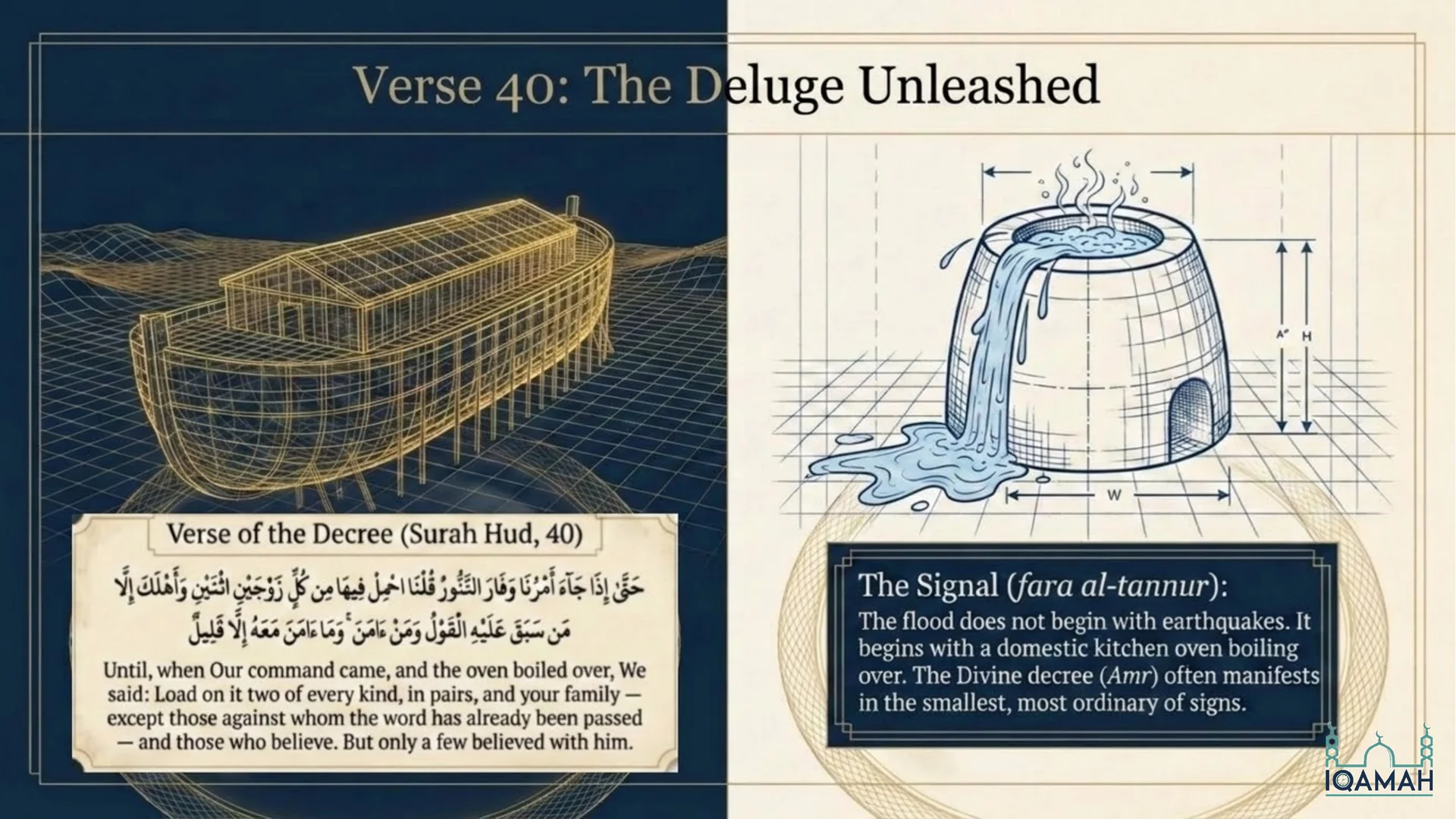
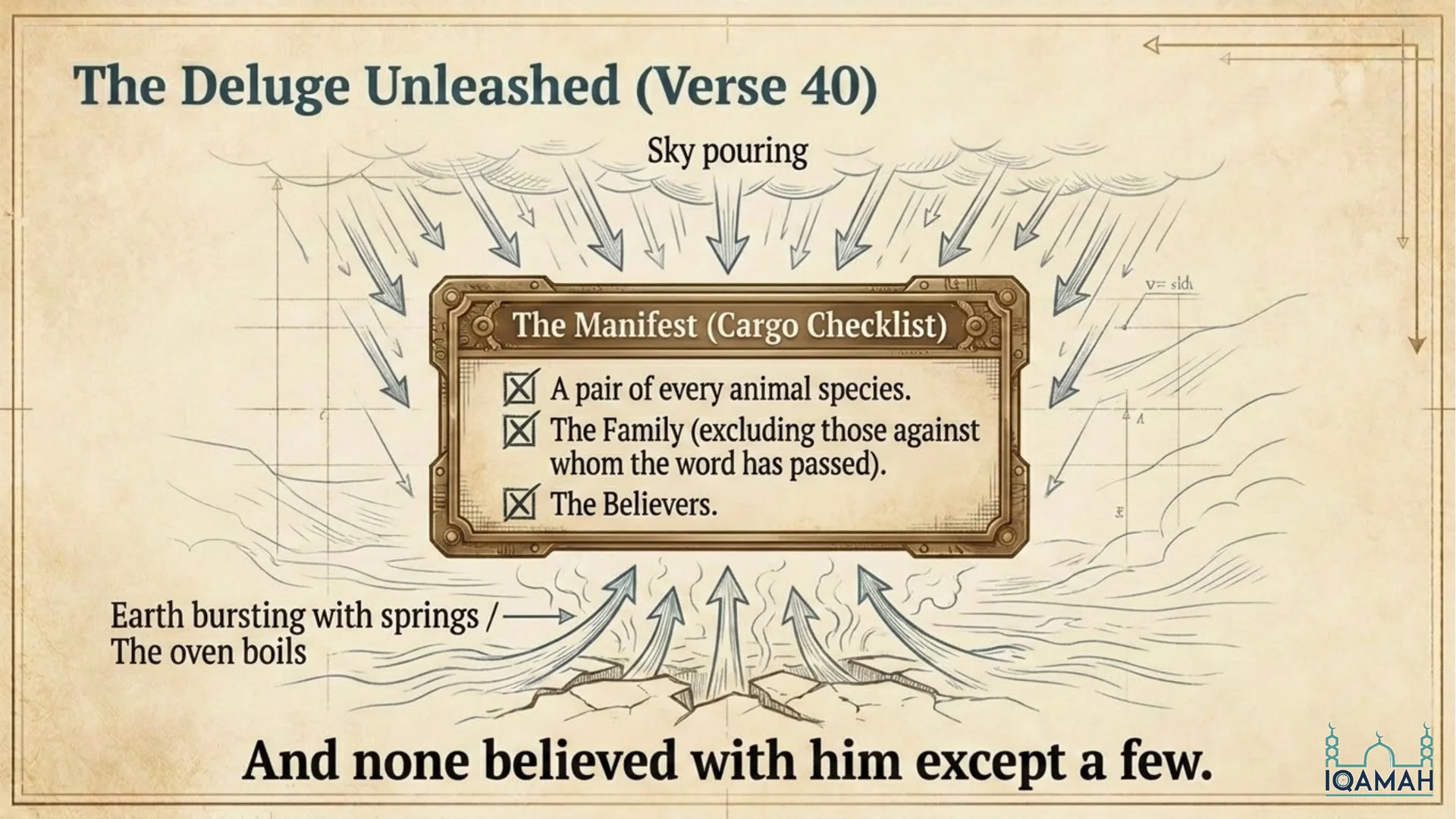
'Until, when Our command came and the oven boiled (fāra al-tannūr), We said: load into it a pair of every kind, and your family — except those against whom the sentence has already passed — and those who believed. But only a few believed with him.'

Three actions converge in this verse: the signal (the tannūr, treated next), the cargo (pairs of animals plus the believing remnant), and the final tally — 'only a few.' Saʿdī (pp. 287–288): rain poured in torrents and the earth gushed with springs until the waters met at the decreed level (cf. 54:11–12). Maʿāriful notes that the 'pairs' were domestic animals that cannot survive in water, which answers the old puzzle of how the ark could hold every species — it did not need to.

Slide 32
Slide 32 of 48 #

The cargo on the slide — a pair of every relevant animal, the family minus those sentenced, and the believers — follows the verse exactly. Maʿāriful reports, on the authority of Ibn ʿAbbās, that those aboard numbered around eighty, including three sons (Sām, Ḥām, Yāfith) and their wives; the fourth son stayed with the disbelievers and drowned.

The refrain, 'and only a few believed with him,' carries the emotional weight of the verse — 950 years, and this is the harvest. Yet Qutb insists this 'few' is precisely what God valued enough to reset the world for. The tarbiyyah lesson: do not despise the small faithful remnant; in God's scale it can outweigh a whole civilization. Numbers are not God's measure of worth.

Slide 33
Slide 33 of 48 #

The final movement runs from embarkation (v. 41) through the sailing and the drowning son (vv. 42–43), the cosmic stilling (v. 44), Nūḥ's plea and correction over his son (vv. 45–47), the blessed disembarkation (v. 48), and the closing address to the Prophet ﷺ (v. 49).

Qutb calls this the sūrah's most vivid stretch — the events unfold, in his phrase, as though we see them now before our very eyes. The deck's 'cinematic' framing fits: the Qurʾān shifts into present-tense scene-painting (tajrī, v. 42) and stages a father-son dialogue against waves 'like mountains.' Tell the group you will be drawing attention to the language itself here, not only the events — this is where tadabbur and balāghah meet.

Slide 34
Slide 34 of 48 #

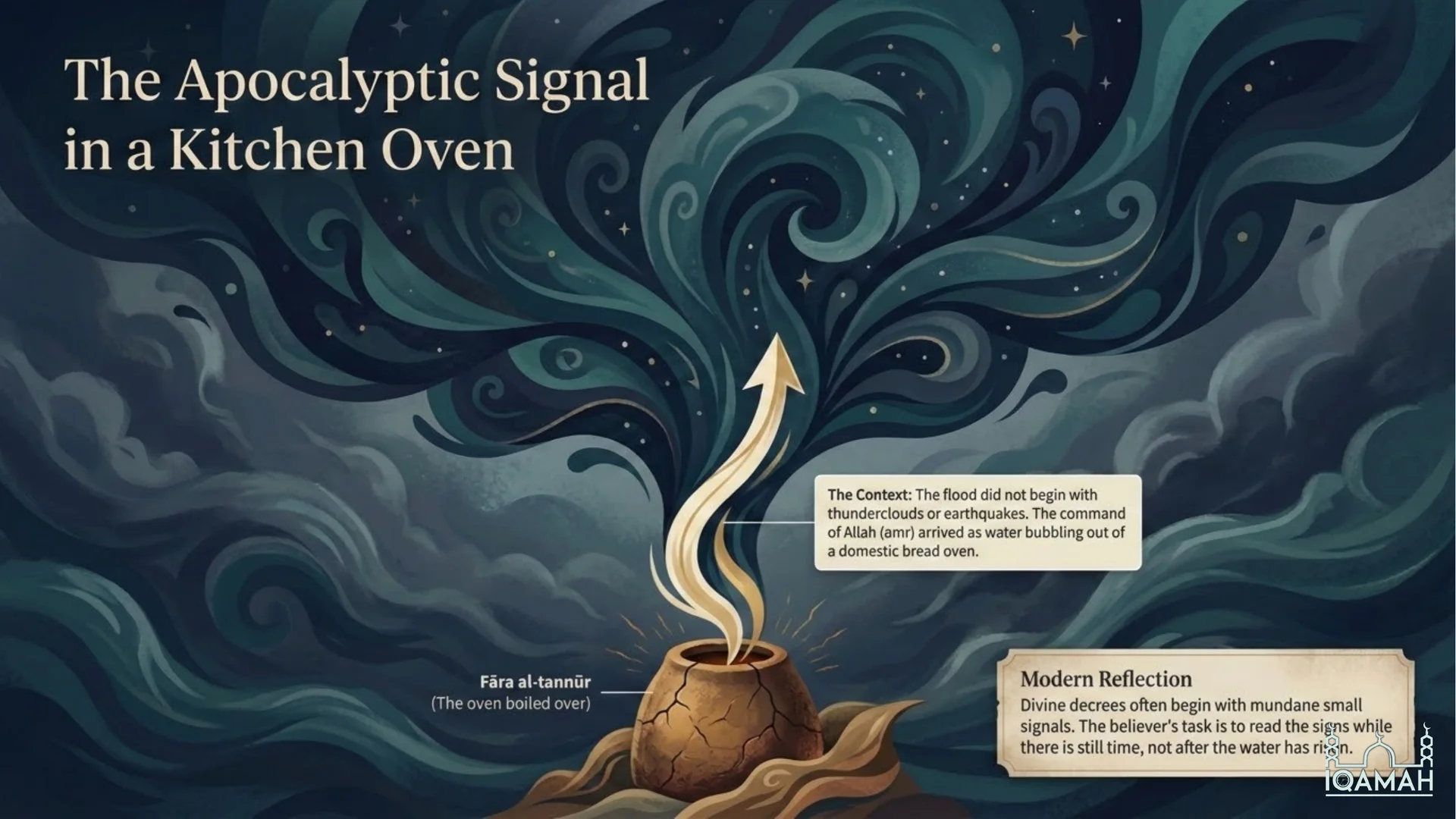
'The oven boiled' (fāra al-tannūr). Maʿāriful surveys the classical opinions on al-tannūr (p. 632): (1) the surface of the earth; (2) the oven of Ādam at ʿAyn al-Wardah in Syria; and (3) Nūḥ's own oven, reported at Kūfah — the majority view, held by al-Ḥasan, Mujāhid, al-Shaʿbī, and Ibn ʿAbbās. On Ibn ʿAbbās's report, Allah had told Nūḥ: when you see water surge from the oven in your home, the flood has come.

Qurṭubī, cited by Maʿāriful, harmonizes these readings — they are not really in conflict: water burst from the baking-oven, from the ground, and from the Syrian spring at once (cf. 54:11). Qutb's counsel is worth passing on: chasing one precise meaning leads, in his words, into a maze; the certain point is simply that it was a God-given signal. The power of the image lies in the contrast — the apocalypse announced not by a comet but by a household bread-oven.

For tadabbur: the cosmic can break in through the utterly ordinary. The sign of the end of a world was a kitchen. Where in our own ordinary surroundings might Allah be placing signals we are too distracted to read?

Slide 35
Slide 35 of 48 #

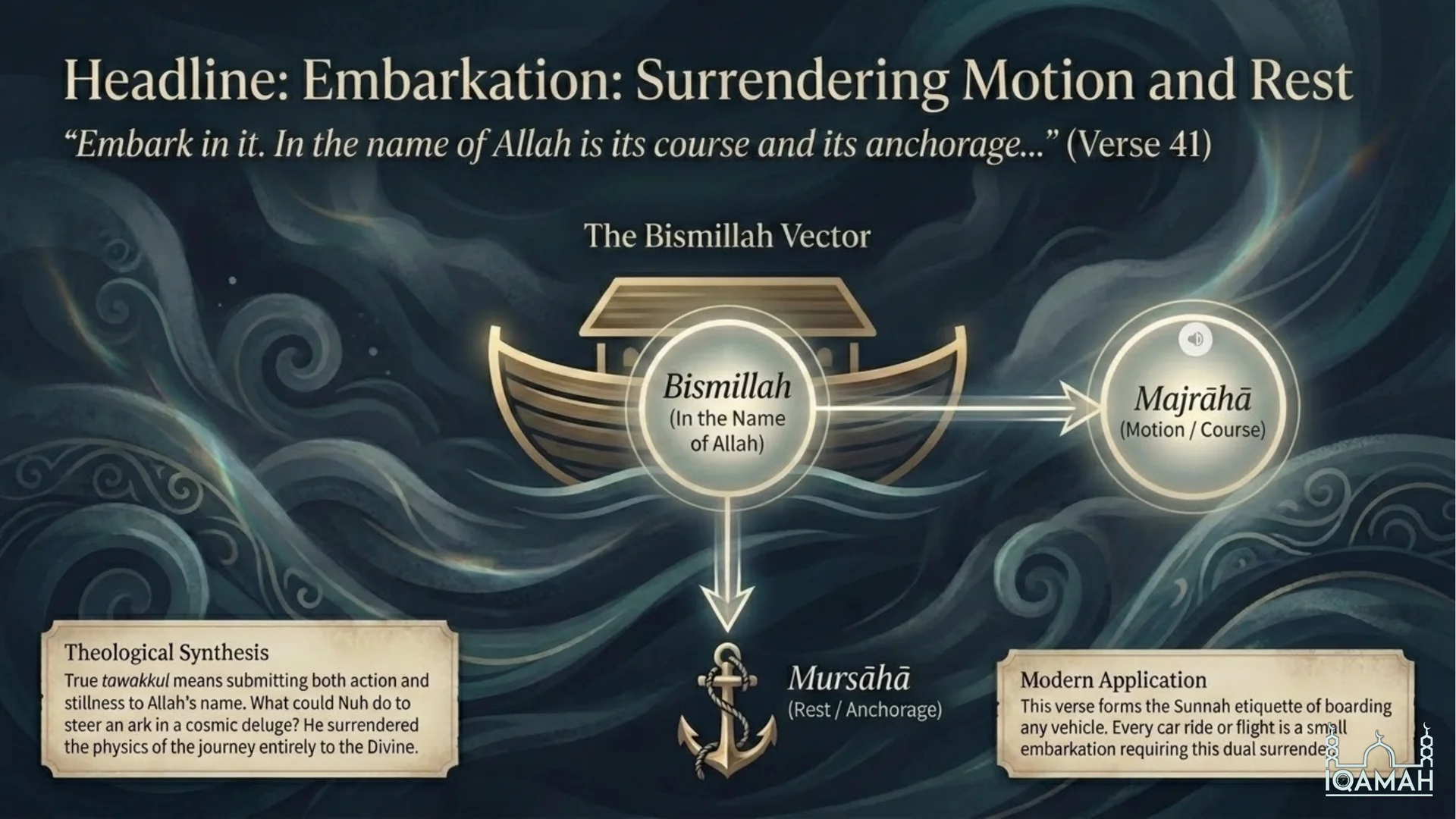
'He said: embark in it; in the name of Allah is its course and its mooring (bismillāhi majrāhā wa mursāhā). Indeed my Lord is Forgiving, Merciful.' Maʿāriful (p. 632) reads this as the etiquette of boarding any conveyance, and notes the grammar: majrā is its sailing or motion, mursā its anchoring or rest — both entrusted to Allah's name and power. (Ḥafṣ's qirāʾah reads majrāhā with a distinctive imālah.)

The slide's 'surrendering motion and rest' is exactly right: in a deluge that no seamanship could survive, Nūḥ hands both the going and the stopping to Allah. Maʿāriful adds a beautiful note — a believer and a disbeliever may ride the very same vessel, but the believer's bismillāh turns the journey into an act of God-consciousness; he becomes, in its phrase, a citizen of a higher world.

The tarbiyyah lesson: tie your means to Allah's name. The same action becomes worship when its start and its finish are placed in His hands — which is why we still say bismillāh on boarding any vehicle.

Slide 36
Slide 36 of 48 #

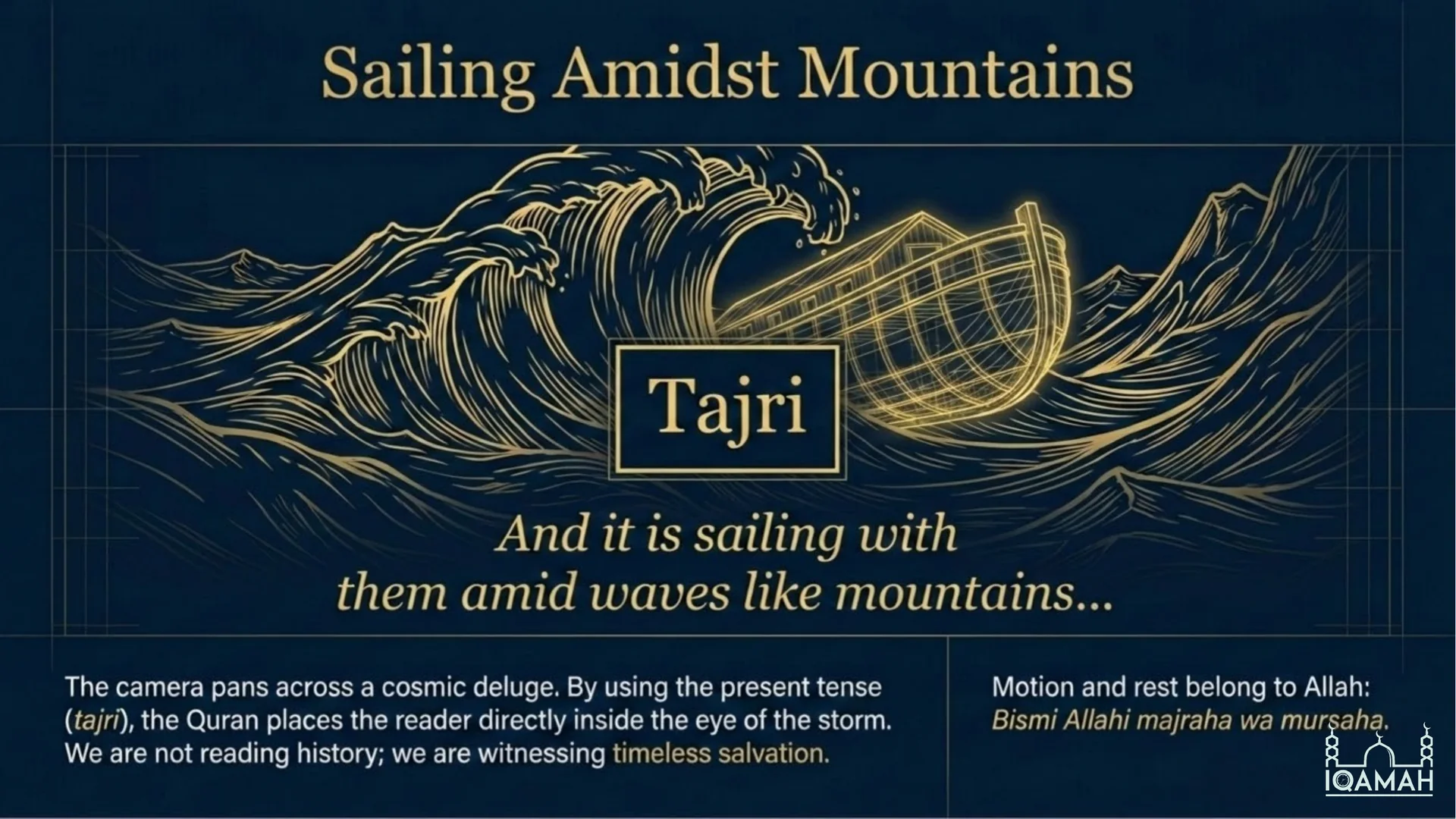
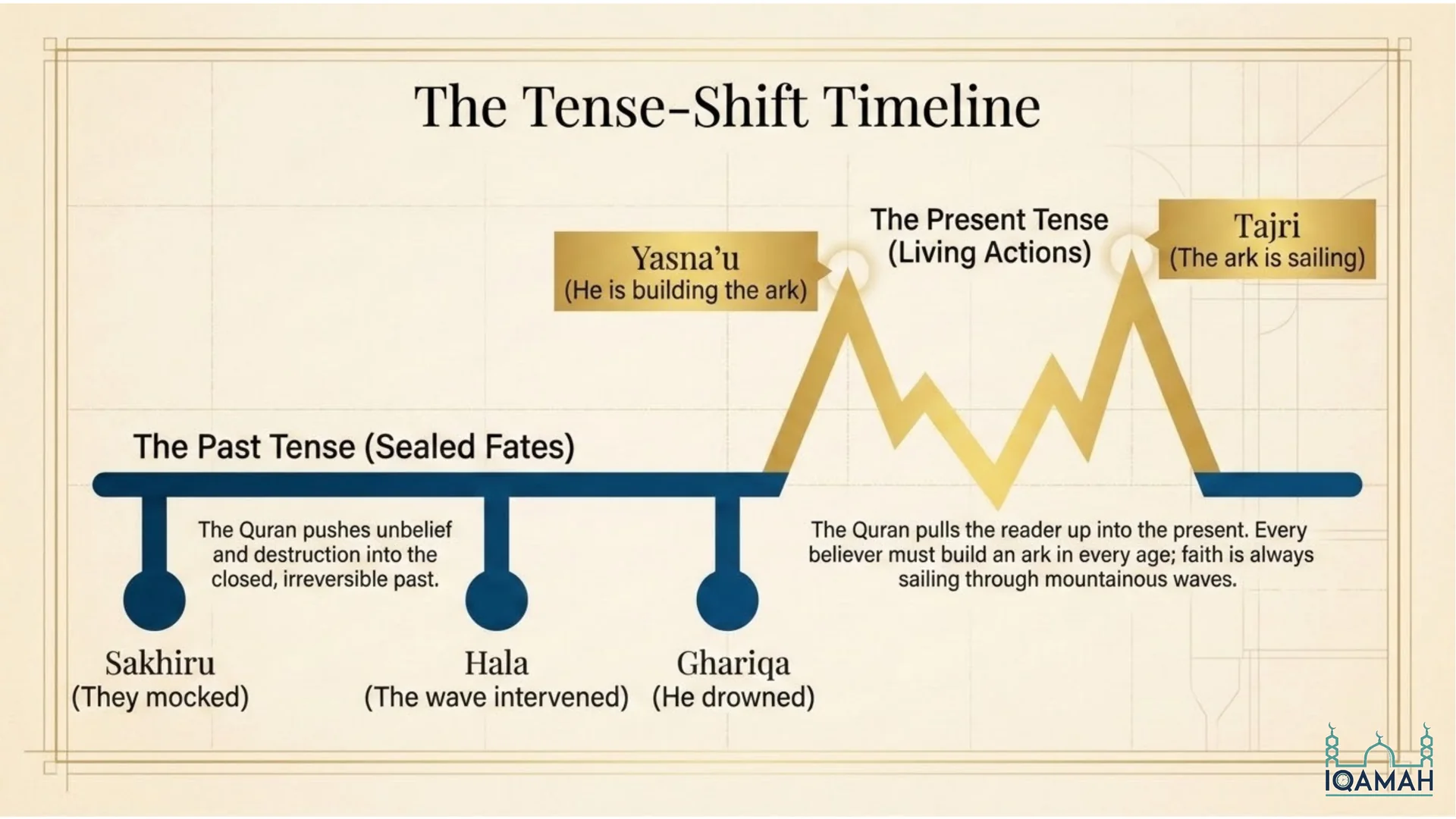
'And it was sailing (tajrī) with them amid waves like mountains (mawj ka-l-jibāl).' The slide's focus word, tajrī, is the linguistic hinge of the next two slides: the verb is present-tense in the middle of a past narrative, pulling the listener into the scene as it unfolds. For the iltifāt and the tense-shift, a teacher may consult Ibn ʿĀshūr, cited for balāghah.

Qutb reads the scene as a fusion of two terrors — the silent, towering violence of nature, and the dread inside the soul as Nūḥ spots his son outside the ark. The image of waves 'like mountains' sets up the next slide's irony: the son will trust an actual mountain against waves that are themselves mountain-high.

Slide 37
Slide 37 of 48 #

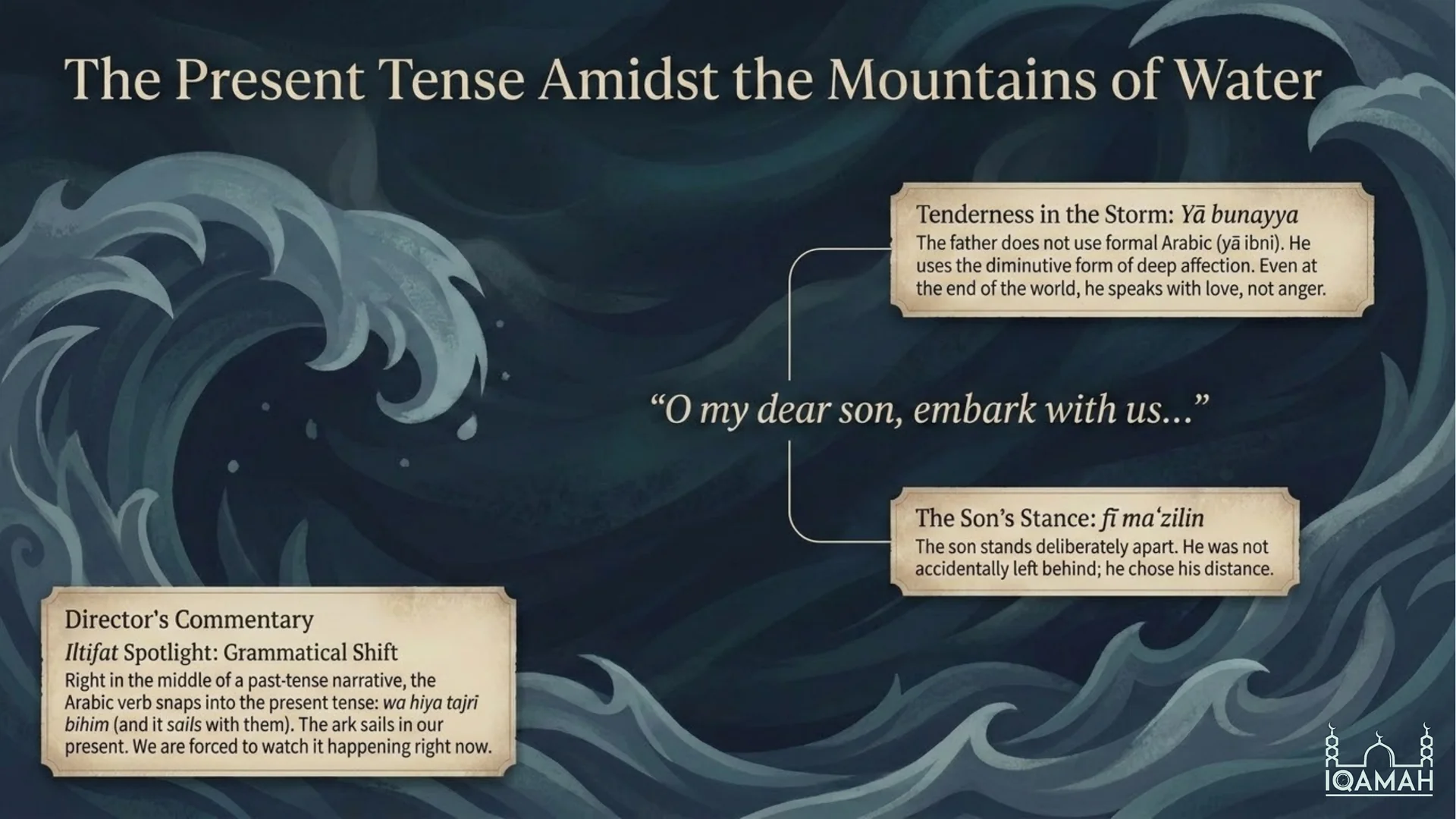
Stay on the craft of the verse. The narration could have said 'it sailed'; instead, 'it is sailing' (tajrī) makes the deluge contemporaneous with the reader. Qutb explicitly notes that the Qurʾān here makes us feel as if we see these events now. This is the 'cinematic grammar' the deck is named for.

Pair the linguistic point with the human one: at the very peak of the storm, the verse zooms from cosmic scale — mountain-high waves — to one father's voice calling one son. The technique, from wide shot to close-up, is part of how the passage moves the heart and not only informs the mind. A question for the group: how does telling a true story in the present tense change the way it lands, and why might revelation choose to make this scene 'happen now'?

Slide 38
Slide 38 of 48 #

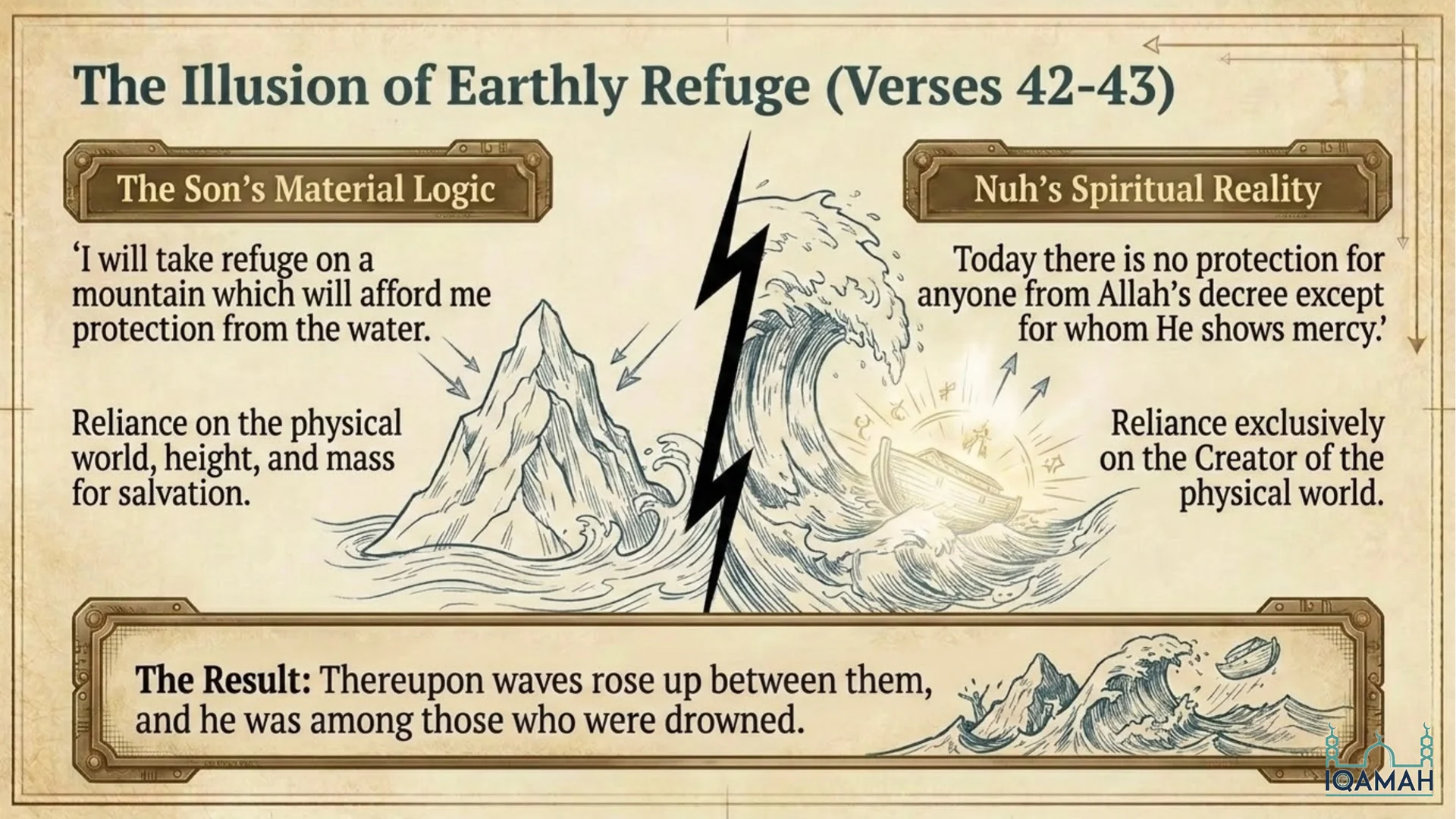
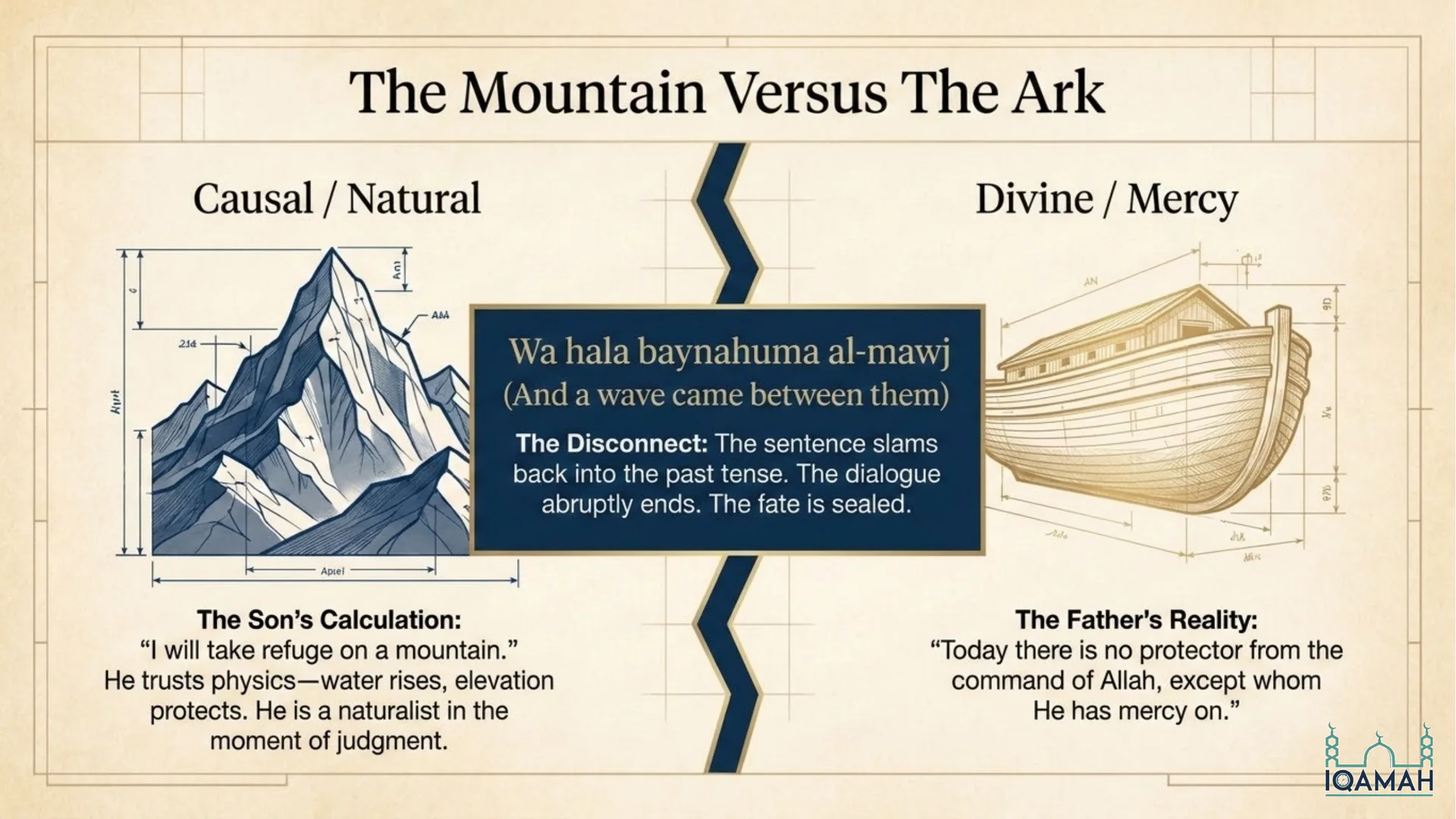
Nūḥ calls out: 'O my son, embark with us, and do not be with the disbelievers.' The son: 'I will take refuge on a mountain that will save me from the water.' Nūḥ: 'There is no protector today from the command of Allah except for the one He has mercy on.' Then a wave came between them, and he was among the drowned.

Maʿāriful offers a tender reading: Nūḥ likely did not know his son was a settled disbeliever — he may have taken him for a wavering hypocrite — and his call was itself an invitation to repent and board. The son's fatal error is the 'material logic' the slide names: he reads the flood as a weather event to be out-climbed, not a divine decree from which only mercy can shelter.

The tarbiyyah lesson: every 'high mountain' we trust to save us from a divine reckoning — wealth, status, cleverness — is the son's mountain. The only refuge from the command of Allah is the mercy of Allah.

Slide 39
Slide 39 of 48 #

The slide's two columns crystallize the verse: the son's causal, natural calculation ('a mountain will block the water') against the father's divine, mercy-centered logic ('no saver today except by His mercy'). Both face the same flood; only one reads it correctly.

Note the structural echo across the sūrah: the disbelievers earlier wanted physical proof and physical protection; here the son wants physical altitude. The Qurʾān keeps exposing the same reflex — trusting the seen against the decree of the Unseen. The ark is not a better mountain; it is refuge offered on God's terms, boarded 'in the name of Allah' (v. 41). For tadabbur: which 'mountain' am I climbing instead of boarding the ark that Allah has actually provided?

Slide 40
Slide 40 of 48 #

The slide tracks the verbs that close the son's arc — the move from his living refusal to the finished, sealed past ('he was among the drowned,' fa-kāna mina al-mughraqīn). Read it alongside the tajrī of v. 42, and the passage breathes between vivid present (the unfolding scene, the living dialogue) and decisive past (the wave, the drowning). The grammar enacts the theology: a window of choice that then snaps shut.

For those who want the balāghah, a teacher comfortable with the Arabic can show how the shift between living, present action and the sealed perfect tense dramatizes the closing of the door of mercy at the decreed moment; consult Ibn ʿĀshūr or Zamakhsharī for the mechanics only. For tadabbur: while the present tense lasts, the invitation is open. The lesson is to board now — not at the moment the tense turns to 'was.'

Slide 41
Slide 41 of 48 #

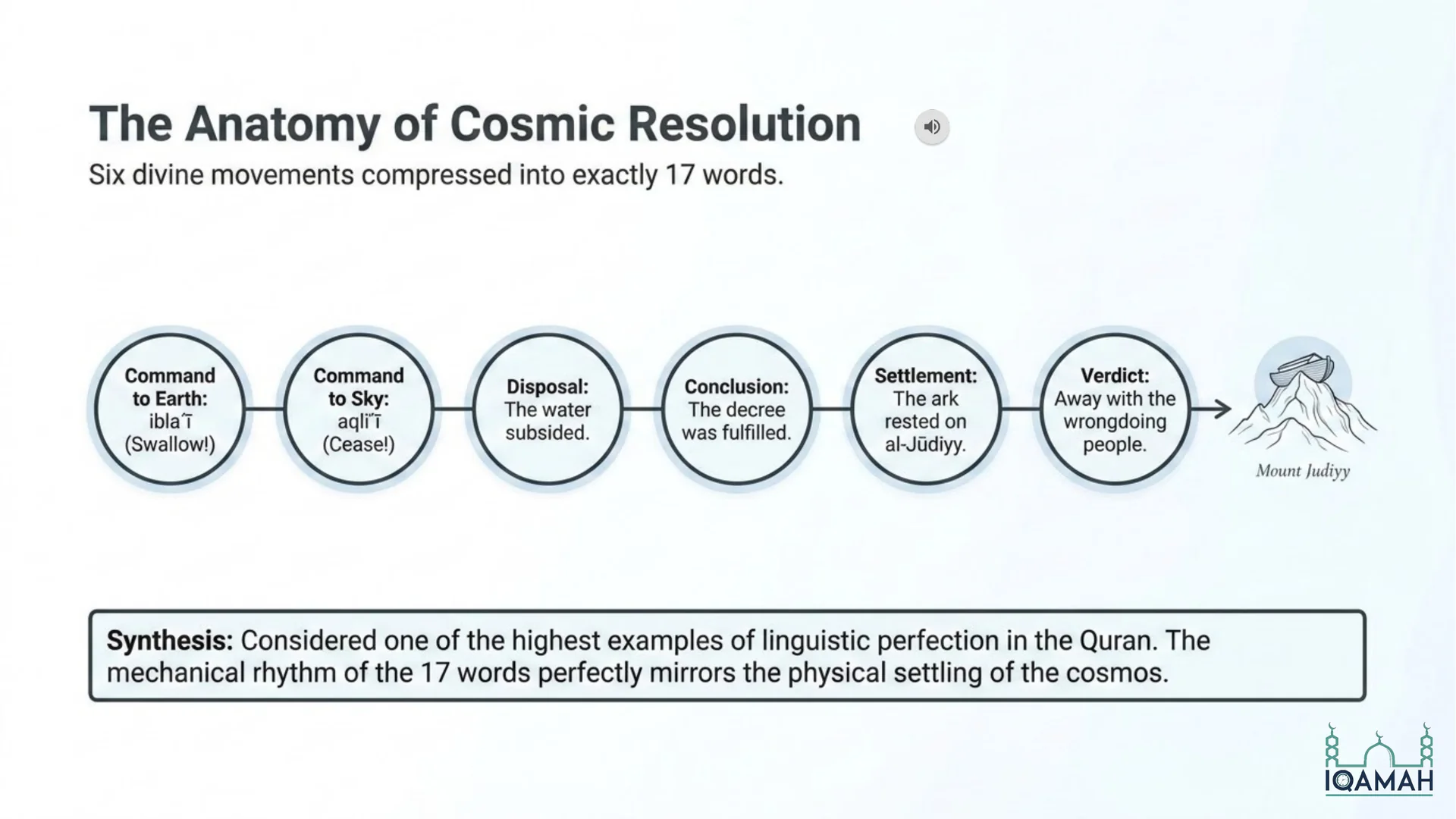
'And it was said: O earth, swallow your water; O sky, withhold. The water subsided, the matter was decreed, the ark settled on al-Jūdī, and it was said: away with the wrongdoing people.' Six commands and outcomes are compressed into a single, famously compact verse — the slide's 'seventeen words.' This āyah is celebrated across the tradition for its eloquence (iʿjāz al-bayānī); a teacher may draw on Ibn ʿĀshūr or Zamakhsharī for the formal analysis, citing them for balāghah.

Qutb gives the literary reading we can teach directly: earth and heaven are addressed as if they were sentient servants, both instantly obeying, and the words convey something coming to a complete standstill. Maʿāriful adds the theological note that addressing the seemingly insensate earth and sky is real, not merely figurative — all creation has awareness according to its capacity (cf. 17:44). al-Jūdī is a mountain near Mosul; the Torah's 'Ararat' names part of the same range (Maʿāriful, p. 636).

For tadabbur: when Allah closes a matter, the entire cosmos returns to stillness at a word. The verse's calm, measured rhythm mirrors the calm of a decree fully executed. Recite it slowly and feel the world go quiet.

Slide 42
Slide 42 of 48 #

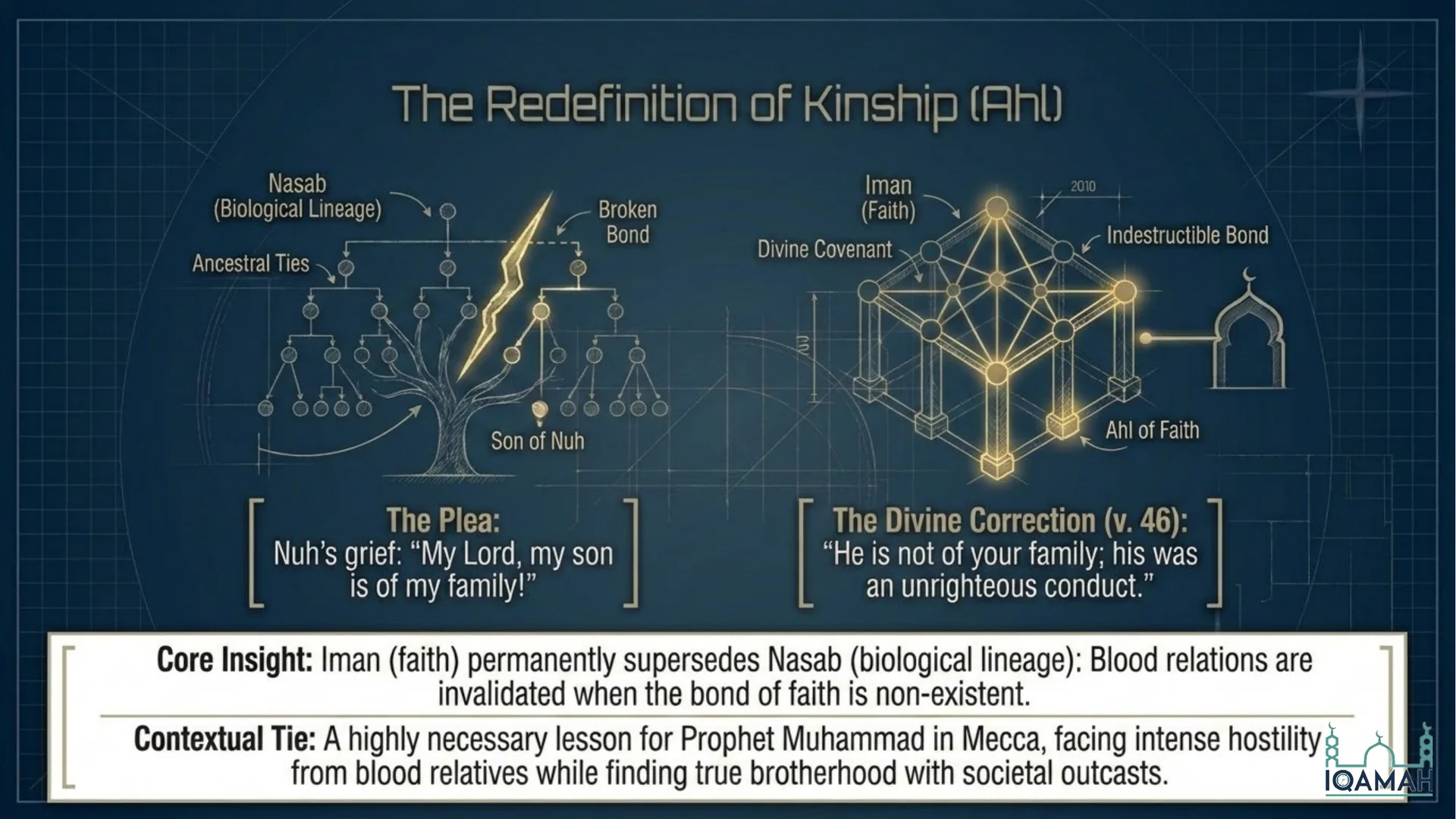
Nūḥ appeals: 'My Lord, my son is of my family (ahlī), and surely Your promise is true.' The answer comes: 'O Nūḥ, he is not of your family; his conduct was unrighteous (innahu ʿamalun ghayru ṣāliḥ). Do not ask Me about what you have no knowledge of; I admonish you lest you be among the ignorant.'

Saʿdī (pp. 290–291): Nūḥ had understood the promise to save 'your family' (v. 40) as covering the son; Allah clarifies that the true bond is faith, not blood. Qutb develops this as a central theme of the sūrah — the tie that binds the believing community has nothing to do with family or blood, land or country, tribe or nation. Faith re-draws the map of belonging; the son was disqualified by his deeds, not by his lineage. (The qirāʾāt vary subtly — ʿamila ghayra ṣāliḥ or ʿamalun ghayru ṣāliḥ — but the meaning converges.)

A question for the group: if faith, not blood, is the deepest bond, how should that reshape our loyalties without making us cold to our actual relatives? Note that Nūḥ's love for his son is honored, not condemned; it is only his theological inference about the promise that is gently corrected.

Slide 43
Slide 43 of 48 #

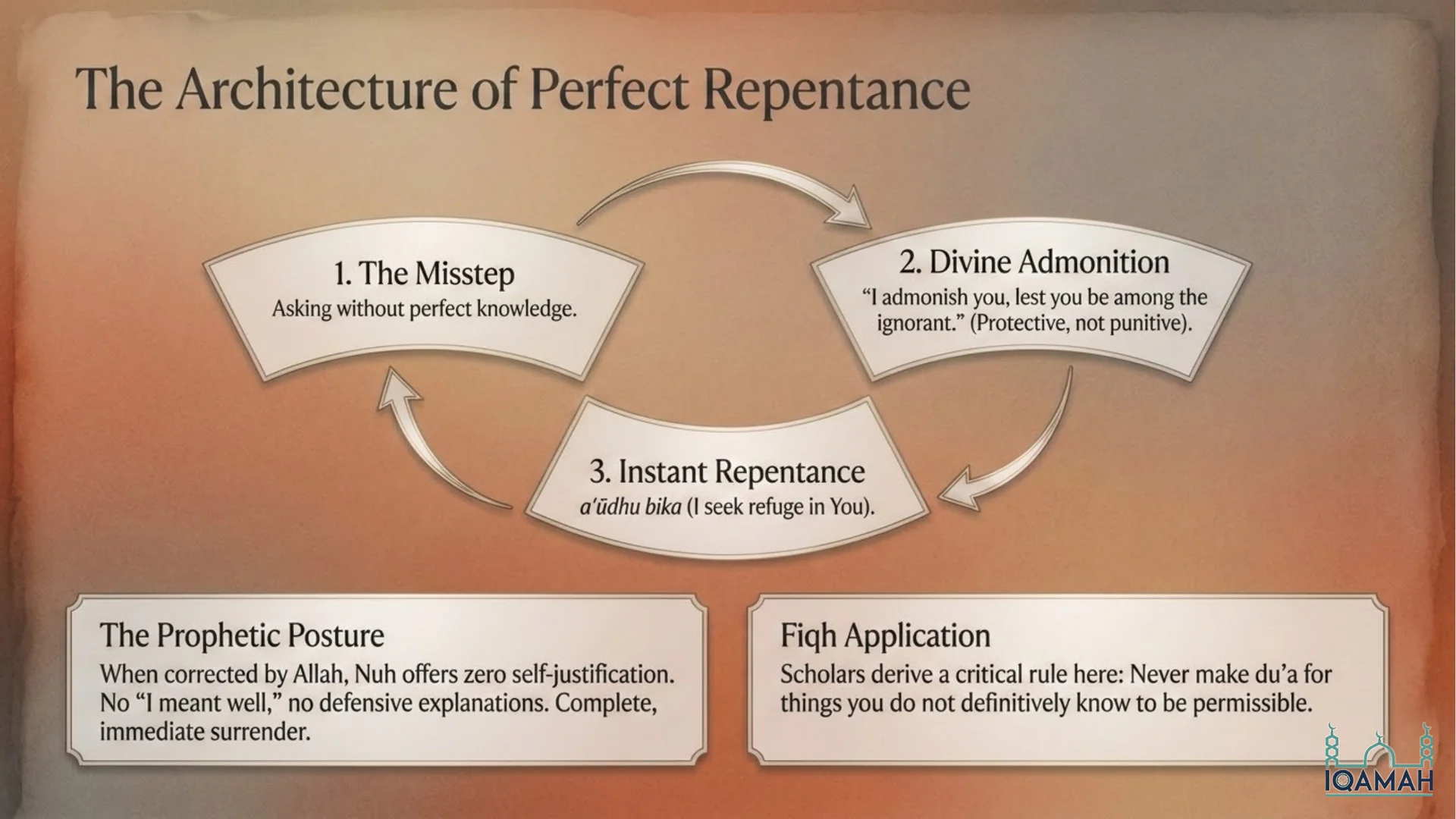
Watch the sequence the slide names. First, the misstep: Nūḥ asks about something he should not have — the salvation of one already sentenced. Second, the divine admonition: 'do not ask Me of what you have no knowledge of.' Third, the instant repentance: 'My Lord, I seek refuge in You from asking You of what I have no knowledge of; and unless You forgive me and have mercy on me, I shall be among the losers' (v. 47).

This is the teaching jewel of the passage. A prophet, corrected over a mere question asked out of grief, does not defend himself — he turns at once to istighfār. Saʿdī and Maʿāriful both note that he models the principle that one should never lean on one's own resolve but seek Allah's protection. The fiqh-flavored lesson, in Maʿāriful's register: after a slip, the right response is not self-justification but immediate return to Allah.

Note the adab in Nūḥ's wording: he does not merely say 'I was wrong,' he folds even his repentance into dependence on Allah — 'I seek refuge in You from asking what I do not know.' The tarbiyyah lesson: the measure of a believer is not never slipping, but how fast and how completely he turns back.

Slide 44
Slide 44 of 48 #

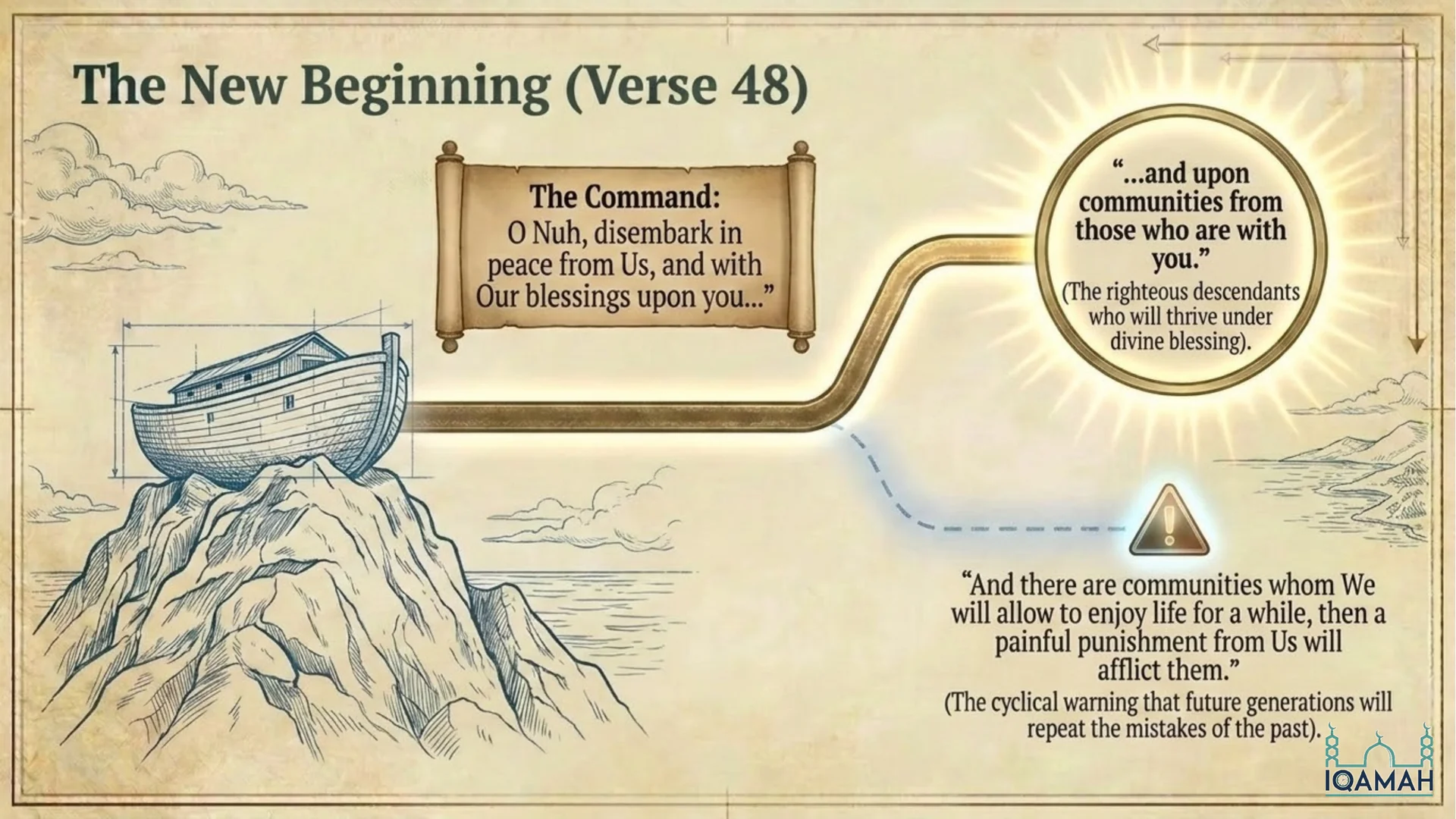
'It was said: O Nūḥ, disembark in peace from Us, with blessings upon you and upon nations (umam) from those with you. And there are nations whom We shall let enjoy, then a painful punishment from Us will reach them' (Saʿdī, p. 292).

Maʿāriful explains that 'nations from those with you' means all of post-flood humanity descends from those aboard — which is why Nūḥ is called the second Ādam (cf. 37:77). The blessing is real but not unconditional: among his descendants will be both believers and disbelievers, so the verse closes the door on assuming salvation by ancestry — the very lesson of the son. Note, too, that the salām and barakāt at disembarking answer the bismillāh at embarking (v. 41): the journey opened and closed in Allah's name.

The tarbiyyah lesson: salvation is by faith and conduct, never by pedigree — even descent from a prophet guarantees nothing without belief.

Slide 45
Slide 45 of 48 #

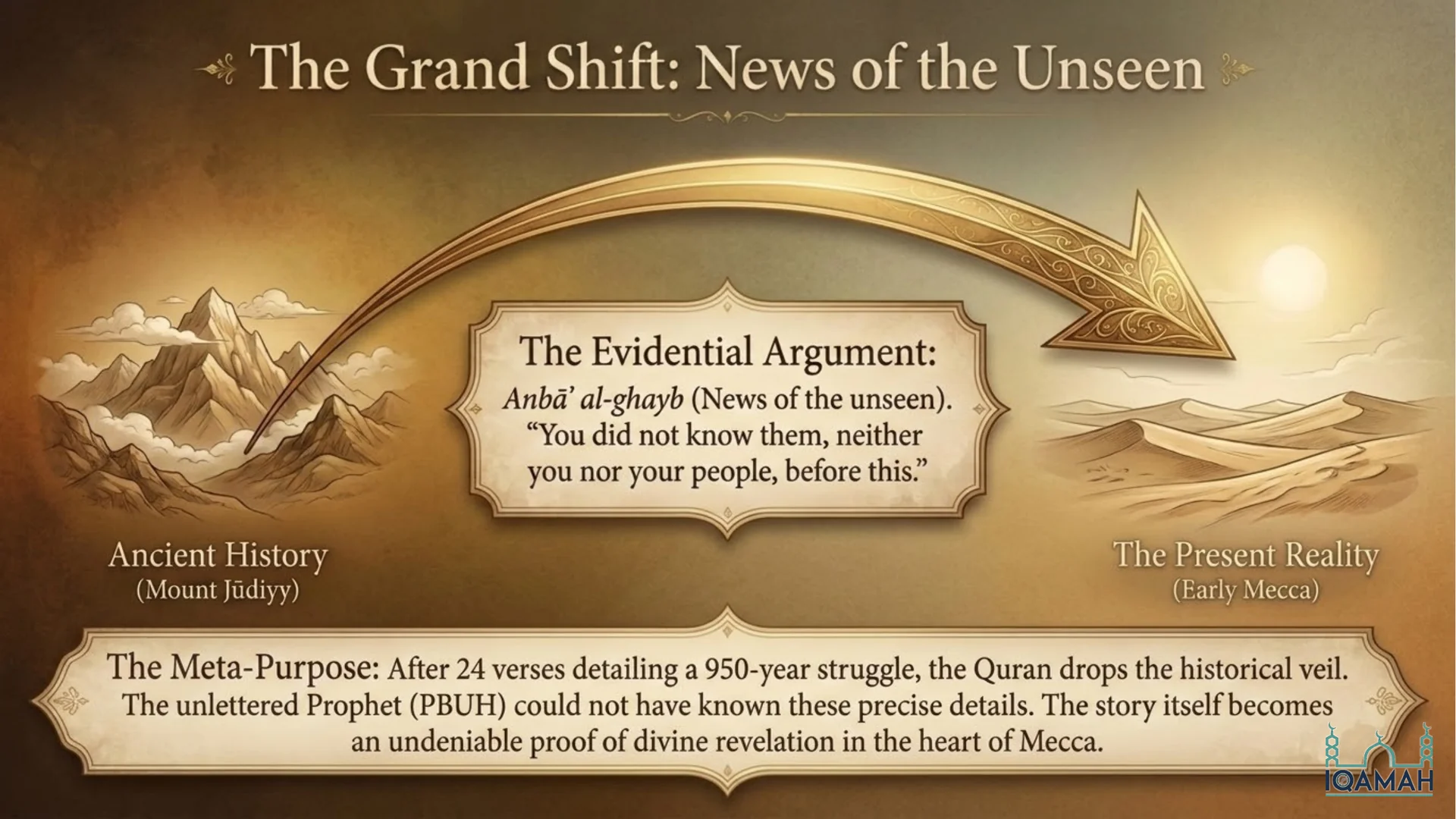
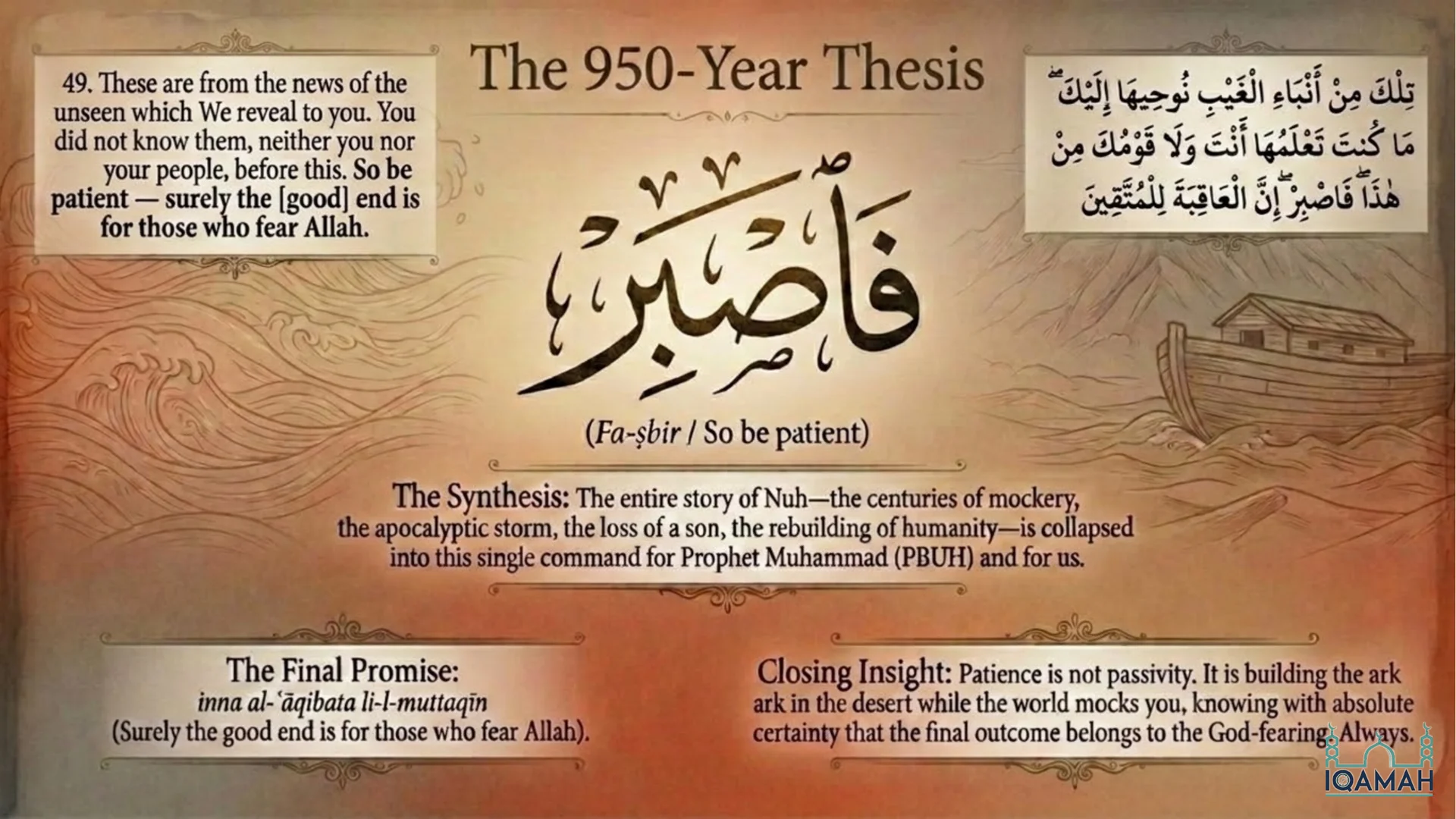
'These are tidings of the unseen (anbāʾ al-ghayb) that We reveal to you; neither you nor your people knew them before this.' The camera now pulls all the way back from Nūḥ's flood to the Prophet ﷺ in Mecca. Saʿdī (p. 293) notes that no one could have known this account except one whom Allah informed by revelation — so the story is itself a proof of prophethood.

Maʿāriful makes the logic explicit: the Arabs had no written record of these events, so the only explanation for the Prophet's ﷺ detailed knowledge is waḥy. The whole Nūḥ narrative thus becomes a standing witness to the truth of the Prophet ﷺ. This is why the sūrah told the story in the first place — it is evidence, not only edification. Cross-reference 3:44 and 12:102, where the same formula (min anbāʾ al-ghayb nūḥīhi ilayk) frames other narratives.

Slide 46
Slide 46 of 48 #

The verse ends with the command and the promise that anchor the entire sūrah: 'So be patient (fa-ṣbir); indeed the good outcome (al-ʿāqibah) belongs to the God-fearing (al-muttaqīn).' The slide's '950-year thesis': measured against Nūḥ's near-millennium of rejection, the Prophet's ﷺ hardships in Mecca are brief — and the end is guaranteed for the righteous.

Saʿdī (p. 293): praise and thank Allah, hold fast to the straight path, and be patient in calling people — for, he says, you will ultimately prevail over your people, as Nūḥ prevailed over his. The patience commanded is an active ṣabr in daʿwah, not passive resignation. This is the consolation the long story was built toward, and it closes Movement 5.

A question for the group: Nūḥ 'succeeded' with perhaps a dozen believers after 950 years. How does this verse redefine success — and what does that mean for our own discouragement, whether in daʿwah, in the tarbiyah of our children, or in simply holding to the dīn in a hostile climate?

Slide 47
Slide 47 of 48 #

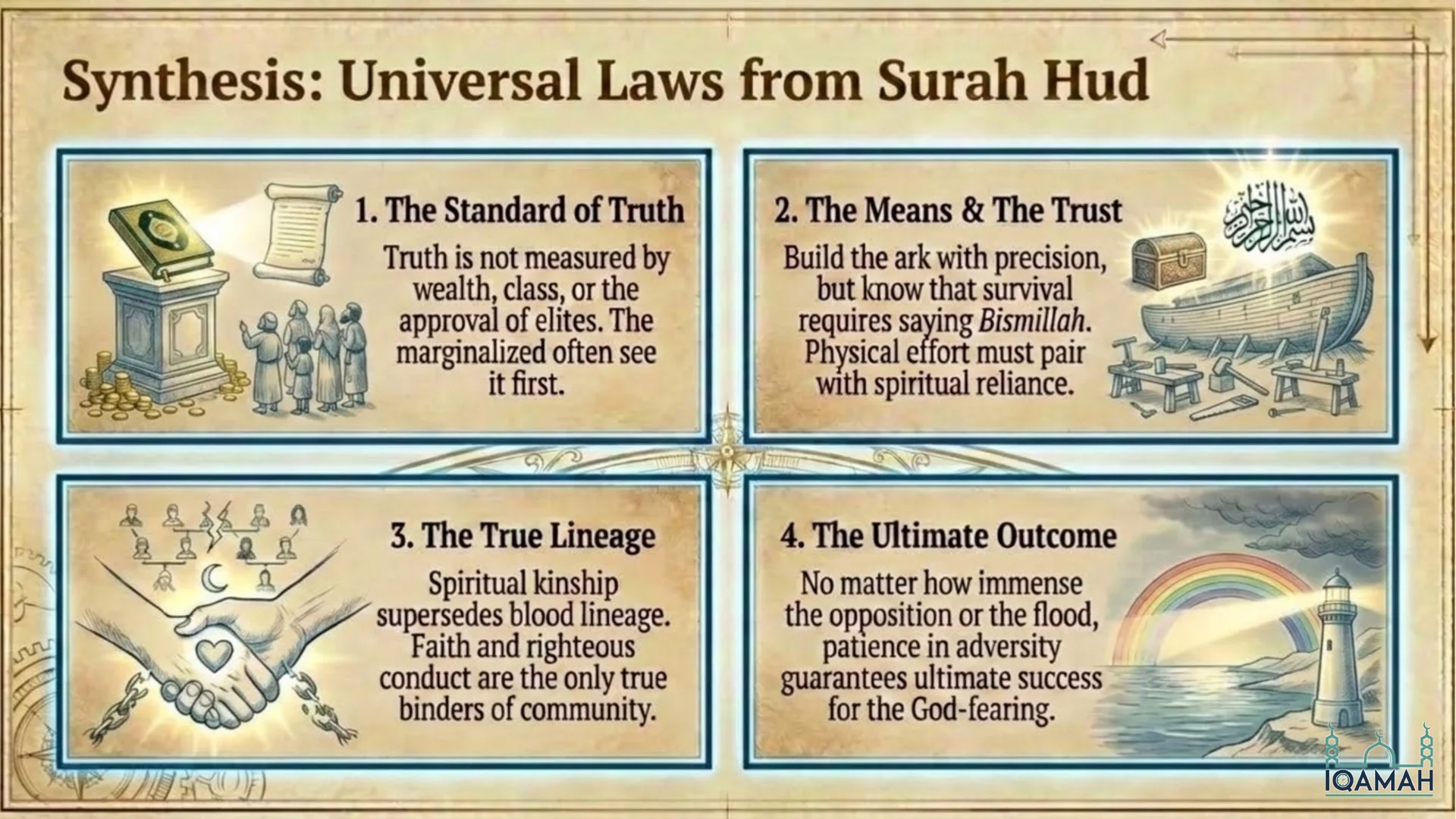
Use this slide to consolidate. (1) The Standard of Truth — truth is not measured by wealth, class, or the approval of elites (vv. 27, 31); the marginalized often see it first. (2) The Means and the Trust — build the ark with precision, yet board it saying bismillāh (v. 41): effort and tawakkul together, never one without the other. (3) The True Lineage — faith and righteous conduct, not blood, are the only true binders of community (vv. 45–46). (4) The Ultimate Outcome — however vast the opposition or the flood, patience in adversity secures the end for the muttaqīn (v. 49).

Each of these 'laws' is anchored in a verse we have already taught, so invite the group to call out which scene gave rise to which principle. This is the work of tadabbur turning back into amal: the aim is not to admire the story but to carry it into Monday morning.

Slide 48
Slide 48 of 48 #

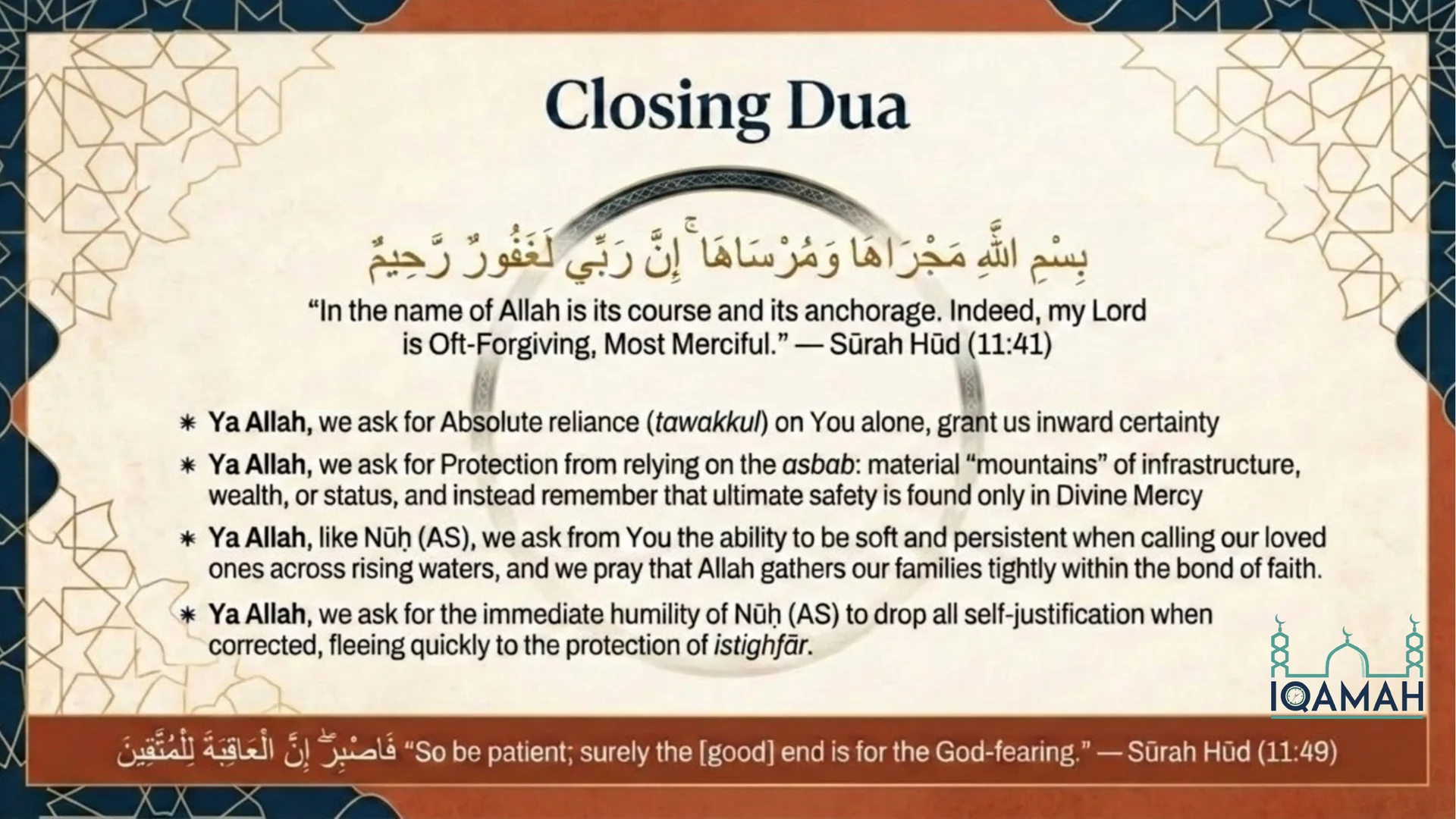
The closing weaves two verses from this session — the boarding-formula of v. 41 (bismillāhi majrāhā wa mursāhā; indeed my Lord is Forgiving, Merciful) and the patience-promise of v. 49. In the spirit of Part 1's closing duʿāʾ: Yā Allāh, You who carried Nūḥ and the believing few above waves like mountains — make our going and our resting be in Your name; let us board the ark of revelation rather than climb the mountains of our own devising; teach us that no lineage saves but faith, and that the ʿāqibah belongs to those who fear You. Make us of the patient, and number us among the saved remnant, however few. Āmīn.

A sensitivity note for the teacher: this narrative includes the drowning of a prophet's own child. If anyone in the circle carries grief over a loved one who has left the faith or the family, close gently — the lesson is the limit of even a prophet's knowledge and the supremacy of Allah's wisdom and mercy, not a verdict any of us is equipped to pronounce. End on mercy.

About this series

This is the second session in a planned six-part series walking through the tafsir of Sūrah Hūd. Part 1 established the doctrinal framework of vv. 1–24; Part 2 (this session) walks through the daʿwah of Nūḥ (ʿalayhi al-salām) and the Flood (vv. 25–49) — the first and longest of the seven prophet-stories that demonstrate the framework. Subsequent parts will treat Hūd and ʿĀd, Ṣāliḥ, Ibrāhīm and Lūṭ, Shuʿayb, and Mūsā. To be notified about future sessions, drop a line to admin@iqamah.org — we'll keep a list and reach out as new parts publish.

  1. 1
    An Illuminated Framework vv. 1–24 — Doctrinal core, cosmic context, prophetic challenge
  2. 2
    The Ark and the Oven vv. 25–49 — Nūḥ's daʿwah, the Ark, and the boiling oven
    You are here
  3. 3
    Blueprints of Faith and Ruin vv. 50–68 — Hūd and ʿĀd, Ṣāliḥ and Thamūd, and the polished heart
  4. 4
    The Heavenly Guests vv. 69–83 — Ibrāhīm's guests, the glad tidings of Isḥāq, and the overturning of Lūṭ's people
  5. 5
    The Scales and The Scepter vv. 84–99 — Shuʿayb and Madyan, Mūsā and Firʿawn, and the question of the grave
  6. 6
    The Anchored Heart vv. 100–123 — the ruins as diagnosis, the Witnessed Day, istiqāmah, and the command to worship and trust