Iqamah

Resources · Surah Hud Tafsir Series

Part 4 of 6

The Heavenly Guests — Surah Hud, Part 4

Mercy and Judgement in a Single Command — Ibrāhīm’s Guests and the People of Lūṭ

Sūrah Hūd, Part 4 — the visit of the angelic guests to Ibrāhīm (the impossible glad tidings of Isḥāq, and after him Yaʿqūb) and the overturning of the people of Lūṭ, verses 69–83. The two episodes are read as a single mission: one delegation of angels carries raḥmah to one household and ʿadhāb to another. The session leans on Saʿdī, Maʿāriful Qurʾān, and Sayyid Qutb, with Zamakhsharī and Ibn ʿĀshūr for the passage’s unusually rich grammar and rhetoric.

Slides 29
Format Slides + notes
Series Surah Hud Tafsir Series
Cover slide: The Heavenly Guests — Surah Hud, Part 4
Slide 1
Slide 1 of 29 #

Sūrah Hūd reaches its heart in this passage. Having followed Nūḥ through the flood and the matched ruin of ʿĀd and Thamūd in the earlier sessions, we arrive at the visit of the honoured guests to Ibrāhīm (ʿalayhi al-salām) and the destruction of the people of Lūṭ, verses 69 to 83. The two episodes belong together, and the deck reads them as a single unit: one delegation of angels carries mercy to one household — the impossible glad tidings of Isḥāq — and punishment to another — the overturning of the towns of Lūṭ's people. One errand, two decrees. That doubleness is the key to all that follows.

Sayyid Qutb (Fī Ẓilāl al-Qurʾān, vol. 9) describes the Ibrāhīm scene as a respite of mercy (raḥmah) set deliberately between the thunderclaps of judgement — a moment of hospitality, tenderness, and good news that refreshes the heart and reties the sūrah to its central claim: the believer saved by mercy, the wrongdoer overtaken by a command that cannot be turned back. The words that open the deck, fa-staqim kamā umirta (11:112), 'remain on a right course as you have been commanded,' are placed here for a reason. These histories exist to steady the Prophet ﷺ, and through him every believer who must hold a straight course in a crooked age. Throughout we draw on Saʿdī for direct meaning, Maʿariful Qurʾān for synthesis, Qutb for reflection on the heart, and al-Wāḥidī for the occasions of revelation; and because this passage is so rich in language, we lean more than usual on Zamakhsharī's al-Kashshāf and Ibn ʿĀshūr's al-Taḥrīr wa-l-Tanwīr for its naḥw and balāgha.
Slide 2
Slide 2 of 29 #

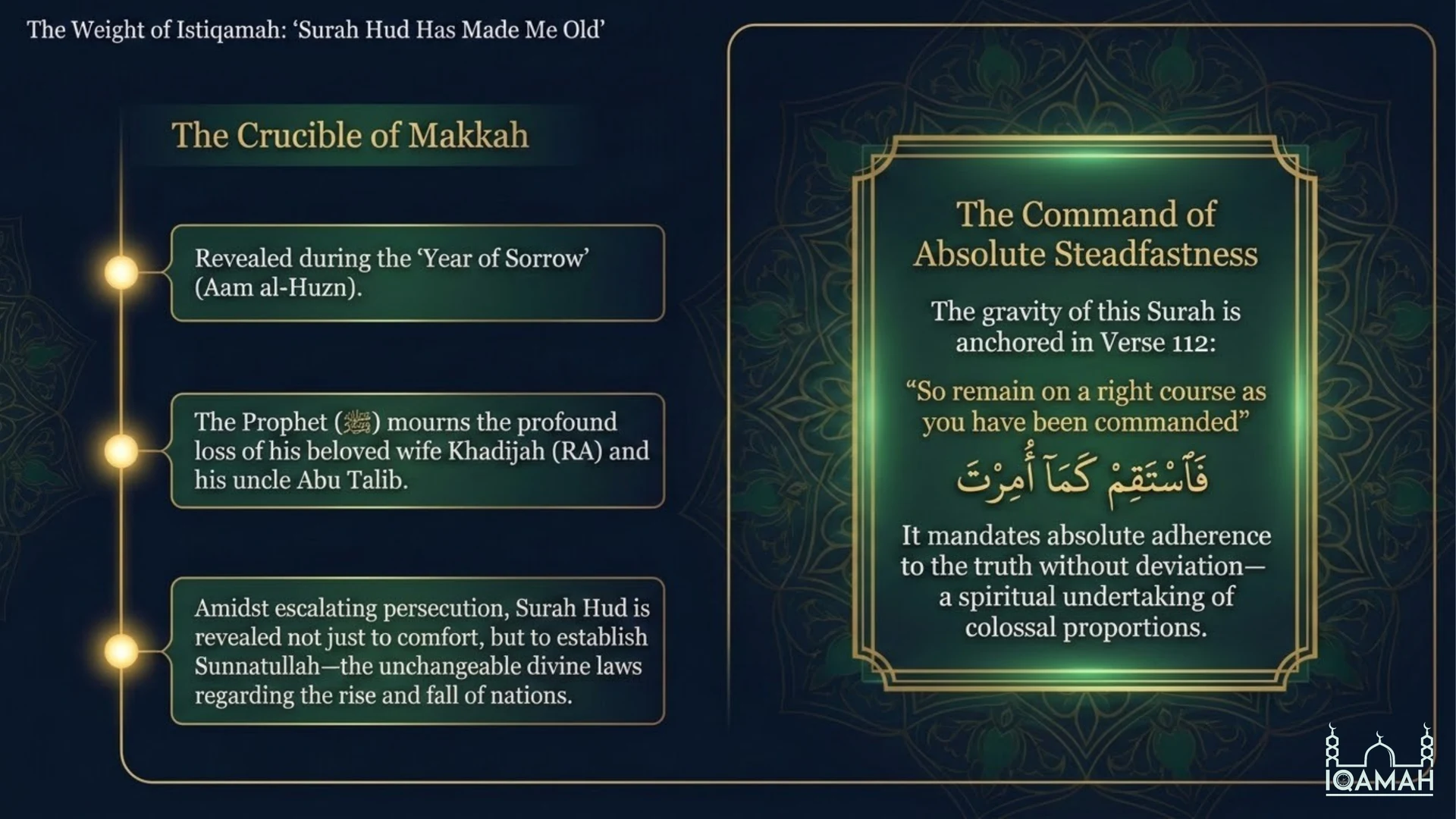
Before entering the account it helps to recall why the sūrah carries such weight. When Abū Bakr (raḍiya Allāhu ʿanhu) remarked that the Prophet ﷺ had aged, he replied, 'Sūrah Hūd and her sisters have made me old' (recorded by al-Tirmidhī). Maʿariful Qurʾān and the mufassirūn note that it is the stories of destruction in particular — Nūḥ's flood, ʿĀd's wind, Thamūd's cry, and now the overturning of Lūṭ's people — that give the sūrah its gravity, alongside the heavy command of v. 112 to stand firm.

This frames how the stories of Ibrāhīm and Lūṭ should be received: not as distant spectacle but as a trust the Prophet ﷺ himself carried, and as a summons to the same istiqāmah named in the sūrah's command. The material is weighty and serious; it is meant to form the heart, not merely to inform the mind.

Slide 3
Slide 3 of 29 #

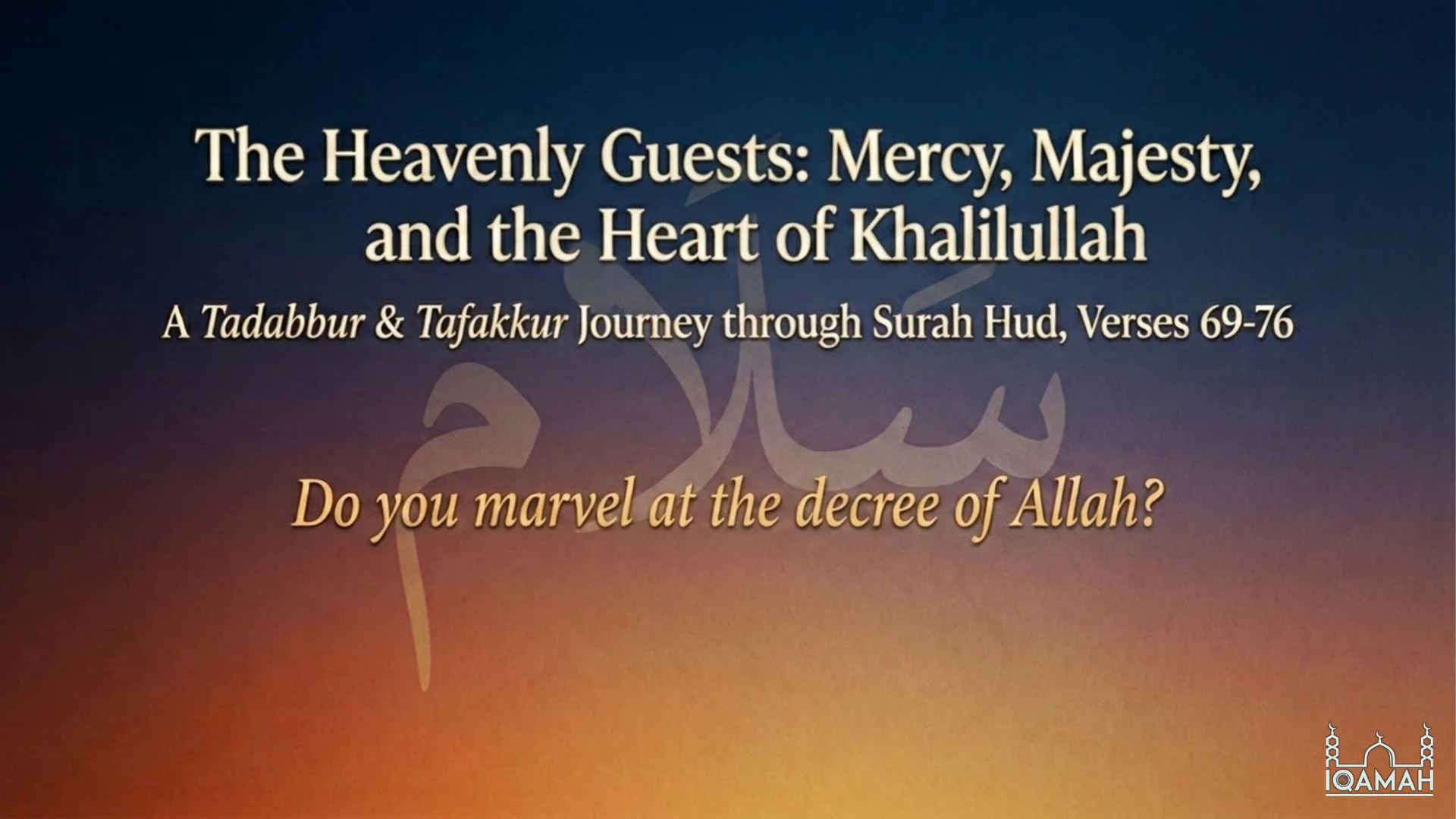
This is the threshold of the Ibrāhīm episode (vv. 69–76), gathered under three words: mercy, majesty, and the heart of Khalīlullāh — Ibrāhīm, the one Allah took as an intimate friend (khalīl, cf. 4:125). The question that titles the section, 'Do you marvel at the decree of Allah?', is taken from v. 73, the angels' gentle reminder to Ibrāhīm's astonished household, which we reach shortly.

The scene holds both faces of Allah's command at once. The same angels who bring Ibrāhīm and Sārah the impossible news of a son in old age are on their way to destroy a township; the passage carries raḥmah and ʿadhāb in the same breath. What is striking is that the heart of the friend of Allah meets both with the same qualities — forbearance, tenderness, and constant turning to his Lord — the very three named of him in v. 75.

Slide 4
Slide 4 of 29 #

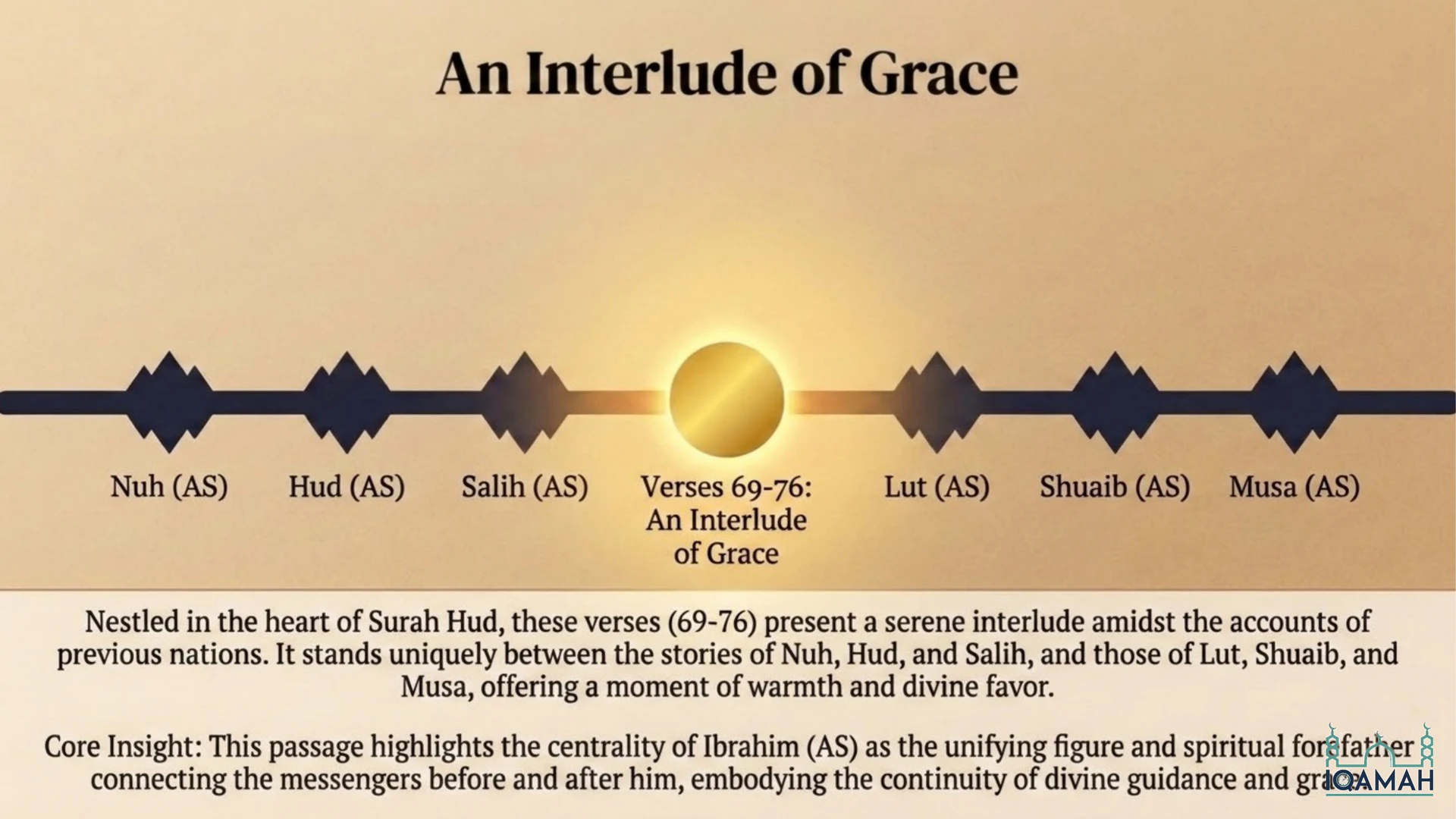
Qutb's framing of this episode as a respite of mercy is more than a passing remark; it reflects the structure of the sūrah. The stories run in sequence — Nūḥ, Hūd, Ṣāliḥ, then Ibrāhīm and Lūṭ, then Shuʿayb and Mūsā. The Ibrāhīm scene is unique among them in containing no rejected call and no nation of his own destroyed. It is a moment of hospitality and glad tidings set in the middle of the judgements.

Its placement is itself a mercy: a breath of warmth and nearness to Allah before the calamity of Lūṭ's people, and a reminder that the One who decrees ruin for the corrupt is the same One who visits the righteous with honour and good news. Ibrāhīm stands at the hinge — receiving the mercy of a son and pleading against the punishment prepared for Lūṭ's people — and so embodies the unbroken thread of divine guidance between the messengers before him and those after.

Slide 5
Slide 5 of 29 #

وَلَقَدْ جَآءَتْ رُسُلُنَآ إِبْرَٰهِيمَ بِٱلْبُشْرَىٰ قَالُوا۟ سَلَٰمًۭا ۖ قَالَ سَلَٰمٌۭ ۖ فَمَا لَبِثَ أَن جَآءَ بِعِجْلٍ حَنِيذٍۢ

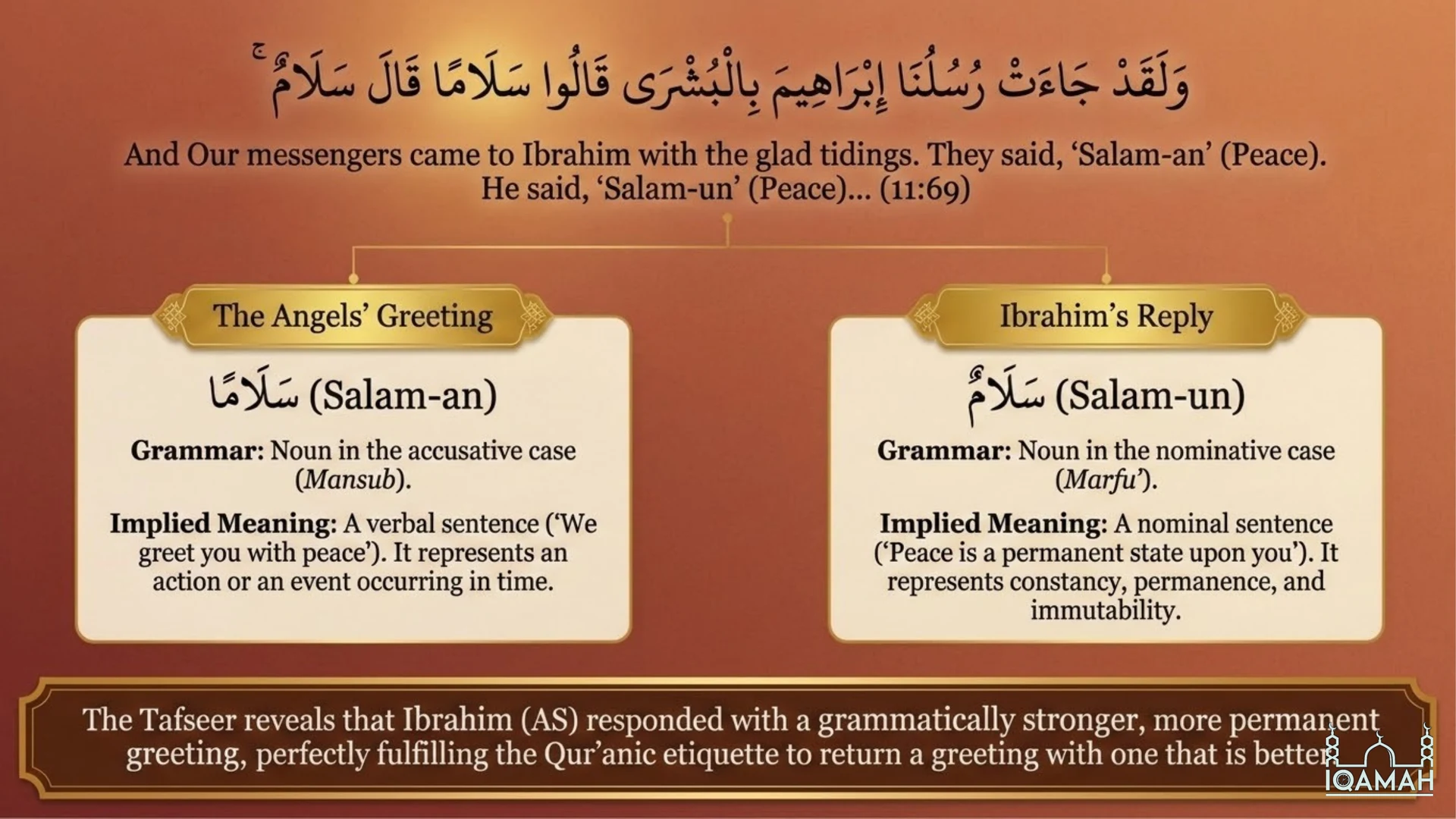
"And certainly did Our messengers come to Abraham with good tidings; they said, "Peace." He said, "Peace," and did not delay in bringing [them] a roasted calf." — Sūrah Hūd 11:69

The episode opens with an arrival and a greeting, and the greeting itself rewards close reading. The angels say salām-an; Ibrāhīm answers salām-un. Zamakhsharī in al-Kashshāf and Ibn ʿĀshūr in al-Taḥrīr wa-l-Tanwīr both draw out the naḥw: salām-an is manṣūb (accusative), the object of an implied verb — 'we offer you peace' — making it a jumla fiʿliyya, a verb-led sentence that names an act occurring in time; salām-un is marfūʿ (nominative), the opening of a jumla ismiyya, a noun-led sentence — 'peace be upon you' — which in Arabic conveys constancy and permanence. Ibrāhīm thus returns a stronger, more lasting greeting, fulfilling in advance the later command to answer a greeting 'with one better than it' (4:86). The friend of Allah out-greets the very angels.

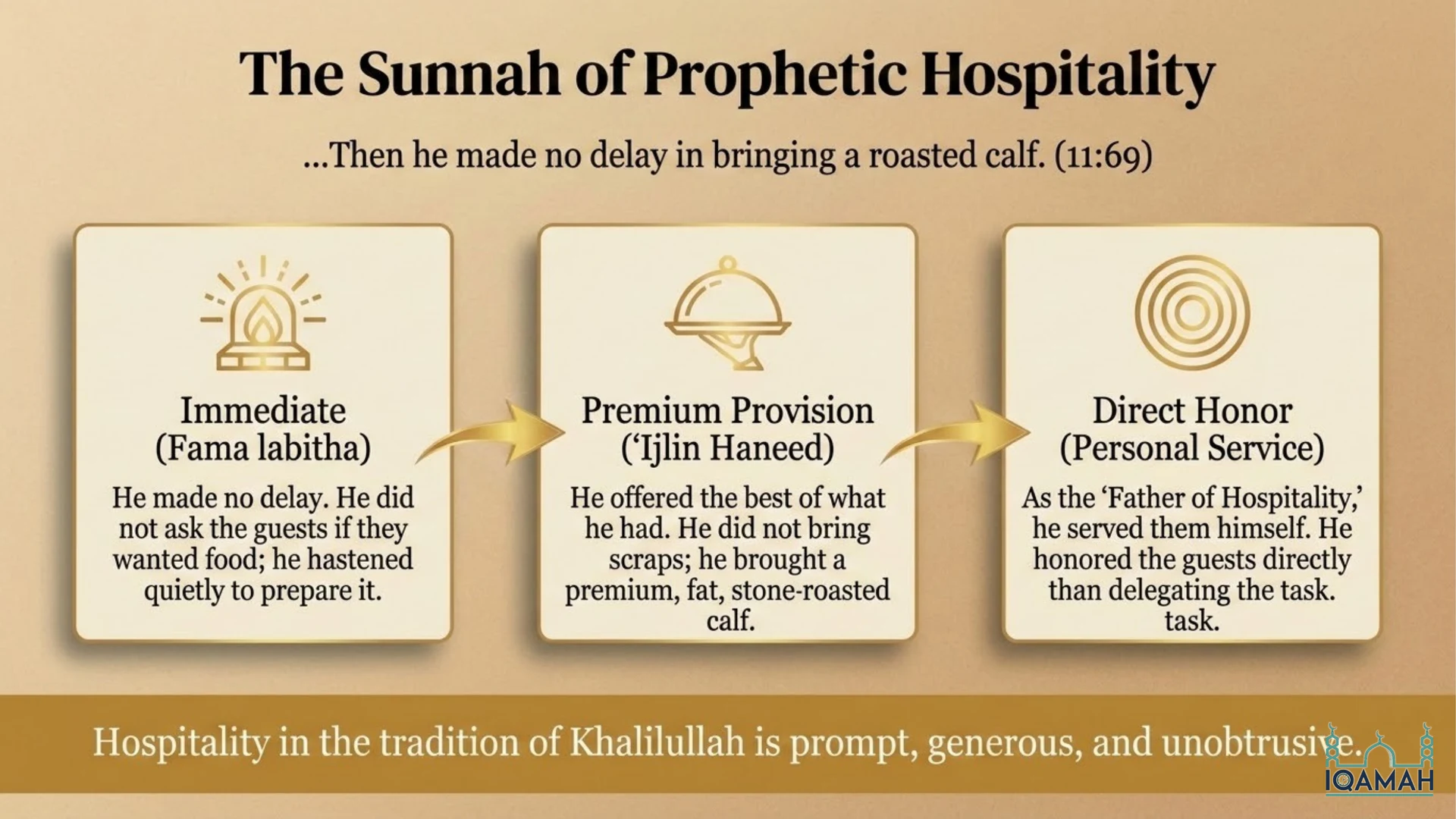
Then comes the hospitality. 'He did not delay in bringing a roasted calf.' Saʿdī (p. 305) and Maʿariful draw attention to three things in quick succession: the speed (fa-mā labitha, 'he tarried not'), the quality (ʿijl ḥanīdh, a whole calf roasted on hot stones — the best he had, not scraps), and the personal service of a host who waited on his guests himself. The word ḥanīdh — grilled on heated stones — is sensory and deliberate; it signals a lavish welcome of strangers. Before a single word of the angels' grave errand is spoken, the scene has already shown the character of the host: a man whose first instinct toward guests is honour. The contrast with how Lūṭ's people will receive the same angels could hardly be sharper.

Slide 6
Slide 6 of 29 #

This slide stays with the hospitality of v. 69 and draws from it three movements: the immediate response (fa-mā labitha — no delay, no asking whether the guests were hungry), the finest provision (ʿijl ḥanīdh — the best he owned), and the direct honour of a host who served them himself, as the one later remembered as the father of hospitality.

From this scene Maʿariful derives a point of adab worth keeping: the practice of serving guests promptly and generously, and of saying bismillāh before a meal and al-ḥamdu lillāh after it, is rooted in the conduct of Khalīlullāh here. A reported detail captures the spirit — when Ibrāhīm invited the guests to eat in the name of Allah, Jibrīl marvelled that Allah had taken this man as a khalīl, and that he was worthy of it. Hospitality in the way of the Prophets is, in a phrase, prompt, generous, and without display.

Slide 7
Slide 7 of 29 #

فَلَمَّا رَءَآ أَيْدِيَهُمْ لَا تَصِلُ إِلَيْهِ نَكِرَهُمْ وَأَوْجَسَ مِنْهُمْ خِيفَةًۭ ۚ قَالُوا۟ لَا تَخَفْ إِنَّآ أُرْسِلْنَآ إِلَىٰ قَوْمِ لُوطٍۢ

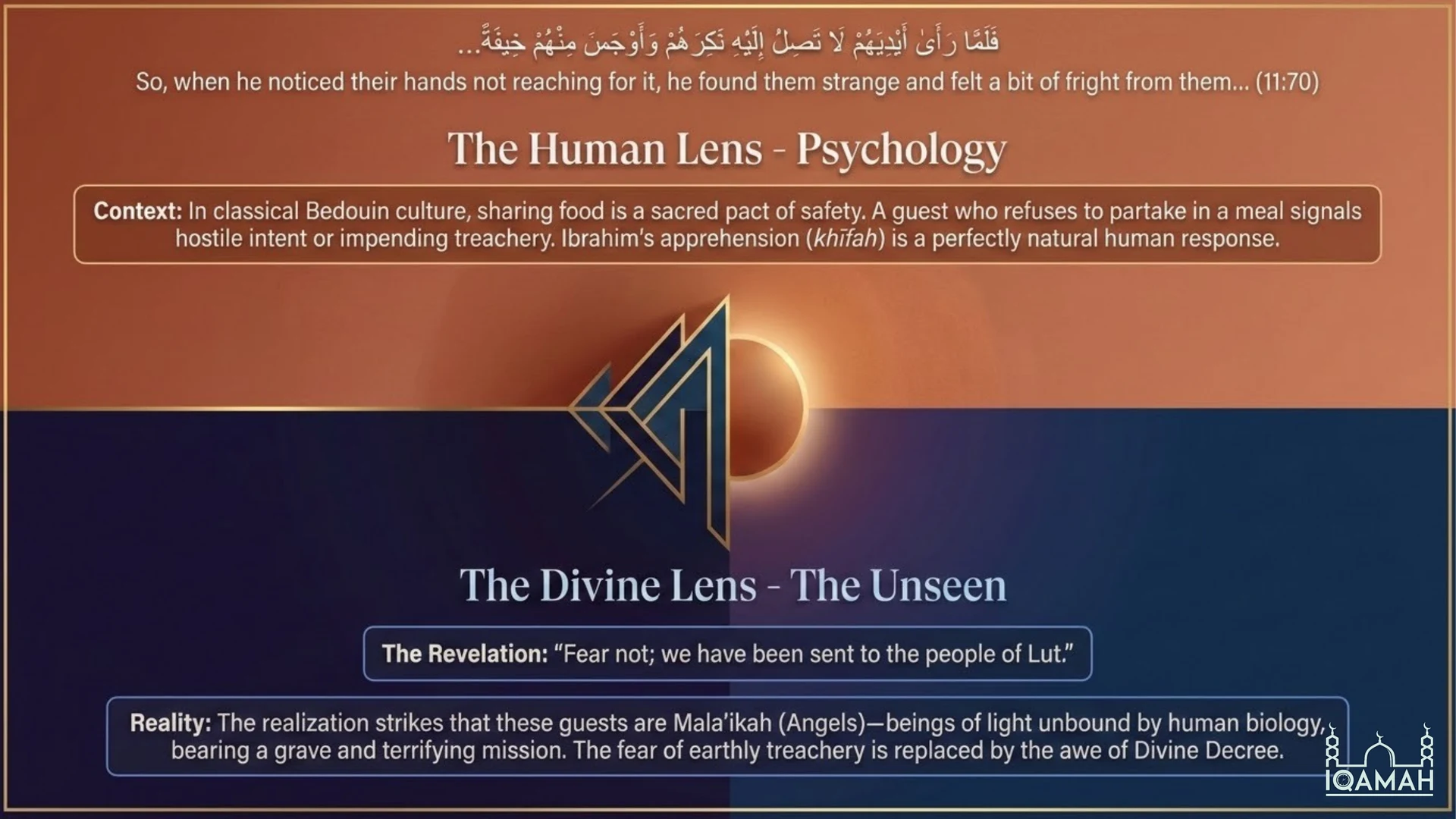
"But when he saw their hands not reaching for it, he distrusted them and felt from them apprehension. They said, "Fear not. We have been sent to the people of Lot."" — Sūrah Hūd 11:70

The scene now turns. When the guests' hands did not reach for the food, Ibrāhīm grew uneasy — because angels do not eat, though he did not yet know they were angels. Saʿdī and Qutb explain the custom of the Arabs: to share a host's food was to enter a bond of safety, so a guest who refused the meal signalled hostile intent. Ibrāhīm therefore 'found them strange' (nakirahum) and 'sensed a fear of them' (awjasa minhum khīfah).

The verb awjasa is precise. It means to feel something within, a hidden, unspoken apprehension rather than open alarm; Ibn ʿĀshūr notes this sense of a concealed inner feeling. Here a Prophet reads the situation by ordinary human signs and feels the natural unease of a host facing possible treachery. The angels lift the veil at once — 'Fear not; we have been sent to the people of Lūṭ' — and the fear of earthly harm gives way to awe before Allah's decree. The passage keeps weaving together these two ways of seeing, the human and the unseen, and here it quietly affirms that even a Prophet feels ordinary, relatable apprehension, and that calm comes from knowing the reality behind the appearance.

Slide 8
Slide 8 of 29 #

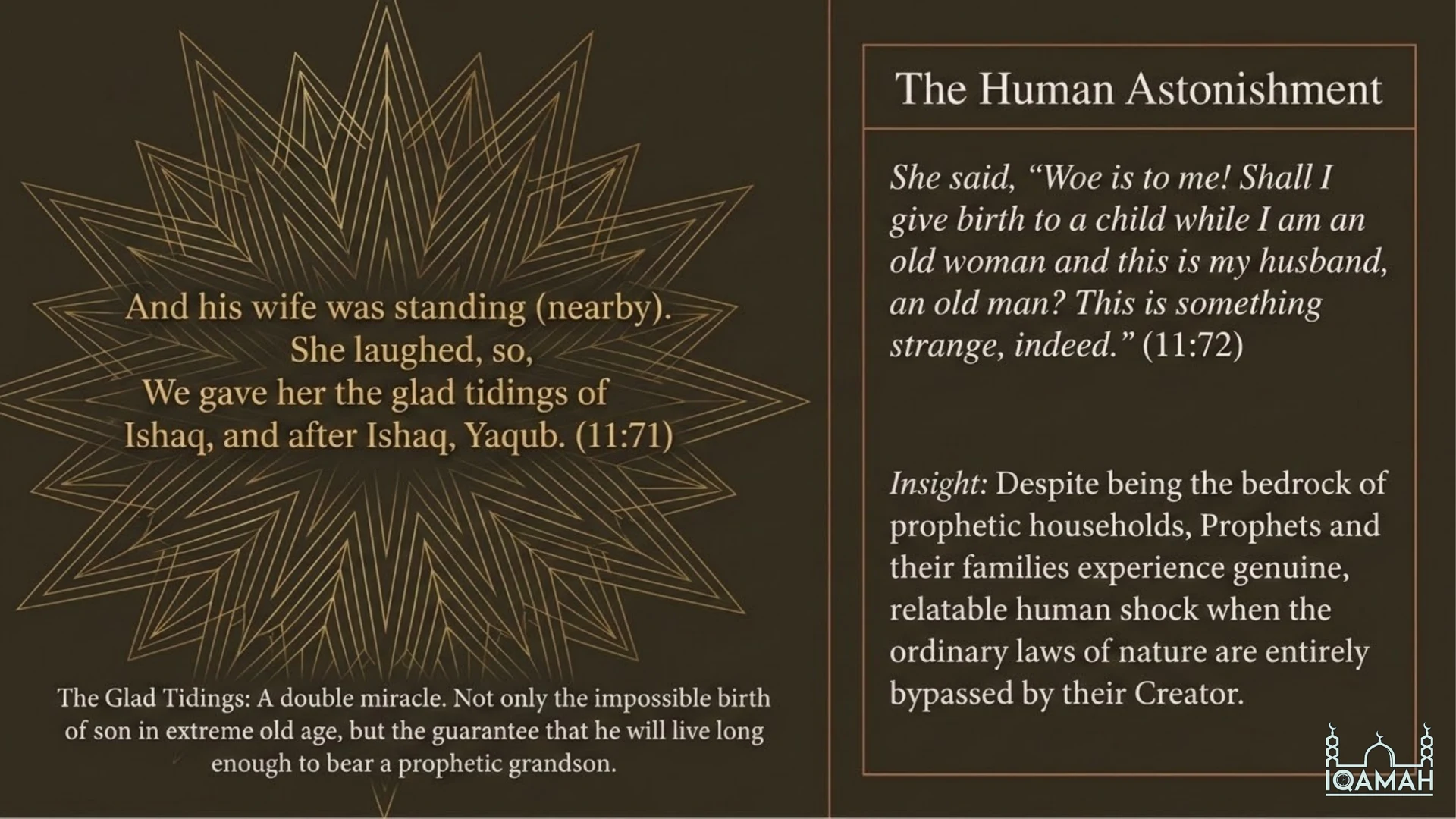
وَٱمْرَأَتُهُۥ قَآئِمَةٌۭ فَضَحِكَتْ فَبَشَّرْنَٰهَا بِإِسْحَٰقَ وَمِن وَرَآءِ إِسْحَٰقَ يَعْقُوبَ

"And his Wife was standing, and she smiled. Then We gave her good tidings of Isaac and after Isaac, Jacob." — Sūrah Hūd 11:71

قَالَتْ يَٰوَيْلَتَىٰٓ ءَأَلِدُ وَأَنَا۠ عَجُوزٌۭ وَهَٰذَا بَعْلِى شَيْخًا ۖ إِنَّ هَٰذَا لَشَىْءٌ عَجِيبٌۭ

"She said, "Woe to me! Shall I give birth while I am an old woman and this, my husband, is an old man? Indeed, this is an amazing thing!"" — Sūrah Hūd 11:72

Two verses sit on this slide, and they are best read as two halves of one moment: the wife's reaction, and her astonishment. On v. 71, 'his wife was standing, and she laughed (fa-ḍaḥikat).' The mufassirūn cited by Zamakhsharī and Ibn al-Jawzī record two readings of ḍaḥikat: the dominant one is that Sārah laughed — whether from relief once the guests' nature was known, or from sheer wonder — while a smaller view reported from Mujāhid takes ḍaḥikat in an older Arabic sense of ḥāḍat (menstruated), itself a sign of returning fertility. The stronger reading is 'laughed,' and the setting of glad tidings supports it.

What follows is a layered mercy: 'We gave her good tidings of Isḥāq, and after Isḥāq, Yaʿqūb.' Saʿdī notes the double gift — not only an impossible child in old age, but the assurance, in the same breath, of a grandson, which means Isḥāq is promised long life and a prophetic line. The tidings reach past the son to his descendants.

Verse 72 captures the human astonishment: 'Woe to me! Shall I give birth while I am an old woman, and this, my husband, is an old man? Indeed, this is an amazing thing.' As Ibn ʿĀshūr observes, the exclamation yā waylatā is not a literal curse but an Arabic expression of amazement — closer to 'oh my!' The lesson is that even the household at the root of prophetic history feels genuine, relatable shock when the ordinary ways of nature (the ʿādah Allah set) are entirely set aside by their Creator. Sārah marvels and believes at once; wonder and faith are not opposites.

Slide 9
Slide 9 of 29 #

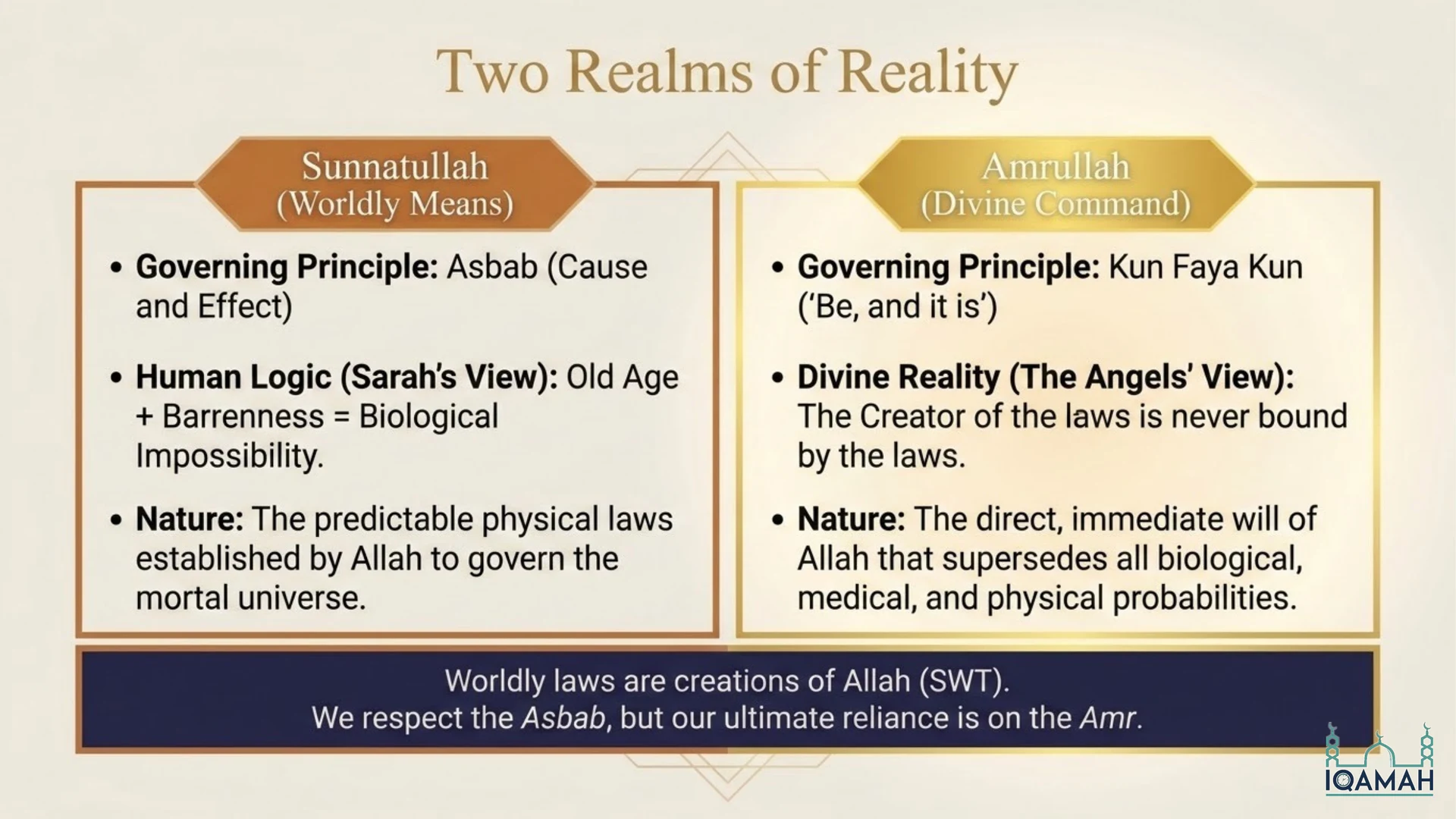
Between Sārah's astonishment and the angels' reply, this slide names the deeper lesson as a meeting of two realms. There is the realm of asbāb — means and natural causes, the reasoning that asks 'how can an old woman bear a child?' — which governs the seen world; and there is the realm of Allah's command, kun fa-yakūn, 'Be, and it is' (cf. 2:117, 36:82), which is not bound by that order.

Sārah's reasoning is sound by the measure of asbāb: by ordinary causes the thing is impossible. But the One who set the means in place is not Himself bound by them; the Maker of the order stands above it. This is the cure for despair. When a believer asks Allah for what seems impossible by ordinary causes, the asking is directed not to the system of means but to the Lord of the means — which is exactly why the angels ground their reply not in mechanics but in His names, the mercy and blessings that flow from His glory and praiseworthiness.

Slide 10
Slide 10 of 29 #

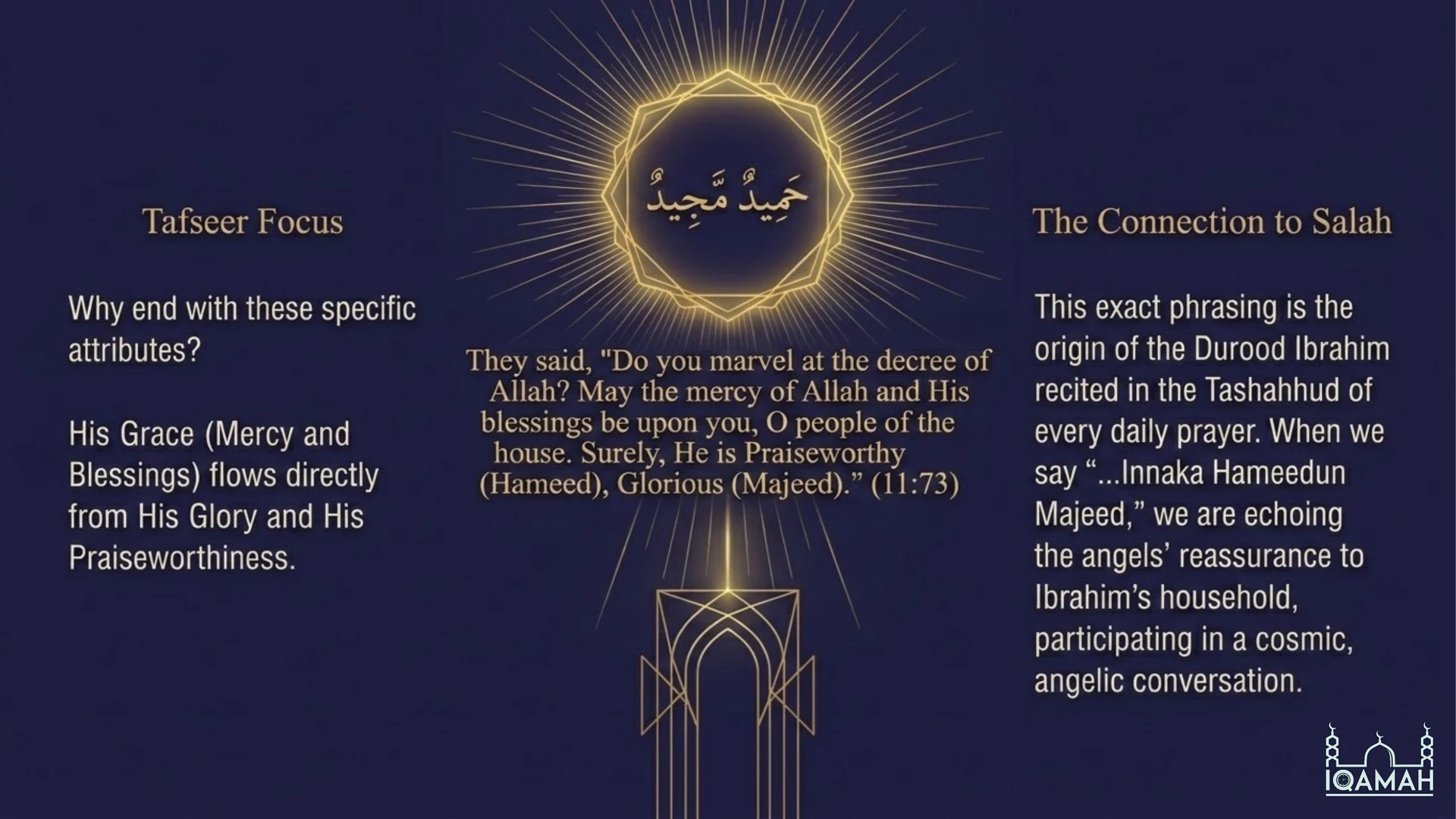
قَالُوٓا۟ أَتَعْجَبِينَ مِنْ أَمْرِ ٱللَّهِ ۖ رَحْمَتُ ٱللَّهِ وَبَرَكَٰتُهُۥ عَلَيْكُمْ أَهْلَ ٱلْبَيْتِ ۚ إِنَّهُۥ حَمِيدٌۭ مَّجِيدٌۭ

"They said, "Are you amazed at the decree of Allah? May the mercy of Allah and His blessings be upon you, people of the house. Indeed, He is Praiseworthy and Honorable."" — Sūrah Hūd 11:73

The angels answer Sārah's wonder with a gentle reminder about the power of Allah: 'Do you marvel at the decree of Allah?' For the One whose command is kun fa-yakūn, a child granted to the aged is no marvel at all. They then invoke a blessing (duʿāʾ) over the household: 'The mercy of Allah and His blessings be upon you, people of this house. Indeed, He is Praiseworthy, Glorious.'

The two closing names are beautifully chosen, and Ibn ʿĀshūr draws out why. Ḥamīd is the One praised for every act, including this gift; Majīd is the One of boundless glory and open-handed generosity (majd joins honour with lavish giving). The impossible child is thereby set in its true light: not a break in nature but an overflow of a Lord who is, by His very names, praiseworthy and generous. The angels do not merely soothe Sārah; they change the very way she sees the event. What looks to human eyes like a breach of the natural order is, on the side of the unseen, simply the Ḥamīd Majīd acting as He is — and the honour conferred on 'the people of this house,' sealed with mercy and blessings, arrives at the very moment the family receives its prophetic future.

Slide 11
Slide 11 of 29 #

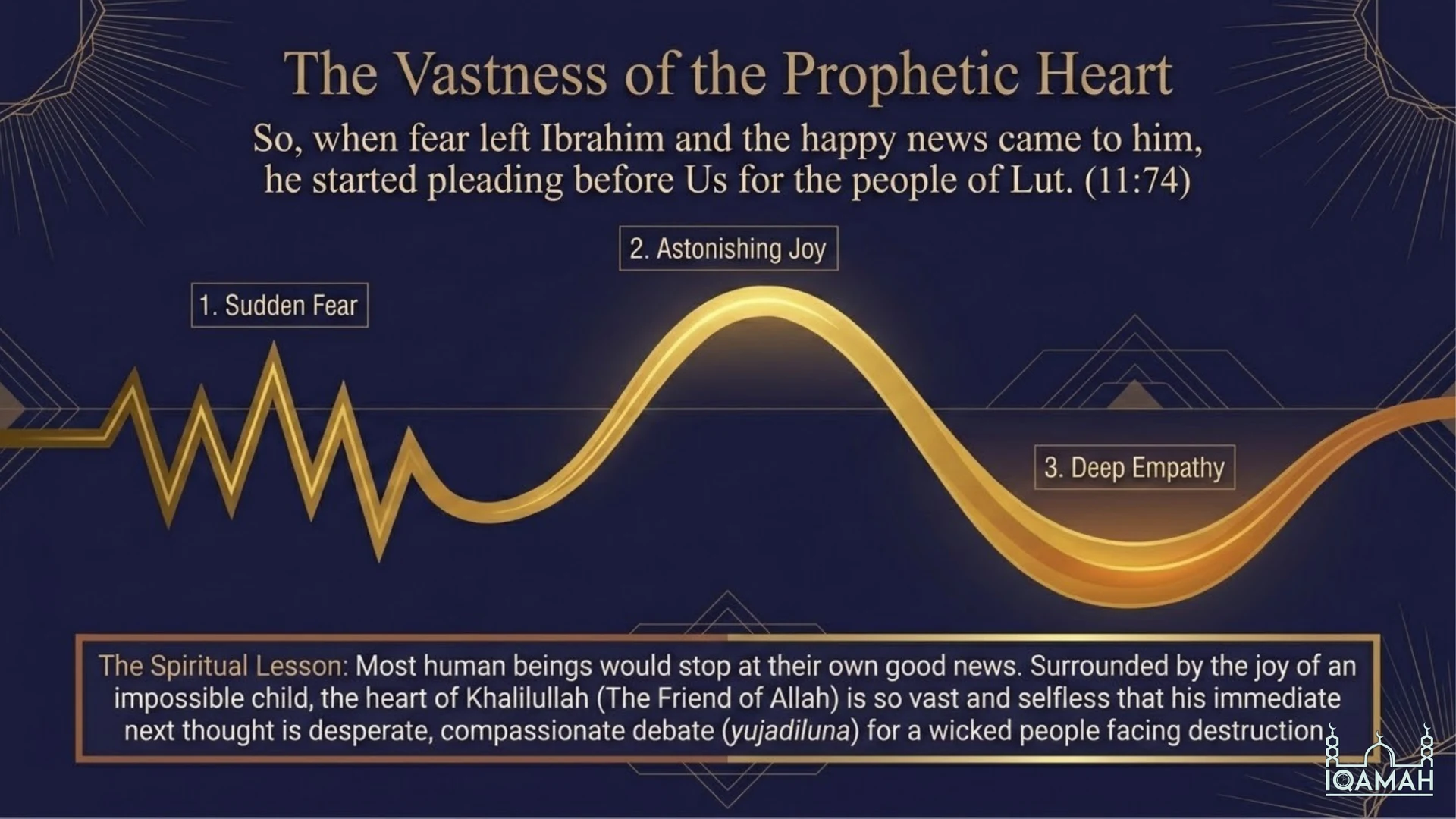
فَلَمَّا ذَهَبَ عَنْ إِبْرَٰهِيمَ ٱلرَّوْعُ وَجَآءَتْهُ ٱلْبُشْرَىٰ يُجَٰدِلُنَا فِى قَوْمِ لُوطٍ

"And when the fright had left Abraham and the good tidings had reached him, he began to argue with Us concerning the people of Lot." — Sūrah Hūd 11:74

Here the passage turns from mercy received to mercy sought for others, and the language is remarkable. 'When the fright had left Ibrāhīm and the good tidings had reached him, he began to plead with Us (yujādilunā) concerning the people of Lūṭ.' Zamakhsharī and Ibn ʿĀshūr both note the tense: yujādilunā is in the muḍāriʿ (present) in the midst of a past account, a turn of speech the scholars of balāgha call ḥikāyat al-ḥāl al-māḍiyah — relating a past moment as though it were unfolding now — so that the Qurʾān holds Ibrāhīm before us in the very act of pleading.

The verb yujādil, from jadal (disputation), is striking when used of a Prophet addressing his Lord, and the mufassirūn are careful with it: here it does not mean quarrelling but earnest pleading — Ibrāhīm pressing the case for mercy, asking whether the towns might be spared for the sake of any righteous within them, a scene shown more fully at 29:31–32 ('But Lūṭ is there!'). The point to dwell on is the timing. The very moment his own fear lifts and joy arrives, Ibrāhīm's instinct is not private relief but pleading for others under threat. The heart of Khalīlullāh, receiving good news, turns it outward — and the next verse names the very qualities that make this possible.

Slide 12
Slide 12 of 29 #

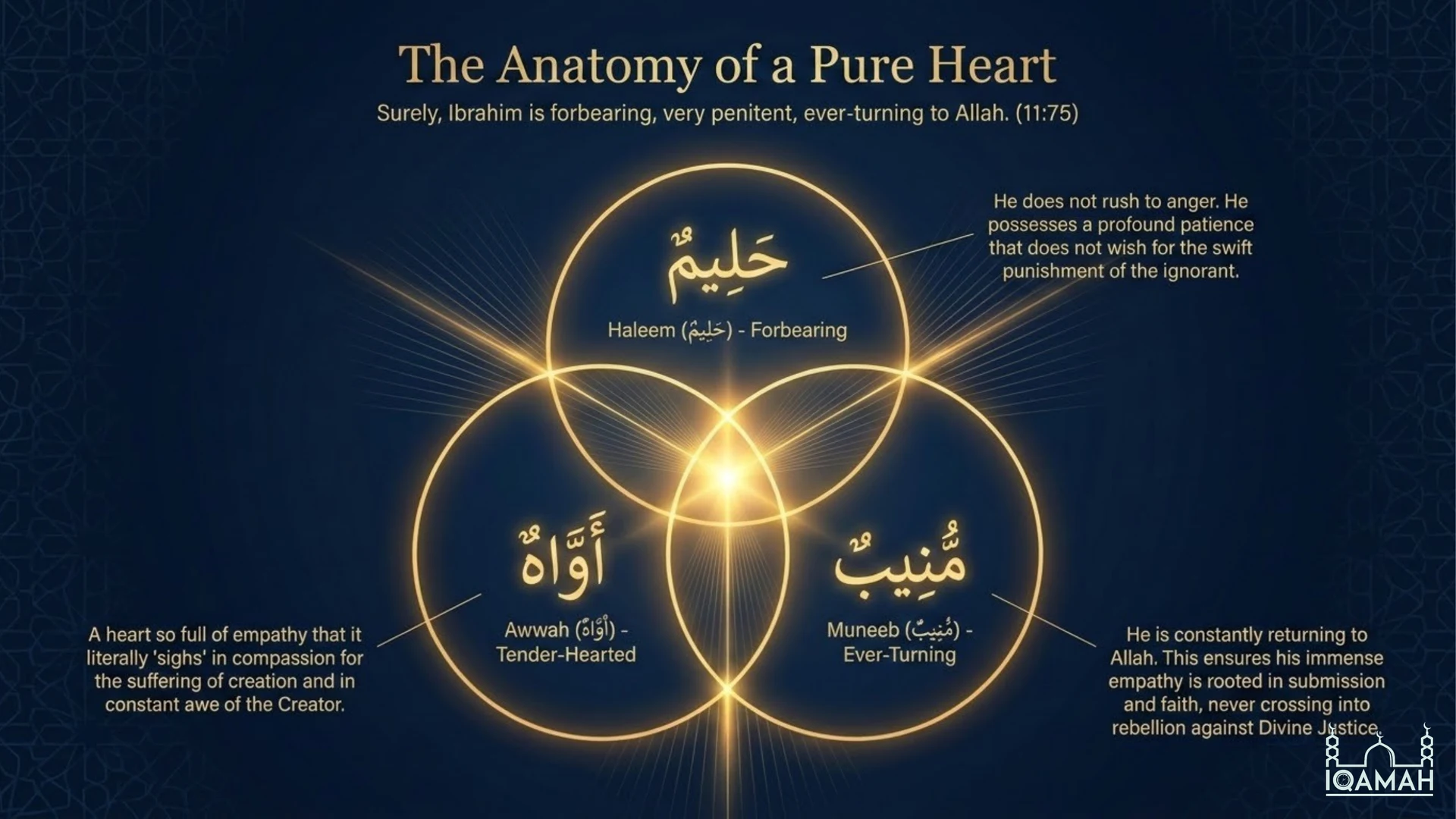
إِنَّ إِبْرَٰهِيمَ لَحَلِيمٌ أَوَّٰهٌۭ مُّنِيبٌۭ

"Indeed, Abraham was forbearing, grieving and [frequently] returning [to Allah]." — Sūrah Hūd 11:75

This verse is the Qurʾān's own portrait of Ibrāhīm, and the deck fittingly treats it as the make-up of a pure heart. Three names are given. Ḥalīm — forbearing, slow to anger, large-hearted, unmoved to harshness by the ignorance of others. Awwāh — a word over which Ibn al-Jawzī (Zād al-Masīr) records a wide range of views: one who sighs much (from the sound āh) out of tenderness and fear of Allah, one who supplicates abundantly, one of deep compassion, one always mindful of his Lord; the thread joining them is a heart so tender it aches. And munīb — one who turns back to Allah again and again (from anāba), the very quality urged on ʿĀd and Thamūd.

Taken together the three names explain the pleading of the previous verse: it is because Ibrāhīm is forbearing enough not to give up even on a doomed people, tender enough to ache for them, and ever-returning to his Lord that he pleads for the people of Lūṭ. His pleading is not a quirk of temperament but the fruit of a purified character. Ibn ʿĀshūr notes the force of the emphatic phrasing — inna Ibrāhīma la-ḥalīm, the particle inna with the lām al-tawkīd — which marks these not as a passing mood but as a settled station. Forbearance, tenderness, and constant return to Allah are the soil; pleading and mercy are what grow in it.

Slide 13
Slide 13 of 29 #

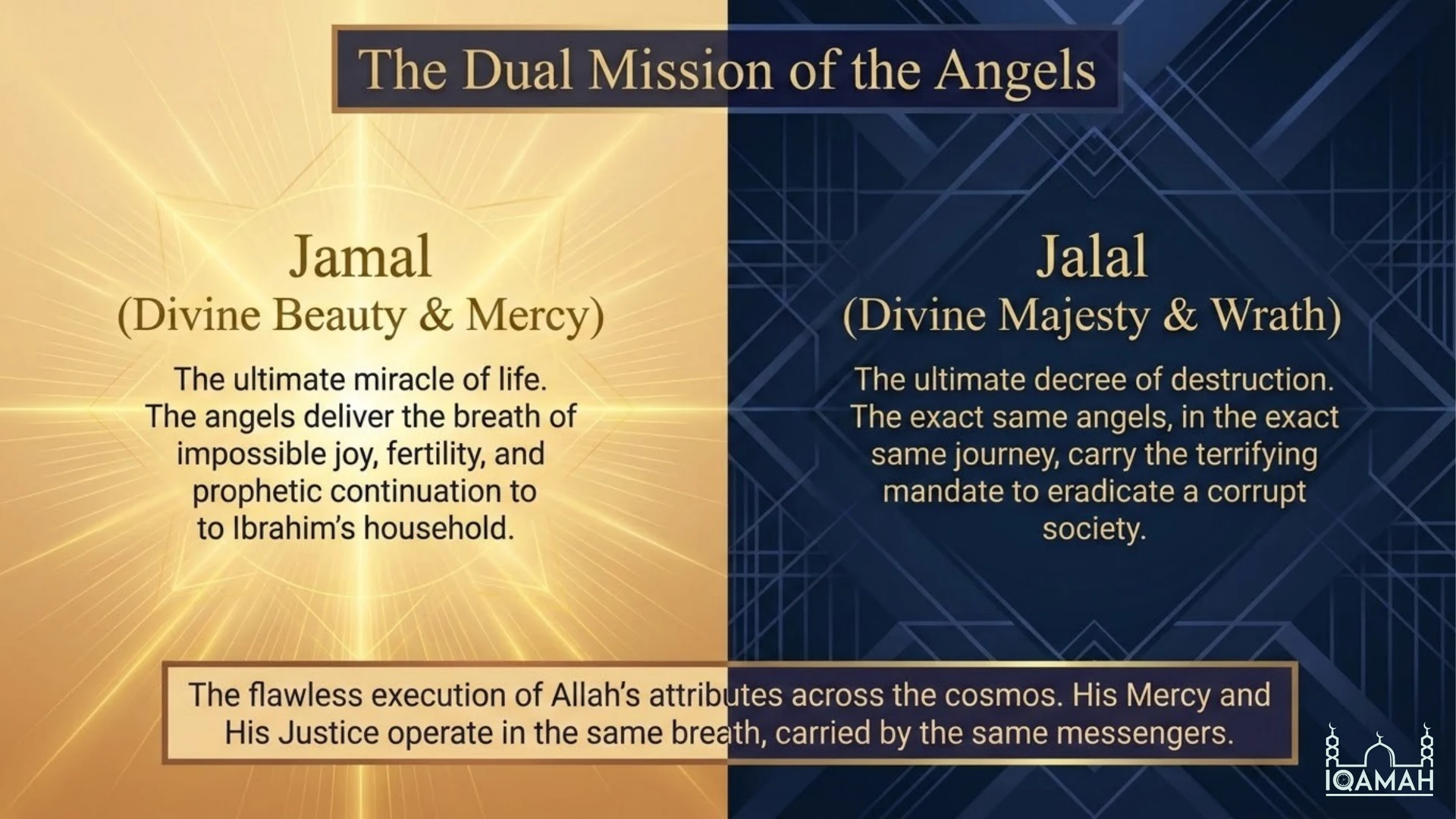
This slide reads the two faces of the angels' single errand as jamāl, the beauty and mercy of Allah, and jalāl, His majesty and might. To Ibrāhīm's household the messengers carry jamāl, bringing the glad tidings of a son; to the people of Lūṭ they will carry jalāl, executing the overturning. In both directions the ordinary, settled course of nature is set aside — a child against the odds, and a township unmade.

The uniting truth is that jamāl and jalāl are not two powers but two faces of one Lord's command, carried by the same hands, on the same night. The flawless carrying out of His mercy and His justice runs through the same messengers. The believer learns from this to know his Lord in both — to receive blessing as His jamāl and to fear wrongdoing because of His jalāl — without ever splitting the two into rival powers.

Slide 14
Slide 14 of 29 #

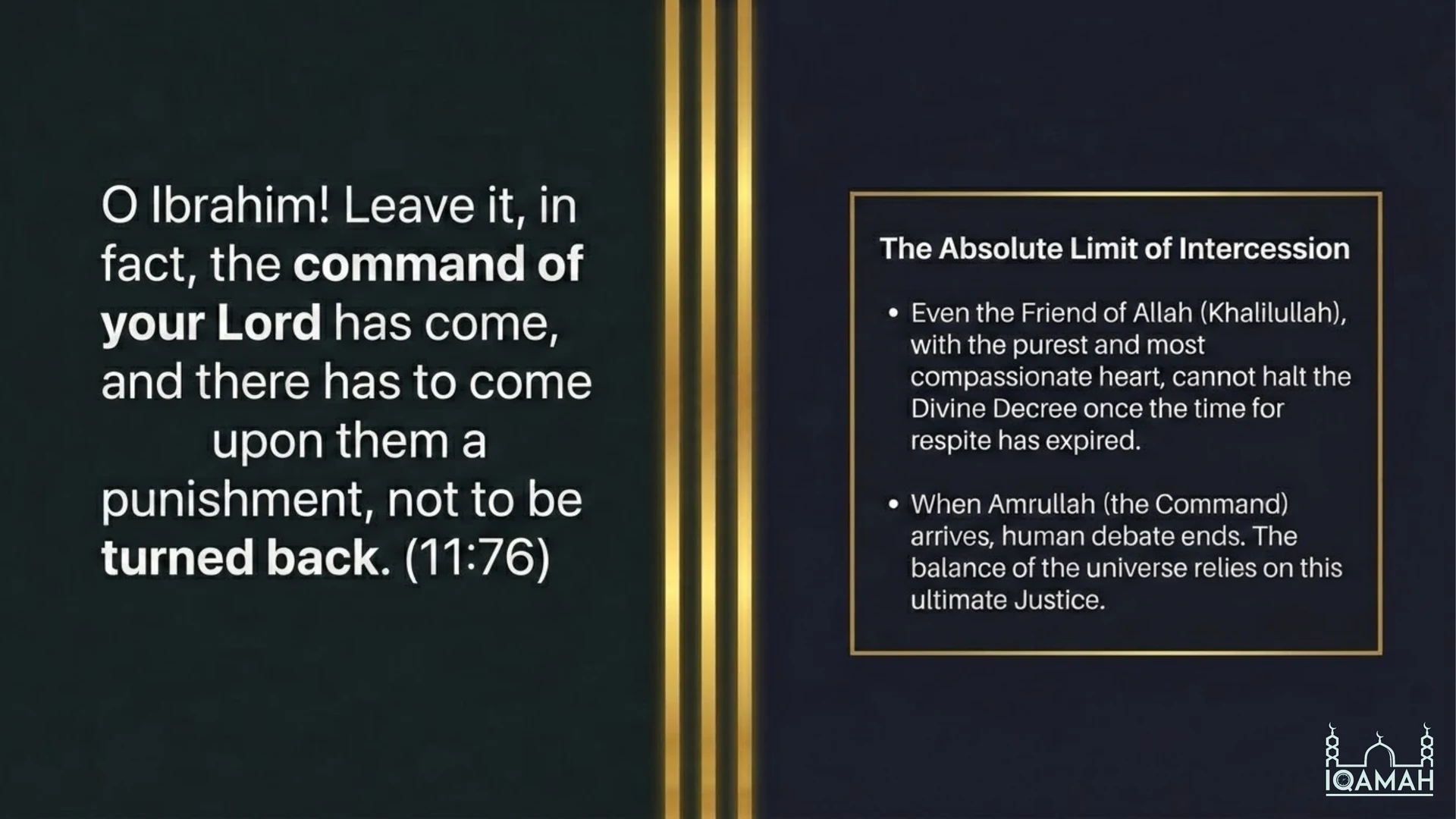
يَٰٓإِبْرَٰهِيمُ أَعْرِضْ عَنْ هَٰذَآ ۖ إِنَّهُۥ قَدْ جَآءَ أَمْرُ رَبِّكَ ۖ وَإِنَّهُمْ ءَاتِيهِمْ عَذَابٌ غَيْرُ مَرْدُودٍۢ

"[The angels said], "O Abraham, give up this [plea]. Indeed, the command of your Lord has come, and indeed, there will reach them a punishment that cannot be repelled."" — Sūrah Hūd 11:76

The pleading is gently brought to a close. 'O Ibrāhīm, turn away from this. Indeed, the command of your Lord has already come, and there is coming to them a punishment that cannot be repelled.' Saʿdī and Qutb note the tenderness even in the refusal: Ibrāhīm is not blamed for pleading — his pleading was praised a verse earlier — but he is told the matter is now settled, the decree has gone forth, and the time for appeal has passed.

The phrase ghayru mardūd, 'not to be turned back,' marks the outer limit of pleading. There is a moment after which even a Prophet's appeal, however beloved, cannot turn aside what the Lord has decreed — the same limit met with Nūḥ ('do not plead for the wrongdoers,' v. 37) and standing at the door of every judgement in the sūrah: when amr Allāh comes, the door of appeal closes. Ibrāhīm's greatness shows in both directions at once — in the pleading, and in the immediate acceptance when told to desist. Pleading is noble and beloved to Allah right up to the limit He sets, and recognising that limit is itself part of submission.

Slide 15
Slide 15 of 29 #

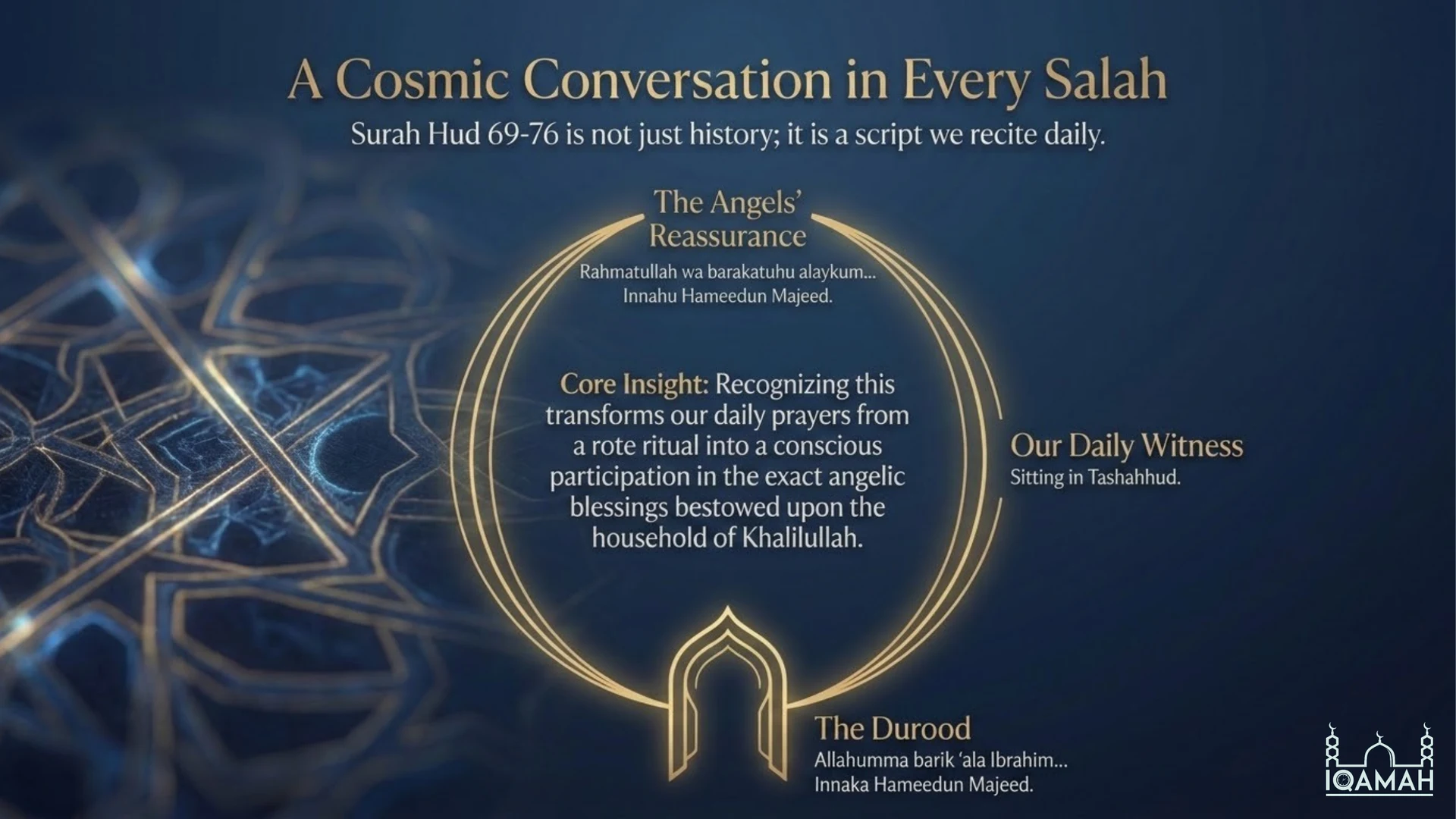
This slide connects the honouring of Ibrāhīm's household to the believer's daily prayer. In every ṣalāh we send the Ibrāhīmic blessing — Allāhumma ṣalli ʿalā Muḥammad... kamā ṣallayta ʿalā Ibrāhīm — joining the Prophet ﷺ and his household to Ibrāhīm and his. The blessing the angels invoked over 'the people of this house' in v. 73 is, in a sense, echoed by every Muslim in every prayer.

So the honour shown to the household of Khalīlullāh is not a sealed event of the past but a living formula we recite, a daily share in a flow of blessing that began at Ibrāhīm's table. It is worth carrying that awareness into the next prayer: when we reach the ṣalawāt, we are stepping into the very scene this passage describes.

Slide 16
Slide 16 of 29 #

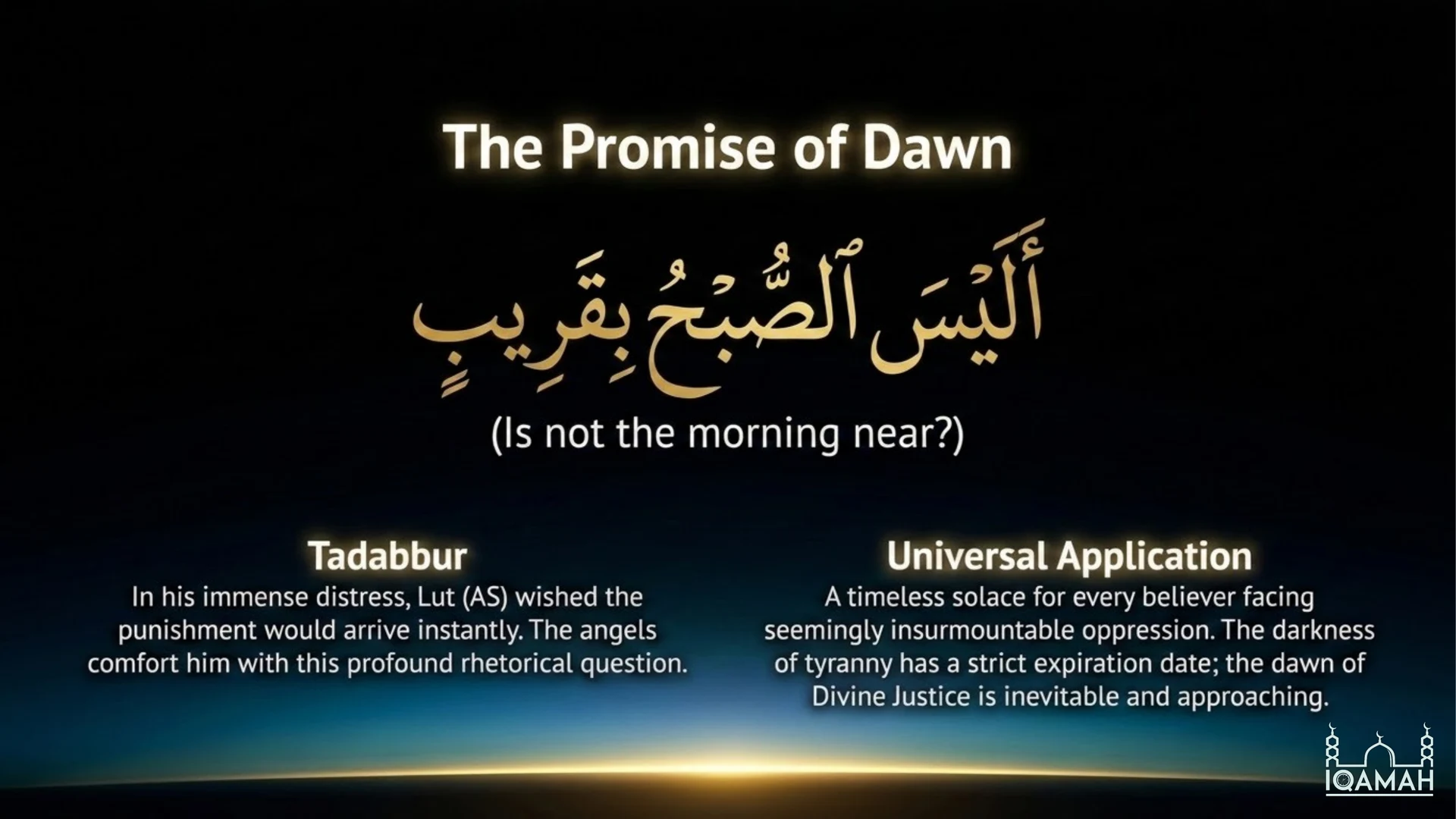
The account now turns to Lūṭ (vv. 77–83), and the deck's title for the section — 'The Night of Decree' — is exact: the angels who brought day-bright mercy to Ibrāhīm now bring nightfall judgement to the people of Lūṭ. The Arabic line shown on the slide, alaysa al-ṣubḥu bi-qarīb, 'is not the morning near?' (v. 81), looks ahead to the dawn at which the decree will fall.

The same delegation, the same night — but a wholly different reception awaits. Where Ibrāhīm met the strangers with a roasted calf, the people of Lūṭ will descend on them as prey, and the contrast the sūrah has been building, between the hospitality of the believer and the predation of the corrupt, is about to reach its terrible peak. Maʿariful underscores the gravity of what they practised — a fāḥishah, an obscene act, unknown in the world before them — which is why a punishment unlike any other was prepared.

Slide 17
Slide 17 of 29 #

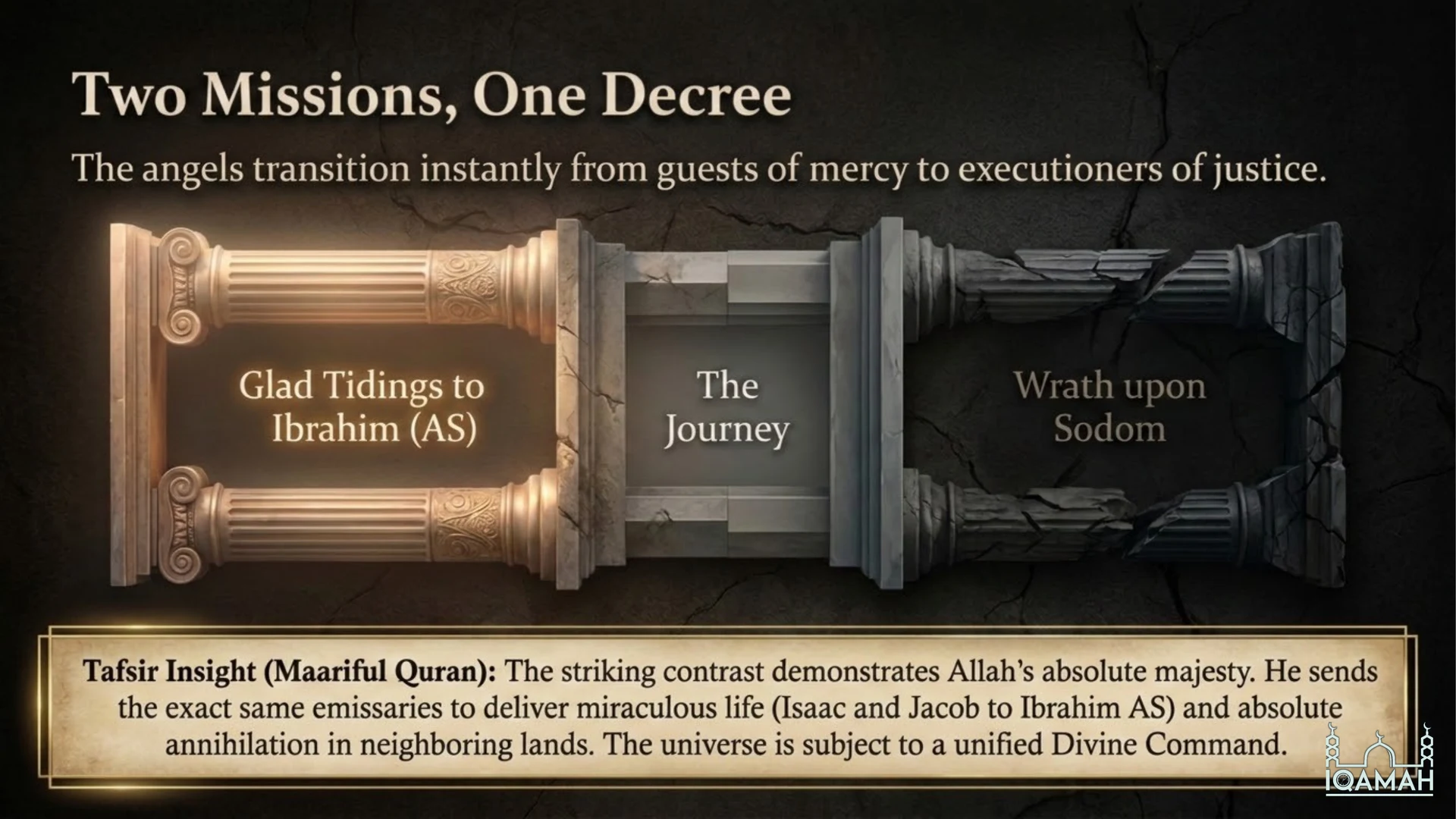
This slide holds the symmetry in view: the glad tidings to Ibrāhīm and the wrath upon the people of Lūṭ are two outcomes of a single command, carried by the same angels. Saʿdī's observation is striking — the very messengers who announce the miraculous births of Isḥāq and Yaʿqūb also destroy a nation; the whole of creation answers to one command of Allah, mercy and justice alike.

The lesson is that there is no second power. The hand that gives and the hand that withholds are the same hand, and tawḥīd guards us against a divided belief in which mercy and justice belong to rival forces. To fear His justice and to hope in His mercy is therefore to stand rightly before one Lord, not to bargain between two.

Slide 18
Slide 18 of 29 #

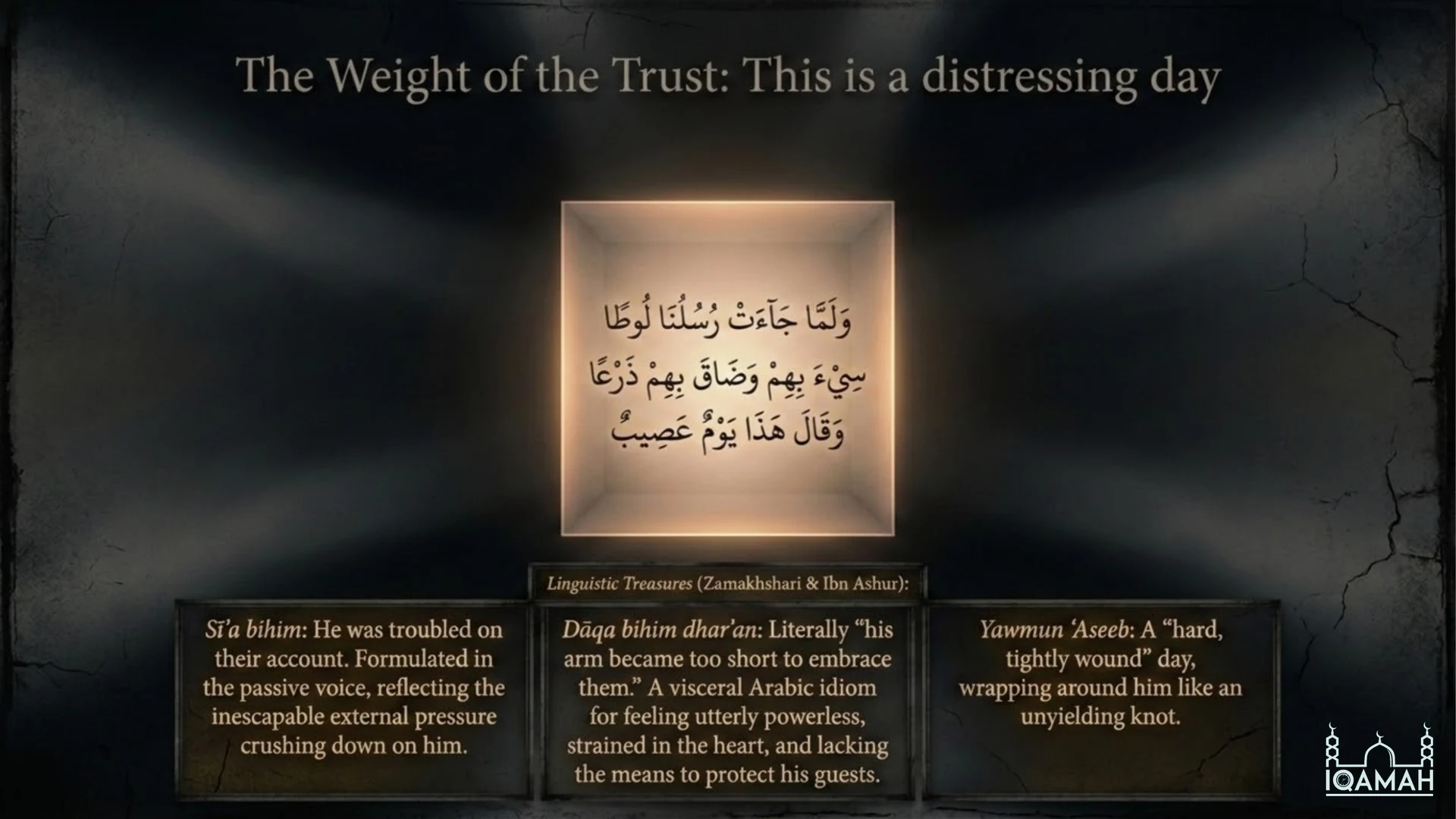
وَلَمَّا جَآءَتْ رُسُلُنَا لُوطًۭا سِىٓءَ بِهِمْ وَضَاقَ بِهِمْ ذَرْعًۭا وَقَالَ هَٰذَا يَوْمٌ عَصِيبٌۭ

"And when Our messengers, [the angels], came to Lot, he was anguished for them and felt for them great discomfort and said, "This is a trying day."" — Sūrah Hūd 11:77

The scene of Lūṭ opens on his distress, and every word of v. 77 is weighted. 'He was grieved for them (sīʾa bihim) and felt straitened on their account (ḍāqa bihim dharʿan), and said: This is a distressing day.' Sīʾa bihim — he was pained by their very arrival, because unlike Ibrāhīm, Lūṭ knew exactly what his townsmen would do to beautiful young guests. Ḍāqa bihim dharʿan is an Arabic expression Ibn ʿĀshūr unfolds: dharʿ is one's reach or capacity, and for it to 'narrow' is to be overwhelmed, cornered, left with no room to act.

The day itself is ʿaṣīb, from the root ʿ-ṣ-b, to bind tightly — as a turban (ʿiṣābah) binds the head; a yawm ʿaṣīb is a day so hard it seems knotted shut, a day that closes in. Qutb captures Lūṭ's position: a lone righteous man, a settler with no clan or tribe, responsible for guests he has no worldly power to protect. It is worth noticing the difference between Ibrāhīm's fear, a brief unease at once relieved, and Lūṭ's distress, a settled dread of what he knows is coming. Both are righteous men, and both feel; the passage honours the truth of human anguish even in those whom Allah is about to rescue.

Slide 19
Slide 19 of 29 #

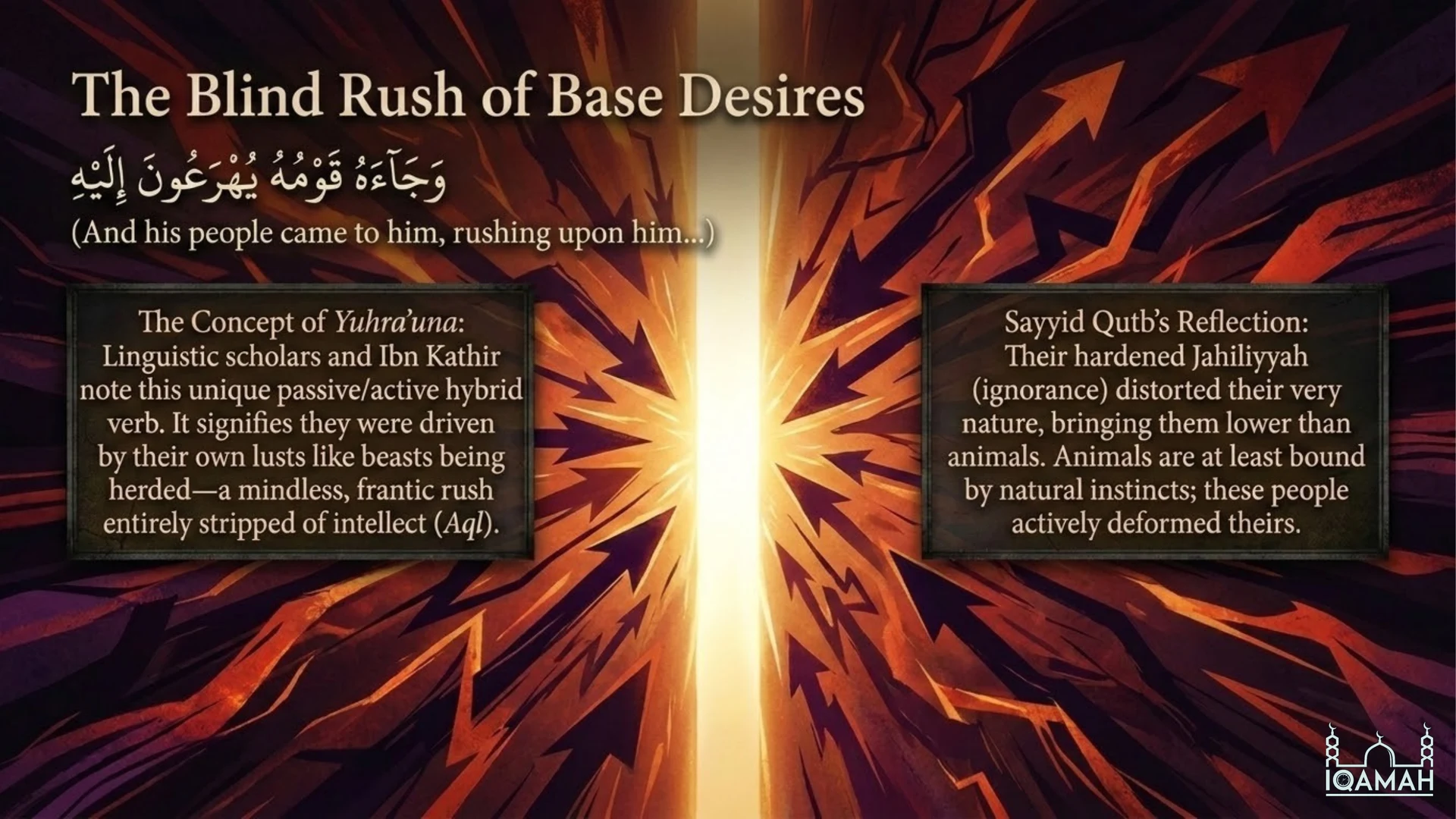
وَجَآءَهُۥ قَوْمُهُۥ يُهْرَعُونَ إِلَيْهِ وَمِن قَبْلُ كَانُوا۟ يَعْمَلُونَ ٱلسَّيِّـَٔاتِ ۚ قَالَ يَٰقَوْمِ هَٰٓؤُلَآءِ بَنَاتِى هُنَّ أَطْهَرُ لَكُمْ ۖ فَٱتَّقُوا۟ ٱللَّهَ وَلَا تُخْزُونِ فِى ضَيْفِىٓ ۖ أَلَيْسَ مِنكُمْ رَجُلٌۭ رَّشِيدٌۭ

"And his people came hastening to him, and before [this] they had been doing evil deeds. He said, "O my people, these are my daughters; they are purer for you. So fear Allah and do not disgrace me concerning my guests. Is there not among you a man of reason?"" — Sūrah Hūd 11:78

The crowd arrives. 'His people came rushing toward him (yuhraʿūna ilayhi), and they had long been doing evil deeds.' The verb yuhraʿūn is passive in form — they are driven, impelled, as if pushed by their own desire; Ibn ʿĀshūr notes the sense of being hurried along by an inner compulsion, not walking but stampeding. The aside that they 'used to commit evil deeds' shows this was their settled practice, not a single lapse.

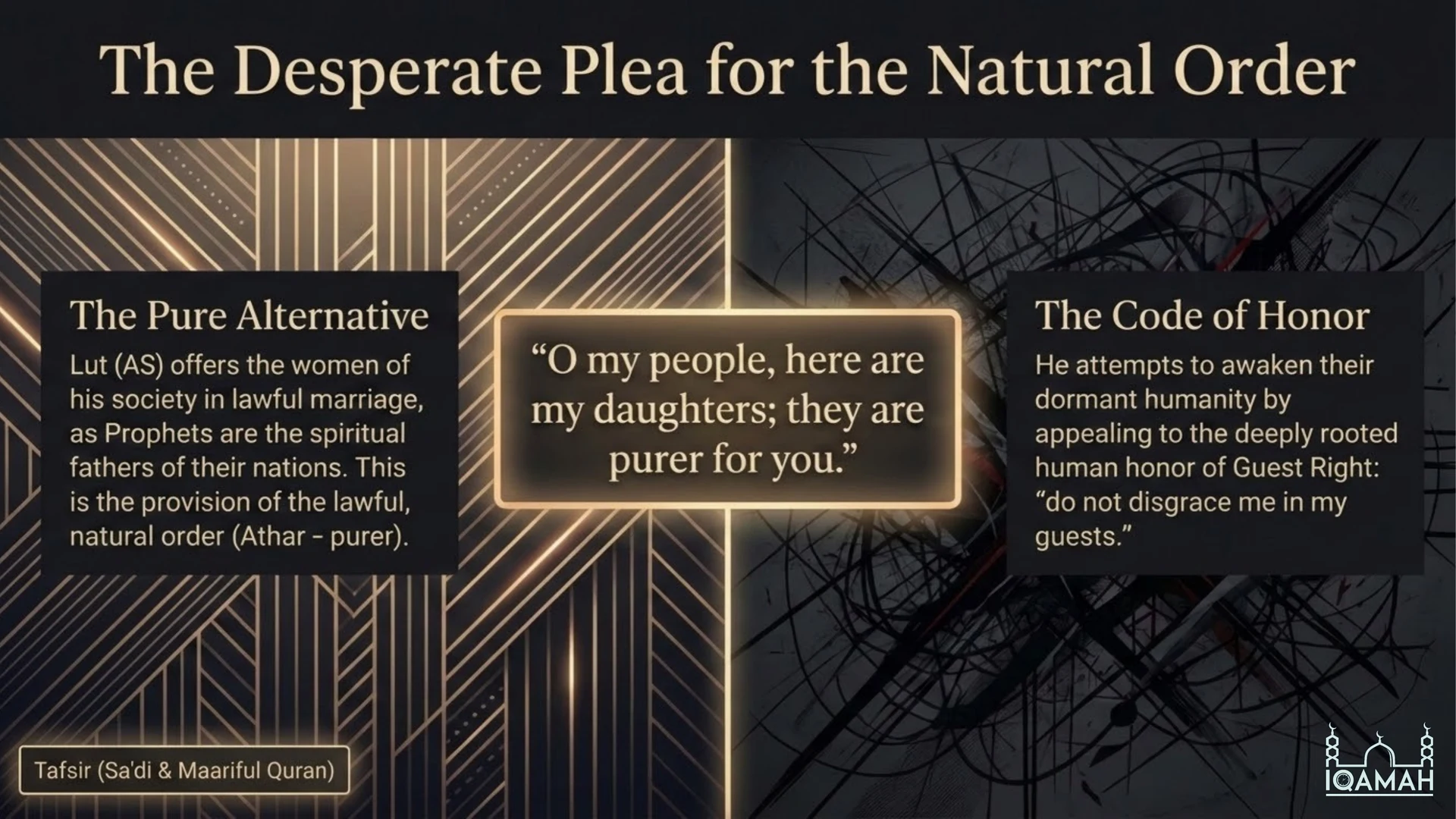
Lūṭ's appeal is desperate and threefold: 'Here are my daughters; they are purer for you. So fear Allah and do not disgrace me concerning my guests. Is there not among you a single right-minded man?' On 'my daughters,' Saʿdī gives the decisive reading in his comment on the verse: the meaning is 'the daughters of my nation' — Lūṭ was urging the men toward lawful marriage with the women of the town, the pure and natural way, not literally offering up his own children. Qutb takes aṭhar in every sense at once: purer in body, in conduct, and in religion — the lawful path the Creator provided for desire. Lūṭ pulls three levers in one breath — natural decency, the fear of Allah, and the sacred duty of hospitality — and ends with a despairing search for even one right-minded man (rashīd). The tragedy is that none of these moves a people whose nature has been turned upside down. This is no Prophet offering up his own daughters; it is a cornered man pointing a frenzied crowd back toward the lawful and the pure.

Slide 20
Slide 20 of 29 #

This slide dwells on the reasoning of Lūṭ's plea in v. 78, setting the pure alternative he offers — lawful marriage to the women of the town, the daughters of his nation — against the 'code of honour' of a people who have made the abnormal their demanded standard and who mock the lawful as beside the point.

Qutb's reflection is worth following: Lūṭ's offer appeals to a sound nature (fiṭrah), to a sense of decency, and to the fear of Allah — and the horror of his people is precisely that none of these reaches them any longer. The natural has become repugnant to them and the unnatural their craving. When a people turn the God-given order upside down, the very appeals that should move them — nature, decency, taqwā — become the things they brush aside. This is what the deck names the erosion of ḥayāʾ, modesty: once shame dies, the abnormal hardens into a claimed right.

Slide 21
Slide 21 of 29 #

قَالُوا۟ لَقَدْ عَلِمْتَ مَا لَنَا فِى بَنَاتِكَ مِنْ حَقٍّۢ وَإِنَّكَ لَتَعْلَمُ مَا نُرِيدُ

"They said, "You have already known that we have not concerning your daughters any claim, and indeed, you know what we want."" — Sūrah Hūd 11:79

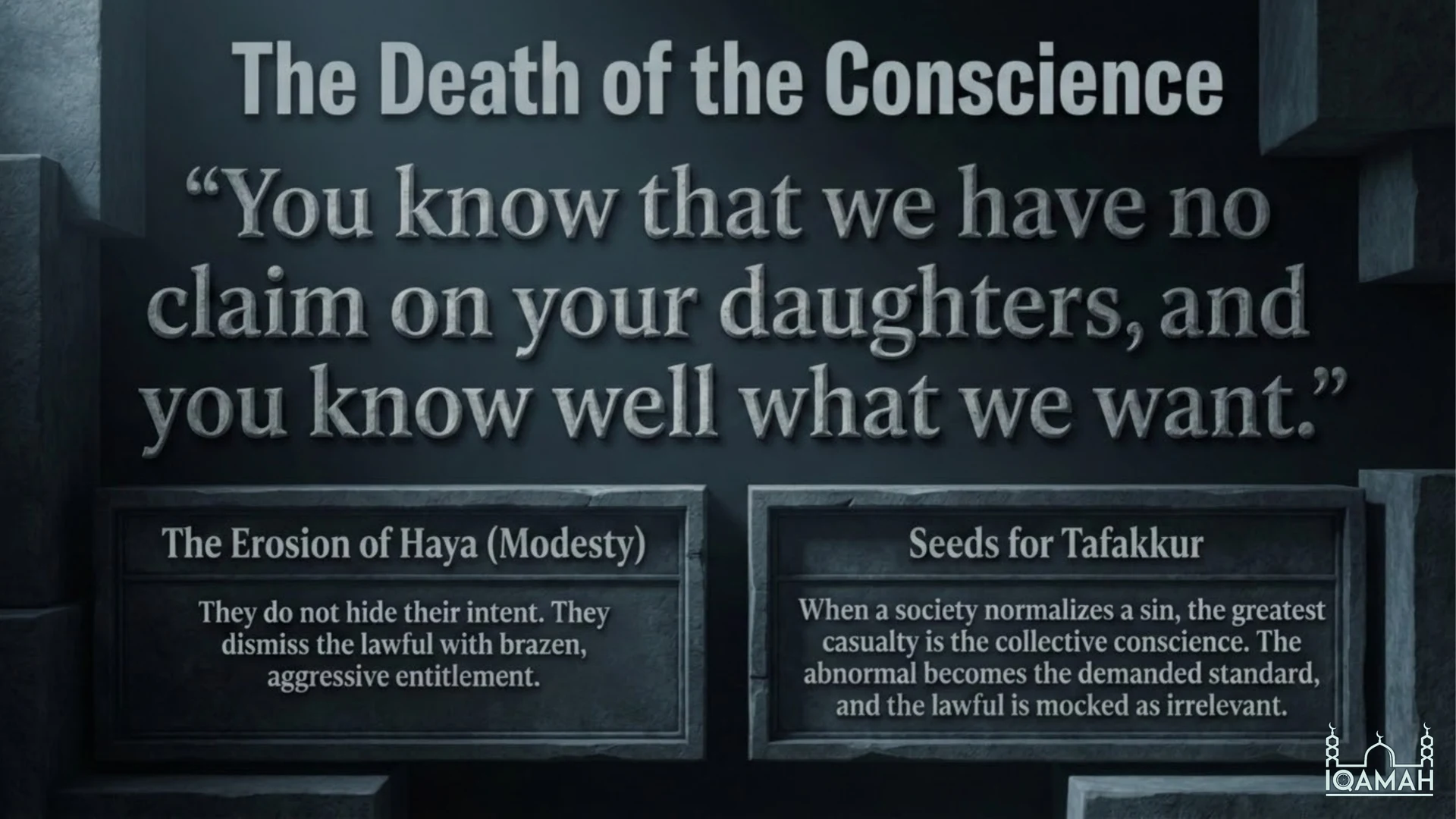
The crowd's reply strips away the last pretence. 'You already know that we have no claim to your daughters, and you know well what we want.' Two admissions are buried in this, as Qutb notes. The mention of having no 'claim' (ḥaqq) is a sneering acknowledgement that lawful marriage was always open to them — had they wanted the women, they had every right to seek them — which lays bare that desire, not access, was never the issue. And 'you know what we want' is a brazen, knowing declaration of intent: evil no longer troubling even to hide itself.

The deck calls this the death of the conscience, and the description fits. Saʿdī's words on the sealed heart apply: a people who can state their wickedness plainly, without shame, to the face of a Prophet have passed beyond the reach of argument. The most chilling stage of corruption is not the doing of evil but the open, unembarrassed avowal of it — when 'you know what we want' is spoken as a boast rather than confessed as a sin. The erosion of modesty is complete when the wrong can be said aloud without a flinch.

Slide 22
Slide 22 of 29 #

قَالَ لَوْ أَنَّ لِى بِكُمْ قُوَّةً أَوْ ءَاوِىٓ إِلَىٰ رُكْنٍۢ شَدِيدٍۢ

"He said, "If only I had against you some power or could take refuge in a strong support."" — Sūrah Hūd 11:80

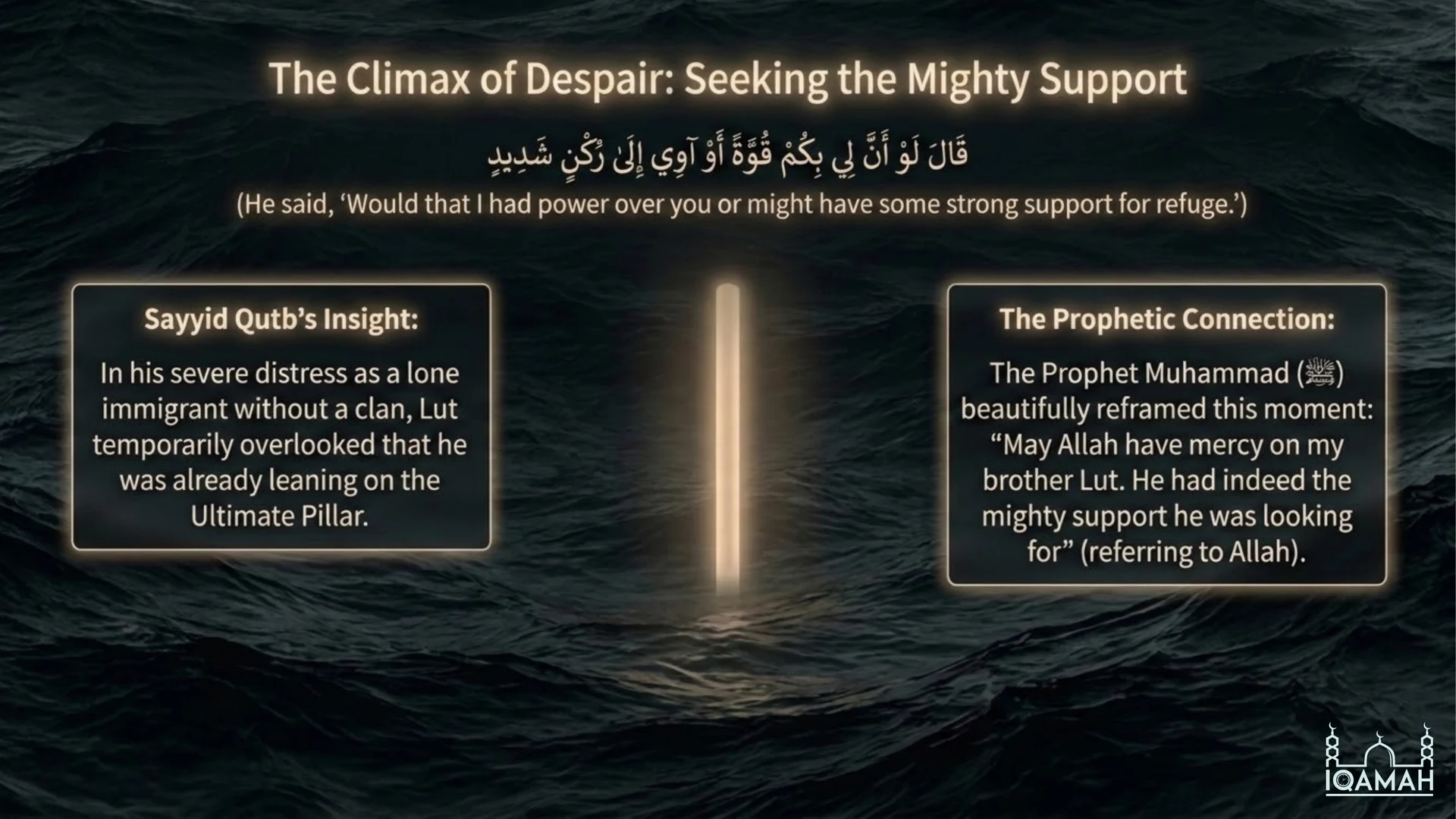
Cornered and without a clan, Lūṭ utters one of the most moving lines in the sūrah: 'If only I had against you some power, or could take refuge in a strong support (rukn shadīd).' Qutb explains the plight: Lūṭ was a settler who had come among these people, with no tribe, no armed kin, none of the clan-strength that in that world protected a man and his guests. In his anguish he wishes for either power of his own or a mighty ally to lean on.

And here come the Prophet's ﷺ well-known words. On reciting this verse he said, 'May Allah have mercy on Lūṭ — he was indeed leaning on a mighty support' (reported via al-Tirmidhī and others). Saʿdī brings out the tenderness in it: as far as worldly means went, Lūṭ had none, yet the strongest support of all — Allah Himself, whose might none can resist — was with him the whole time, about to act through the very guests he despaired of protecting. The rukn shadīd he wished for was standing in his house. In the moment of greatest human helplessness, the believer's true support is at its strongest; Lūṭ simply could not yet see it. When we feel we have neither strength nor refuge, that is precisely the moment to remember whose hand is already upon the matter.

Slide 23
Slide 23 of 29 #

قَالُوا۟ يَٰلُوطُ إِنَّا رُسُلُ رَبِّكَ لَن يَصِلُوٓا۟ إِلَيْكَ ۖ فَأَسْرِ بِأَهْلِكَ بِقِطْعٍۢ مِّنَ ٱلَّيْلِ وَلَا يَلْتَفِتْ مِنكُمْ أَحَدٌ إِلَّا ٱمْرَأَتَكَ ۖ إِنَّهُۥ مُصِيبُهَا مَآ أَصَابَهُمْ ۚ إِنَّ مَوْعِدَهُمُ ٱلصُّبْحُ ۚ أَلَيْسَ ٱلصُّبْحُ بِقَرِيبٍۢ

"The angels said, "O Lot, indeed we are messengers of your Lord; [therefore], they will never reach you. So set out with your family during a portion of the night and let not any among you look back - except your wife; indeed, she will be struck by that which strikes them. Indeed, their appointment is [for] the morning. Is not the morning near?"" — Sūrah Hūd 11:81

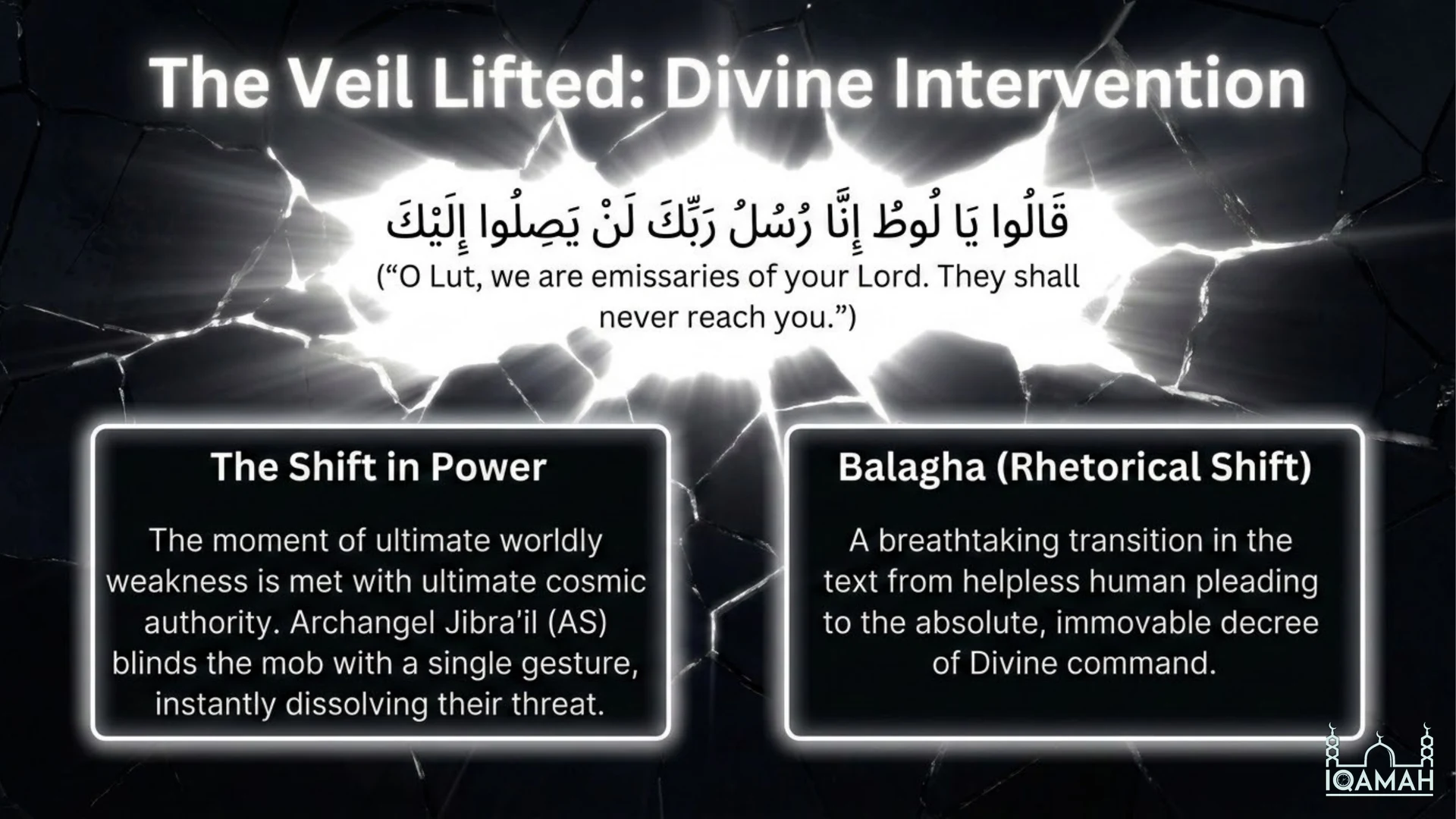
Relief arrives as the angels reveal themselves. 'O Lūṭ, we are messengers of your Lord; they will never reach you. So set out with your family in a portion of the night, and let none of you look back — except your wife; she will be struck by what strikes them. Their appointed time is the morning. Is not the morning near?' Saʿdī and Qutb relate that Jibrīl, with a movement of his wing, struck the crowd blind at the door, and 'they will never reach you' became plain truth in an instant.

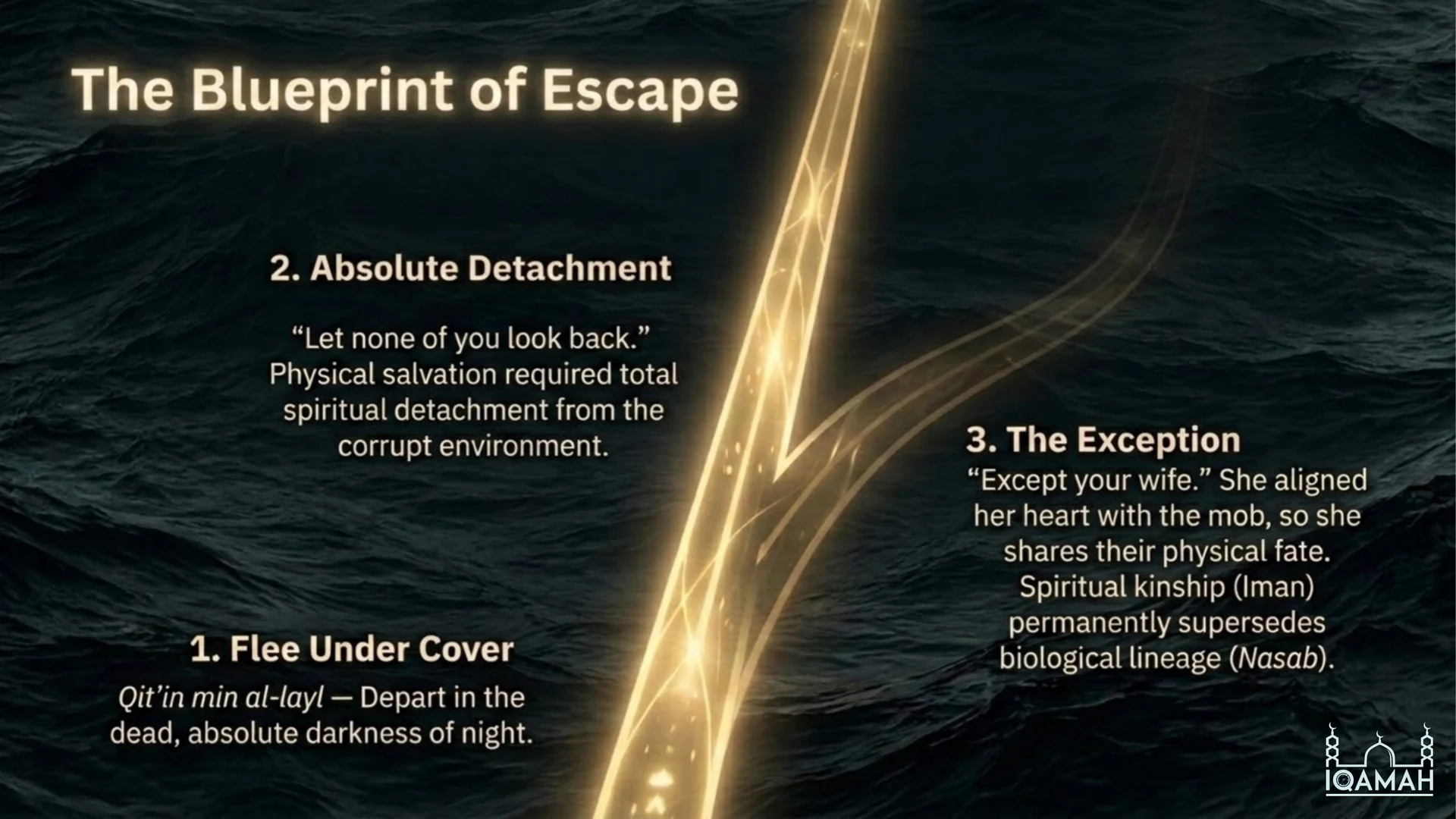
The exception carries a fine point of language, and the mufassirūn preserve two readings of illā imraʾatak through the qirāʾāt. On one reading the manṣūb form makes it an exception from 'your family' — do not even take her with you, for she belongs with the doomed; on the other the marfūʿ form makes it an exception from 'let none look back' — she alone will turn back and so be struck. Maʿariful relates the reconciling report that she set out, but on hearing the destruction turned in grief for her people and was finished by a hurled stone. Either way the lesson is the same, and it rhymes with the fate of Nūḥ's son: nearness to a Prophet saves no one whose heart is with the wrongdoers. The closing question, alaysa al-ṣubḥu bi-qarīb, is meant to comfort — in his distress Lūṭ longed for the punishment to come at once, and the angels gently reassure him that dawn, and deliverance, are near. The command to leave without looking back is the believer's posture before a doomed order: depart from it decisively, and do not let the heart turn back toward what Allah has condemned.

Slide 24
Slide 24 of 29 #

This slide draws the angels' instructions in v. 81 into a clear pattern: leave under cover of night (bi-qiṭʿin mina al-layl — in the dark, dead part of the night, for distance and concealment), detach completely (let none look back — no lingering attachment to the condemned town), and the single exception, the wife, whose heart remained with her people.

Saʿdī's reading of 'do not look back' is gentle and practical: hasten away and let your whole concern be your rescue; do not turn round, in body or in longing, toward what is being destroyed. The wife's failure is precisely a failure to detach — her backward glance is the outward sign of an inward attachment to the doomed. Leaving a corrupt setting behind follows the same pattern: a firm departure, a refusal to keep looking back at what we have left, and the sober knowledge that nearness to the righteous does not save a heart that never truly left.

Slide 25
Slide 25 of 29 #

This slide lingers on the question that closes v. 81: alaysa al-ṣubḥu bi-qarīb — 'is not the morning near?' The mufassirūn read it as reassurance. In his anguish Lūṭ longed for the matter to be over, and the angels answer his impatience with a question that is really a comfort: the dawn of his rescue and of their judgement is only hours away.

The verse speaks past Lūṭ to every believer surrounded by the darkness of a corrupt order: the night is finite, and the morning is near. The same Lord who fixes the hour of judgement fixes the hour of relief. 'Is not the morning near?' is a question to carry into our own hard nights — not a denial of the darkness, but a promise about its end.

Slide 26
Slide 26 of 29 #

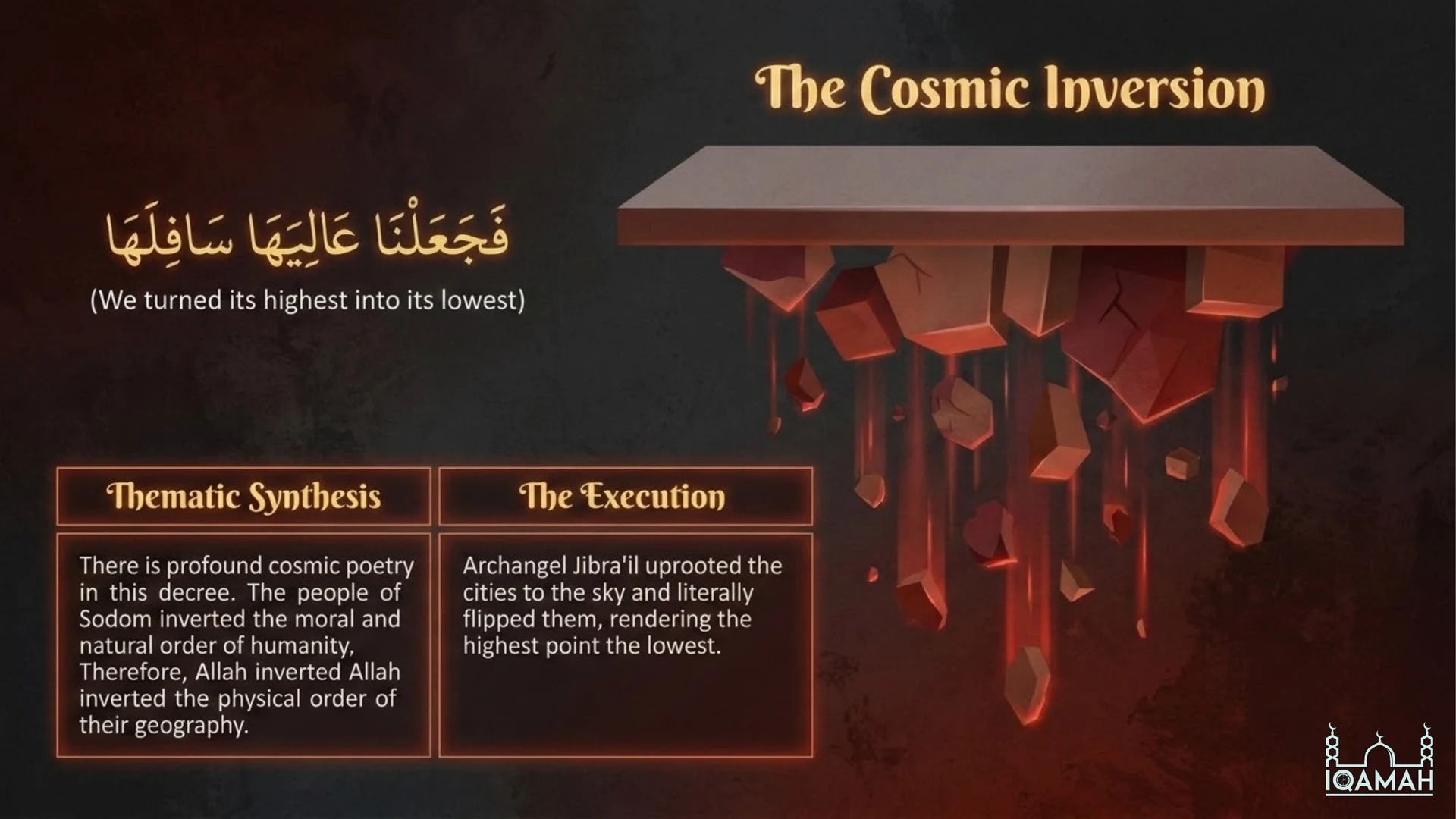
فَلَمَّا جَآءَ أَمْرُنَا جَعَلْنَا عَٰلِيَهَا سَافِلَهَا وَأَمْطَرْنَا عَلَيْهَا حِجَارَةًۭ مِّن سِجِّيلٍۢ مَّنضُودٍۢ

"So when Our command came, We made the highest part [of the city] its lowest and rained upon them stones of layered hard clay, [which were]" — Sūrah Hūd 11:82

The decree falls. 'When Our command came, We made its highest part its lowest, and rained upon them stones of layered baked clay.' Maʿariful relates the report that Jibrīl raised the towns — the four settlements the Qurʾān elsewhere calls al-muʾtafikāt, 'the overturned' (9:70, 69:9) — lifted them until the angels could hear the people's voices, and then turned them over. Qutb draws out the fittingness of it: turning the towns upside down mirrors how the people of Lūṭ had turned human nature itself upside down, dragging it down from its high station to a level below the animals.

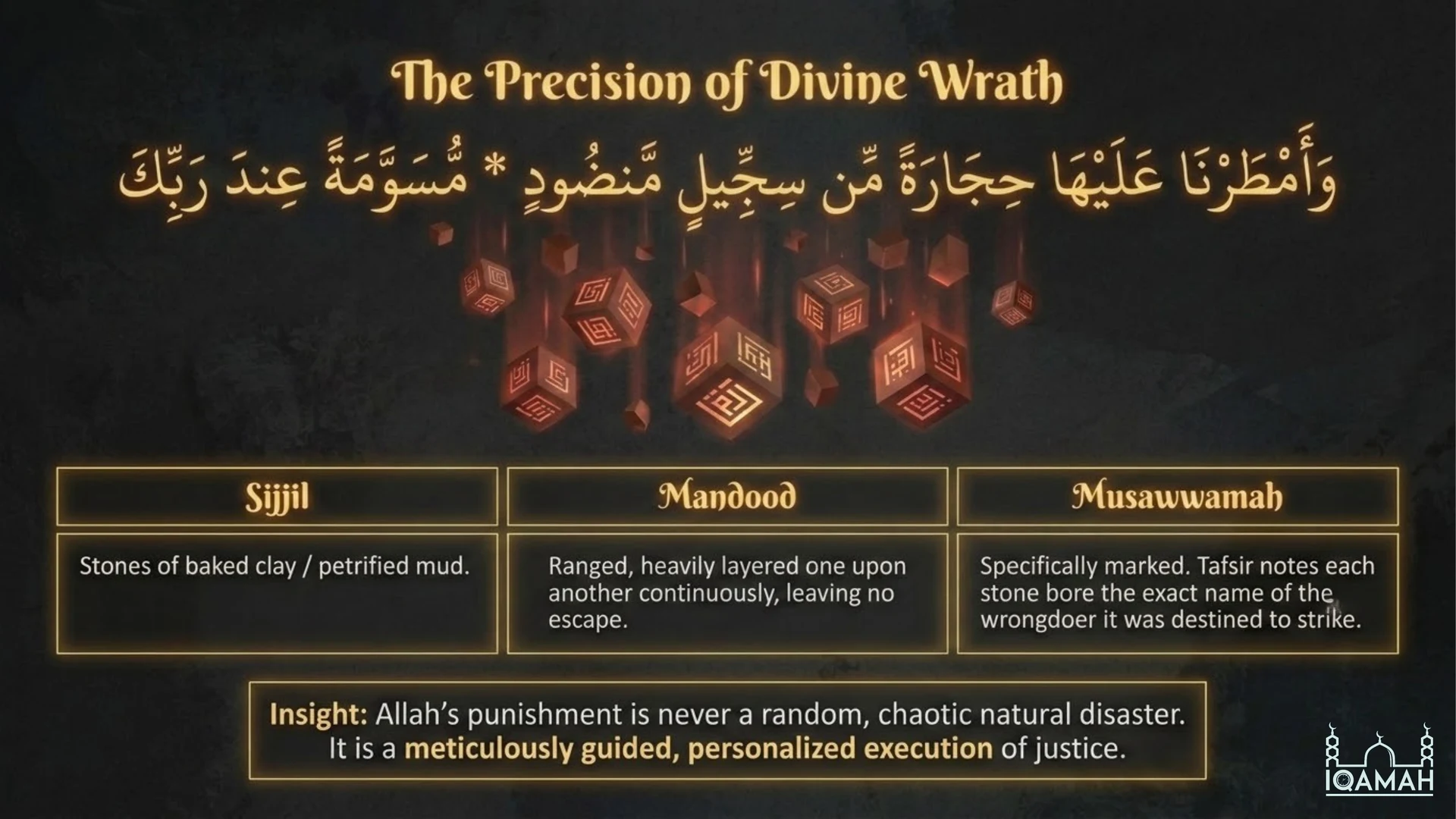
The language is exact. Sijjīl means baked clay hardened into stone — a word widely held to come from the Persian sang-gil, 'stone-clay' — and Saʿdī describes the stones as 'of very hot fire.' Manḍūd means layered, set one upon another; Ibn al-Jawzī records the range of views, from following one another in succession (Ibn ʿAbbās), to set in rows (ʿIkrima, Qatāda), to piled one atop another (al-Rabīʿ ibn Anas). The picture is of a relentless, ordered fall, not a random hail — even the punishment is measured and purposeful, which the next verse underlines with a single word.

Slide 27
Slide 27 of 29 #

This slide gathers the three describing words of vv. 82–83 — sijjīl, manḍūd, and musawwamah — into one lesson: the punishment of Allah is never random, aimless violence but a precisely guided, personally measured carrying-out of justice. The stones are of baked clay (sijjīl), they fall ranged and layered and unceasing (manḍūd), and they are specifically marked (musawwamah).

Ibn al-Jawzī's survey of musawwamah is instructive: most read it as muʿallamah, 'marked' (al-Zajjāj), with views on the marking ranging from streaked white-in-red to, in a well-known report Maʿariful relates, each stone inscribed with the name of the one it was to strike. The point of all three words together is the same — this is aimed, ordered, and named, the very opposite of a blind calamity. The precision is itself the message: a random disaster says nothing, but a marked stone says that every soul is known, every sentence deliberate, and nothing in Allah's response is left to chance.

Slide 28
Slide 28 of 29 #

مُّسَوَّمَةً عِندَ رَبِّكَ ۖ وَمَا هِىَ مِنَ ٱلظَّٰلِمِينَ بِبَعِيدٍۢ

"Marked from your Lord. And Allah 's punishment is not from the wrongdoers [very] far." — Sūrah Hūd 11:83

The verse seals the scene and then turns it toward the living. 'Marked from your Lord. And it — the punishment — is not far from the wrongdoers.' Saʿdī reads the marked stones as bearing the brand of punishment and wrath, held in reserve 'with your Lord,' and Qutb dwells on the haunting picture: the stones are marked the way cattle are branded and set apart, as if held ready for the moment they are needed.

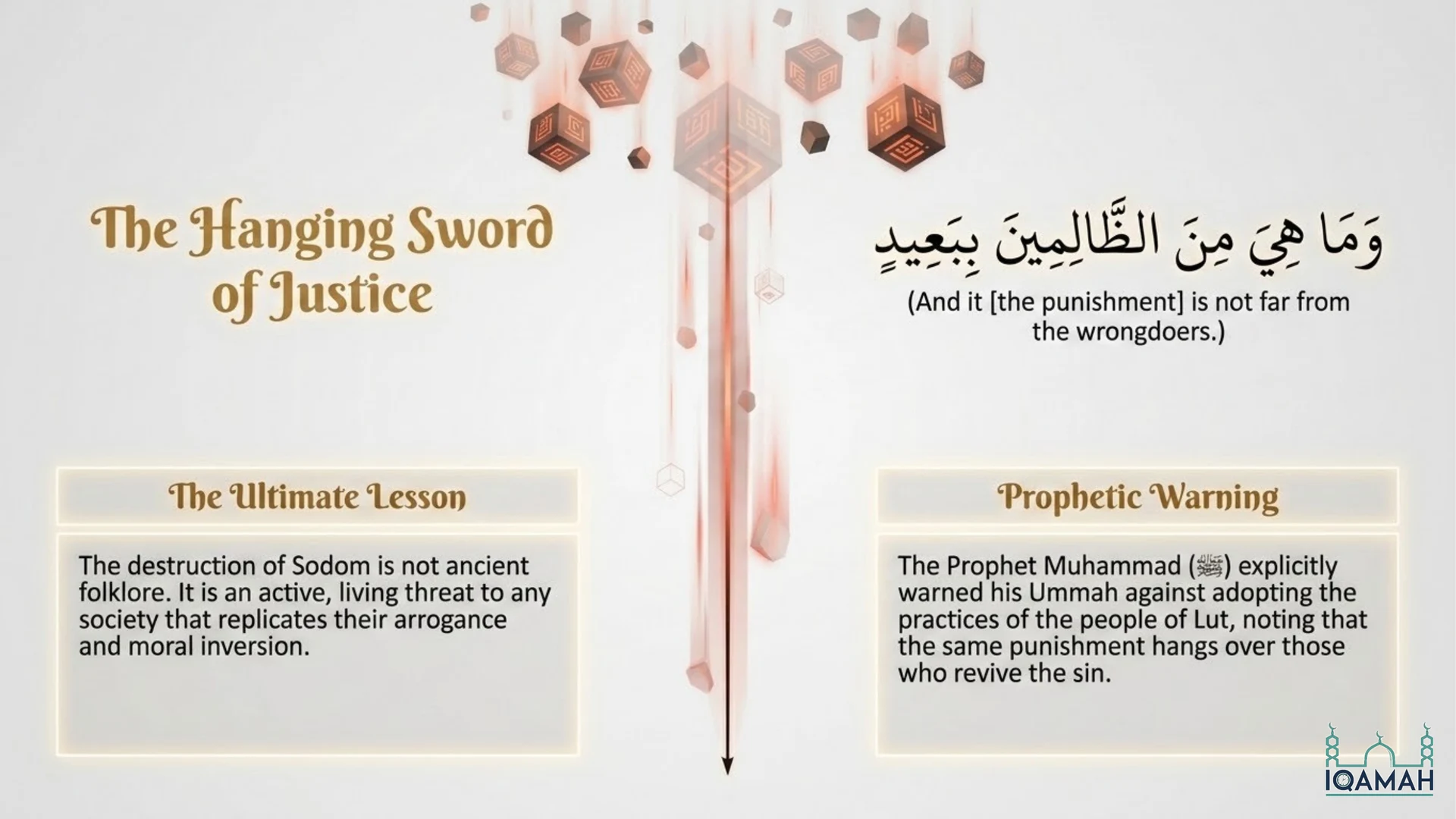
The closing words are the verse's turn to us. 'It is not far from the wrongdoers' means, as Saʿdī and Maʿariful explain, that this punishment is not remote from any who imitate the deeds of the people of Lūṭ — so let people beware. Maʿariful cites the Prophet's ﷺ grave warning, 'I fear for my Ummah the deed of the people of Lūṭ,' and the report that when such acts spread the like punishment may follow (via al-Tirmidhī and others). The verse deliberately refuses to leave the people of Lūṭ safely in the past; 'not far' closes the distance between that nation and ours. The lesson is not the horror of long ago but a sober warning for today — the law of Allah that destroyed them is still in force, and the One who marked those stones is the same Lord now.

Slide 29
Slide 29 of 29 #

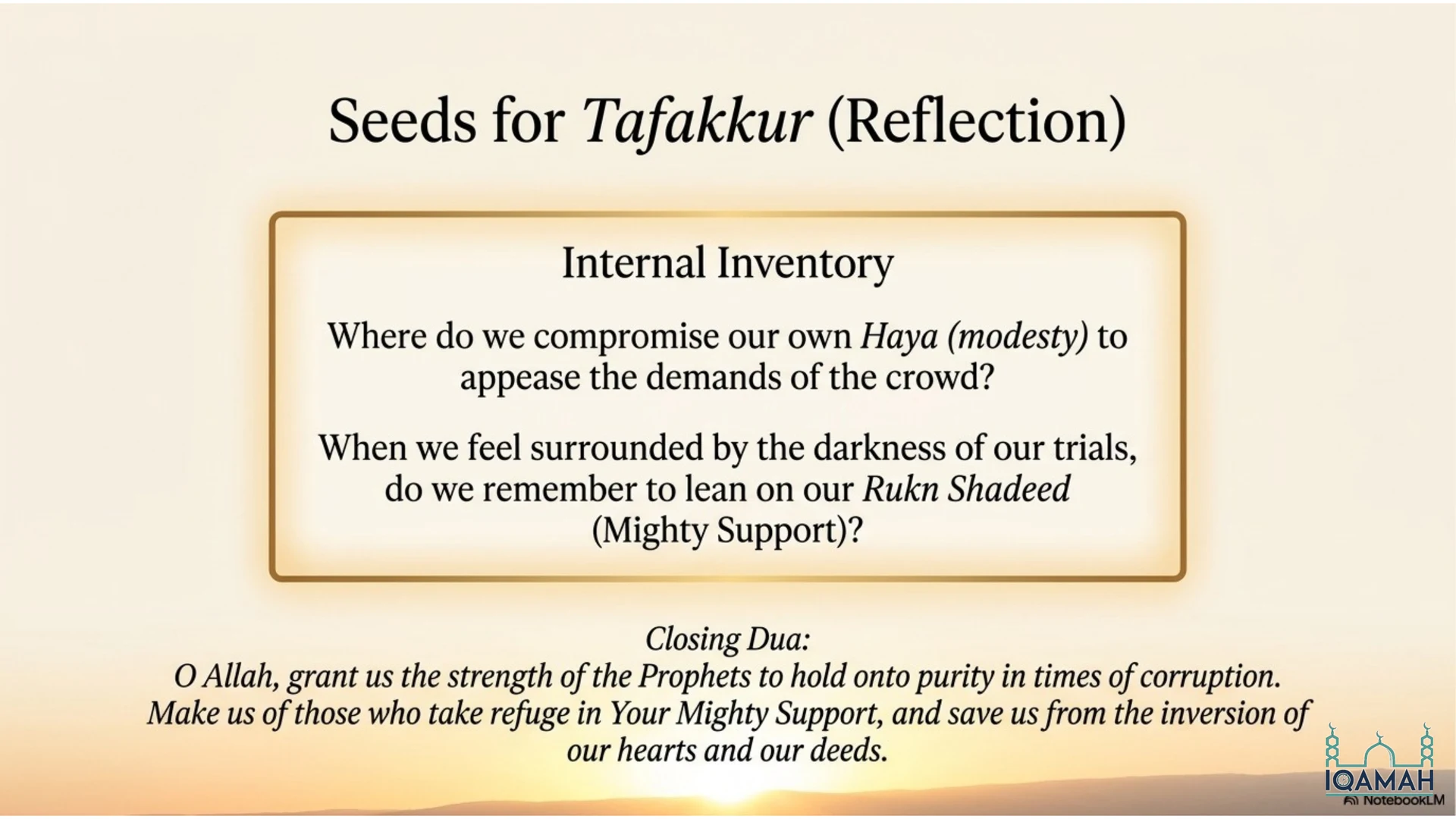
The closing reflection turns the whole passage inward. Its first question is where we, in small and ordinary ways, give up our own ḥayāʾ — modesty — to please a crowd, softening or excusing or staying silent before what Allah has named wrong, the way the people of Lūṭ pressed against him. Its second is whether, when the darkness of our trials closes in, we remember to lean on our own rukn shadīd, the Mighty Support of v. 80 — the very refuge Lūṭ wished for and in truth already had.

The session's threads gather here: the hospitality of Khalīlullāh, the mercy that gave a child against every ordinary cause, the forbearing and tender heart that pleaded even for sinners, the decree that finally could not be turned back, and the believer's way out — leave the corruption, do not look back, and trust that the morning is near. A word of balance is fitting in closing: this passage names a grave sin and a terrible punishment, and it is best held in the Qurʾān's own proportion — clear about the wrong, but set within mercy, the open door of tawbah, and the reminder that the purpose of all such reflection is to purify our own hearts, not to congratulate ourselves over the ruined.

We close on the words of the duʿāʾ: O Allah, grant us the strength of the Prophets to hold onto purity in times of corruption; make us of those who take refuge in Your Mighty Support, and save us from the inversion of our hearts and our deeds. Āmīn.

About this series

This is the fourth session in a planned six-part series walking through the tafsir of Sūrah Hūd. Parts 1–3 established the framework (vv. 1–24), walked through the Nūḥ narrative (vv. 25–49), and read the matched ruin of ʿĀd and Thamūd (vv. 50–68). Part 4 (this session) takes the heart of the sūrah — the angelic guests of Ibrāhīm and the overturning of the people of Lūṭ (vv. 69–83) — as a single mission of mercy and judgement. Subsequent parts will treat Shuʿayb and Madyan, then Mūsā and the closing istiqāmah. To be notified about future sessions, drop a line to admin@iqamah.org — we'll keep a list and reach out as new parts publish.

  1. 1
    An Illuminated Framework vv. 1–24 — Doctrinal core, cosmic context, prophetic challenge
  2. 2
    The Ark and the Oven vv. 25–49 — Nūḥ's daʿwah, the Ark, and the boiling oven
  3. 3
    Blueprints of Faith and Ruin vv. 50–68 — Hūd and ʿĀd, Ṣāliḥ and Thamūd, and the polished heart
  4. 4
    The Heavenly Guests vv. 69–83 — Ibrāhīm's guests, the glad tidings of Isḥāq, and the overturning of Lūṭ's people
    You are here
  5. 5
    The Scales and The Scepter vv. 84–99 — Shuʿayb and Madyan, Mūsā and Firʿawn, and the question of the grave
  6. 6
    The Anchored Heart vv. 100–123 — the ruins as diagnosis, the Witnessed Day, istiqāmah, and the command to worship and trust